
You’re probably dealing with the same shipping mess most small businesses hit sooner or later. One customer wants it fast, another wants it cheap, the courier quote changes when the box is measured properly, and someone on your team still prints labels from three different systems. That’s not a logistics strategy. That’s daily friction dressed up as “just part of business”.
It doesn’t have to stay that way.
If you ship boxes and parcels within Australia, smart shipping comes down to a few controllable decisions. Pick the right service type. Pack to the actual price rules, not your guess. Build a repeatable booking process. Stop treating delivery as a dead cost when it can support margin, customer trust, and repeat sales. A good australia courier service setup saves time first. The money usually follows.
Your Guide to Smarter Business Shipping
Small businesses often outgrow their first shipping setup without noticing. At the start, one courier account and a roll of labels feel fine. Then order volume rises, delivery locations spread out, and every mistake gets more expensive.
That matters because parcel delivery isn’t some side function anymore. Australia’s courier, express, and parcel market reached AUD 19.87 billion in 2025 and is projected to reach AUD 33.94 billion by 2035, driven primarily by e-commerce, according to Expert Market Research’s Australia CEP market report. If your business sells online, shipping is part of your customer experience whether you like it or not.

What smart shipping actually looks like
It’s not complicated. It’s disciplined.
- You compare service options per shipment, instead of forcing every order through one carrier.
- You measure cartons properly, because guessed dimensions create bad quotes and annoying adjustments.
- You match speed to customer need, not to your internal panic.
- You use one clean workflow for booking, labels, and tracking.
Practical rule: If your shipping process depends on memory, favours, or “we usually do it this way”, it’s costing you money.
Where most businesses go wrong
The common mistake isn’t choosing the wrong courier once. It’s building no decision system at all.
A strong australia courier service approach should give you clarity at the moment you book. You should know what you’re paying for, why one option costs more than another, and when faster delivery is worth it. Once you have that discipline, shipping stops feeling like a constant interruption and starts working like a business tool.
Decoding Australian Courier Service Types
Think of courier services like transport options for your parcel. Some are the local train. Some are the interstate coach. Some are the airport express.
If you use the wrong one, you either overpay or disappoint the customer.
Metro, national, and express
Metro services suit same-city and nearby deliveries. They’re for businesses shipping within one capital city or into surrounding suburbs. If your customer is local and the order is fairly urgent, this is usually where you look first.
National or regional services are the workhorse. They’re not glamorous, but they handle most routine parcel traffic across states and regional routes. For many businesses, this is the default setting because it balances price and reliability.
Express services are for orders where timing matters more than the rate. Use them selectively. They’re useful when the product is urgent, the customer paid for speed, or the delay would cost you more than the higher freight charge.
Mordor Intelligence notes that e-commerce accounts for 35.78% of Australia’s CEP market share in 2025, non-express services hold 74.84%, and the express segment is growing at 5.56% CAGR in its Australia courier, express and parcel market report. That tells you something important. Most shipments still move through non-express networks, but demand for faster options is rising.
Courier service types compared
| Service Type | Typical Speed | Cost Level | Best For |
|---|---|---|---|
| Metro | Fast within local areas | Low to medium | Same-city orders, urgent local fulfilment |
| National or Regional | Standard Australia-wide transit | Low | Everyday parcel delivery across states and regional areas |
| Express | Faster priority handling | Medium to high | Time-sensitive orders, premium checkout options, urgent replacements |
How to choose without overthinking it
Use this filter:
- Choose metro when the receiver is local and the order has a short lead time.
- Choose national when cost control matters more than shaving off a bit of transit time.
- Choose express only when the business case is obvious.
A slow parcel sent at the right price is often smarter than a fast parcel sent on reflex.
If you want those choices shown clearly in one quoting flow, look at domestic courier service options for Australia-wide shipping. What matters is seeing speed and cost side by side before you book, not after the invoice lands.
The Anatomy of Courier Pricing
Most business owners don’t hate shipping costs. They hate not understanding them.
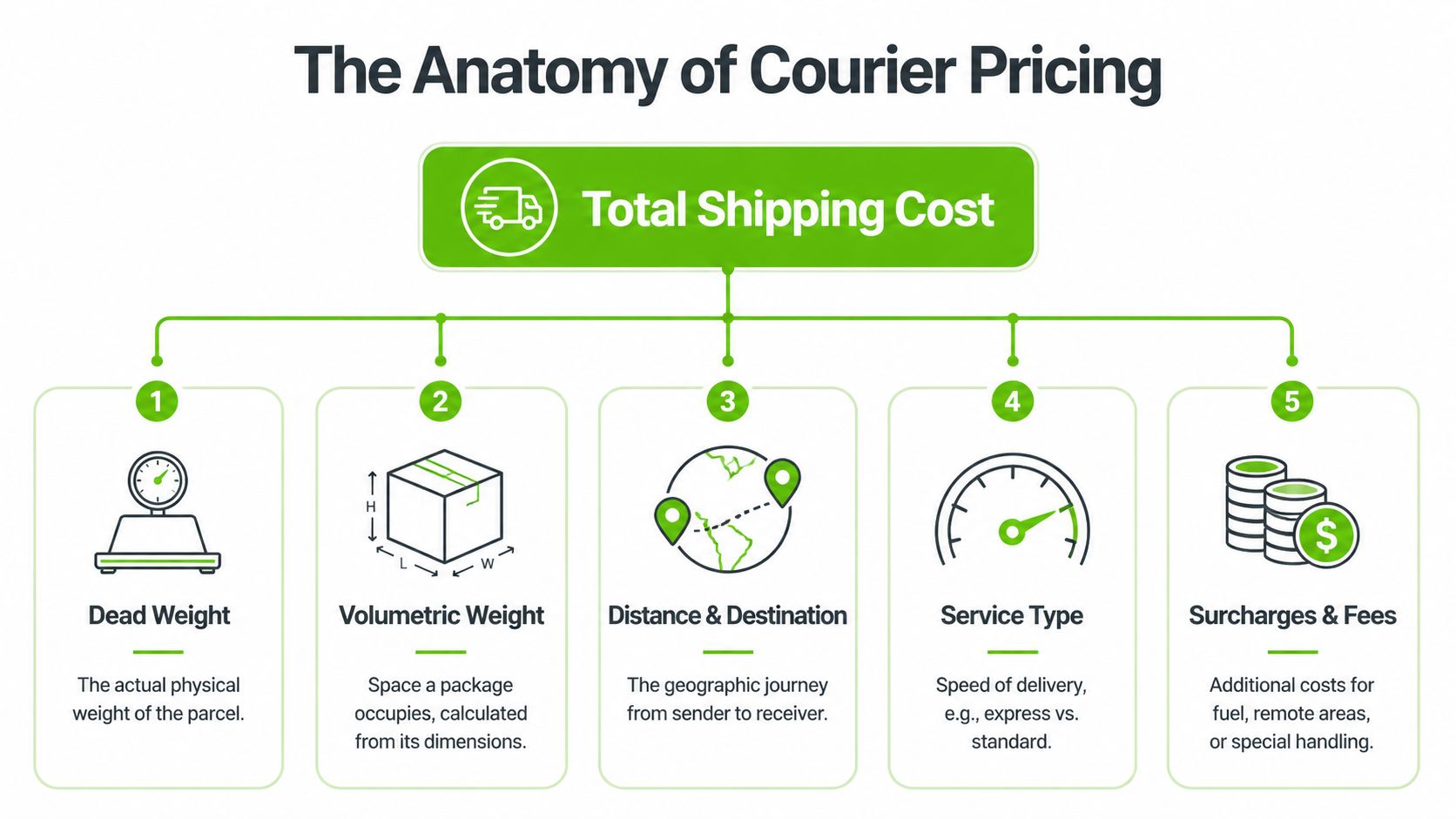
A courier quote usually comes down to five things. Actual weight, box size, destination, service speed, and extra fees tied to the route or handling. Once you understand that mix, pricing stops feeling random.
Why box size can cost more than weight
A small box of books is heavy but compact. A large box of pillows is light but takes up space. Couriers care about both because vehicles fill by weight and by volume.
That’s why volumetric weight catches so many businesses out. If your carton is oversized for the item inside, you may pay as if it were heavier than it really is. This is one of the easiest ways to waste money on domestic shipping.
The five cost drivers
- Dead weight is the physical weight measured on the scale.
- Volumetric weight reflects the space your carton occupies.
- Distance and destination affect linehaul cost and network complexity.
- Service type changes the price because priority handling costs more.
- Surcharges and fees can apply for remote routes or special delivery conditions.
Australia’s courier pick-up and delivery services industry supported 56,550 businesses in 2025, with enterprise numbers growing at a 18.3% CAGR from 2020 to 2025, reflecting a highly competitive market shaped by pricing and service pressure. That figure appears in the market summary discussed earlier. In a crowded market like this, businesses that understand pricing mechanics buy better.
What to do with this knowledge
Don’t just read quotes. Interrogate them.
- Measure every carton before you book.
- Reduce empty space inside boxes where possible.
- Reserve express for orders that justify the premium.
- Standardise packaging sizes so your team isn’t reinventing the job daily.
For faster quoting, courier price comparisons for parcels and boxes help you check rates without manually bouncing between carriers.
Navigating the Shipping Process from Start to Finish
A good shipping process should feel boring. That’s the point. If every parcel needs a fresh decision, your team will make avoidable mistakes.
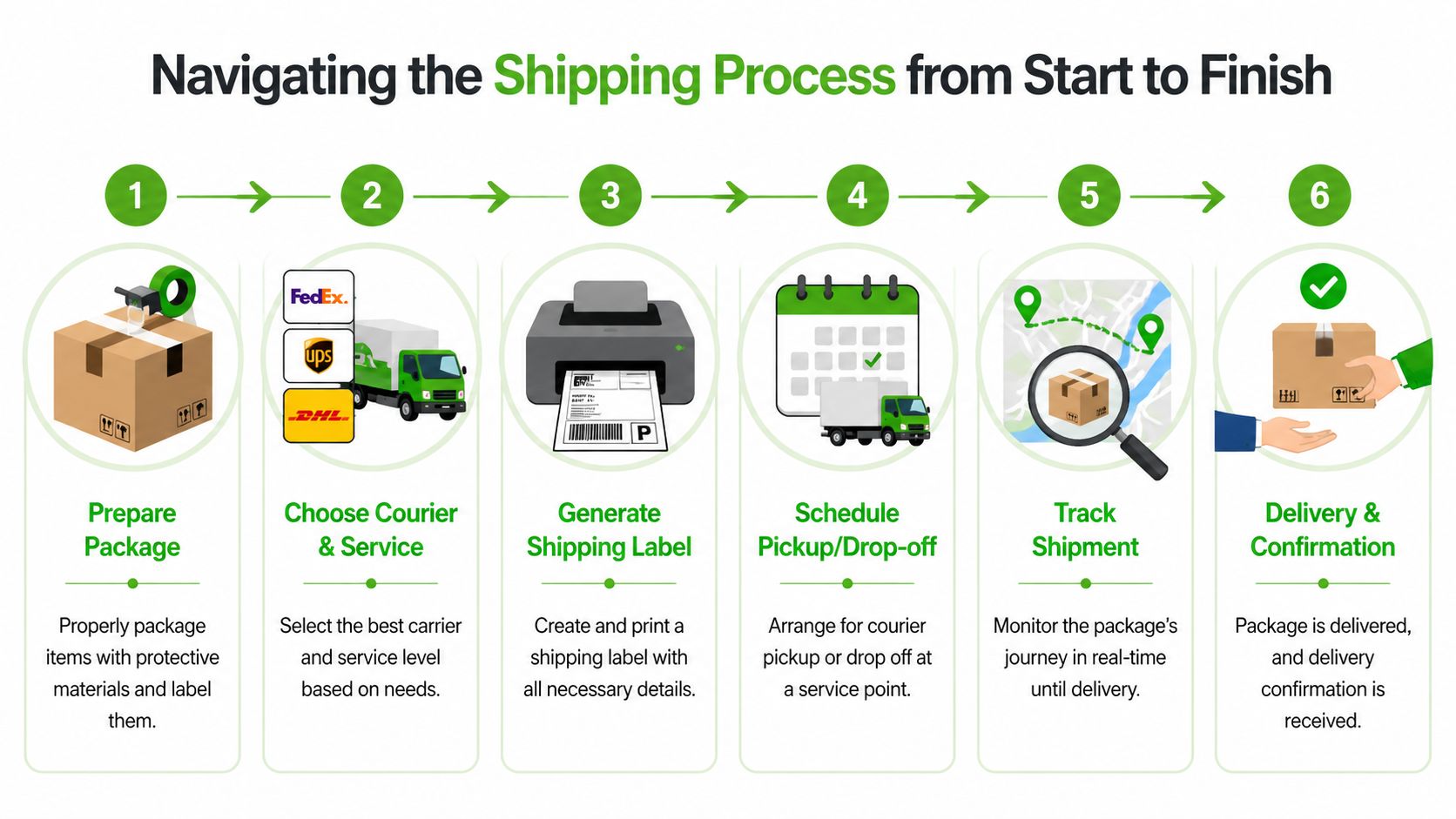
The cleanest workflow starts before pickup. It starts when someone enters the job correctly.
Step one is accuracy, not speed
You enter sender and receiver details, parcel weight, and dimensions. At this point, businesses either save themselves trouble or create it. If the dimensions are wrong, the quote is wrong. If the address is messy, delivery gets messy too.
If you run an online store and want a broader operational view, this guide for Australian e-commerce businesses is useful for thinking through fulfilment choices around your shipping model.
Booking, labels, and the handoff
Once the quote is locked in, book the pickup or drop-off. Then generate the shipping label and attach it properly. Don’t tape over barcodes. Don’t stick labels over box seams if you can avoid it. Don’t assume the driver will fix a weak label for you.
A parcel moves through multiple handling points. If the label scans cleanly and the package is declared correctly, the job has a much better chance of flowing without intervention.
Tracking isn’t optional in Australia
Australia is big enough to punish vague shipping visibility. The distance between major hubs can exceed 4,000 km, and Zoom2u’s analysis of same-day interstate courier logistics notes that route optimisation and real-time tracking can reduce ETA variance by 15% to 20%. You don’t need to ship same-day interstate to learn from that. You do need visibility.
If your customer asks where the parcel is, you should answer from tracking data, not from hope.
A repeatable shipment routine
This is the operating rhythm I recommend:
- Pack first, then measure. Don’t estimate dimensions from the product alone.
- Quote against the packed parcel. That keeps rates realistic.
- Choose service by promise level. Match the courier service to what the customer purchased.
- Print and place the label cleanly. Scannability matters.
- Monitor tracking exceptions daily. Delays compound when no one owns them.
Many businesses also benefit from understanding the paperwork side properly, especially if different team members book shipments. A plain-English consignment note guide for courier bookings helps tighten that part of the process.
Packaging Your Parcels for a Safe Journey
Packaging is where cheap shipping often goes wrong. Businesses chase a lower rate, then throw the item into a tired box with loose fill and hope for the best. Hope isn’t packaging.
Your parcel has to survive conveyors, stacking, vehicle movement, and repeated handling. During the 2024 peak period from 1 November to 31 December, Australia Post delivered nearly 103 million parcels, equal to 2,800 parcels per minute. That figure was noted in the market data referenced earlier, and it tells you exactly why weak packaging gets punished fast.

Pack for movement, not for the shelf
Your product may look secure on a packing bench and still fail in transit.
Use a box that fits the item closely without crushing it. If the item can move inside the carton, it will. That movement creates corner damage, burst seams, and broken contents.
The practical packing rules
- Use a sturdy box sized to the item, not the nearest carton lying around.
- Cushion all sides so the product doesn’t shift during transport.
- Seal with the H-tape method across the centre seam and both edges.
- Remove old labels and barcodes if you reuse outer cartons.
- Keep the label flat and visible on the largest practical surface.
Packing test: Shake the sealed box gently. If you hear movement, reopen it and fix it.
If you need a simple reference on box types and sizes before you standardise your packing station, this guide to moving boxes in Australia is handy for understanding common carton options.
Don’t let packaging inflate the price
Packaging affects cost as much as protection. Oversized cartons can push up volumetric charges. Odd shapes can create handling issues. Poor taping can cause repacking or claims headaches.
If you occasionally send larger cartons and want to keep that affordable, cheap options for sending bigger parcels can help you compare what’s practical before you book.
Also, if your items include aerosols, batteries, or other goods that need special declaration, check the carrier rules before dispatch. For everyday parcel shipping, that simple habit prevents the worst kind of delay: the one caused by your own paperwork.
Unlock Hidden Savings and Rewards on Shipping
Most businesses focus too narrowly on the base rate. That’s understandable, but incomplete.
The cheapest visible quote isn’t always the cheapest shipping outcome. If one platform saves admin time, reduces booking mistakes, consolidates tracking, and returns value through rewards, that total picture matters more than a small headline difference on one consignment.
Stop buying shipping one courier at a time
Using one carrier for every parcel is lazy procurement. Different routes, box sizes, and service levels suit different networks. A multi-carrier approach gives you room to compare instead of overcommitting.
If you want to pressure-test costs before checkout or before quoting customers, use a shipping price calculator for domestic courier comparisons. The point isn’t to chase perfection on every order. The point is to stop paying the wrong price by default.
The overlooked lever is rewards
This part gets ignored in most courier comparisons, and that’s a mistake. According to Aeros Couriers’ discussion of courier options and rewards in Australia, rewards programs are rarely covered, yet they can help SMBs offset costs. That same source states that businesses can earn points redeemable on over 10,000 merchandise items, helping offset 10% to 20% of shipping spend.
That’s not just a nice extra. It changes how you think about freight.
One practical option in this space is Aeros Couriers, which gives users access to instant quotes, booking, labels, tracking, and a rewards system tied to merchandise redemptions. For a small business, that means shipping spend can support marketing collateral, promo items, or internal procurement instead of disappearing as a pure operating cost.
Shipping shouldn’t only move parcels. It should return some value to the business that pays for it.
Why this matters for online stores
Customers care about shipping cost at checkout, and margin pressure doesn’t disappear after the sale. If you’re trying to improve conversion while protecting fulfilment economics, this piece on how to reduce shopping cart abandonment is worth reading alongside your shipping strategy.
When you combine sharper rate comparison with a reward mechanism, you stop treating delivery as a fixed pain. You start managing it like any other business lever.
Turn Your Shipping into a Growth Engine
Shipping is one of the few business functions that touches operations, finance, customer service, and marketing at the same time. That’s why sloppy systems hurt so much. They create wasted labour, pricing mistakes, delayed parcels, and unhappy buyers in one hit.
The upside is just as strong.
When you choose the right service type, pack to the actual pricing rules, book through a consistent workflow, and track every parcel properly, you remove friction from the business. Customers get clearer delivery expectations. Your team spends less time chasing errors. Your margin stops leaking through avoidable overspend.
That’s the key value of a smarter australia courier service setup. It isn’t only about moving boxes from A to B. It’s about building a delivery operation your business can rely on as volume grows.
Keep it simple. Measure properly. Compare before you book. Use express only when it earns its keep. Package like the parcel will be handled by a busy network, because it will be. And if a platform helps you recover value through rewards, treat that as a commercial advantage, not a gimmick.
If you want a simpler way to book affordable Australia-wide parcel deliveries, compare carrier options, print labels, track shipments, and turn shipping spend into redeemable rewards, take a look at Aeros Couriers.
Courier quotes, tracking and support
Ready to send a parcel? Compare the available services for your postcodes, parcel dimensions and weight. For an existing delivery, use your consignment number to check tracking or ask our team for help.