
Shipping a large item across Australia doesn't have to be a budget-breaker. In my experience, the secret to finding a cheap way to send big parcels isn't just about picking the cheapest courier—it’s about outsmarting the system. It comes down to a few key things: understanding how couriers really calculate their prices, being clever with your packaging, and using the right tools to find hidden wholesale rates for fast box and parcel deliveries Australia-wide.
Once you get these fundamentals right, you can dramatically slash your delivery costs before you even think about booking a courier.
The Blueprint for Sending Large Parcels Cheaply in Australia
When you’re faced with shipping a bulky item, it's easy to feel like you're at the mercy of the couriers. But the real savings happen long before you get a quote. The foundation for genuinely affordable shipping is built on a simple shift in mindset: stop thinking about just shipping an item, and start thinking about shipping it efficiently.
This means getting your head around a concept called dimensional weight and tapping into a competitive marketplace where couriers fight for your business. You have more control than you might realise. With a bit of know-how, what looks like an expensive problem can become a surprisingly cheap and easy task.
Understanding Dimensional Weight vs. Actual Weight
If there’s one thing you absolutely must grasp, it’s dimensional weight (often called cubic weight). Couriers don't just charge you for how heavy your parcel is; they charge for the space it hogs in their van. They’ll calculate a price based on both its actual weight and its dimensional weight, and—you guessed it—they'll charge you for whichever is greater.
Think of it this way: a big box full of fluffy pillows might only weigh 5kg, but it takes up a massive amount of room. On the other hand, a small box of books could also weigh 5kg, but it’s dense and compact. The box of pillows will almost always be charged at a higher dimensional weight, making it far more expensive to send.
The Golden Rule: Your mission is to make your parcel as dense and compact as possible. Shaving just a few centimetres off your box dimensions can lead to massive savings. This is, without a doubt, the most powerful first step you can take to send big parcels cheaply.
Your Secret Weapon: A Multi-Carrier Comparison Platform
Forget the old days of ringing around individual couriers for quotes. It's a waste of your time. The smartest and fastest way to get the best price is to use a multi-carrier platform like Aeros Couriers. We’ve already done the hard yards by negotiating bulk discounts with a huge range of carriers. This gives you access to wholesale rates you simply can’t get by going direct.
Instead of being stuck with one courier's pricing, you can instantly see a whole menu of options.
- Compare dozens of couriers at once: See real-time prices from national and local carriers, all on one screen.
- Unlock wholesale rates: You get the benefit of our bulk buying power, even if you’re only sending one parcel.
- Choose the right service for you: Easily pick between express, standard, or economy services to find the perfect balance between speed and cost.
To get a feel for what you could save, jump on our online tool and estimate shipping costs. It's a great way to benchmark prices before you even tape up your box.
The Australian courier market is incredibly competitive, valued at USD 12.8 billion in 2024 and only set to grow. This fierce competition, especially across the country’s vast road network, is fantastic news for you. It puts constant downward pressure on prices, creating opportunities to find a fantastic deal for fast box deliveries. It’s this exact environment that allows comparison platforms to thrive and pass those savings directly on to you.
Master Your Packaging and Slash Those Shipping Costs
If you need to send a large parcel without breaking the bank, your first instinct might be to jump online and find the cheapest courier. But hold on. The real, game-changing savings—the kind that truly impact your budget—start long before you even think about getting a quote.
Believe it or not, seasoned shippers know that smart packaging is their most powerful tool for cost control. It’s not just about keeping things safe.
How you measure, pack, and seal your parcel has a massive impact on its chargeable weight. A few minutes of extra effort at this stage can save you from paying for empty space or getting hit with surprise fees for oversized or poorly packed boxes. It’s about being clever and turning your packaging process into a cost-saving machine.
This is the fundamental flow: pack smart to keep the size down, measure everything precisely, and then you’re ready to compare rates and lock in a great deal.
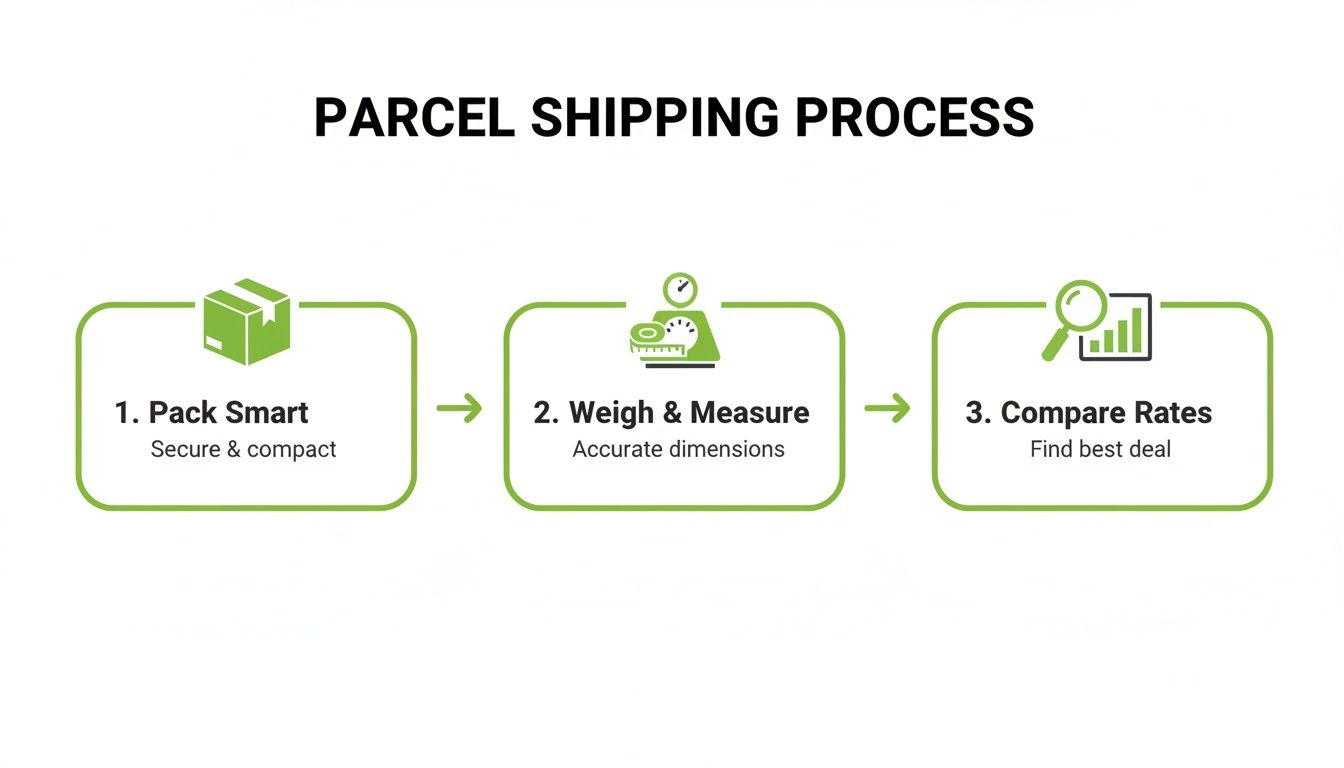
As you can see, cutting costs isn't about one magic trick. It's a sequence of smart decisions, and it all begins with how you pack.
Choose the Right Box to Minimise Volume
Your mission here is simple: use the smallest box that can safely hold your item. Couriers charge based on dimensional weight, which means every centimetre you can trim from the length, width, and height translates directly into money back in your pocket.
Think about shipping a disassembled flat-pack bookcase. You could just toss all the bits into a big, square box. The problem? You’d be paying to ship a whole lot of empty air. A much better way is to lay out the pieces into the tightest rectangular shape you can manage, then find a box that fits snugly. You might even discover that two smaller, denser boxes are cheaper to send than one large, half-empty one.
The most expensive thing you can ever ship is air. By choosing a box with a snug fit and minimal empty space, you're actively cutting its dimensional weight—and its cost.
Reinforce Without Adding Weight
For anything heavy, a standard single-walled cardboard box is a recipe for disaster. They just aren't built to take the strain and can easily tear or collapse, leading to damaged goods and potential extra handling fees from the courier. You absolutely need a double-walled or heavy-duty cardboard box. These are made specifically to handle bigger loads without giving up.
Here’s how to make it even stronger:
- Tape the bottom seams properly: Use the 'H-tape' method. Run tape along the centre seam where the flaps meet, then run tape across both of the edge seams. This forms a capital 'H' and gives the box maximum support right where it needs it most.
- Add some internal support: If your item is seriously heavy, lining the inside walls of the box with extra sheets of cardboard adds incredible strength without adding much weight or bulk.
This approach makes sure your parcel can handle the bumps and tumbles of transit, especially on long-haul domestic freight express journeys, without needlessly inflating its chargeable weight.
Perfect Your Void Fill and Sealing
Once your item is in the box, the next job is to stop it from moving. Items that shift around inside are a leading cause of damage. But choosing the right void fill is crucial for keeping costs low. Steer clear of heavy materials like rolled-up newspapers; they add surprising weight.
Instead, go for lightweight and effective options like these:
- Bubble wrap: The classic choice for a reason. It’s brilliant for protecting fragile surfaces and filling gaps.
- Air pillows: These are basically bags of air, making them the lightest possible option for filling large voids.
- Crumpled packing paper: A fantastic, low-cost material that provides great cushioning and holds things in place.
Your goal is to fill every single gap until the contents are completely immobilised. Give the sealed box a gentle shake. If you feel or hear anything moving, you need more fill.
Finally, seal that box up tight with strong, high-quality packing tape. Cover all the seams on the top and bottom. A securely sealed box doesn't just protect what’s inside—it also prevents it from accidentally popping open, which can cause frustrating delays and extra charges.
Finding the Best Courier Deals: How to Play the Market and Win
Trying to find the cheapest way to send a large parcel in Australia can feel like you're shouting into the void. The market is absolutely flooded with options, and it’s easy to get analysis paralysis. But here’s a little secret I’ve learned over the years: that intense competition is actually your biggest weapon. If you play your cards right, you can get these carriers to fight for your business, which means you’ll never pay a cent more than you have to.

The trick is to let go of any old-school loyalty to a single courier brand. It's time to adopt a smarter, more agile strategy. The moment you start comparing a wide range of services, you can zero in on the one that gives you the perfect blend of speed, reliability, and—most importantly—price for that specific job. This is how you go from just another person sending a parcel to a truly savvy shipper.
National Giants vs. Local Heroes
Australia's delivery network is a fascinating mix of massive national players and nimble, local operators. Each has its place, and understanding their strengths is the key to getting a great deal when sending big parcels.
Your national carriers, think Toll or TNT, have networks that reach nearly every corner of the country. They’re fantastic for dependable interstate jobs and usually have solid tracking. The trade-off? Their size can make their pricing rigid, especially if you’re only sending a one-off large box.
On the other hand, you have local or regional couriers. These guys are often the undisputed champs in their specific city or state. I’ve often seen them offer much sharper pricing and more flexible service within their home turf. The problem, of course, is that ringing them all up one by one is a huge waste of time.
The real power move is to sidestep this dilemma entirely. Don't pick a side. Instead, use a system that brings both the giants and the heroes to you, letting you cherry-pick the absolute best deal for every single shipment you send.
This is precisely where a courier comparison platform becomes your secret weapon. You don’t need to be an expert on who has the best depot in Dubbo; you just need to see all the final prices laid out in front of you.
Unlock Wholesale Rates with Courier Comparison
Honestly, the most powerful thing you can do to guarantee you’re not overpaying is to get instant quotes from multiple couriers at once. This is the entire model behind platforms like Aeros Couriers. By bundling the shipping volume from thousands of users, these platforms have the buying power to negotiate incredible wholesale rates.
These are the kinds of discounts that a small business or an individual could only dream of getting on their own. The platform then passes these savings directly on to you. You're no longer paying the standard "walk-in" rate; you're tapping into a much, much lower price point.
This approach completely flips the script for anyone wanting to send big parcels cheap. The whole process is refreshingly simple:
- Enter Your Shipment Details Once: Just plug in your parcel's dimensions, weight, and where it's going.
- See All Your Options Instantly: The system goes to work, fetching real-time quotes from a huge range of available couriers.
- Pick the Winner: Compare the prices and delivery estimates side-by-side to find the perfect match for your wallet and your deadline.
This isn’t about guesswork; it's about data. You see the entire market at a glance, giving you the confidence that you've found the best possible rate for that shipment on that day. If you're keen to see it in action, you can compare couriers right now and see what you could be saving.
Balancing Speed and Cost for Interstate Deliveries
Let's say you're sending a bulky box from Sydney to Perth. The service level you choose will make a massive difference to your final bill. On most comparison tools, you'll generally be presented with a few clear choices.
- Standard Road Freight: For heavy or bulky parcels, this is almost always your cheapest bet. It’s no-frills, travels by truck, and will take a few business days to cross the country.
- Express Road Service: Think of this as the priority version of the above. Your parcel gets a bit of extra attention, which can often shave a day or two off the transit time for a slightly higher price.
- Air Freight (Express): This is the fastest you can get, with next-day or two-day delivery possible between major cities. But that speed comes at a serious premium, making it a rare choice for saving money on large items.
For most situations, standard road freight offers unbeatable value. The savings can be genuinely substantial, and if your delivery isn't a frantic, last-minute rush, it's the most sensible option. The key is simply having all these choices laid out clearly, so you can make a smart decision based on what matters most to you: time or money.
Putting It All Together to Find the Best Rate
Alright, your parcel is all packed, taped up, and ready to go. Now for the moment of truth: finding a great shipping price without spending hours jumping between different courier websites or making endless phone calls.
This is where all your prep work pays off. Instead of guessing, you can use a smart platform like Aeros Couriers to instantly compare your options and lock in a fantastic rate. Forget feeling overwhelmed. We're about to turn that pile of carrier choices into one clear, simple list, so you can see exactly what you’re paying for.
Let's walk through how you can go from having a box on your floor to a fully booked, paid, and labelled parcel, ready for pickup in just a few clicks. This is how you send big parcels cheap, the smart way.
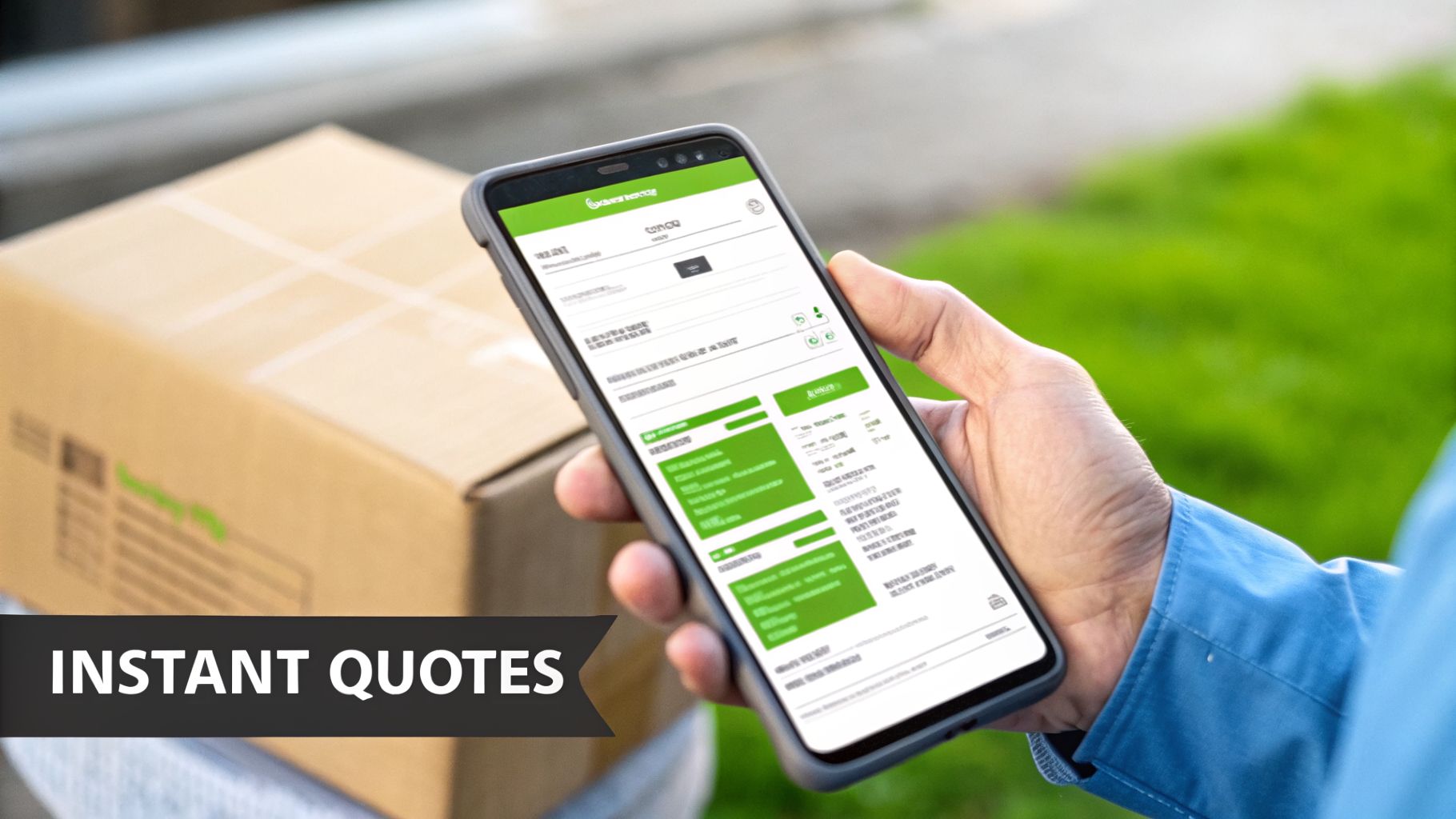
This is what modern shipping should feel like—getting real, comparable quotes right on your phone or computer. It’s the kind of power you need to make sure you're never overpaying.
Getting a Rock-Solid Quote in Seconds
It all starts with our instant quote tool. The secret to getting a truly accurate price lies in the details you enter, which is why getting your measurements right earlier was so important.
For each parcel you're sending, you’ll just need to pop in three bits of info:
- Your Exact Dimensions: The length, width, and height of your packed box, in centimetres. Always round up to the nearest centimetre to be safe.
- The Actual Weight: Put your sealed parcel on a scale and enter the weight in kilograms. Just like with dimensions, round up to the nearest kilo.
- Pickup and Delivery Postcodes: This tells the system the exact journey your parcel is taking, which is a massive factor in the final cost.
Once you’ve entered those details, the system does all the heavy lifting. It crunches the numbers, works out the dimensional weight, and instantly pulls up the real-time wholesale rates from our entire network of trusted carriers.
Comparing All Your Options at a Glance
This is where the magic really happens. Instead of one single price, you get a full list of carriers with their costs and estimated delivery times laid out side-by-side.
You can immediately see the cost difference between a standard road service that might take 5-7 days and a priority express option that could get there in 2-3 days. It’s all there in black and white, letting you make the right call based on what matters most—whether it's pure cost-savings or getting it there faster. This is especially handy when shipping to regional Australia, where delivery times and prices can really vary between carriers.
The best part? No more nasty surprises. The price you see on the screen is exactly what you pay. There are no hidden account fees or sudden surcharges, which means you have complete control over your budget from the get-go.
It’s this kind of straight-up, transparent pricing that makes Aeros Couriers one of Australia's top choices for stress-free deliveries.
Locking in Your Booking in Under Five Minutes
Found the perfect service? Great. Booking it in is just as easy. You’ll just confirm the pickup and delivery details, add any notes for the driver (like "watch out for the dog!"), and head to the checkout.
As soon as your booking is confirmed, your shipping labels are ready to download and print. These aren't just address stickers; they contain all the crucial barcodes and tracking info the courier network needs to get your parcel on its way without a hitch.
Here’s what happens next:
- Print Your Labels: The system generates a PDF. Just print it on A4 paper, fold it, and pop it into a clear plastic sleeve taped securely to your parcel.
- Schedule a Pickup: A pickup is automatically booked for the next business day from your nominated address. You don't have to lift the phone.
- Get Peace of Mind: Every single booking comes with included freight insurance for loss or damage, so you're covered.
Seriously, you can go from getting a quote to having a labelled parcel waiting by the door in less than five minutes. It’s this efficiency that gives small businesses and individuals a real edge, letting you offer professional shipping without the usual cost or administrative headaches. You’re not just saving money; you’re getting back your time.
Final Checks to Keep Your Shipment Compliant and Affordable
Alright, before you smash that ‘confirm booking’ button, let's take five minutes for a final once-over. This isn't just about ticking boxes; it's your last chance to catch small mistakes that can lead to big headaches like surprise fees or delivery failures. This is what separates the pros from the rookies and ensures you genuinely send big parcels cheap.
Think of it as your pre-flight checklist. You've done the heavy lifting—packing perfectly and finding a great rate. Now, let’s make sure your parcel has a smooth, trouble-free journey.
Double-Check Your Dimensions and Weight
This might sound like a no-brainer, but you’d be amazed how many costly errors happen right here. If your measurements are off, a courier will re-weigh and re-measure your parcel mid-journey. The result? A new invoice for the difference, plus a frustrating admin fee.
Always perform one final check:
- Final Dimensions: With the box completely packed and taped shut, run the tape measure over it one last time. You need the absolute final length, width, and height.
- Final Weight: Pop the fully sealed and labelled parcel onto your scales. This is its ‘dead weight,’ a critical part of the courier's cost calculation.
Here's a pro tip: always round up to the nearest centimetre and kilogram when you get a quote. This tiny buffer is your best defence against under-quoting and saves you from potential disputes down the line.
Make Sure Your Item is Safe to Send
Every single courier network has a strict list of prohibited and dangerous goods. Sending something on this list, even by accident, can get your parcel seized, destroyed, or sent back to you at your own expense. It’s a costly and entirely avoidable mistake.
As a rule of thumb, you can't send items like these through standard parcel services:
- Aerosols, perfumes, and other flammable liquids.
- Batteries, particularly loose lithium-ion types.
- Explosives, firearms, or any hazardous chemicals.
- Perishable foods.
It's not just about safety; it's about compliance. Before you ship, take 30 seconds to scan the courier's dangerous goods list. This simple check guarantees your parcel is good to go and won’t get stuck in transit.
Review the Delivery Details and Optional Extras
Getting the address right is absolutely mission-critical. This is especially true for regional or remote areas, where a single failed delivery attempt can cause major delays and extra costs. Double-check the street number, suburb, and postcode to make sure they are 100% accurate.
Now is also the time to make a call on those optional extras:
- Signature on Delivery: This gives you concrete proof that your parcel was received. It's a small price to pay for peace of mind, especially for high-value goods.
- Authority to Leave (ATL): If you're confident the delivery spot is secure, giving the driver permission to leave the parcel can be a smart move to avoid re-delivery fees if no one's around.
Your choice here really depends on the item’s value and the delivery location. Make an informed decision instead of just clicking the default. This is also the perfect moment to ensure you understand your shipping labels and paperwork. The consignment note, for example, is vital for tracking and serves as your proof of shipment. You can get the full rundown on its importance in our guide on what a consignment note is.
The delivery landscape in Australia is exploding, thanks to the e-commerce boom. The last-mile delivery market is set to skyrocket from AUD 1.74 billion in 2025 to AUD 7.74 billion by 2034. This fierce competition means couriers are constantly innovating to offer more efficient and affordable services—which is fantastic news for anyone looking to send large parcels without breaking the bank. You can see these trends for yourself by exploring the last-mile delivery market report.
Your Top Questions Answered
Sending a big, bulky item can feel like a minefield of hidden costs and confusing rules. We get it. After helping countless Aussies ship everything from gym equipment to car parts, we've heard just about every question there is.
So, we've put together this quick-fire guide to clear up the confusion. Think of it as having an expert in your corner, giving you the straight answers you need to ship with confidence and save some serious cash.
What Is the Absolute Cheapest Way to Send a Heavy Parcel in Australia?
Hands down, the cheapest way to get a heavy or bulky parcel across Australia is with a standard road freight service. Forget the bells and whistles of express or air freight—your package travels by truck, which is by far the most economical way to move large goods over long distances.
The real secret, though, is how you book it. Instead of going to a single carrier, you need to use a courier comparison tool. It lets you pop in your parcel's details just once and instantly see the discounted rates from a whole network of couriers, all competing for your job. This is how you find the true rock-bottom price for your specific route.
Our Golden Rule: The recipe for cheap shipping is simple: Pack it tight, and book it right. Use a strong, compact box to keep the dimensions down, then book a standard road service through a comparison platform to lock in the best rate.
How Do I Avoid Unexpected Fees When Sending a Large Item?
Nothing stings more than an unexpected fee on your shipping invoice. The good news is that these are almost always preventable. The two biggest culprits are getting the measurements wrong and a failed delivery attempt.
Here’s how to sidestep those frustrating extra charges:
- Measure It Packed, Not Empty: Once your item is fully packed, sealed, and ready to go, get out the tape measure and scales. Don't guess! When you get your quote, round each measurement up to the nearest whole centimetre and kilogram. This little buffer is your best friend.
- Triple-Check the Address: A simple typo in the postcode or street name is a classic reason for a failed delivery, which often comes with a re-delivery fee. Read it over one last time before you confirm.
- Give 'Authority to Leave' (ATL): If it’s safe to do so, ticking the 'ATL' box allows the driver to leave the parcel without a signature. This is a great way to avoid missed delivery fees if nobody’s going to be home.
Your best defence is a platform that gives you one, all-inclusive price upfront. That way, what you see is what you pay—no nasty surprises later on.
Is It Cheaper to Use Australia Post or a Courier for Large Parcels?
For big parcels, a specialised courier service will be cheaper almost every single time. While Australia Post is brilliant for letters and small packages, their system isn't built for heavy or oversized items.
They have pretty strict size and weight limits—often around 22kg and 105cm in length. Anything bigger than that is either rejected outright or pushed into a far more expensive service tier. Couriers, on the other hand, live and breathe bulky parcels. Their entire network is designed to handle it efficiently, which means their pricing is much, much sharper for those larger items.
Does My Large Parcel Need Special Packaging?
Yes, one hundred percent. Don't even think about shipping a large item in a flimsy box. Your parcel is going on a big adventure—it will pass through sorting depots, travel on trucks alongside other heavy freight, and be handled multiple times. Flimsy packaging just won't cut it.
A small investment in proper packing is the best insurance you can buy for your goods.
- Get a Tough Box: Start with a new, double-walled cardboard box. The extra layer provides the strength needed to hold the weight and shrug off any bumps along the way.
- Leave No Wiggle Room: Pack all the empty space inside the box with filler material like bubble wrap, air pillows, or even scrunched-up paper. If the item can't shift around, it's far less likely to get damaged.
- Tape It Like You Mean It: Use strong packing tape on every seam—top and bottom. A securely taped box is a structurally sound box.
Ready to put these tips into action and see how much you can save? At Aeros Couriers, our platform makes it easy to compare instant quotes from Australia’s top carriers and book a cheap, reliable delivery in minutes. Get your instant shipping quote today!
Courier quotes, tracking and support
Ready to send a parcel? Compare the available services for your postcodes, parcel dimensions and weight. For an existing delivery, use your consignment number to check tracking or ask our team for help.