Finding a genuinely cheap interstate courier in Australia isn’t about luck; it’s about understanding what you’re actually paying for. It’s a common mistake to think it all comes down to weight. In my experience, factors like the travel distance, the physical size of your box, and how fast you need it there often have a much bigger impact on the final price.
Decoding Australian Interstate Courier Costs
Sending a parcel from one state to another can sometimes feel like a lottery, but there's a definite method to the madness. Once you start to see how quotes are built, you can spot where the real savings are and avoid those frustrating hidden fees. It’s about looking beyond the weight and seeing the bigger picture.
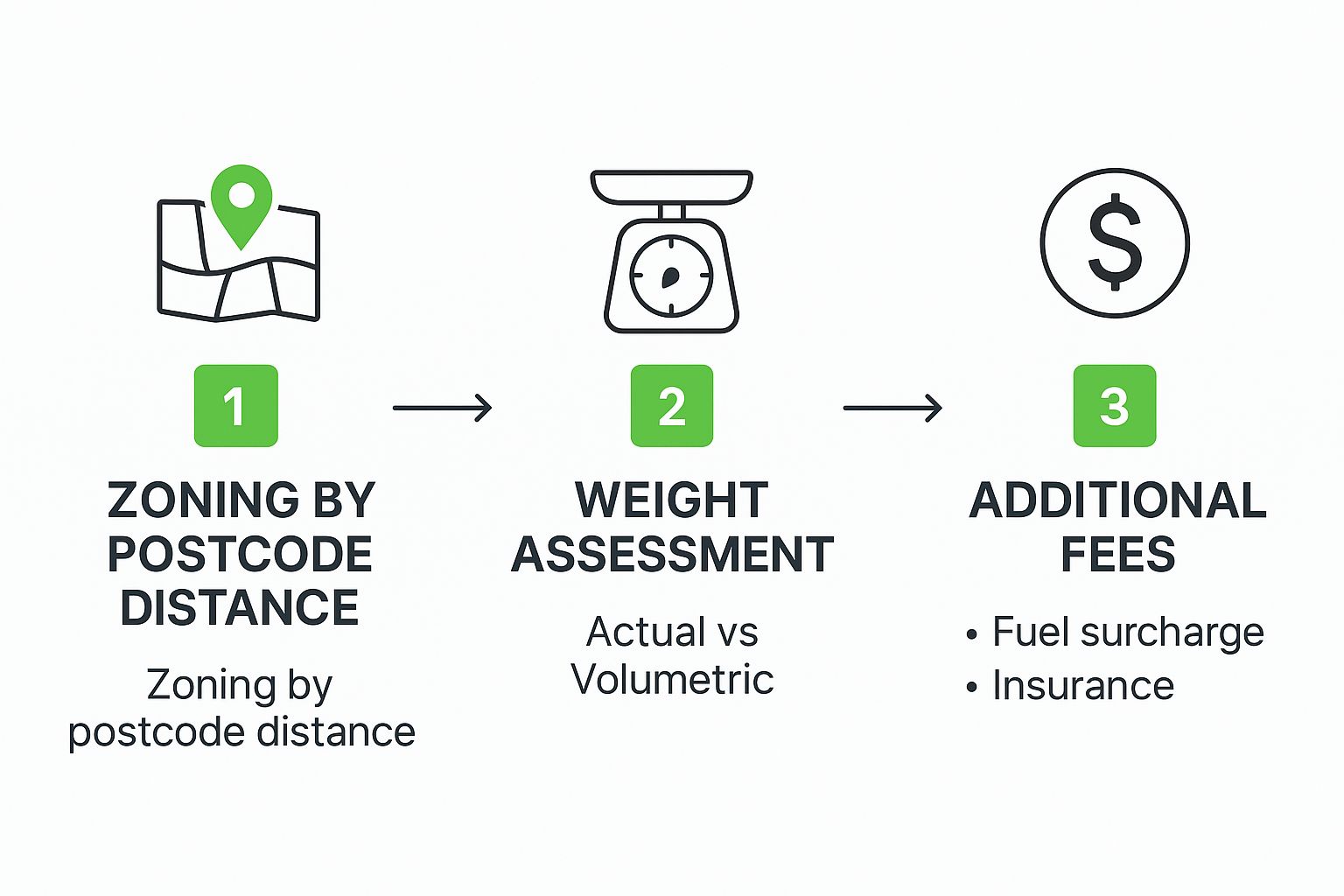
Think of your shipping cost as being built in layers. It starts with the basic journey and then adds on other elements depending on size, speed, and any extras you choose.
How Distance and Zoning Affect Prices
The single biggest chunk of your shipping bill almost always comes down to distance. Couriers don't just measure kilometres; they use a "zoning" system based on postcodes to group different areas. A parcel going from one major city to another, like Melbourne to Sydney, is a common, well-serviced route and will be in a cheaper zone.
On the other hand, sending that same parcel from Melbourne to a small town in regional WA? That’s a completely different zone, and the price will reflect the extra logistics involved.
To put it in perspective, a small package up to 3kg from Melbourne to Sydney can cost as little as $8. But if you're sending something larger, say between 3-10kg, that price can jump to $28 or more for the same route. It’s all about these delivery tiers—inner-city, suburban, regional—and costs climb the further your destination is from a major transport hub.
Actual Weight vs. Volumetric Weight
This is the one that catches people out all the time. Couriers charge for the space your parcel occupies in their van or plane, not just what it weighs on a scale. It’s a concept called volumetric weight (or cubic weight), and it’s non-negotiable.
Imagine you're shipping a big, fluffy doona. It’s light as a feather, but it takes up a huge amount of space. In this scenario, you'll be charged based on its large size, not its low actual weight.
Key Takeaway: The courier will always calculate both the actual weight and the volumetric weight, then charge you for whichever figure is higher. This is why smart packaging is your secret weapon—using a smaller box can instantly reduce your shipping cost, sometimes dramatically.
Understanding Surcharges and Extra Fees
So, you’ve got your quote. But is that the final price? Not always. A few other things can get added to the total, and it pays to be aware of them.
Here’s a quick rundown of what to look out for:
- Fuel Surcharges: This is a variable fee that carriers tack on to cover the ever-changing price of fuel. It’s pretty standard across the industry.
- Insurance: Most services include basic transit cover, but if you're sending something valuable, you'll want to pay a little extra for more comprehensive protection.
- Service Type: This one’s a no-brainer. An urgent overnight express delivery via air freight will always cost a premium compared to a standard road service that takes a few days.
To really get to grips with these different variables, this guide on how to calculate shipping costs for your business is an excellent resource. You can also find more of our own tips and tricks for managing these expenses in our articles covering shipping costs in Australia.
Key Factors Influencing Your Interstate Courier Quote
To pull it all together, let’s look at the main variables that shape your final quote. Knowing these inside and out is the first step to becoming a savvy shipper.
| Cost Factor | What It Means for You | How to Save Money |
|---|---|---|
| Distance & Zoning | The further your parcel travels, especially to a remote area, the more you'll pay. | Consolidate shipments or use a service with strong networks in your destination area. |
| Volumetric Weight | You're charged for size or weight, whichever is greater. Big, light items can be costly. | Use the smallest box possible. Don't use a massive box for a tiny item. |
| Service Speed | Express and same-day services cost significantly more than standard road freight. | If it’s not urgent, always choose the standard or economy shipping option. |
| Surcharges | Extra fees for fuel, residential delivery, or oversized items can add up. | Check the carrier’s fine print for potential surcharges before you book. |
| Insurance | Extra cover for valuable goods will increase the total cost. | Assess the true value of your item. Don't over-insure if it's not necessary. |
Keeping these factors in mind every time you prepare a shipment will help you avoid overpaying and ensure you’re always getting the best possible deal for your needs.
Finding the Best Quote for Your Shipment
Understanding courier costs is one thing, but actually locking in a great price comes down to what you do during the booking process. Getting this part right not only saves you cash upfront but also helps you dodge those frustrating re-invoicing fees that can pop up later. It all starts with being accurate.
The bedrock of any reliable quote is precise parcel details. Before you even head to a website, grab a measuring tape and a set of scales. Seriously. Guessing the dimensions or weight of your package is the single biggest reason people get stung with unexpected charges after their item is already on its way.
Nail Your Parcel Measurements
When you’re chasing a cheap interstate courier in Australia, accuracy is your greatest ally. Being off by just a few centimetres or kilograms can easily bump your shipment into a more expensive price bracket.
- Weight: Digital scales are best for an exact reading. For a bigger item, bathroom scales can work in a pinch—just weigh yourself, then weigh yourself holding the box. The difference is your parcel’s weight.
- Dimensions: Measure the length, width, and height of your box at its absolute longest points. My advice? Always round up to the nearest whole centimetre to give yourself a buffer.
Keep in mind, every courier will re-weigh and measure your parcel at their depot. If the details you declared don’t match their scan, they’ll adjust the invoice, and trust me, that adjustment is never in your favour.
Compare Multiple Carriers Instantly
Once you’ve got your exact details, the smartest thing you can do is use a comparison tool. Instead of trawling through multiple courier websites and plugging in your info again and again, you can see all your options laid out in one spot. This is where the real savings are hiding.
All you need to do is enter your pickup and delivery postcodes, along with your parcel’s exact dimensions and weight, to see what’s available.
Here’s a look at what the first step of the quote process looks like on our platform.

The system immediately pulls live quotes from a range of Australian carriers, letting you compare them side-by-side.
Now you can weigh up your options. Don’t just fixate on the price tag; look closely at the estimated transit times, too. A service that’s a few dollars cheaper might take an extra three days to arrive, which might not work for you. It’s all about finding the best balance of cost and speed for what you need.
Pro Tip: Pay close attention to the fine print on the service type. Some of the cheapest quotes might be for depot-to-depot delivery, not door-to-door. Always double-check you’re booking the exact service you need.
Finalising Your Booking
With your preferred service chosen, it’s time to make it official. A few small details in this final stage can make a huge difference in ensuring a hassle-free pickup and delivery.
One of the most crucial choices is giving Authority to Leave (ATL). Ticking this box gives the driver permission to leave the parcel in a safe place if no one is home. If you don’t select ATL and the recipient isn’t around, the parcel gets carted back to the depot, which almost always leads to a re-delivery fee.
Finally, print your shipping label clearly and stick it securely onto the largest flat side of your box. Make sure there are no old labels visible and that the barcode isn’t bent, creased, or covered by tape. That one piece of paper is your parcel’s passport through the entire courier network—make sure it’s perfect.
Insider Strategies for Cheaper Parcel Delivery
Finding a genuinely cheap courier service is about more than just picking the lowest number from a list. The real pros know that the biggest savings happen before you even get a quote. It’s all about thinking like a logistics expert, even if you’re just sending a one-off parcel.

These insider tips aren’t complicated, but they’re incredibly effective and can make a real difference to your shipping budget.
Optimise Your Packaging
Here’s the golden rule of affordable shipping: never pay to ship empty air. Every extra centimetre on your box can bump up the volumetric weight, and as we’ve discussed, that’s often what sets the price.
Your goal is to make your parcel as small and dense as you can, safely.
- Find the Right-Sized Box: It sounds simple, but always use the smallest box your item can fit into without being at risk. If you’ve got heaps of empty space around your item, you need a smaller box.
- Use Lightweight Filler: Ditch the heavy packing paper and switch to something like air pillows. They offer great protection without adding to the actual weight of the parcel, which is a massive win.
Honestly, just getting your packaging right is probably the single most effective thing you can do to slash your base shipping cost.
Unlock the Power of Backloading
One of the cleverest ways to find a cheap interstate courier in Australia is by tapping into something called backloading. It’s a classic win-win for both you and the courier company.
Picture this: a truck drives a full load from Sydney to Melbourne. Instead of driving all the way back empty, the courier company offers that return trip space at a seriously discounted rate. You’re essentially piggybacking on a journey that was already happening.
Backloading is a game-changer for interstate courier services in Australia. By filling up otherwise empty return trips, couriers can reduce shipping costs by up to 60%. It’s a smart system that makes the most of a courier’s capacity while passing some massive savings on to you.
This strategy is perfect if you have a bit of flexibility with your delivery dates, as you’re fitting into an existing schedule rather than creating a new one.
Consolidate and Time Your Shipments
If you send parcels regularly, a bit of forward planning can save you a fortune. Instead of firing off multiple small packages to the same general area throughout the week, try to group them together.
Sending one larger box with several items inside is almost always cheaper than sending them as individual parcels. You avoid paying multiple base fees and handling costs.
It’s also worth thinking about timing. Booking during off-peak periods can sometimes score you better rates. Avoiding the pre-Christmas chaos or the Monday morning rush can mean courier networks have more capacity and potentially lower prices. For more practical advice on cutting costs, you can find other great tips to keep your moving costs down.
These small tweaks to your shipping habits really do add up, proving that being strategic is just as important as being frugal.
Choosing the Right Courier Service
Navigating the Australian courier market can feel like a maze. With the e-commerce boom, new players are popping up constantly, and it’s tough to know where to start. But getting a handle on the landscape is the only way to find a service that actually fits what you need—whether that’s blistering speed or the absolute lowest price.
Let’s be clear: not all couriers are built the same. The best choice for one job could be a terrible fit for the next. This is especially true when you’re hunting for a cheap interstate courier in Australia. You need to understand the real difference between a budget carrier, built from the ground up to minimise costs, and a premium express service that promises next-day delivery.
The constant push for faster shipping is driving the whole industry forward, which is great news for businesses. It means better logistics, smarter tech, and more options for you.
Budget Carriers vs Premium Express
The first big decision always comes down to cost versus speed. It’s a classic trade-off, and knowing what to expect from each side is crucial.
- Budget Carriers: Think of these as the reliable workhorses. Their entire model is built around volume and efficiency, usually relying on road freight to keep their prices down. If your shipment isn’t urgent and saving money is your main goal, this is your go-to.
- Premium Express Services: These guys are all about speed. They leverage air freight and slick, highly organised networks to get parcels delivered in the shortest time possible. That speed costs more, making them perfect for urgent documents or high-value items where every hour counts.
This is a massive, growing market. In 2024, the Australian courier, express, and parcel industry was valued at roughly $21 billion and it’s not slowing down. This growth is all thanks to our collective demand for quick, flexible delivery.
Matching the Courier to Your Parcel
Beyond just speed and price, different couriers specialise in handling certain types of freight. Picking a service that’s a good match for your specific item can save you a lot of money and prevent major headaches down the track.
For example, a courier that’s fantastic at zipping small satchels between Sydney and Melbourne probably isn’t the most cost-effective choice for a bulky 20kg box heading to Perth.
Key Insight: Many couriers optimise their entire network for specific routes or freight types. When you find a carrier that regularly services your key destinations, you often get better pricing and more reliable delivery times because your parcel just slots right into their existing workflow.
This is where a comparison platform really shows its value. It cuts through the noise and lets you see who offers the best deal not just on price, but for the exact size, weight, and destination of your parcel. Our own guide on courier comparison dives deeper into these strategies.
By taking a moment to think about what you’re actually sending—whether it’s a tiny package or a large, heavy item—you can find a cheap interstate courier that nails both savings and reliability.
Common Mistakes That Drive Up Your Shipping Costs
You’ve found what looks like a great price for your shipment, locked it in, and breathed a sigh of relief. But the initial quote you get is only half the story. The journey to genuinely cheap interstate shipping in Australia is often booby-trapped with small, easily avoidable errors that can inflate your final bill and lead to some serious headaches.
I’ve seen it happen countless times. These aren’t hidden tricks; they’re common slip-ups that catch people out every single day.

Think of this as your field guide to avoiding those traps. Once you know what to look for, you can make sure the price you’re quoted is the price you actually pay.
The Number One Error: Getting Your Dimensions Wrong
By far the most common—and costly—mistake is getting the parcel’s weight and dimensions wrong. It’s so tempting to just have a quick guess, but that’s the fastest way to get slapped with a painful re-invoicing fee from the courier.
Here’s the deal: every single parcel that enters a depot goes through automated scanners that weigh and measure it. There’s no getting around it. If the details you provided don’t match what their machines find, the system automatically recalculates the cost. You’ll be billed for the difference, plus an admin fee for their trouble.
Let’s say you declared your package at 15kg, but it really weighs 18kg. That might not seem like a huge difference, but it could easily bump your shipment into a completely different price tier, adding a nasty surprise to your invoice.
Bad Packaging and Its Painful Consequences
Another classic blunder is shoddy packaging, especially when you’re sending something fragile. Just slapping a ‘FRAGILE’ sticker on a weak, flimsy box is wishful thinking, not protection. If your item gets damaged on its way and the courier sees the packaging wasn’t up to scratch, you can kiss any chance of a successful transit cover claim goodbye.
Good packaging isn’t complicated, but it is non-negotiable.
- Start with a strong, new box. Old boxes get weak and lose their structure. For anything heavy or delicate, go for a double-walled box every time.
- Cushion it properly. You need at least 5cm of solid padding—think bubble wrap, foam, or packing peanuts—on all sides. The item shouldn’t be able to rattle around inside at all.
- Seal it up tight. Use strong packing tape on all the seams to make sure it doesn’t burst open if it gets bumped.
Spending a few extra dollars on proper packing materials is always cheaper than replacing a broken item and forfeiting your shipping costs. It’s a no-brainer.
Misreading the Fine Print on Services and Cover
Finally, a lot of extra costs come from simply not reading the details. Choosing a service that doesn’t fit your needs or not understanding what your insurance actually covers can cause some major problems down the line.
A classic example is trying to send prohibited items. Every courier has a list of things they won’t handle, like aerosols, certain batteries, or flammable liquids. If you try to send them, you risk having the parcel returned to you—at your own expense.
Likewise, just assuming the standard included transit cover is enough for a valuable item is a massive gamble. Most basic cover is capped at around $100. If you’re sending a laptop, a piece of art, or anything you can’t afford to lose, failing to buy extra cover leaves you completely exposed if something goes wrong on its journey across Australia.
Answering Your Interstate Shipping Questions
Even when you’ve snagged a great price, it’s natural to have a few questions buzzing around. Getting the full picture on how interstate shipping works from start to finish means you know exactly what to expect, and that makes for a much smoother delivery.
We get asked a lot about the ins and outs of finding and using a cheap interstate courier in Australia. Let’s walk through some of the most common questions and give you the straightforward answers you need.
What’s the Cheapest Way to Send a Parcel Interstate in Australia?
Hands down, the most effective way to find the lowest price is to jump on a courier comparison site and look for standard road freight. This option is almost always going to be cheaper than flying your parcel across the country with an express service.
To really get that price down, it all comes back to the basics.
- Pack smart: Keep your parcel as small and light as possible. Using the right-sized box minimises its volumetric weight, which is a massive factor in pricing.
- Plan ahead: Leaving your booking to the last minute can really limit your choices, often leaving you with only the pricier express options.
- Stay flexible: If your delivery isn’t urgent, you can unlock some serious savings. Keep an eye out for services that use backloading—they’re a fantastic way to tap into much lower rates.
At the end of the day, if your number one goal is keeping costs to a minimum, road freight will always beat air freight.
How Can I Track My Parcel Across Different States?
Once your booking is locked in, you’ll get an email with a unique tracking number and a link that takes you straight to the courier’s online tracking page. Think of this as your parcel’s digital passport.
Just pop that number into the carrier’s website, and you’ll see live updates every time it gets scanned at a depot along its journey. Many comparison platforms, ours included, also pull all that information into one place. This means you can check on your parcel’s progress right on the site you booked with, saving you from bouncing between different courier pages.
Every single scan—from the moment it’s picked up, through every sorting depot, right up to the final delivery—is logged. This gives you a completely transparent view of where your parcel is at every stage of its trip across Australia.
Should I Pay for Extra Insurance on My Shipment?
This one really boils down to what you’re sending. Most courier services include a bit of complimentary transit cover, but it’s usually capped at around $100. For everyday, low-value items, that’s often perfectly fine.
But if you’re shipping something valuable, delicate, or one-of-a-kind, taking out extra insurance is a very smart move. For a small extra cost, you’re buying complete financial protection against the rare chance of it getting lost or damaged on its way.
Before you make a call, always take a minute to read the policy details. Knowing exactly what’s covered (and what isn’t) lets you make the right choice for your shipment and gives you that extra peace of mind.
Ready to find the best rate for your next shipment? With Aeros Couriers, you can compare quotes from trusted carriers, book your delivery in minutes, and manage everything from one simple platform. Get your free, no-obligation quote today!
Courier quotes, tracking and support
Ready to send a parcel? Compare the available services for your postcodes, parcel dimensions and weight. For an existing delivery, use your consignment number to check tracking or ask our team for help.