
Not so long ago, sending a parcel felt a bit like a leap of faith. You’d drop it off and hope for the best. But today, couriers have completely changed the game, turning shipping into a fast, transparent, and genuinely powerful tool for Australian businesses.
Think of modern courier services as the arteries of Australian commerce. They’re what connects an online store in a Sydney suburb with a customer in regional Queensland, all with a speed and precision that would have seemed impossible just a decade ago. We specialise in fast box and parcel deliveries Australia-wide, making it easy to send your goods anywhere in the country.
Welcome to the New Age of Australian Couriers
The days of shipping being a slow, murky process run by just a few big names are well and truly over. We've moved far beyond the old post office counter into a world driven by smart technology, where sending a box across the country is simpler and more accessible than you might think. This isn't just about getting things there faster; it's about giving businesses real control over their Australian deliveries.

Just picture it: you get an instant price from a dozen different carriers, book a pickup right from your home office, print a label, and then watch your parcel’s entire journey in real-time. All from a single screen. That’s not a futuristic dream; it’s the reality of modern logistics in Australia, focused on providing the cheapest parcel and box delivery possible.
This huge shift has been fuelled by the explosion in online shopping. The Australian courier, express, and parcel (CEP) market is rocketing towards a projected value of USD 17.7 billion by 2033. With domestic deliveries expected to be the main driver by 2026, the need for reliable, fast shipping across our vast 427,000 km paved road network has never been greater.
From Complex to Convenient
In the past, booking a shipment often meant wrestling with complicated price lists and very few choices. For a small business, this was a massive headache and made it tough to compete with bigger companies who had the power to negotiate bulk discounts. Today, courier platforms have completely reset the board.
By bringing a whole network of couriers together under one digital roof, modern services give everyone access to competitive pricing and incredible flexibility. It means a small artisan in Tasmania can offer the same cheap, fast shipping as a major retailer in Melbourne.
This new way of working gives your business some serious advantages:
- Unbeatable Choice: Instead of being stuck with one provider, you can instantly compare prices and delivery times from a huge range of couriers. You’ll always find the best fit for that specific job.
- Total Transparency: Real-time tracking is now the standard. Both you and your customer can follow the parcel from the moment it leaves your hands to the second it arrives, which builds trust and dramatically cuts down on "where's my order?" calls.
- Remarkable Speed: With options for same-day metro delivery and express interstate services, you can finally meet your customers' expectations for a quick turnaround—a non-negotiable in modern e-commerce.
Shipping is no longer just a cost of doing business; it's a strategic part of your customer experience. When you get it right, you don't just deliver a product. You deliver a fantastic experience that keeps people coming back.
To get a better sense of what’s possible, you might want to explore our deeper look into national courier services across Australia. This is the new standard, and it’s ready for you to use right now.
Finding the Right Courier Service for Your Needs
Trying to pick the right courier can feel like you're staring at a map with a million different roads. But it's much simpler than it looks. The secret is to stop thinking about it as a random choice and start thinking of it like picking the right tool for a specific job.
You wouldn't use a tiny screwdriver to assemble a heavy-duty bookshelf, right? The same logic applies here. Matching the service to the job turns a simple delivery into a smart, strategic move for your business, giving you the confidence to nail your budget and timeline every single time.
The Need for Speed in Metro Areas
For businesses hustling within a single major city, metro courier services are your secret weapon. These services are built for one thing and one thing only: pure, unadulterated speed. We're talking about getting a parcel from one side of town to the other on the same day, often within a 3-hour window.
Picture this: you’re running a local business in Sydney, and a customer desperately needs a replacement part. Making them wait for an overnight delivery just won’t cut it. A metro courier can swoop in, grab the item, and have it in your customer's hands that same afternoon. You’ve just turned a potential crisis into a five-star review.
Balancing Cost and Speed with Nationwide Shipping
But what about when your parcel needs to cross state lines, say from Melbourne to Brisbane? This is where nationwide shipping comes into play, the absolute workhorse of Australian e-commerce. It’s all about finding that perfect balance between getting it there fast and keeping your shipping costs in check to get the cheapest price.
You’ve really got two main paths to choose from:
- Standard Shipping: This is your reliable, budget-friendly option. It’s not about breaking land-speed records; it's about dependable delivery that doesn't break the bank. This is the go-to for everyday e-commerce orders where your customers are happy to wait a few days for free or low-cost shipping.
- Express Shipping: When time is money—or a customer’s special event is on the line—express is your answer. Think of a boutique in Melbourne needing to get a last-minute dress to a customer in Perth for a wedding. That’s a job for an express satchel. It costs a bit more, but the peace of mind is priceless.
Choosing between standard and express isn’t just about a delivery deadline. It’s about understanding and responding to your customers' needs. Offering both gives them control and shows you’ve got their back.
Making the Right Choice in Practice
Let's bring this to life with a real-world scenario. An electronics store in Adelaide has two very different orders to get out the door. The first is a box of cables for a local office, and the second is a high-value camera heading to a photographer in Cairns.
- For the local delivery: A metro courier is the obvious choice. It’s fast, efficient, and guarantees the cables arrive the same day, keeping that local B2B client delighted with your service.
- For the interstate delivery: Here, the owner opts for express nationwide shipping. That camera is expensive and the photographer needs it for a shoot. The extra speed and detailed tracking of an express service protect the investment and ensure everyone breathes easy.
When you break it down this way, the right choice becomes crystal clear. You're not just 'sending a package'; you're executing a delivery strategy. The best way to get a handle on this is to see all your options in one place. You can compare couriers and find the cheapest rates for your specific shipment, arming you with the knowledge to make the smartest, most cost-effective decision every time.
Mastering the Essentials of Safe and Compliant Shipping
Getting your products out the door is one thing, but ensuring they arrive safely and professionally is what truly sets a business apart. Long before a courier even scans that first barcode, your job as the sender has already begun.
Think of it this way: proper packaging and following the rules aren’t just red tape. They’re your best insurance policy against the headaches of damaged goods, unhappy customers, and costly delays. Taking a few extra moments here transforms a simple shipment into a statement of quality and care.
This is the bedrock of a reliable delivery experience, connecting every part of the courier network—from a quick local drop-off to an urgent cross-country delivery.
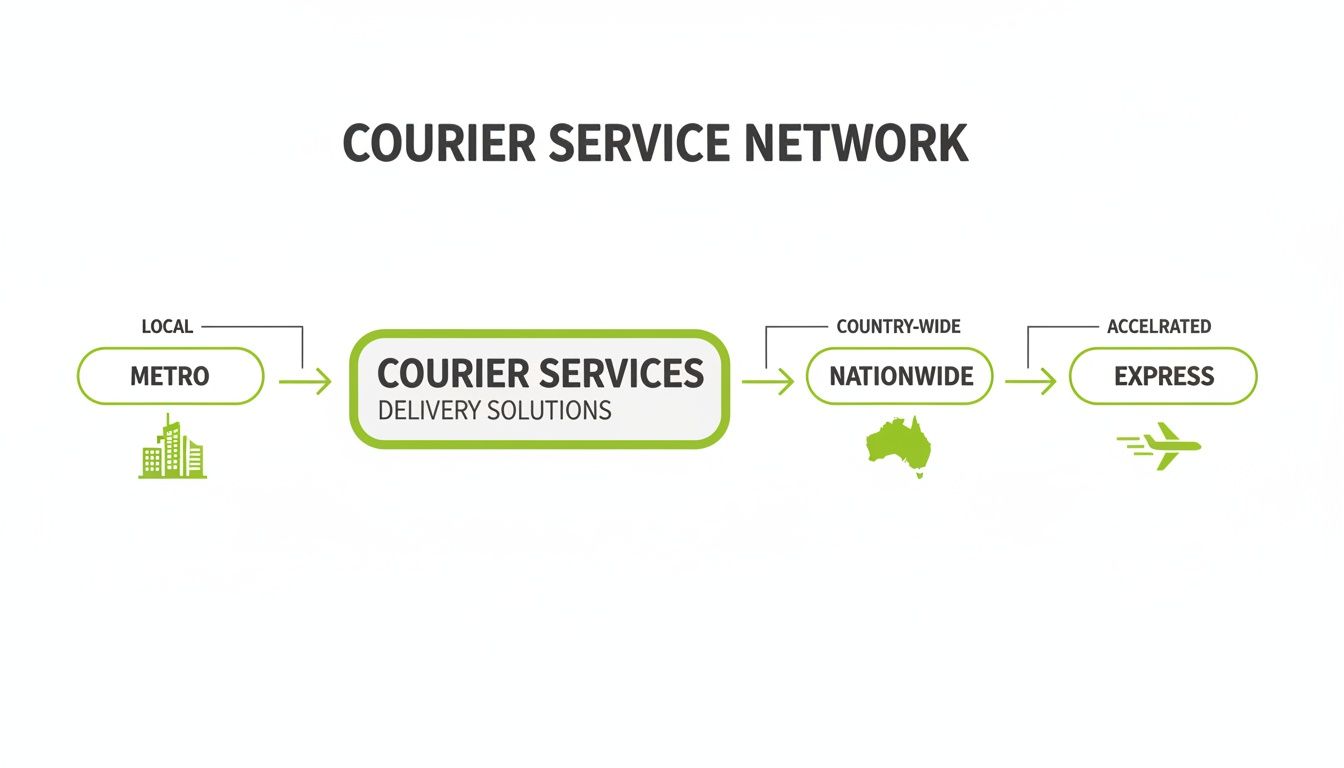
The journey from a metro run to an express flight shows just how flexible a modern courier service can be, but it all relies on every parcel being safe and ready for the trip.
Packaging for Success
Let's start with the basics. Great packaging is your first line of defence. It’s a silent promise to your customer that what’s inside will turn up in perfect condition. This isn’t just about grabbing any old box; it’s about creating a secure little fortress for your items.
First up, the container. Always go for a new, sturdy cardboard box that’s the right size. Too big, and your item will rattle around like a pinball. Too small, and there's no room for cushioning, leaving it vulnerable to every little bump.
With the right box in hand, the next step is to create a protective buffer inside.
- Wrap It Right: Give each item its own protective layer. Bubble wrap is a classic for a reason, but other materials work too.
- Fill the Voids: Use packing peanuts, air pillows, or even scrunched-up paper to fill every last bit of empty space. When you give the box a gentle shake, nothing should move. Nothing at all.
- Seal Securely: A strong packing tape is your best friend here. Use the 'H-tape' method—tape down the middle seam and then across both edge seams—to create a really solid seal.
Understanding Dangerous Goods
Now, let's talk about what can and can't go through a standard courier service. Some everyday items are classified as dangerous goods (or DG) because they can pose a health, safety, or environmental risk during transit. Trying to send them without declaring them is a serious issue.
Many business owners are genuinely surprised to find out what counts as DG. We're not just talking about industrial chemicals. You'd be amazed what's on the list:
- Aerosol cans (like deodorant or hairspray)
- Perfumes and aftershaves (thanks to their alcohol content)
- Nail polish and remover
- Lithium batteries (the powerhouse behind laptops, phones, and countless gadgets)
- Many common cleaning products
These things aren't outright banned, but they absolutely need to be declared and handled by specialised services. If you’re ever unsure, the responsibility is on you, the sender, to check.
Embracing the Chain of Responsibility
In the Australian logistics world, safety isn't just one person's job—it's a shared duty. This principle is formalised in law as the Chain of Responsibility (CoR). It means that everyone who touches a shipment, from the person packing the box to the driver behind the wheel, shares legal accountability for its safety.
As the sender, you are the first and one of the most important links in this chain. Your role is to make sure your parcels are packed securely, their weight and dimensions are declared accurately, and they don’t contain any undeclared dangerous goods. It’s a collective effort that keeps everyone safe.
This isn’t just a suggestion; it’s a legal obligation. Misstating the weight of a parcel or sneaking a restricted item into a box isn’t a harmless fib. It’s a breach of safety that can have very real consequences for the people handling your freight.
Finally, none of this works without clear labelling. Think of a label as your parcel's passport. A securely attached, easy-to-read label is essential for compliance and a smooth journey. Using high-quality Shipping and Mailing Labels ensures all the critical information is there for a fast, accurate delivery from your door to theirs.
How to Choose the Best Courier Service for Your Business
Moving from knowing what a courier does to actually picking one is a huge step. This isn't just about finding someone to move a box; it's about choosing a partner that directly impacts your customer experience, your budget, and your brand's reputation.
Think of it this way: your courier is the final handshake you have with your customer. The right one makes you look like a superstar. The wrong one can create headaches you never even knew were possible.
To get it right, you need to find your sweet spot between four key things: speed, cost, reliability, and any special services you might need. Whether you're an e-commerce store where every hour counts or a B2B supplier chasing rock-solid efficiency, nailing this choice is a serious competitive advantage.
The Great Balancing Act: Speed vs. Cost
The first, and often most urgent, decision is weighing up delivery speed against your budget. It's the classic trade-off: how fast do you need it there, and what are you willing to pay to make that happen? For most Aussie businesses sending parcels nationwide, this is a daily calculation.
A same-day or 3-hour metro delivery can be a lifesaver for urgent, local orders, but that speed comes at a premium. On the flip side, standard road services are incredibly budget-friendly for parcels that aren’t in a mad rush to get across the country.
When to prioritise speed: Go for express or same-day services when you're shipping high-value goods, urgent replacement parts, or time-sensitive documents. The higher cost is easily justified by the customer satisfaction (and your own peace of mind) it delivers.
When to prioritise cost: Stick with standard shipping for regular e-commerce orders, especially where customers have chosen a low-cost or free shipping option at checkout. The key here is to find the cheapest price while still managing expectations from the get-go.
Remember, the cheapest option isn’t always the best, and the fastest isn't always necessary. The real goal is to match the service to the promise you made to your customer.
Reliability and Trust
Once you’ve got a handle on speed and cost, reliability is what separates the good from the great. A super cheap courier is worthless if your parcels constantly show up late, damaged, or worse, not at all. Your courier is a direct extension of your brand, and their performance is a reflection on you.
A reliable courier doesn't just deliver a parcel; they deliver on a promise. This trust is built on a foundation of consistent on-time performance, transparent tracking, and clear communication when things (inevitably) go wrong.
When you're checking out a courier’s reliability, look for a solid reputation and genuine customer reviews. Think about how their performance feeds into your bigger picture. When you master e-commerce customer service, you quickly learn that the delivery experience is one of the most powerful moments you have to build customer loyalty. That makes a trustworthy courier a non-negotiable part of your team.
Special Features and Extra Protection
Finally, what extras do you need? These value-added services can make a world of difference, offering convenience and security that go far beyond just getting a box from A to B.
Some of the most common features to look for include:
Signature on Delivery: This gives you proof that your parcel was received, which is absolutely vital for high-value items or deliveries to business addresses.
Freight Protection (Insurance): While most services have some limited liability cover, buying extra protection for valuable or fragile goods is a smart move. It's a small price to pay for total peace of mind.
Residential vs. Commercial Pickups: Make sure the courier can actually collect from your specific location, whether you're working from a home office, a busy warehouse, or a retail storefront.
Here’s where the sheer scale of Australia’s delivery network really works in your favour. The courier industry in Australia is projected to be powered by over 56,550 businesses by 2026, and an incredible 89.0% of these are sole traders. This huge, decentralised network means more flexible and local pickup options for small businesses, no matter where you are. You can dive deeper into these industry insights on the growth of Australian couriers.
To help you put it all together, think about what your number one priority is. Are you focused on delighting customers with speed, or do you need to protect your margins with a cost-effective solution? This table breaks down what to look for based on what matters most to your business.
Choosing Your Courier Service Focus
| Priority | What to Look For | Best For | Aeros Couriers Solution |
|---|---|---|---|
| Speed | Same-day, 3-hour, or overnight express services. A provider with a large metro fleet. | Urgent documents, last-minute gifts, premium e-commerce. | Our Express and VIP services offer fast delivery across major metro areas. |
| Cost | Standard road express, off-peak delivery options, and access to competitive shipping rates. | Standard e-commerce, non-urgent stock transfers, businesses wanting the cheapest price. | Our Standard road service provides a cost-effective solution with reliable nationwide coverage. |
| Reliability | High on-time delivery rates, positive customer reviews, real-time GPS tracking, and proactive support. | High-value items, B2B shipments, subscription boxes, and brands focused on customer loyalty. | All our services come with end-to-end tracking and a dedicated support team to ensure transparency. |
| Special Needs | Services for fragile items or requiring specific handling instructions. | Medical supplies, industrial parts, artwork, and wineries. | We are experts in handling delicate and time-sensitive box and parcel deliveries with care. |
By focusing on your primary goal first, you can quickly narrow down the options and find a courier that not only meets your needs but also helps your business thrive. By carefully weighing these four pillars—Speed, Cost, Reliability, and Features—you can confidently choose the perfect courier partner to delight your customers, every single time.
Your Step-by-Step Guide to Booking and Tracking a Parcel
Let’s be honest, shipping can feel like a chore. But it doesn’t have to be. Forget wrestling with complex logistics; modern courier platforms are designed to put you in the driver’s seat. We’re going to walk through just how simple it is to book and track a delivery, giving you back precious time to focus on what you do best.
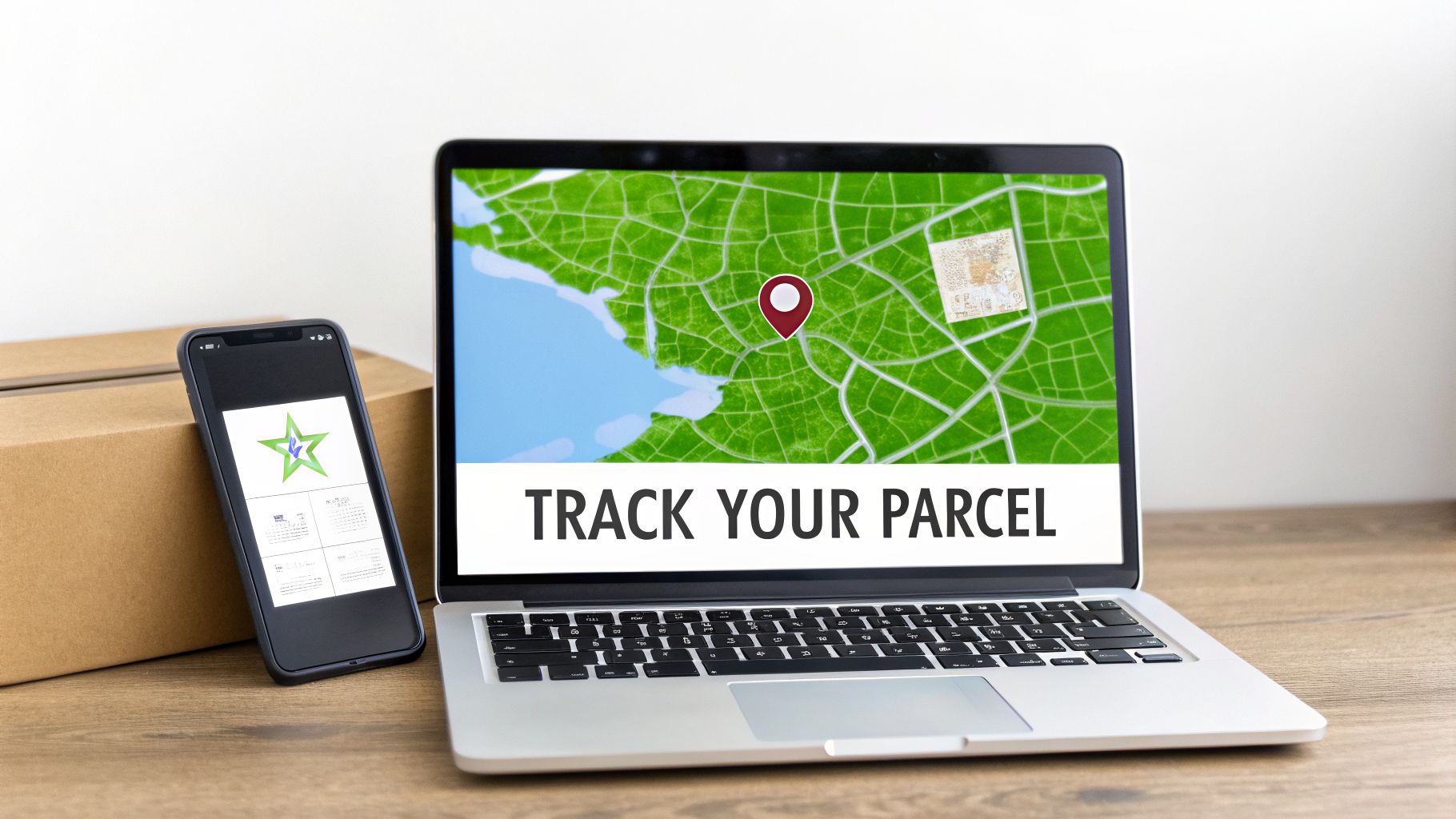
Think of it as your personal shipping command centre, where everything from getting a quote to watching your parcel’s journey is just a few clicks away. Here’s a simple four-step guide that shows you exactly how to manage your own fast box and parcel deliveries right across Australia.
Step 1: Get an Instant Quote
Every shipment starts with one simple question: “How much will this cost?” Gone are the days of calling around or just guessing. Today’s couriers give you the power of instant pricing.
You just need the basics of your shipment:
- The pickup and delivery postcodes.
- Your parcel’s dimensions (length, width, and height in centimetres).
- The total weight of your parcel in kilograms.
Once you pop in these details, the platform does the heavy lifting. It instantly pulls up quotes from a range of trusted carriers, laying out all your options so you can compare prices and delivery estimates side-by-side. No guesswork needed.
Step 2: Book Your Delivery
With your quotes on the screen, the next move is yours. This is where you get to weigh up speed against budget. Do you need an express service to get it there tomorrow, or is a standard road option the smarter, more cost-effective choice?
This decision is more important than ever. Customer expectations for speed are through the roof, with Australia’s same-day delivery market projected to hit AUD 2.98 billion by 2034. That ‘need-it-now’ attitude is fuelling a 5.62% annual growth in express services, with air freight becoming crucial for connecting our cities fast. You can find more analysis on the future of same-day shipping.
After you’ve picked your service, just confirm the booking details, add any extras like signature on delivery, and handle the payment. The whole process is done in minutes.
Step 3: Print and Attach Your Label
Once your booking is locked in, you’ll get your shipping label. Think of this label as your parcel’s passport—it holds all the vital information the courier network needs to guide your item to its destination without a single hiccup.
A correctly attached, clearly printed label is one of the single most important parts of a successful delivery. It’s what allows automated scanners to read your parcel’s data, preventing delays and misroutes.
Make sure to print the label clearly and stick it flat and securely onto the largest surface of your box. It’s a good idea to cover it with clear packing tape to protect it from rain and scuffs, but be careful not to tape over the barcode—that can cause scanning headaches.
Step 4: Track Your Parcel in Real-Time
And now for the best part. From the moment the courier picks up and scans your parcel, you get a front-row seat to its entire journey. This kind of modern tracking gives you complete visibility, which not only builds trust with your customers but also gives you total peace of mind.
You and your customer can see every scan, from the initial pickup right through to that final “out for delivery” alert. Understanding these milestones is a game-changer; for a closer look, check out our guide on what ‘in transit’ really means for your parcel.
By following these simple steps, you can confidently take charge of all your parcel shipments across Australia. It’s that easy.
Your Top Questions About Australian Couriers, Answered
Thinking about using a courier? You’ve probably got a few questions rolling around. The world of shipping can seem complicated from the outside, but once you know a few key things, it all clicks into place. We’ve heard every question in the book, so we’ve pulled together the most common ones to give you clear, straightforward answers.
Our goal is simple: to help you send your parcels with complete confidence. Whether this is your first time shipping or you’re a seasoned pro, these insights will make your entire process smoother and more affordable. Let’s dive in.
How Can I Find the Absolute Cheapest Price to Send a Parcel?
Forget spending hours hunting around on different websites. The secret to finding the best deal is to compare quotes from multiple couriers all at once. Using a comparison platform is the quickest and smartest way to do it.
You just pop in your parcel’s details – its weight, size, and destination – and in seconds, you get a full list of available services, ranked by price. It’s the only way to see a true side-by-side comparison. You might even find that a premium carrier offers the best price for your specific route, which is something you’d never discover otherwise.
Can I Send a Parcel from My Home Address?
Yes, absolutely! This is one of the best things about modern courier services. The convenience of booking a pickup straight from your residential address is a real game-changer, especially for home-based businesses, eBay sellers, or anyone who just wants to skip a trip to the post office.
When you make your booking, you can simply list your home as the collection point. All you need to do is have your parcel properly packed, sealed tight, and the shipping label stuck on securely before the driver shows up. It effectively turns your doorstep into your own private mailroom.
Do I Need a Special Business Account to Use a Courier?
Not anymore. This is probably one of the biggest myths we hear. In the past, you often needed a formal business account and had to promise a minimum number of shipments to get decent rates. Thankfully, those days are long gone.
Today’s courier platforms have thrown the doors wide open, giving everyone access to professional-grade shipping. You can send a one-off parcel as a casual user and pay as you go, with no contracts, credit checks, or strings attached. It’s this flexibility that lets individuals and small businesses tap into the same reliable services that were once reserved for the big players.
You get all the perks, like great pricing and live tracking, right from your very first shipment.
What Happens If My Parcel Gets Lost or Damaged?
It’s the one question nobody likes to think about, but it’s crucial to know the procedure. If the unfortunate happens and a package is lost or arrives damaged, your first step is to contact the courier or the booking platform you used immediately.
Most services include a basic level of complimentary freight protection or insurance. For anything valuable or fragile, we always recommend purchasing extra cover when you book. It’s a small price for total peace of mind. To make any claim process as smooth as possible, be ready with proof of the item’s value and, if it’s damaged, clear photos of the item and the packaging.
What’s the Difference Between Cubic Weight and Actual Weight?
This concept trips a lot of people up, but it’s essential for understanding your shipping costs. Couriers charge based on whichever is greater: the actual weight (how heavy it is) or the cubic weight (how much space it takes up).
- Actual Weight: This is the straightforward one. It’s simply what your parcel weighs on a set of scales, in kilograms.
- Cubic Weight: This is a formula based on your parcel’s volume. It’s calculated by multiplying its dimensions (Length x Width x Height) by a standard industry factor, which is usually 250 for domestic road freight in Australia.
Think of it like this: a big box of fluffy pillows is light, but it takes up a lot of room in the van, so it will likely be charged on its cubic weight. On the other hand, a small, dense box of books will be charged on its actual weight. Always measuring and weighing your items accurately is non-negotiable for getting a correct quote, just as important as knowing what a consignment note is and its function in the journey of your parcel.
Ready to see how simple and affordable shipping can be? At Aeros Couriers, we give you instant quotes from Australia’s most trusted carriers for fast box and parcel deliveries, with easy online booking and real-time tracking that puts you in the driver’s seat. Get your free quote today and find out how much you can save.
Courier quotes, tracking and support
Ready to send a parcel? Compare the available services for your postcodes, parcel dimensions and weight. For an existing delivery, use your consignment number to check tracking or ask our team for help.