If you're running an Australian business, you know that getting your products into customers' hands, wherever they are, is the name of the game. National courier services are the arteries of Australian commerce, pumping goods from a warehouse in Wollongong to a doorstep in Darwin. They're the specialists in moving boxes and parcels quickly, safely, and at the cheapest prices, right here within Australia.
This is what makes it possible for a small online store to go toe-to-toe with the big players on a national scale.
Your Guide to Shipping Parcels Australia Wide
For any Aussie business looking to scale up, getting a handle on national shipping isn't just a good idea—it's essential. The days of only selling to your local community are long gone. Now, a customer in Perth can order from a boutique in Brisbane with a single click, and a Melbourne startup can supply clients in the quiet corners of regional Queensland.
This incredible connectivity is all thanks to a robust network of national courier services.
But let's be real, it can feel like a massive headache. How do you find a courier that’s fast enough to keep customers happy but affordable enough to protect your bottom line? The good news is, you don’t have to reinvent the wheel. Modern courier platforms have been built specifically to solve this puzzle for small and medium-sized businesses (SMEs), turning what was once a logistical nightmare into a powerful engine for growth.
The E-commerce Boom and What It Means for You
The explosion of online shopping has completely changed the game for Australia's delivery industry. This incredible surge in parcels crisscrossing the country has fired up competition and sparked huge leaps in shipping technology.
In fact, the courier pick-up and delivery sector hit a staggering $13.7 billion in revenue in 2025, with an incredible 56,550 businesses now competing in the space. You can dive deeper into these numbers with IBISWorld's comprehensive market research. For you, this fierce competition is fantastic news—it means more options, better service, and the cheapest prices.
Think of this guide as your roadmap. We’ll walk you through everything you need to know, from picking the right service to packing your goods like a pro.
Stop thinking of shipping as just another expense. See it as your direct connection to every potential customer in Australia. The right courier partner doesn't just move boxes; they help you deliver on your brand's promise, turning logistics from a challenge into your competitive edge.
This is all about putting you in the driver's seat. Armed with the right know-how and the right tools, you can send your parcels and boxes anywhere in Australia with complete confidence, building a loyal following and unlocking your business's true potential.
Let's get started.
Choosing the Right Courier Service for Your Needs
Diving into the world of national couriers can feel like trying to crack a code. You're hit with terms like 'express', 'standard', and 'same-day', and it's easy to get lost or, worse, end up paying a fortune for a service you don't really need.
The trick is to think of it like picking the right tool for a job. You wouldn't use a sledgehammer to hang a picture frame, right? In the same way, you don't need the absolute fastest shipping for every single parcel. Getting a handle on the core service types is your first step to becoming a savvy shipper. It lets you make smart calls that balance speed, reliability, and your budget—keeping both your customers and your bottom line happy.
This flowchart is a great starting point for making that initial choice, helping you decide between the two most common options based on what matters most for each shipment.
Ultimately, every package you send is a trade-off between urgency and cost. The right answer will always depend on the specific situation at hand.
Getting to Grips With Different Service Types
To help you navigate the options, here's a quick breakdown of the most common courier services you'll come across in Australia. Each one is designed for a specific purpose, and understanding the differences is key to making the best choice for your business and your customers.
Comparing Courier Service Types
| Service Type | Best For | Typical Speed | Key Feature |
|---|---|---|---|
| Standard / Economy | Non-urgent deliveries, bulk stock, everyday e‑commerce orders | 2-7 business days | The most budget-friendly option for reliable delivery. |
| Express / Overnight | Urgent orders, time-sensitive documents, high-value items | Next business day (metro-to-metro) | Prioritised handling and the fastest road or air network. |
| Same-Day / Urgent | Critical local deliveries, emergency parts, last-minute requests | Within hours on the same day | Point-to-point service, typically within the same city. |
Choosing the right service really comes down to matching the delivery speed and cost with the customer's expectations for that particular order.
Why Metro vs. Regional Makes a Big Difference
Australia is a massive country, and that simple fact adds another crucial layer to shipping: the difference between sending something to a major city versus a regional town. A parcel going from Sydney to Melbourne follows a well-worn path, but a delivery from Sydney to a remote community in Western Australia is a whole different ball game.
- Metro Areas: Think major capital cities and their surrounding suburbs. Deliveries here are quick and efficient, often taking just 1-3 business days on a standard service. The routes are established and the population density makes it straightforward.
- Regional Areas: These are all the locations outside those main city hubs. Shipments to regional and remote postcodes will naturally take longer. They often involve more complex logistics, like being passed between several depots to cover the vast distances.
A good courier platform will always give you a clear estimated time of arrival (ETA) when you book. This is vital. It allows you to set realistic expectations for your customers, whether they're in a CBD high-rise or a quiet country town. If you want to learn more about what separates a great delivery partner from a good one, check out our guide on how to choose a courier company in Australia.
Think of every parcel you send as a direct reflection of your brand's promise. Choosing the right service isn't just a logistical decision; it's a customer service one. Matching the delivery speed to your customer's expectation is key to building trust and encouraging repeat business.
Beyond just speed, it's worth looking at the extra features that give you peace of mind. Things like signature on delivery offer concrete proof that your package arrived safely, while included insurance protects your wallet if something goes wrong. These little extras can turn a simple delivery into a secure, fully-managed experience for your valuable goods.
Getting to Grips with Australian Shipping Costs
To really nail your shipping strategy, you have to look past the sticker price and understand what's actually driving the cost. It’s a bit like planning a big road trip across the country. The final bill isn’t just the cost of the car hire; it’s a mix of how far you’re going, the price of fuel, how quickly you need to get there, and how much gear you’re packing. Sending a parcel works pretty much the same way.
Once you get your head around these factors, you can start unlocking some serious savings. By understanding how national couriers calculate their fees, you'll make smarter choices about your packaging and pick the right service level for the job. It’s how you turn shipping from a painful expense into the cheapest possible rate.
The Key Ingredients in a Courier Quote
There are a few core elements that all come together to determine the final price of sending a parcel anywhere in Australia. Each one plays its part, and even small tweaks can lead to big savings down the line.
Here’s a breakdown of what shapes your shipping quote:
- Parcel Size and Weight: This is the big one. Couriers look at both the actual dead weight of your item and its physical dimensions.
- Delivery Distance: It’s no surprise that sending a package from Sydney to Perth will cost more than sending it across town. It’s a longer journey with more fuel and logistics involved.
- Service Level and Speed: Need it there tomorrow? A fast, next-day delivery will always have a higher price tag than a standard economy service that takes a few days.
- Fuel Surcharges: These are variable fees that carriers add on to cover the ever-changing cost of fuel, and they can definitely impact the final invoice.
Why You Can’t Ignore Volumetric Weight
One of the most common surprises in courier pricing is volumetric weight, sometimes called cubic weight. This has nothing to do with how heavy your parcel feels and everything to do with how much space it hogs in a van or on a plane. A big, light box can easily cost more to ship than a small, heavy one simply because it takes up more precious room.
Couriers will calculate both the actual weight and the volumetric weight of your parcel. Then, they’ll charge you based on whichever number is greater. This single detail can have a massive impact on your shipping costs, especially if you're sending bulky but light items.
Think about sending a large box of pillows. It might only weigh 2kg, but its dimensions could give it a volumetric weight of 10kg. In this case, the courier will charge you for 10kg because that’s the amount of space it’s taking up. This is exactly why smart, compact packaging is one of the best cost-saving tools you have. Learning how this works is a game-changer, and you can calculate shipping charges accurately using online tools that do the maths for you.
How to Access Cheaper Prices with Wholesale Power
For most small and medium businesses, trying to compete on shipping can feel like an impossible task. Big corporations negotiate massive discounts directly with carriers because they ship thousands of items a day—a level of volume most of us can only dream of. But this is where modern shipping platforms are completely changing the game.
These platforms work by bringing together the shipping volume of thousands of small businesses just like yours. By pooling everyone's shipments, they create a huge collective bargaining power that allows them to negotiate significant wholesale rates from all the major national couriers.
This model gives you a direct advantage in a few key ways:
- Access to Discounted Rates: You get to tap into cheap prices that were once reserved for only the biggest companies.
- No Minimum Volumes: You don’t have to promise to send hundreds of parcels a week just to get a better deal.
- Instant Comparisons: You can see quotes from multiple carriers side-by-side in seconds, making sure you always get the best price for every single shipment.
By using a platform like this, you’re plugging into a powerful network that levels the playing field. It gives your business the ability to offer fast, affordable, and reliable shipping all across Australia, so you can compete, grow, and keep your customers happy with every order.
How to Pack and Ship Your Parcels Safely
Getting your product into a box is only half the battle. How you pack that box can be the difference between a delighted customer and a frustrating damage claim. When you use national courier services, your parcel joins a massive, fast-moving network. It needs to be tough enough to handle the journey.
Proper packaging is your first and best line of defence. It's what protects your items from the inevitable bumps, drops, and pressures of being stacked in a delivery van. This isn't just about good business practice; it’s about making sure your reputation for quality and care follows your product all the way to your customer's doorstep.
And this commitment to safety? It's more than just a good idea—it's a shared legal duty.
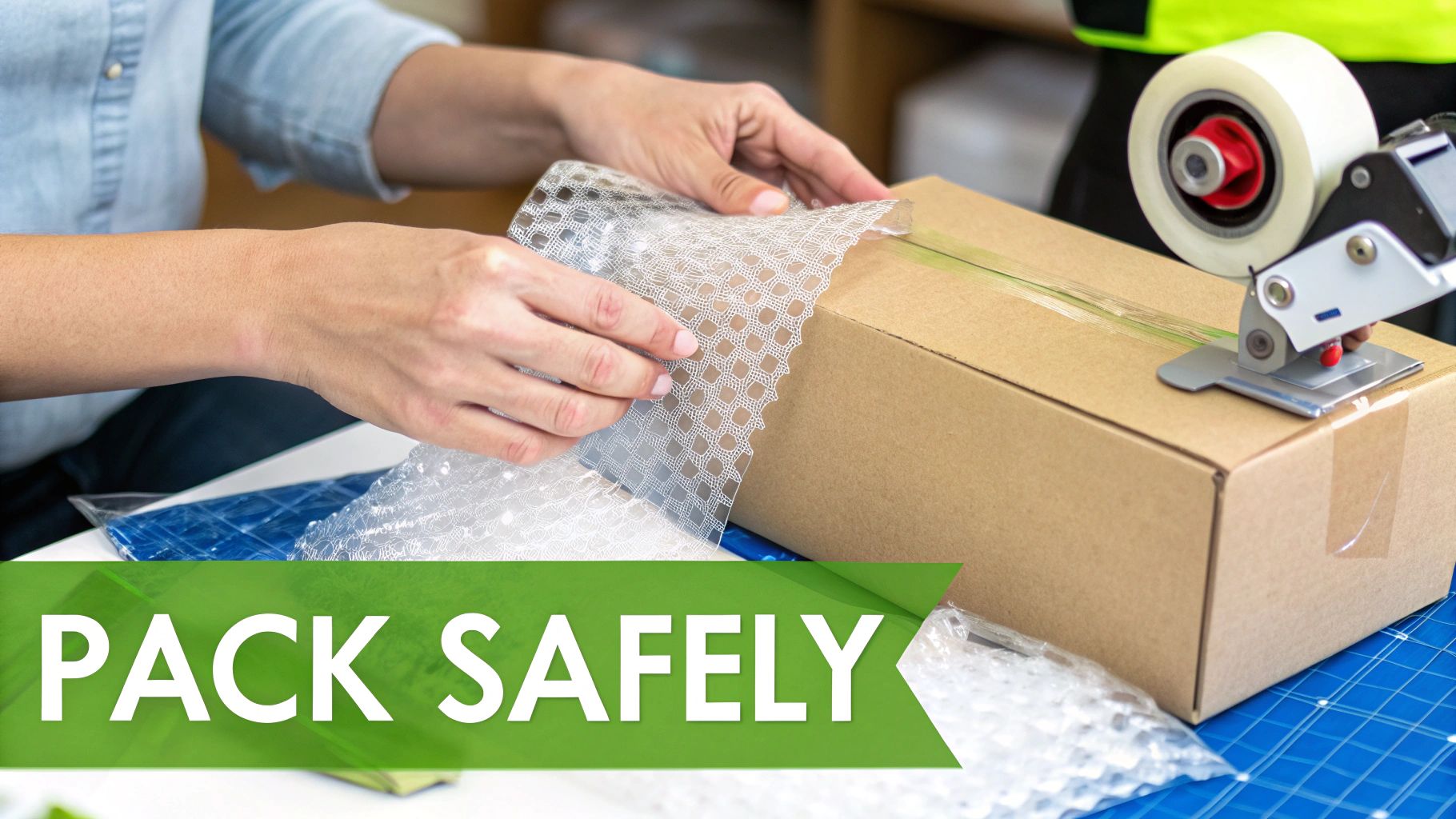
Best Practices for Parcel Packaging
Think of your parcel's packaging as its suit of armour for the trip ahead. A little extra care here goes a seriously long way in preventing headaches down the track.
For every box you send, just follow these simple but incredibly effective steps:
- Choose the Right Box: Start with a strong, high-quality cardboard box. It should be just a bit larger than your item, leaving enough room for a good layer of cushioning.
- Cushion Generously: Use bubble wrap, packing peanuts, or even scrunched-up paper to create a protective buffer of at least 5cm around your item on all sides. This is what absorbs shocks and stops things from rattling around.
- Seal It Securely: Tape is your best friend here. Grab some strong packing tape and seal the box along all seams and edges. Use the 'H' pattern on the top and bottom for maximum strength.
- Label Clearly: Your shipping label should be the only label on the box. Stick it flat on the largest surface and make sure the barcode and address are clear and easy to scan. If you're unsure, you can learn more about the best ways to place a label on a package to avoid any hold-ups.
Understanding Your Role in Shipping Safety
In Australia, the entire logistics industry operates under a principle known as the Chain of Responsibility (CoR). In simple terms, this means everyone in the supply chain—and that includes you, the business sending the goods—shares responsibility for safety.
By packing your goods securely and declaring them accurately, you are fulfilling your part of the Chain of Responsibility. This ensures your parcels don't pose a risk to transport workers, equipment, or the public, helping to keep Australia's delivery networks safe for everyone.
This shared duty is especially vital when you're sending items that could be hazardous. Getting this right isn't just a suggestion; it’s a legal requirement designed to prevent accidents before they happen.
Demystifying Dangerous Goods
The term "dangerous goods" probably brings to mind images of hazardous chemicals, but it actually covers a lot of common household and business products. These are simply items that, if not handled correctly, could pose a risk during transport.
You might be surprised by what's on the list:
- Aerosol cans (like hairspray or deodorant)
- Items containing lithium batteries (laptops, phones, power banks)
- Perfumes and aftershaves (because they're flammable)
- Many common cleaning products
It is your legal responsibility to correctly identify and declare any dangerous goods before you ship them. Trying to hide them can lead to hefty fines, damaged goods, and, most importantly, serious safety incidents. If you’re ever in doubt about an item, just ask your courier platform. Honesty and transparency are what keep the entire delivery network moving safely and efficiently.
This focus on safe shipping is more important than ever. Australia's national courier, express, and parcel market is projected to be worth a staggering AUD 33.94 billion by 2035, powered by the incredible growth of e-commerce. As millions more parcels travel across the country's 427,000 km of paved roads, every sender's commitment to safety is absolutely critical. You can discover more insights about this rapidly expanding market and what it means for your business.
A Checklist for Choosing Your Courier Partner
Choosing the right national courier isn't just a box to tick on your to-do list; it’s one of the most important strategic decisions you'll make for your business. Think about it – your courier is the final touchpoint, the handshake that completes the promise you made to your customer. Get it right, and you build loyalty. Get it wrong, and you risk your reputation.
To help you find a partner that genuinely has your back, I've put together a checklist. This isn't about marketing fluff; it's about giving you the power to see past the sales pitch and find a service that aligns with your budget, your operations, and your big-picture vision.
Comprehensive National Coverage
First things first: can they actually get your parcels where they need to go? A truly national courier needs to have Australia covered, from the heart of Sydney's CBD to the most far-flung regional town. Your growth shouldn't be capped by a courier's delivery map.
- Metro and Regional Reach: Double-check that their network is just as strong in country areas as it is in the major cities.
- Clear Transit Times: When you get a quote, they should give you a clear estimated time of arrival (ETA) for every destination. No guesswork. This is how you manage your customer's expectations and keep them happy.
Transparent Pricing and Instant Quotes
Nothing kills trust faster than hidden fees and confusing pricing. A great partner lays all the costs on the table from the very beginning, so you can budget properly and protect your profit margins.
The ability to get an instant, all-inclusive quote online—without having to sign up or log in—is a massive win. It puts you in the driver's seat, letting you compare the cheapest prices for every single shipment, right when you need to.
Once you have that quote, the booking process should be dead simple. Look for a clean, intuitive dashboard where you can lock in a job, print your labels, and manage everything without pulling your hair out. It should feel like a tool that helps, not another chore to get through.
Essential Features and Value-Adds
Okay, so they can deliver the goods at a fair price. What else have they got? The little extras are what elevate a courier from a simple service provider to a genuine partner. These are the things that give you peace of mind and can even add a little something back to your bottom line.
When you're comparing national courier services, keep an eye out for these game-changers:
- Included Freight Insurance: Does complimentary insurance come standard? This is your safety net, protecting you from the financial sting of a lost or damaged parcel. It’s absolutely crucial.
- Reliable Tracking: In this day and age, real-time tracking is non-negotiable. It gives both you and your customer total visibility, which means fewer "where's my order?" emails for you.
- Rewards Programs: Some platforms actually reward you for shipping with them. You can earn points on every dollar you spend and redeem them for things like branded merchandise—a clever way to turn a business cost into a marketing opportunity.
Finally, you need a partner who won't buckle under pressure. Peak season is the ultimate stress test. To give you an idea of the scale, during the November-December rush in 2025, the national network moved a staggering 111 million parcels – that's a 7.6% jump from the year before. You can read more about Australia Post's record 2025 peak to understand just how intense it gets. This is exactly why you need a courier partner with a resilient, scalable network that can handle the heat when it matters most.
Shipping Made Simple and Affordable
Let’s be honest, choosing the right national courier service can feel like trying to solve a puzzle with half the pieces missing. But now that we've walked through the costs, the packaging rules, and what to look for in a provider, the picture should be much clearer. You need a partner that cuts through the complexity and just gets the job done fast, so you can get back to doing what you do best—running your business.
What if you could stop wasting hours bouncing between carrier websites or getting hit with surprise fees? That's exactly what a modern shipping platform is built for. It takes the logistical nightmare of shipping and turns it into one of your biggest strengths. This isn't just about moving boxes from A to B; it's about giving your business the power to reach customers anywhere in Australia and grow.
This is where the rubber meets the road. A great platform isn't just theory; it’s a practical tool that solves every challenge we’ve talked about, offering a seamless and affordable way to manage all your parcel and box deliveries, Australia-wide.
Get Instant Quotes and the Cheapest Prices
One of the toughest challenges for a growing business is getting a fair go on shipping prices. The best platforms completely level the playing field by giving you instant quotes online, no sign-ups or commitments needed. You see the real cost right away, with total transparency.
How is this possible? Simple. These platforms combine the shipping volume of thousands of businesses just like yours, giving them serious negotiating power to secure significant wholesale rates from the big carriers. Those savings are then passed directly on to you. Suddenly, you have access to the kinds of cheap prices that were once reserved for the big corporates. Curious what you could save? You can use a simple online tool to get an instant shipping fee calculation and find out in seconds.
A Central Hub for All Your Shipping Needs
Say goodbye to juggling multiple accounts, logins, and websites. A well-designed dashboard pulls everything you need into one clean, intuitive space. Think of it as your mission control for shipping.
From this one spot, you can handle it all:
- Book and Pay in Minutes: Just pop in your parcel details, pick the service you want, and pay securely by card. No fuss.
- Print Labels Instantly: Your professional shipping labels are ready with a single click. Just print and stick.
- Track Every Shipment: Keep an eye on every single delivery from the moment it's picked up until it reaches its destination. You and your customers will always be in the loop.
Built for Australian Businesses Big and Small
A genuinely great shipping partner knows the ins and outs of getting things across Australia. That means rock-solid national coverage that connects you to customers in busy city centres just as easily as those in quiet country towns.
When you make a booking, you’ll get clear, realistic transit time estimates for any postcode, which is crucial for keeping your customers happy. On top of that, flexible pickup options mean you can have a driver collect parcels directly from your home, office, or warehouse, saving you a trip and giving you back precious time.
Choosing the right shipping platform is an investment in your own efficiency and growth. It's a partner that works behind the scenes to ensure every delivery reflects the quality and reliability of your brand, helping you build trust one parcel at a time.
As a final touch, some platforms even have rewards programs that turn a necessary expense into a real bonus. By earning points on every delivery, you can redeem them for branded merchandise, helping to offset your costs and give your marketing a little boost. It’s a smart way to transform shipping from a cost centre into a rewarding part of your business strategy.
Got Questions About National Courier Services? We've Got Answers.
Diving into the world of national courier services can feel a bit overwhelming, especially when your main focus is on running and growing your business. Let's clear up some of the most common questions so you can ship your parcels across Australia with total confidence.
How Can My Small Business Get the Cheapest Prices for Shipping?
The secret isn't about shipping more; it's about shipping smarter. Your best bet is to team up with a platform that bundles the shipping volume from thousands of small businesses just like yours. This gives them the power to negotiate incredible wholesale rates with major national couriers—the kind of discounts that are usually out of reach for a single business.
Beyond that, it really comes down to two simple habits:
- Measure Everything: Always get the precise actual weight and the dimensions (length, width, height) of your packed parcels. Couriers use volumetric weight to calculate costs, so keeping your packaging as snug and compact as possible is a massive money-saver.
- Pick the Right Speed: If your delivery isn't urgent, an economy or standard road service will always be your most cost-effective choice over a fast express option.
The real key to affordable shipping is having options. When you can see instant quotes from multiple carriers on one screen, you can compare every single time you ship. It guarantees you'll always find that perfect sweet spot between price and delivery speed, without ever overpaying.
What Is the Difference Between Metro and Regional Delivery Times?
It all boils down to distance and the complexity of the delivery network. Metro deliveries, which are those within a major capital city and its suburbs, are typically very quick—often landing in just 1-2 business days. The infrastructure is dense, with plenty of drivers and well-trodden routes.
Regional deliveries, on the other hand, cover everywhere else. These journeys are longer and often involve your parcel moving through several depots before it reaches its final destination. Naturally, this extends the transit time. Any good courier platform will give you a clear estimated time of arrival (ETA) for both metro and regional postcodes right when you book, so there are no surprises.
Do I Need an Account to Book a Courier Service?
The old-school answer was yes, but thankfully, things have changed for the better. In the past, you'd have to jump through hoops—setting up a business account, going through credit checks, and committing to a minimum number of shipments.
Today’s platforms have completely torn down those barriers.
You can now get an instant quote, book a delivery, pay securely by card, and have your shipping label ready to print in a matter of minutes. There are no applications, no lock-in contracts, and no ongoing fees. It's a simple, pay-as-you-go system that gives small businesses the freedom they need. To get a better handle on the paperwork, you can learn what a consignment note is and see how it streamlines the whole process.
Ready to stop guessing and start shipping with confidence? With Aeros Couriers, you get instant quotes, unlock cheap wholesale rates, and can have your next parcel on its way in minutes. Ship smarter and save more with Aeros Couriers today!
Courier quotes, tracking and support
Ready to send a parcel? Compare the available services for your postcodes, parcel dimensions and weight. For an existing delivery, use your consignment number to check tracking or ask our team for help.