
Ever wondered how much it costs to send a package across Australia without spending ages on the phone or jumping between different courier websites? That's where a shipping rate calculator comes in. It’s a simple online tool that gives you an instant price estimate for your shipment.
You just pop in the key details—your parcel's dimensions, weight, and where it's headed—and the calculator crunches the numbers. In seconds, it pulls up real-time quotes from multiple courier services, letting you see the most budget-friendly option straight away.
What Is a Shipping Rate Calculator and Why Use One?
The easiest way to think of a shipping rate calculator is like a flight comparison site, but for parcels. Instead of manually checking prices with every single courier, this one tool does all the heavy lifting for you. It pulls all the information you need into one convenient dashboard, acting as your personal logistics command centre.
For any Australian business that ships products—whether you're a small online store running out of a garage in Perth or a large company with warehouses in Sydney—it's an absolute game-changer for daily operations.
This tool cuts through the complexity of domestic shipping. With just a few clicks, you get a clear, side-by-side comparison of different courier services. And it's not just about the final price. You can also see estimated delivery times and compare service levels (like standard vs. express), helping you figure out which carrier gives you the best bang for your buck on that particular shipment.
The Power of Instant Comparison
The biggest win here is getting immediate access to competitive pricing. The Australian courier market is packed with options, and prices can swing wildly from one provider to the next, even for the exact same route.
For instance, sending a standard 1 kg parcel from Sydney to Melbourne could set you back anywhere from $7.46 to $10.85, all depending on the courier and how fast you need it there. A good shipping rate calculator pulls this live data to give you accurate, up-to-the-minute quotes, saving you the headache of trying to figure out each carrier's complicated pricing tables.
At its core, a shipping rate calculator removes the guesswork from logistics. It transforms an unpredictable expense into a manageable, transparent cost, empowering you to protect your profit margins on every single order you send.
Ultimately, using a tool like this puts you back in control. It helps you:
- Find the Best Value: Instantly spot the most affordable courier that still meets your delivery deadline.
- Save Time: Ditch the tedious admin work of hunting down rates from multiple carriers one by one.
- Improve Customer Experience: Give your customers accurate, real-time shipping quotes at checkout, which helps build trust.
By using a tool like the Aeros Couriers shipping cost calculator, you're not just getting a price—you're building a smarter, more efficient shipping strategy from the ground up.
Understanding the Key Factors in Your Shipping Quote
Ever plugged your parcel details into a shipping rate calculator and wondered why the price can swing so dramatically? The final quote you see isn't just a number plucked from thin air; it’s the result of several key factors all working together. Getting a handle on these variables is the first step to truly controlling your shipping expenses.
At its core, a shipping calculator is solving a complex puzzle with five main pieces. Each one—from the size of your box to how fast it needs to get there—plays a critical part in shaping the final cost for your Australian shipment.
This simple flowchart breaks down how a calculator takes your parcel's details and turns them into an instant quote.
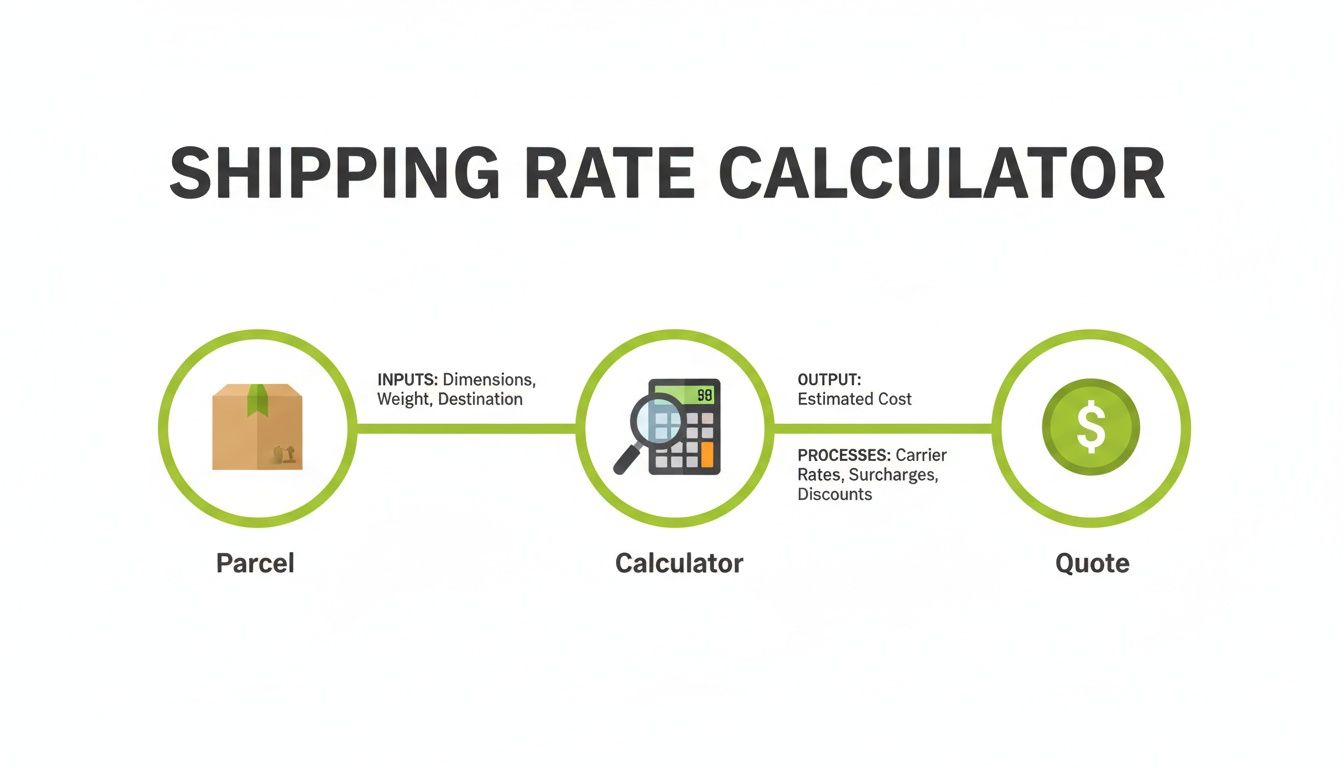
As you can see, the process flows logically from what you enter to the final price, which really underscores why accurate information is so important from the get-go.
The Two-Sided Coin: Weight and Dimensions
The most obvious factor is your parcel’s size and weight, but it's not as simple as just popping it on a scale. Australian couriers use a concept called volumetric weight (or cubic weight), and it's a game-changer.
Think of it this way: what’s harder to fit in a packed delivery van, a 10kg box of bricks or a 10kg box of pillows?
The pillows take up way more room, and that space is precious. Because of this, carriers will charge you based on whichever is greater: the actual weight (what the scales say) or the volumetric weight (the space it occupies). This is exactly why a large but light item, like a lampshade or a big teddy bear, can sometimes cost more to send than a small, heavy one.
Volumetric weight ensures the shipping cost reflects how much space a parcel actually takes up on a truck or plane, not just how heavy it is. It's standard practice right across the Australian courier industry for this very reason.
To learn more about getting this right, check out our simple guide on how to calculate cubic weight.
Destination and Service Speed
Where your parcel is headed is just as crucial as its size. Couriers slice Australia up into shipping zones, and the more zones your package has to cross, the higher the cost. It makes sense, right? A delivery from Melbourne to a regional town in Western Australia is a much bigger logistical undertaking than a quick hop over to a Sydney suburb.
On top of distance, a few other variables will influence your final quote:
- Service Level: Do you need it there tomorrow? Express or overnight services will always carry a premium compared to standard road freight, which might take a few extra days.
- Surcharges: These are the extra fees tacked on for specific situations. Common surcharges in Australia include fees for delivering to a remote area, needing a tailgate lift for a heavy pallet, or having to attempt redelivery because no one was home to sign for it.
For really specialised shipments, like sending a pet, the details matter immensely. Knowing things like airline approved pet carrier dimensions and limits is essential, and it’s a great parallel for how even small details in your parcel’s specifics can affect the cost.
To show you how this all comes together, have a look at the table below. It demonstrates how just one or two changes can really impact the price.
How Shipping Variables Impact Your Final Quote
| Shipping Factor | Example Scenario | Impact on Cost |
|---|---|---|
| Volumetric Weight | A 2kg designer lamp in a large, protective box. | The box's large dimensions result in a 12kg volumetric weight, and the shipping cost is based on this higher figure. |
| Destination Zone | Shipping that same lamp from Sydney to Perth vs. Sydney to Newcastle. | The Perth shipment crosses multiple zones, making it significantly more expensive than the shorter, regional trip to Newcastle. |
| Service Level | Choosing "Express Next Day" vs. "Standard Road" for the Perth delivery. | The express option could easily double the cost to guarantee faster delivery across the country. |
| Surcharges | The Perth address is in a remote area outside the main metro zone. | A remote area surcharge of $25+ is added on top of the base shipping rate to cover the "last mile" delivery costs. |
As you can see, the final price is a blend of all these factors. By mastering these five core elements, you can use any shipping rate calculator with confidence, knowing exactly what’s driving the price you see on the screen.
How to Get an Accurate Quote Every Time
Getting a reliable shipping quote shouldn’t feel like a guessing game. By following a few straightforward steps, you can make sure the price you see on the screen is the price you actually pay. Think of it like giving a builder a detailed blueprint for a house—the more precise the information, the more accurate the final cost will be.
It all starts with feeding the shipping rate calculator the right details from the very beginning. In my experience, inaccurate data is the number one culprit behind surprise price adjustments down the line.

Step 1: Measure and Weigh Your Packed Parcel
Before you even think about opening a calculator, your parcel needs to be completely packed, sealed, and ready for its journey. Measuring an empty box or estimating the final weight is a recipe for an incorrect quote.
Measure Dimensions Accurately: Grab a tape measure and get the exact length, width, and height of your fully packed box. Pro Tip: I always round measurements up to the nearest whole centimetre. This small buffer helps avoid under-declaring and getting hit with correction fees from the courier.
Weigh It Properly: Pop your sealed parcel on a set of postal or digital scales to find its precise weight in kilograms. If you don't have scales on hand, your local post office can usually weigh it for you.
Step 2: Enter the Correct Postcodes
The next crucial pieces of the puzzle are the origin and destination addresses. A shipping calculator relies on postcodes to map out the exact shipping zones your parcel will cross within Australia.
Entering the correct pickup and delivery postcodes is non-negotiable. A simple typo—swapping one digit that changes a Sydney suburb to a regional NSW town—can dramatically change the final cost.
Step 3: Compare and Interpret the Results
Once you've entered all your details, the calculator will spit out a list of courier options. This is your chance to make a smart decision based not just on price, but also on overall value.
Take a moment to look at the different services side-by-side. You'll want to pay close attention to:
- Carrier Name: Compare services from well-known national couriers.
- Estimated Transit Time: Check the delivery window. Does standard road service work, or do you need an express option to meet a deadline?
- Total Cost: This is the final price, which should include GST and any fuel levies.
By providing precise data, you give the calculator everything it needs to generate a quote you can trust. You can try it for yourself with the Aeros Couriers shipping quote calculator to see how different carriers and service levels compare for your next shipment.
Practical Ways to Lower Your Shipping Bill
Using a shipping rate calculator is a great first step, but finding the rock-bottom price for one-off shipments isn't the whole story. Real, sustainable savings come from taking a smarter look at your entire shipping process.
It’s about building good habits, not just grabbing the cheapest quote that pops up. By putting a few simple strategies into practice, you can transform shipping from a painful cost into a real advantage for your business.
It All Starts With the Right Box
Honestly, one of the biggest money-savers is hiding in plain sight: your packaging. We've talked about how couriers charge based on either the actual weight or the volumetric weight—whichever is greater. This is where so many businesses get stung. A big, half-empty box with a light item inside can cost a small fortune to ship.
The fix is simple: use the smallest box you can that will still keep your item safe and sound.
- Kill the Empty Space: Fillers like bubble wrap are great for protection, but make sure you're not just shipping air. Pick a box that’s a snug fit.
- Stock Up on Sizes: It's tempting to buy one or two standard box sizes, but having a variety on hand is a game-changer. It stops you from reaching for a huge box for a tiny product, which is an easy but expensive mistake.
- Think About Satchels: For things that aren't fragile, like clothing or documents, courier satchels are almost always a cheaper and lighter option than a box.
A simple switch from a standard box to a right-sized one can reduce your volumetric weight by 30-50%. That's a massive, instant saving on every single parcel you send out the door. It's probably the easiest win you'll find in logistics.
Consolidate Your Shipments and Plan Ahead
Another powerful move is to bundle your orders together. Got a few packages going to the same suburb? Or one customer who placed multiple orders? Combining them into a single, larger shipment is often way more cost-effective than sending them out one by one. Carriers usually give better rates for heavier consignments.
Planning is also your best friend. Not every customer needs their order tomorrow. While express shipping is a great option to have, many people are perfectly happy to wait a few days if it saves them some money.
By offering different delivery speeds at checkout—like a Standard (3-5 days) and an Express (1-2 days) option—you let your customers decide. You’d be surprised how many will choose the slower, cheaper service. That saves them money and, more importantly, it saves you on freight costs. You can learn more about finding the cheapest courier service by playing around with different speeds and carriers.
Many of these cost-saving ideas apply across all types of transport. For example, there are surprisingly similar lessons in a guide to pet transportation costs and safe, affordable travel that can be applied to general package shipping. By mastering your packaging, consolidating orders, and offering flexible delivery speeds, you put yourself back in control of your shipping spend.
For any Australian online store, the checkout page is make-or-break. It’s the final hurdle, and getting it wrong means losing sales. One of the most effective ways to smooth out this crucial step is to plug a shipping rate calculator directly into your e-commerce platform.
This turns what could be a point of friction into a seamless part of the buying experience. Instead of forcing customers to guess, or offering a flat rate that either overcharges them or eats into your own margins, your store can display accurate, real-time prices from different couriers based on what’s in their cart and where they live.
Why Automation Is a Game Changer
An integrated calculator does so much more than just show a price; it completely overhauls your fulfilment process. Once a customer hits "buy," the system can automatically take care of all the tedious admin work that follows.
This means far less manual data entry and a dramatic reduction in errors. The benefits stack up quickly:
- Automatic Label Generation: Shipping labels are created on the spot with the right service and address details, ready for you to just print and stick.
- Streamlined Fulfilment: With all the order and shipping information in one place, your pick-and-pack process becomes a well-oiled machine.
- Reduced Cart Abandonment: We’ve all done it—gotten to the checkout only to be shocked by the shipping cost. Live rates give customers transparency upfront, which builds trust and keeps them on the page.
Integration isn't just a nice-to-have; it's a strategic decision to win back your time. By automating the most repetitive shipping tasks, you free up hours you can pour back into marketing, product development, or customer service.
Connecting Your Store with an API
So, how does this all work? The magic behind this connection is a Shipment Application Programming Interface (API).
Think of an API as a secure messenger that lets your e-commerce platform—whether it's Shopify, WooCommerce, or Magento—talk directly to your courier’s system. It’s the bridge that allows information to flow back and forth seamlessly.
This connection is what fetches real-time quotes for the cart, and it’s also what pushes tracking updates back to your store to notify the customer. For any business serious about scaling, a powerful shipment API is non-negotiable. It’s the engine that drives an efficient, automated, and customer-friendly shipping operation.
Common Shipping Questions from Australian Businesses
Jumping into the world of couriers and shipping calculators can definitely spark a few questions. Let's tackle some of the most common queries we hear from businesses across Australia, with clear, no-nonsense answers.
Why Is My Lightweight but Large Item So Expensive to Ship?
This is a classic shipping puzzle, and the answer almost always comes down to something called volumetric weight. Think of it this way: couriers in Australia aren't just charging for how heavy your parcel is, but for the precious space it takes up in their truck or plane.
If you're sending something bulky but light—like a big bag of chips, a decorator cushion, or a boxed-up lamp shade—its volumetric weight will be calculated based on its dimensions. The courier will then look at both the actual weight and the volumetric weight and charge you for whichever is higher. It’s their way of making sure a truck full of feathers pays its way just like a truck full of bricks. The best fix? Use the smallest, snuggest packaging you can find that still keeps your item safe.
How Accurate Are Online Shipping Rate Calculators?
The calculators on reputable platforms are incredibly accurate because they tap directly into the courier networks for live pricing. If the price you get at pickup differs from your quote, 99% of the time it's because the details entered were slightly off.
The golden rule for getting a locked-in price is to measure and weigh your parcel after it’s fully packed, taped up, and ready to go. Even a centimetre or a few hundred grams can bump your shipment into a new price bracket.
Can I Use a Shipping Calculator for Sending Pallets?
Absolutely. Modern shipping platforms are designed for much more than just standard boxes and satchels. You can get instant quotes for palletised freight simply by entering the pallet's total dimensions (length, width, and height) and its all-up weight.
Just remember that shipping pallets in Australia comes with its own set of rules. You'll need to follow the proper wrapping and labelling guidelines to stay compliant with our Chain of Responsibility laws, which are all about keeping the freight stable and safe for everyone on the road.
Ready to take the guesswork out of your shipping? The Aeros Couriers platform gives you instant quotes, access to wholesale rates, and a dead-simple booking process. Get a free, no-obligation quote online and see how much you could save on your next Australian delivery.
Courier quotes, tracking and support
Ready to send a parcel? Compare the available services for your postcodes, parcel dimensions and weight. For an existing delivery, use your consignment number to check tracking or ask our team for help.