Figuring out the cost to send a parcel in Australia can feel a bit like a guessing game. The price tag seems to shift depending on what you're sending and where it's headed. But it's not random—it all comes down to a few key factors: your parcel's weight and size, how far it has to travel, and how fast you want it there. Getting a handle on these is the first step to taming your shipping budget.
Demystifying Australian Parcel Prices
Sending a package shouldn't be a mystery. While the final price can vary, it's always calculated using a logical set of rules. Think of it like ordering a pizza: the base price changes if you get a large instead of a small, add extra toppings, or choose delivery over pickup. Shipping works pretty much the same way.
The price isn't based on just one thing, but a combination of metrics that carriers use to figure out their own costs. Understanding these is essential for anyone—from individuals sending a one-off gift to small businesses shipping products every day—who wants to keep their expenses in check.
The Building Blocks of Shipping Costs
At its heart, every shipping quote is built on the answers to a few basic questions:
- How heavy is it? This is the straightforward weight of your package in kilograms.
- How big is it? This looks at the parcel's physical dimensions—its length, width, and height.
- How far is it going? The distance between the sender's and receiver's postcodes is a major factor.
- How fast does it need to get there? An express service will always cost more than a standard one.
Actual Weight vs Cubic Weight
Here’s where things get a little trickier, and it’s one of the most important concepts to grasp: the difference between actual weight and cubic weight.
Actual weight is simple—it’s what you see when you pop the parcel on a scale. Cubic weight (sometimes called volumetric weight) is a calculation that measures how much space your parcel takes up in a truck or plane.
A carrier will always charge you based on whichever is greater: the actual weight or the cubic weight. This is why a big, light box of foam balls can cost more to ship than a small, heavy box of bolts—the foam takes up much more valuable space.
This rule ensures carriers are paid fairly for the room a package occupies, not just how heavy it is.
By learning the fundamentals of Australian parcel delivery, you can start making smarter packaging choices that cut your costs. This guide will walk you through each of these factors, giving you the know-how to ship more efficiently and affordably.
The Core Factors That Determine Your Shipping Bill
Ever wondered what goes into the price of sending a parcel? It’s not just a random number. The final cost you see is a careful blend of a few key ingredients, and getting your head around them is the first step to making sure you're not paying a dollar more than you need to.
Think of it like a taxi fare. The meter doesn't just clock the distance; it also considers the time. Parcel pricing works in a similar way, taking into account the parcel's physical stats, the journey it's about to take, and just how quickly you need it to get there.
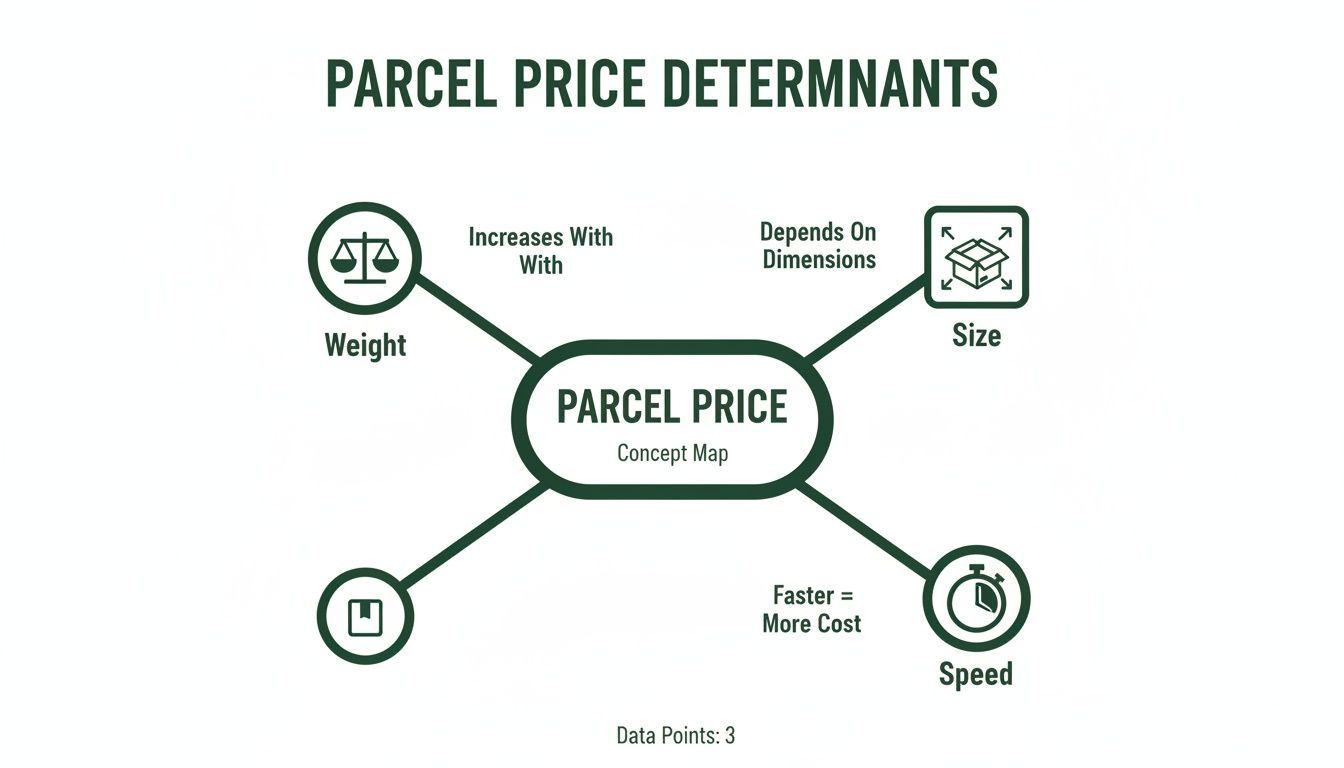
As you can see, it really boils down to how heavy your item is, how much space it takes up, and how fast it needs to travel. Let’s unpack these one by one.
Actual Weight: The First Pricing Checkpoint
The most straightforward factor is actual weight. It’s simply how much your parcel weighs on the scales. Carriers like Australia Post use a tiered system, grouping weights into brackets. A parcel that weighs 490 grams sits in a cheaper tier than one at 510 grams, even though there’s barely any difference.
For example, a small box of books weighing 1.9 kg will slot neatly into the "up to 2 kg" bracket. But if you toss in one more paperback and the scales tip to 2.1 kg, you’ve just bumped yourself into the next, more expensive tier. This is precisely why having an accurate set of scales is non-negotiable for anyone shipping regularly.
Volumetric Weight: When Size Matters More
This is the one that trips a lot of people up. It's called volumetric weight (or cubic weight), and it’s all about the space your parcel occupies. Couriers need to charge for the room a package takes up in their van or plane, not just its physical heft. This metric calculates a "weight" based on the parcel's dimensions: length x width x height.
A carrier will always charge for whichever is greater: the actual weight or the volumetric weight. It’s their way of making sure they get compensated for big, bulky items that are light as a feather but hog a lot of precious cargo space.
Imagine you're sending a large, fluffy cushion. It might only weigh 1 kg, but its size could give it a volumetric weight of 5 kg. In that case, you'll be charged at the 5 kg rate. Learning to calculate your shipping costs accurately, factoring in both weight types, is a game-changer for avoiding nasty surprises on your invoice.
Shipping Zones And The Impact Of Distance
Naturally, how far your parcel has to travel plays a huge role in the final price. In Australia, this is all managed through shipping zones. The country is carved up into different zones based on postcodes, and the more zones your parcel has to cross to get to its destination, the more you'll pay.
Sending a package from one Melbourne suburb to another is cheap because it stays within the same zone. But sending that same package from Melbourne to a small town in regional WA means crossing multiple zones, which pushes the price up to cover the extra fuel, time, and handling involved.
Delivery Speed: How Urgency Affects The Price
Finally, how fast do you need it there? You’ll always pay a premium for speed. It’s the difference between a leisurely road trip and a direct flight.
- Standard Services (e.g., Parcel Post): This is your budget-friendly option. It’s reliable and gets the job done in a few business days without breaking the bank.
- Express Services (e.g., Express Post): Need it there tomorrow? This is the service for you. It comes with a higher price tag because you’re paying for priority handling, air transport, and a much tighter delivery window.
Carriers are always tweaking their rates to keep up with their own costs. For example, Australia Post's domestic flat-rate Parcel Post prices saw a jump in mid-2024, pushing the cost for an extra-large parcel to $23.30 even before you buy the box. It’s a constant reminder of how operational costs directly impact the price you pay.
Once you understand how weight, size, distance, and speed all work together, you're in a much better position to make smarter shipping choices and keep your costs down.
Comparing Australia Post with Private Couriers
Trying to decide between Australia Post and a private courier? It’s not just about picking a name; it’s a decision that hits your wallet and your delivery schedule. The right choice really comes down to what you're sending, where it's headed, and how fast you need it to get there. There's no single "best" option—each has its own turf where it shines.
This decision is more important than ever. The Australian postal services industry is a big business, with revenues expected to hit around $11.2 billion in 2024. This growth isn't from letters, but from the explosion in parcel deliveries. Understanding this market helps you see why comparing carriers is a must for keeping your shipping costs in check.

Getting to know the real differences in what they offer and how they charge is the first step to saving money and making sure your packages arrive when they're supposed to.
When Australia Post Is the Right Choice
Australia Post’s biggest strength is its incredible reach. They're mandated to deliver to every nook and cranny of the country, which often makes them the most dependable—and sometimes only—choice for remote and regional addresses. Private couriers often tack on hefty surcharges for these out-of-the-way spots, making AusPost the clear winner on price.
For small, non-urgent packages, especially if they fit into one of the standard flat-rate satchels or boxes, Australia Post is also very hard to beat. Plus, you can’t argue with the convenience of their massive network of post offices and red street-side post boxes for easy drop-offs.
You should probably stick with Australia Post if:
- You’re sending something to a regional or remote postcode.
- Your parcel is small, light, and doesn’t need to be there tomorrow.
- You like the ease of dropping packages off at your local post office.
When Private Couriers Have the Edge
Private couriers really come into their own where Australia Post’s one-size-fits-all model falls short. They are absolute powerhouses in the business-to-business (B2B) and e-commerce spaces, offering specialised services built for high volumes and tight deadlines.
Need something delivered same-day or next-day within a major city? A private courier will almost always be faster and more affordable. They are also the go-to for bulky, heavy, or awkwardly shaped items that just won’t fit into standard packaging. On top of that, their advanced tracking systems and scheduled pickup options provide a level of service that many businesses can't do without.
For businesses shipping in bulk, private couriers often provide discounted rates and streamlined booking systems that can lead to substantial long-term savings and operational efficiency.
If you're looking to weigh up your options, it's worth checking out our guide on finding the cheapest courier service in Australia, which dives deeper into these comparisons.
Price and Service Comparison at a Glance
To make the difference in postal parcel prices a bit more concrete, let's look at a real-world example. The table below shows some indicative costs for shipping a 5kg parcel (measuring 30x30x30cm) across a few popular domestic routes. Keep in mind, these are just estimates—actual prices will vary depending on the specific carrier and service you choose.
Indicative Parcel Shipping Costs Australia Post vs Private Couriers
| Route | Australia Post (Parcel Post) | Private Courier (Standard Service) | Key Considerations |
|---|---|---|---|
| Sydney to Melbourne | ~$19.50 | ~$15.00 – $22.00 | Private couriers are highly competitive on this high-volume metro-to-metro route. |
| Brisbane to Perth | ~$28.00 | ~$25.00 – $35.00 | Prices are closer, but couriers may offer faster standard delivery times. |
| Melbourne to Dubbo | ~$22.00 | ~$28.00 – $40.00+ | Australia Post's regional network often provides a clear cost advantage here. |
| Adelaide to Darwin | ~$35.00 | ~$40.00 – $60.00+ | The long distance and lower volume make Australia Post the more economical choice. |
At the end of the day, the smartest shipping strategy is a flexible one. Instead of being loyal to a single provider, it pays to assess the needs of each shipment individually. By comparing Australia Post with private couriers on a case-by-case basis, you can make sure you’re always getting the best possible mix of price, speed, and service for every parcel you send.
Actionable Strategies to Reduce Your Parcel Costs
Knowing how parcel prices are calculated is one thing, but actually putting that knowledge to work is where you’ll see the savings pile up. It’s time to get practical. The good news is that you don't need a massive overhaul of your shipping process—just a few smart, simple adjustments can make a huge difference to your bottom line.
Think of it this way: small, consistent tweaks in how you pack and send your items will lead to significant cost reductions over time. By being more strategic, you can stop overpaying and make sure your money is well spent. The key is to look critically at each step.

Let's walk through a checklist of proven tactics that will help you slash that shipping bill.
Optimise Your Packaging
The most common—and costly—mistake we see is using a box that’s far too big for the item inside. When you do this, you're not just paying to ship your product; you're paying to ship empty air. That excess space is a direct hit to your wallet, thanks to volumetric weight calculations.
Carriers charge for the space a parcel takes up on their truck or plane, so a bigger box nearly always means a bigger price tag. The fix is simple: match your box to your product. Don't send a small book in a box big enough for a toaster.
Why It Works: By keeping your parcel's dimensions as small as possible, you lower its volumetric weight. This makes it more likely you'll be charged based on the item's actual weight, which is almost always cheaper for small, dense products.
Keep a handful of different box sizes on hand. That way, you can always grab the most compact and suitable option. This single habit is one of the most powerful ways to keep your postal parcel prices in check.
Consolidate Multiple Shipments
Are you sending a few different items to the same address? It’s nearly always cheaper to bundle them into one larger box rather than shipping them in several small ones. Every individual parcel gets hit with its own base charge and handling fees, and those costs add up fast.
Think about it: sending three separate 1kg packages means you're paying three separate shipping fees. Combine them into a single 3kg parcel, and you only pay that base fee once. It’s a no-brainer, especially for e-commerce businesses fulfilling orders with multiple items.
- What to do: When a customer buys several products, pop them all into one shipment.
- Why it works: You completely avoid paying multiple base fees and handling charges, which directly lowers your total shipping cost.
This straightforward step not only streamlines your packing process but delivers instant savings on every single consolidated order.
Choose the Right Shipping Service
In the world of shipping, speed costs money. While it’s easy to default to the fastest delivery option, it's rarely necessary. Before you click "Express," ask yourself: does this parcel really need to get there tomorrow? Most of the time, a standard or economy service will do the job just fine.
Carriers tier their services, and those express options always come with a hefty premium. You can slash your costs by simply making a standard service your default, unless a customer specifically requests—and pays for—expedited shipping. For anyone serious about cutting costs, exploring these expert strategies to reduce shipping costs can uncover even more ways to save.
This isn't about sacrificing quality. Standard services from all the major carriers are incredibly reliable; they just take an extra day or two. As long as you manage customer expectations by clearly stating delivery timeframes, this strategy is a clear win.
Use a Shipping Comparison Platform
Why would you settle for a single quote when you could get half a dozen in a few seconds? Manually checking prices on different carrier websites is a tedious waste of your time. This is where a shipping comparison platform like Aeros Couriers comes in—it does all the legwork for you.
These tools are brilliant. You enter your parcel’s details once and instantly see live rates from multiple carriers, from Australia Post to a range of private couriers. You can compare prices, delivery speeds, and features side-by-side, guaranteeing you find the absolute best deal for that specific shipment. For a deeper dive, check out our guide on the cheapest way to send a parcel in Australia.
The real power of these platforms is that they pass their bulk-shipping discounts on to you. This gives you access to cheaper rates than you could ever get by going directly to the carrier. By making these four strategies part of your routine, you can consistently chip away at your expenses and boost your bottom line.
Navigating Surcharges and Hidden Shipping Fees
The first quote you get for a parcel delivery? Think of it as the starting line, not the finish. Lurking just beneath that initial number is a whole world of potential surcharges and extra fees that can catch you by surprise and blow out your shipping budget. Getting your head around these common charges is the only way to forecast your costs accurately.
These extra costs aren't just plucked out of thin air. They’re how carriers cover the expense of doing something that falls outside a simple, A-to-B delivery. It’s a bit like booking a flight—the base fare gets you a seat, but you'll pay more for checked baggage, extra legroom, or a meal. Shipping works the same way, with fees tacked on for anything that needs a bit of extra effort.
Why Regional and Remote Deliveries Cost More
One of the most frequent surcharges you'll encounter is for deliveries to regional and remote areas. Sending a package from Sydney to a Melbourne suburb is a well-worn, efficient path. But getting that same parcel to a small town in outback Queensland? That's a completely different ball game.
Carriers add these surcharges because it genuinely costs them more to get there. A driver might have to travel huge distances between drops, burning more fuel and time for just a handful of parcels. This low "delivery density" makes each delivery far more expensive, and that cost is passed on as a surcharge.
A remote delivery surcharge is a direct reflection of the higher operational cost of reaching less populated areas. It’s what allows carriers to sustainably service all of Australia, not just the easy-to-reach major cities.
Unpacking Common Surcharges and Fees
Beyond where your parcel is going, a few other things can trigger extra charges on your invoice. If you know what they are, you can either plan ahead to avoid them or at least factor them into your budget.
Oversized or Heavy Items: If a parcel is too big or heavy for a carrier's standard limits, it needs special handling. It might not fit on the automated conveyor belts and often needs two people to lift it, adding labour costs and slowing things down.
Residential Delivery: Some couriers, especially those geared towards business-to-business freight, will add a small fee for delivering to a home. That's because residential drops are often less efficient—there's a higher chance no one will be home to sign for the package.
Futile Delivery Attempts: If a driver shows up but can't complete the delivery (maybe no one's home and there's no safe place to leave the item), you can be charged a fee for the wasted trip and any follow-up attempts.
Manual Handling Fee: This one catches a lot of people out. Awkwardly shaped items, like posters in a tube or anything not in a standard cardboard box, can't go through the sorting machines. A manual handling fee covers the cost of a person having to physically sort and move it through the depot.
To get the full picture of Australian courier costs, you have to look beyond the base rate and see these potential extras for what they are: part of the total price.
Satchels vs Boxes Specialized Pricing
The packaging you pick makes a real difference to the final price, especially when you weigh up prepaid satchels against using your own boxes.
Prepaid satchels give you a simple flat rate for anything up to a set weight (like 5kg), no matter where it's going in Australia. For predictability, you can't beat them.
On the other hand, using your own box means the cost is calculated on its exact weight, dimensions, and destination. For a small, heavy item going just across town, your own box will likely be cheaper. But for something light but bulky heading across the country, a flat-rate satchel could save you a small fortune. You really have to compare the options for each specific shipment.
It’s worth noting that all these costs are on the rise. E-commerce is booming, and operational pressures are mounting, pushing postal and courier prices up sharply. The Australian Bureau of Statistics clocked a 5.9% quarterly rise in these services, which contributed to a 3.5% increase over the year. This jump is being driven by things like higher fuel and labour costs, which makes it more important than ever to manage every dollar of your shipping spend. You can read more on the ABS website. By getting a handle on these surcharges, you can shield your budget from these industry-wide pressures.
Common Questions About Postal Parcel Prices
Even when you've got a handle on the basics of shipping, a few tricky questions always seem to pop up. Let's tackle some of the most common ones I hear, so you can solve those specific shipping puzzles and make better decisions.
Think of this as your go-to cheat sheet for shipping smarter.
What Is Cubic Weight and Why Does It Matter for My Parcel Price?
Ever been shocked by a shipping quote for something big but surprisingly light? You've just met cubic weight.
Carriers use cubic weight to charge you for the space your parcel takes up in their van or plane, not just what it weighs on the scales. The calculation is simple: length x width x height, multiplied by a conversion factor (usually 250 in Australia). The carrier then looks at the actual weight and the cubic weight and charges you for whichever is higher.
This is a huge deal for anyone shipping bulky but lightweight items—think pillows, a doona, or even a box of empty plastic containers. You're paying for the room it occupies, which can be far more than its physical weight suggests.
The golden rule to remember is that space equals money. Always use the smallest box possible to keep your cubic weight—and your postal parcel prices—as low as possible.
How Can I Find the Cheapest Way to Send a Parcel in Australia?
Hunting down the cheapest shipping rate doesn't have to be a chore. It really boils down to a simple, three-step process.
First, package your item as tightly as possible. Minimising the size and weight is the single biggest thing you can do to lower the cost.
Second, unless your customer is paying for speed, stick with standard or economy shipping. Express services are great when you need them, but they come with a hefty premium that's often unnecessary.
Finally, the quickest way to find the best deal is to use an online shipping comparison website. These platforms pull real-time rates from multiple carriers, including Australia Post, into one simple search. You can instantly see the most affordable option without wasting time checking every carrier's site one by one.
Are Deliveries to Regional Areas Always More Expensive?
In short, yes. Sending a parcel to a regional or remote postcode will almost always cost more than shipping between major cities like Sydney and Melbourne. Carriers apply surcharges to these deliveries because they're simply more expensive and time-consuming to service.
It all comes down to delivery density. In a busy city suburb, a driver can drop off dozens of parcels on a single street. In a regional area, that same driver might have to travel several kilometres between each stop, burning more fuel and time for just a handful of deliveries.
Even though Australia Post has a fantastic national network that often gives them an edge, you should always budget for a higher cost when shipping outside of the major metro zones.
Does Adding Insurance Significantly Increase the Price?
It definitely adds to the cost, but it's a small price to pay for peace of mind when sending something valuable. Most carriers include a very basic level of liability, often capped at just $100, which is rarely enough to cover the true cost of your goods if they get lost or damaged.
If your item is worth more than that, paying a little extra for proper insurance is a no-brainer. The cost is based on the declared value of your goods—so, insuring an item for $800 will naturally cost more than insuring it for $200. It's also vital to get the details right; using durable and clearly printed shipping and mailing labels helps ensure everything goes smoothly and you avoid any hassles.
While insurance bumps up the initial price, it saves you from a potentially big financial hit down the track.
Ready to stop guessing and start saving on every parcel you send? Aeros Couriers gives you instant access to competitive quotes from a network of trusted carriers. Our platform makes it simple to compare prices, book shipments, and track your deliveries, all while earning valuable rewards. Get an instant quote today and see how much you can save!
Courier quotes, tracking and support
Ready to send a parcel? Compare the available services for your postcodes, parcel dimensions and weight. For an existing delivery, use your consignment number to check tracking or ask our team for help.