


Figuring out how to post a letter in Australia can feel a bit daunting at first, but it really just comes down to three simple things: size, weight, and speed. For any letter you're sending within the country, the cost will depend on the size of your envelope, what it weighs, and how fast you need it to get there. Get your head around these three factors, and you've already won half the battle.
Sending a Letter in Australia The Simple Way
Thinking about postage for a letter in Australia is a bit like packing for a flight. You need to know the rules for carry-on versus checked luggage to avoid surprises and extra fees. Let’s go through the "carry-on" rules for letters, so you can get the basics right every single time.
When you break it down, the process is pretty straightforward. Each step, from picking the right envelope to writing the address clearly, is crucial for a smooth delivery. Nailing these fundamentals helps you avoid frustrating delays or unexpected costs. It's also worth remembering that what you put inside matters for security—for example, it’s a good idea to understand the risks of sending cash in the post.
This little guide breaks it all down into three easy stages: getting it ready, addressing it correctly, and finally, posting it.
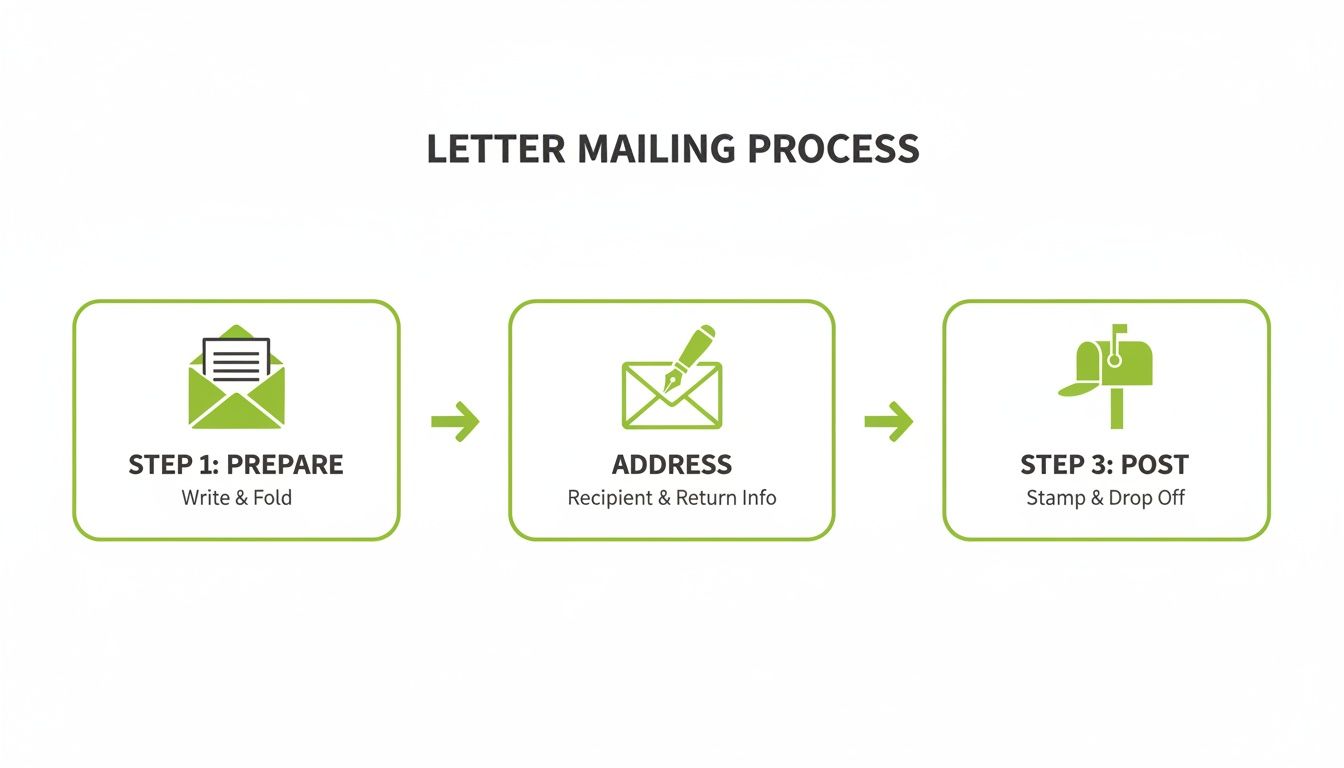
As you can see, a letter’s journey really starts well before it ever touches a post box.
Key Factors Size and Weight
Before you can work out the cost, you need to know what kind of letter you're sending. Here in Australia, domestic letters are split into two main groups: small and large. Think of a standard birthday card in a regular DL envelope—that's a "small letter." An A4 document that you've put into a bigger C4 envelope? That’s a "large letter."
Each of these categories has really specific limits for its dimensions, thickness, and weight. For instance, a small letter can't be any heavier than 250 grams, while a large letter tops out at 500 grams. If you go over these limits, even by a little bit, your letter gets bumped up into the next category—or even classified as a parcel—which will definitely cost you more.
For businesses trying to keep shipping costs down, knowing these cut-offs is essential. If you’re often sending things that are right on the edge, you might want to look into other https://aeroscouriers.com.au/cheap-postage-options/.
Getting a handle on the physical limits for your mail is absolutely critical. If your item is too thick or too heavy for its size category, you’ll either be hit with extra charges or have it sent back to you. That means delays and more money out of your pocket.
To make things easier, here's a quick guide to the standard sizes, weights, and thickness limits for letters sent within Australia.
Quick Guide to Australian Domestic Letter Sizes
| Letter Size | Maximum Dimensions (mm) | Maximum Thickness (mm) | Maximum Weight (g) |
|---|---|---|---|
| Small Letter | 130 x 240 | 5 | 250 |
| Large Letter | 260 x 360 | 20 | 500 |
Keep this table handy, and you'll always know which category your letter fits into before you even think about buying a stamp.
Navigating Domestic Postage Costs and Options
Ever wondered why sending a thick A4 document costs more than a simple birthday card? When you're figuring out the cost for a postage letter in Australia, it really boils down to three things: its size, its weight, and how fast you need it to get there. It’s a bit like ordering a coffee – a small long black has a base price, but if you want a larger size, add syrups, or opt for special milk, the cost goes up.
It’s the same deal with mail. Every letter has a starting price, and these other factors nudge the final cost up. Once you get the hang of these basics, you can make smarter choices and stop overpaying, whether you're sending a personal note or managing company mail.
Breaking Down the Cost Factors
Australia Post keeps its domestic letter service pretty straightforward with a tiered system. The first thing you need to do is work out if your letter is 'Small' or 'Large' based on its dimensions. From there, it's all about weight—the heavier it gets, the more it will cost.
- Size Categories: Your typical DL envelope for bills and cards is a 'Small' letter. That bigger C4 envelope you use for unfolded A4 documents? That’s considered 'Large'.
- Weight Tiers: A 'Small' letter can be up to 250g, while a 'Large' letter can go up to 500g. It's crucial to stay under these limits, as even a few grams over will push your item into the much pricier parcel category.
- Delivery Speed: You have two main choices here. 'Regular' is the standard, most economical service. If you're in a hurry, you can pay a bit more for a 'Priority' label to speed things up.
This system is designed so you only pay for the service you actually need. A light, standard-sized letter will always be your cheapest option. If you want a deeper dive into the numbers, you can learn more about the overall cost of postage and how it all comes together.
The Special Case of Non-Machinable Letters
What about those tricky items? Maybe you’re sending a rigid key, a lumpy birthday card with a badge on it, or an invitation with an odd shape. These are what Australia Post calls non-machinable items, and they need special handling—which, naturally, comes with an extra fee.
The thing is, standard letters are zipping through high-speed sorting machines that expect flat, flexible envelopes. Anything that can't glide through smoothly can jam the equipment or get damaged itself. This includes things that are too stiff, have awkward bumps, or are wrapped in materials like plastic that the machines can't handle.
Because these items have to be pulled aside and sorted by a real person, Australia Post adds a surcharge to cover the cost of that manual labour. It’s simply to account for the extra time and care required to get your unusually shaped mail delivered safely.
So, next time you’re posting a letter with a house key, a fancy card with beads glued to it, or a plastic-sleeved document, just be ready for that little extra charge. It’s a small price to ensure your item is handled with care and doesn't get chewed up by a machine. Knowing these details helps you accurately estimate your postage costs and get any letter ready for its journey across Australia.
How to Buy Stamps and Postage Today
Gone are the days when your only option was to queue up at the post office. Buying what you need to send a postage letter in Australia is now far more flexible, with plenty of choices for everyone, from individuals sending a birthday card to businesses managing large mail-outs.
Whether you prefer the traditional face-to-face experience or the convenience of clicking a button from your desk, there’s a way to get your mail sorted. Knowing your options means you can handle your postage needs efficiently, saving you a bit of time and hassle.
Traditional and Modern Retail Options
Of course, the classic way to buy stamps is still by popping into your local Australia Post outlet. It’s the perfect place to grab single stamps, booklets, or even entire rolls. The staff there can also weigh your letter on the spot and make sure you’ve got the correct postage, which takes all the guesswork out of it.
But you don’t have to go to a dedicated Post Office anymore. Many other authorised retailers sell stamps these days. You can often find them at:
- Newsagents: A handy spot to pick up stamps while you’re grabbing the morning paper.
- Supermarkets: Many larger stores will have stamp booklets available at the service desk or checkout.
- Self-Service Terminals: Found inside many Post Shops, these kiosks let you weigh items, buy stamps, and pay for postage without needing to wait in line for a staff member.
Digital and Business-Focused Solutions
For businesses or anyone who sends mail in bulk, sticking individual stamps on hundreds of envelopes just isn't practical. This is where more modern solutions really shine. A popular choice is a postage meter, which is a machine that prints the correct postage value directly onto your envelopes. Businesses that use a meter often get a small discount on each letter sent, and those savings can really add up.
Another great option is using prepaid envelopes, which have the postage cost built right in. This is brilliant for streamlining big mail-outs – all you need to do is pack, seal, and send.
Better yet, you can now manage and print postage labels straight from your own computer. This is a game-changer for businesses, as it saves countless trips to the post office and gives you much tighter control over your mailing costs and records.
Getting Your Letter Addressed and Packed Right
Think of a letter's address as its GPS coordinates. If you get it right, it sails through the system. Get it wrong, and you're sending it on a wild goose chase – or worse, it comes right back to you. Nailing the addressing and packaging is the single most important thing you can do to make sure your letter arrives safe and sound, without any delays.
When an envelope is clearly and correctly addressed, it zips through the automated sorting machines. It’s a simple step, but it’s your best guarantee for a smooth journey across town or across the country.
How to Format an Address in Australia
Australia Post has a standard format that their sorting machines are built to read. Sticking to it means your letter gets processed quickly. Always use a dark pen and write as clearly as you can.
Here’s the layout that works every time:
- Recipient's Name: The full name of the person or company goes on the top line.
- Street Address: Pop the street number and name on the second line (e.g., 123 Smith Street).
- Suburb, State, and Postcode: The last line is the key. It needs the suburb or town, the state abbreviation, and the four-digit postcode, all together (e.g., MELBOURNE VIC 3000).
Here’s a pro tip: a common mistake is putting the postcode on a separate line. Don't do it! Always keep the suburb, state, and postcode on the same line. Splitting them up can confuse the sorting machines and slow things down.
It’s also a great idea to put your return address on the back. That way, if for some reason your letter can't be delivered, it’ll find its way back home to you.
Sealing the Deal: Packaging Pointers
The envelope itself matters more than you might think. A flimsy envelope can easily tear in transit, and you don’t want its contents spilling out somewhere in a mail sorting facility. Pick an envelope that’s sturdy enough for the job.
You also want to avoid anything that can trip up the sorting machines. For example, never seal an envelope with shiny or glossy sticky tape. The reflection can mess with the optical scanners, causing a jam. A simple lick-to-seal envelope or a dab of glue stick is all you need.
If you’re sending something that’s a bit bulkier or needs more protection than a standard letter, it might be time to look at parcel delivery services instead. Spending that extra minute to prepare your letter properly really does pay off with a speedy, secure delivery.
When to Choose a Courier Instead of Australia Post
Australia Post's standard letter service is fantastic for sending birthday cards or simple documents, but sometimes it just doesn't cut it. There are moments when you need more speed, tighter security, or features that regular mail simply wasn't designed for. That's when a dedicated courier service steps in, acting as your express lane when the standard route won't do.
Figuring out which to use really boils down to what you're sending and just how critical its journey is.

Got an urgent contract that absolutely has to be on a desk across town by tomorrow morning? Or maybe a small, valuable item that needs a signature to prove it arrived safely? A courier offers a level of service that standard postage for a letter in Australia can't match, giving you peace of mind with a bunch of extra features.
Speed and Urgency
The most clear-cut reason to call a courier is speed. Sure, Australia Post's Priority service is a step up from Regular mail, but it still doesn't come with a next-day guarantee. Courier services, on the other hand, are built from the ground up for speed. They can often pull off same-day or guaranteed next-day delivery, especially within major cities.
This makes them a lifesaver for time-sensitive deliveries, like:
- Urgent legal documents or contracts that can't be late.
- Last-minute business proposals with a hard deadline.
- Critical replacement parts or product samples.
If your deadline is set in stone, a courier is easily your most reliable bet.
Security and Tracking
When you're sending something valuable, just knowing where it is at all times is a huge relief. A standard letter is untracked; once it's in the post box, you just have to trust the system. In stark contrast, courier services give you detailed, real-time tracking from the moment it leaves your hands to the moment it's delivered.
For items that are valuable or irreplaceable, the combination of real-time tracking, signature-on-delivery options, and included insurance provides a robust security net. This confirmation is essential for both business and personal shipments where proof of receipt is required.
For a deeper dive, a detailed comparison between a courier and Australia Post can really help you see which service fits your security needs. This level of oversight is a key difference when you're sending anything more important than a friendly note.
To help you decide at a glance, here’s a quick comparison of what you can expect from each service.
Letter Post vs Courier Service: A Feature Comparison
| Feature | Standard Letter Post | Aeros Couriers Service |
|---|---|---|
| Best For | Everyday, non-urgent documents like cards, letters, and bills. | Urgent documents, valuable items, and time-sensitive business parcels. |
| Speed | 2-10 business days, depending on service (Regular vs Priority). | Same-day or guaranteed next-day delivery options available. |
| Tracking | None. | Full real-time, door-to-door tracking included. |
| Security | Basic mail handling. | High-security handling, with options for signature on delivery and insurance. |
| Cost | Very low cost, starting from $1.50. | Higher cost, reflecting the premium speed and security features. |
| Proof of Delivery | Not available. | Signature on delivery provides concrete proof of receipt. |
Ultimately, choosing a courier is an investment in certainty. You're paying for the guarantee that your item will arrive quickly and securely, with a digital trail to prove it.
For Businesses and E-commerce
Let's face it, the world of post has changed. With fewer people sending traditional letters, the whole industry has shifted its focus to parcels, all thanks to the online shopping boom. The Australian postal services sector recently generated around $11.2 billion in revenue, and that growth is almost entirely from logistics and parcels, not old-school letters.
This just goes to show there's a huge demand for shipping solutions that go way beyond what you can fit in a standard envelope.
For any e-commerce seller or business shipping physical goods, couriers are an essential partner. They’re set up to handle items that don't fit the letter system and offer scalable ways to get products to customers all over Australia. Plus, courier platforms make life easier with streamlined booking, easy label printing, and management dashboards that are a must-have for running an efficient business.
Remember When Mail Meant Letters? Things Have Changed.
Have you noticed your letterbox looks a little different these days? It’s probably holding fewer letters and a lot more parcels. You’re not imagining it. The way we use the post in Australia has completely flipped on its head, mostly thanks to the internet. With bills, bank statements, and even birthday cards going digital, the humble letter just isn't the king it used to be.
This isn't just a small shift; it's a massive industry-wide pivot. The postal service has had to adapt, moving its focus from personal mail to the booming world of e-commerce. The real action—and the future of the industry—is now in delivering parcels and handling specialised mail for businesses.
The Letter's Slow Fade
The numbers paint a pretty stark picture. Since the mid-2000s, the number of letters sent within Australia has dropped by a jaw-dropping 72%. That’s a huge decline, driven almost entirely by us choosing email and instant messages instead. And it’s not stopping anytime soon.
Most of the letters you see in the system today aren't from your aunty; they're bulk mail from businesses. If you want to dive deeper, the ACCC has a detailed report on this long-term trend.
This change isn't just an interesting fact—it has real-world consequences for how you and I send things. The old-school letter post still works, of course, but it’s no longer the one-size-fits-all solution it once was. A gap has opened up for services that can do more than just basic delivery.
This is exactly why courier services have become so important. They’re built for the kinds of jobs that standard postage for a letter in Australia was never really designed to handle. Whether you're a business needing reliable parcel shipping or just someone sending something that needs to get there fast and securely, couriers are filling a crucial role that the traditional letter system simply can't.
Common Questions About Sending Letters
Even after getting the basics down, a few common questions always seem to crop up. Let's tackle those lingering queries so you can post your next letter with complete confidence.
How Long Does a Letter Take to Arrive?
This really boils down to two things: where it's going and how fast you want it to get there.
-
Regular Mail: This is your standard, everyday service. If you're sending a letter across the same city, expect it to land in 2-4 business days. Popping something in the post to another state? That'll typically take 3-6 business days.
-
Priority Mail: Need it there a bit quicker? For a little extra, the Priority service gives your letter a nudge up the queue. It generally shaves 1-2 business days off the Regular delivery time, which can make all the difference for something a bit more urgent.
Just remember, if your letter is heading to a rural or remote spot, it might take an extra day or two to complete its journey.
What Happens If I Use the Wrong Postage?
It's a common mistake! Don't worry, your letter won't disappear into a black hole. If an Australia Post sorting machine flags an underpaid item, it usually goes one of two ways.
Sometimes, they’ll deliver it anyway, but the recipient will get a friendly note asking them to cover the difference plus a small handling fee.
More often, the letter will be sent straight back to you so you can add the correct postage. This is exactly why putting your return address on the back is one of the smartest things you can do—it gives your letter a way home if things go wrong.
And what if you forget the stamp altogether? The system is pretty clear-cut on this one. No stamp, no journey. It will almost certainly be returned to the sender.
Sending a letter shouldn't feel like a chore. By keeping these common scenarios in mind, you can sidestep the usual pitfalls and make sure your mail gets where it needs to go without a hitch.
For those times when a stamp just won't cut it—think urgent documents or valuable items—Aeros Couriers offers a fast, secure, and reliable alternative. You can get an instant quote online and book your delivery in minutes.
