



Think of an interstate courier as the ultimate connector, a service built to shrink the massive distances between Australian states. It’s the magic that happens when you need to get a parcel from Melbourne to Brisbane, or a box from Perth to Adelaide, not just reliably, but quickly. This is the very engine that keeps national e-commerce humming and families in touch across the country.
The Lifeline of Australian Business and Connections
Picture a small online boutique in Hobart, pouring their heart into beautiful handmade goods. How do they get their creations into the hands of a customer in Darwin? Or what about a family needing to send an urgent care package from Sydney to a loved one way over in Perth?
In both cases, it's the interstate courier that makes it happen. They are the invisible force that conquers Australia's vast distances, turning what could be a logistical nightmare into a simple, everyday task. This network is so much more than just trucks and planes; it's the true backbone of modern business and personal connection.
For small and medium-sized businesses, having a cheap, dependable interstate courier isn't just a nice-to-have—it's absolutely essential for growth. It’s what lets a local Perth business go toe-to-toe with competitors on a national stage, reaching customers in every single state and territory. This is what unlocks new markets and fuels the entrepreneurial spirit that our economy is built on.
The demand is absolutely exploding. The Australian courier, express, and parcel (CEP) market is on track to hit a staggering AUD 33.94 billion by 2035. That number alone shows just how crucial these services have become in our connected world. This boom is tied directly to the rise of online shopping, which is why having fast and affordable shipping for boxes and parcels across our massive road network is so vital. If you're interested, you can explore more data on the Australian courier market growth and see its direct link to e-commerce.
Connecting Every Corner of the Continent
Let's be honest, Australia's geography is a unique challenge. But a modern interstate courier service turns that vastness from a problem into an advantage. They make next-day delivery between major capital cities a daily reality and bring regional towns that once felt isolated right into the fold.
This whole service is built on three key pillars:
- Speed: Express options are there for when your parcel absolutely, positively has to arrive tomorrow.
- Affordability: Competitive pricing means sending a package across the country is accessible for everyone, not just big corporations.
- Reliability: Real-time, advanced tracking gives you that crucial peace of mind from the moment it's picked up to the second it's delivered.
At the end of the day, an interstate courier service levels the playing field. It gives everyone—from a startup founder working out of their spare room to a major enterprise—the power to operate on a national scale. It forges connections, drives success, and makes our massive country feel just that little bit smaller.
How Interstate Courier Pricing Really Works
Ever sent two boxes of a similar size and wondered why the shipping quotes were wildly different? It’s a common frustration. The secret isn't some complex algorithm; it's actually a lot like booking a flight for your parcel. The final price tag is a blend of distance, speed, and—most importantly—the amount of space it takes up.
Getting your head around these factors is the first real step to finding the cheapest possible rates for your interstate shipments.
It's All About Weight… But Not How You Think
Most people assume shipping costs are all about how heavy a parcel is. And while that's partly true, it’s only half the story. The price you pay is based on the chargeable weight, which is determined by comparing two different measurements: actual weight and cubic weight.
Actual weight is exactly what it sounds like—stick the box on a scale, and that’s the number you get. Simple.
But the real game-changer, and the bit that catches many people out, is cubic weight. This is a measure of your parcel’s volume. Think about it from the courier's perspective: their van has a limited amount of space, and they need to make every square centimetre count. Cubic weight ensures that a big, light item is priced fairly against a small, heavy one.
This is the central nervous system of Australian logistics. Whether you're a business expanding its reach, an online store getting orders to customers, or just someone sending a gift to family, this system is what connects us across state lines.
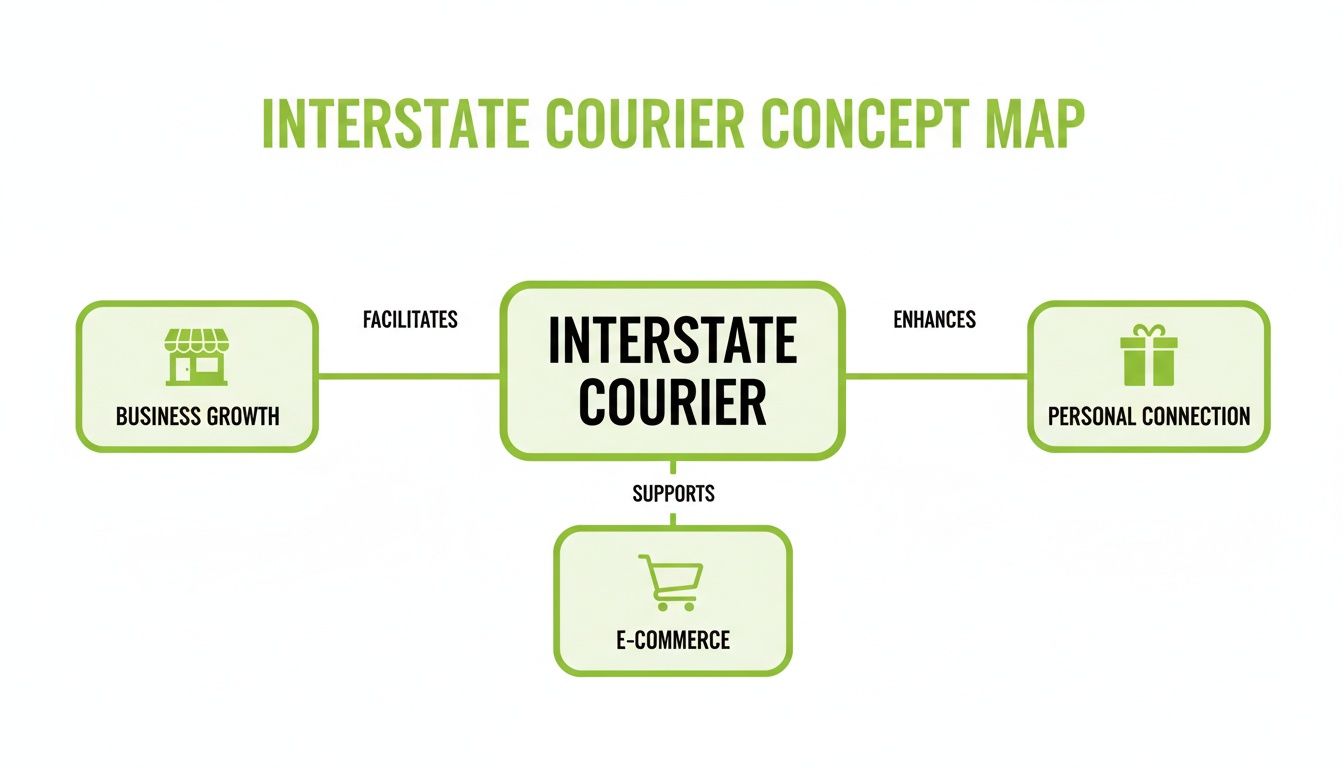
As you can see, efficient and affordable shipping is the invisible thread tying it all together.
The Pillow vs. The Brick Analogy
Still a bit fuzzy? Let’s make it concrete. Imagine you need to ship two different items, and both have an actual weight of 5 kilograms.
- Item 1: A big, fluffy pillow packed in a massive box.
- Item 2: A small, dense brick that fits neatly into a shoebox.
Even though they weigh the same on the scales, that giant pillow box hogs a huge amount of precious space in the delivery van. If the courier only charged for the actual weight, they’d lose money filling their vehicles with bulky but lightweight items.
This is precisely where cubic weight steps in. The pillow’s large dimensions give it a much higher cubic weight than the brick. So, you’ll be charged based on that higher value. The brick, being dense and compact, will be charged on its actual weight.
Key Takeaway: You are always charged for whichever is greater—the actual weight or the cubic weight. Internalising this one rule is your ticket to avoiding surprise fees and mastering your shipping budget.
Understanding the core components of your quote is the best way to control costs. Let's break down the main factors that go into calculating your final price.
| Pricing Factor | What It Means | How to Optimise for Lower Costs |
|---|---|---|
| Chargeable Weight | The higher value between the parcel's actual weight (on the scales) and its cubic weight (the space it occupies). | Use the smallest possible box that safely fits your item. Avoid excessive empty space and bulky packaging materials. |
| Distance & Location | The kilometres your parcel needs to travel between the pickup and delivery postcodes. | While you can't change the distance, be aware that shipping to remote or regional areas often incurs extra surcharges. |
| Service Speed | How quickly you need the parcel to arrive. Options typically range from standard road to express overnight services. | If your delivery isn't urgent, always opt for the standard or economy road service. It's significantly cheaper than express. |
| Surcharges | Extra fees for things like residential delivery, dangerous goods, or attempted delivery failures. | Double-check your dimensions, declare goods accurately, and ensure someone will be available to receive the parcel. |
By paying attention to these four areas, especially how you pack your items, you can directly influence your shipping costs and keep them as low as possible.
Calculating Your Parcel's Cubic Weight
Don't worry, you don’t need to be a maths whiz for this part. The calculation is straightforward, and once you’ve done it a couple of times, it becomes second nature.
Here’s the simple, three-step formula:
- Measure Your Parcel: Grab a tape measure and get the length, width, and height of your box in metres. For example, a 40cm side becomes 0.4m.
- Calculate the Volume: Multiply those three numbers together (Length x Width x Height).
- Apply the Conversion Factor: Multiply the volume you just calculated by the industry standard conversion factor, which is 250.
Let’s run through a quick example. Say your box measures 0.5m x 0.4m x 0.3m. Its volume is 0.06 cubic metres.
Multiply that by the magic number: 0.06 x 250 = 15.
That gives you a cubic weight of 15 kg. If the actual items inside the box only weigh 10 kg, you’ll be charged for the 15 kg cubic weight because it’s the higher value.
To skip the manual maths, you can use a handy online tool to calculate shipping charges for your specific parcel and get an instant, accurate quote before you commit.
Packaging Your Parcel for a Safe Journey
Sending a parcel across the country is more than just a transaction; it’s an act of trust. You’re handing over something important, counting on it to arrive in the exact same condition it left. That trust is a partnership, and your part of the deal starts well before the courier even knocks on your door. Honestly, mastering the art of packaging is the single most important thing you can do to guarantee a safe, damage-free delivery.
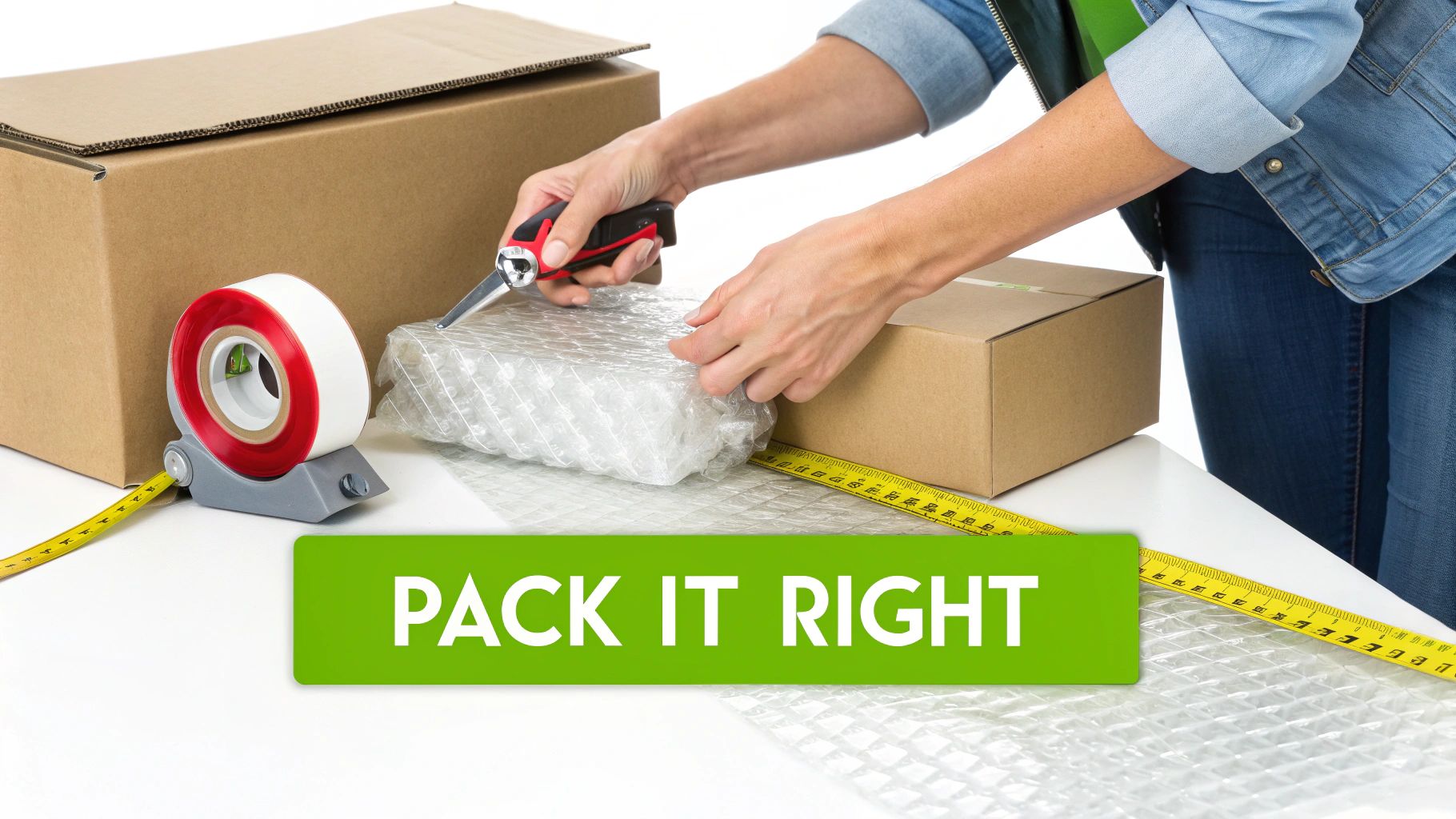
Try to think of your parcel not just as an object, but as a traveller about to go on a long trip. It's going to be handled by many different people, ride alongside countless other packages, and feel the vibrations from every kilometre of road and every sorting machine. Your job is to give it the armour it needs to complete that journey unscathed.
This isn't about overcomplicating things. It's simply about making smart choices to protect your goods and avoid any nasty surprises or extra costs.
Choosing Your Box and Cushioning
Everything starts with the box. It’s the foundation of a secure parcel, so always go for a new, sturdy, double-walled cardboard box. I know it’s tempting to reuse an old box to save a few cents, but it’s a gamble that rarely pays off. A box that’s already been shipped has had its structural integrity compromised, making it far more likely to get crushed or split open.
Size is just as crucial. You want a box that’s just big enough to hold your item with about 5-6 cm of cushioning space on all sides. A box that’s too big is a double-whammy: it increases your cubic weight (and therefore your shipping cost) and allows your item to slide around, which is a leading cause of damage.
Once you’ve got the right box, the real magic happens inside.
- Wrap Individually: If you’re sending more than one thing, give each item its own protective layer of bubble wrap or foam. This is key to stopping them from scratching or banging against each other in transit.
- Fill the Voids: Use packing peanuts, scrunched-up paper, or air pillows to fill every last bit of empty space. Give the box a gentle shake—if you feel anything moving, you need more filler. Nothing should shift.
- Centre the Item: The goal is to suspend your item in the very middle of the box, with cushioning on every side, top, and bottom. It should never be resting directly against an outer wall.
Think of your cushioning as a shock absorber for a car. It's there to soak up all the bumps and jolts of the journey so your precious cargo doesn't have to. This one step is your best defence against transit damage.
Sealing the Deal and Labelling Correctly
The final, crucial stage is getting that box sealed up tight. Use a strong, pressure-sensitive packing tape that’s at least 48mm wide. The best way to do this is with the 'H-taping' method: run a strip of tape along the centre seam where the flaps meet, then run two more strips across the edge seams at each end. This creates a really strong seal that won’t peel away.
Lastly, the label is your parcel’s passport. It has all the critical information the courier network needs to get it to the right place, on time. It’s worth taking a moment to learn how to correctly place a label on your package to prevent scanning errors or hold-ups. By taking these simple but powerful steps, you’re not just packing a box—you’re setting your shipment up for a successful journey from start to finish.
Choosing the Right Courier Service for Your Needs
Not all deliveries are created equal, and neither are the people sending them. An e-commerce store shipping out dozens of orders a week has completely different needs to someone sending a one-off, urgent birthday present to a loved one interstate. To find the perfect courier service, you first need to get a clear picture of your own sending habits.
Are you a business owner whose world revolves around efficiency and the bottom line? Or are you sending a fragile, precious item where tracking and peace of mind are non-negotiable? Figuring out what truly drives your decision is the first and most important step to finding the right features and the best value for your money.
This is especially true here in Australia, where our road freight market is absolutely enormous. Interstate couriers are the lifeblood of this industry, which is tipped to be worth a staggering USD 44.98 billion by 2026. With over 56,550 businesses competing in this space, you can imagine how tough it is to stand out. For a small business, this is actually great news—it means you can find platforms that cut through the noise with simple tools like instant quotes, no account sign-ups, and printable labels, all backed by local 1300 support. You can read the full research on Australia's road freight market to get a sense of just how vital this network is.
Matching Your Needs to the Right Features
Once you've figured out what kind of sender you are, you can zero in on the features that actually matter. It's not about finding a service with a laundry list of options; it's about finding one with the right options for what you're doing.
Let’s break it down with a few real-world examples:
- For the E-commerce Entrepreneur: Your priorities are clear: great prices, reliable speed, and happy customers. You need access to competitive, wholesale rates for all your boxes and parcels, plus real-time tracking you can pass on to your buyers to head off those "where's my order?" emails.
- For the Occasional Sender: If you're sending a personal gift or an important document, things like signature on delivery and included freight insurance become your best friends. They offer that extra layer of security, confirming your important package has arrived safely and into the right hands.
- For the Urgent Shipper: When the clock is ticking, nothing is more important than being able to quickly compare express versus standard delivery times. You need clear, upfront transit estimates for both metro and regional postcodes so you can make a smart choice and hit your deadline.
The biggest and most empowering shift in modern shipping is the move away from being locked into a single provider. You no longer have to put up with one carrier's high prices or limited service. The power is now in your hands to choose the perfect fit for every single shipment.
The Power of a Multi-Carrier Platform
This is where things get really good. Instead of trawling through individual courier websites one by one, a multi-carrier platform brings all the best options together into a single, simple dashboard. Think of it as a flight comparison site, but for your parcels.
You just pop in your parcel's details once and instantly see quotes from a whole range of trusted Australian carriers. This lets you compare a wide range of courier services side-by-side, weighing up speed against cost to find that perfect sweet spot for that specific delivery.
This flexibility doesn't just mean you're getting the cheapest possible rate for fast box and parcel deliveries Australia-wide. It gives you the freedom to make a fresh, smart choice for every single package you send.
Your Step-by-Step Guide to Sending a Parcel
Alright, let's move from theory to action. This is where you’ll see just how simple sending a package across Australia can be with a modern courier service. We’re going to walk through the entire process, showing you how to get your boxes and parcels moving from your home or office, anywhere in the country. Forget any ideas about this being a complicated process for big companies – it's designed for everyone.
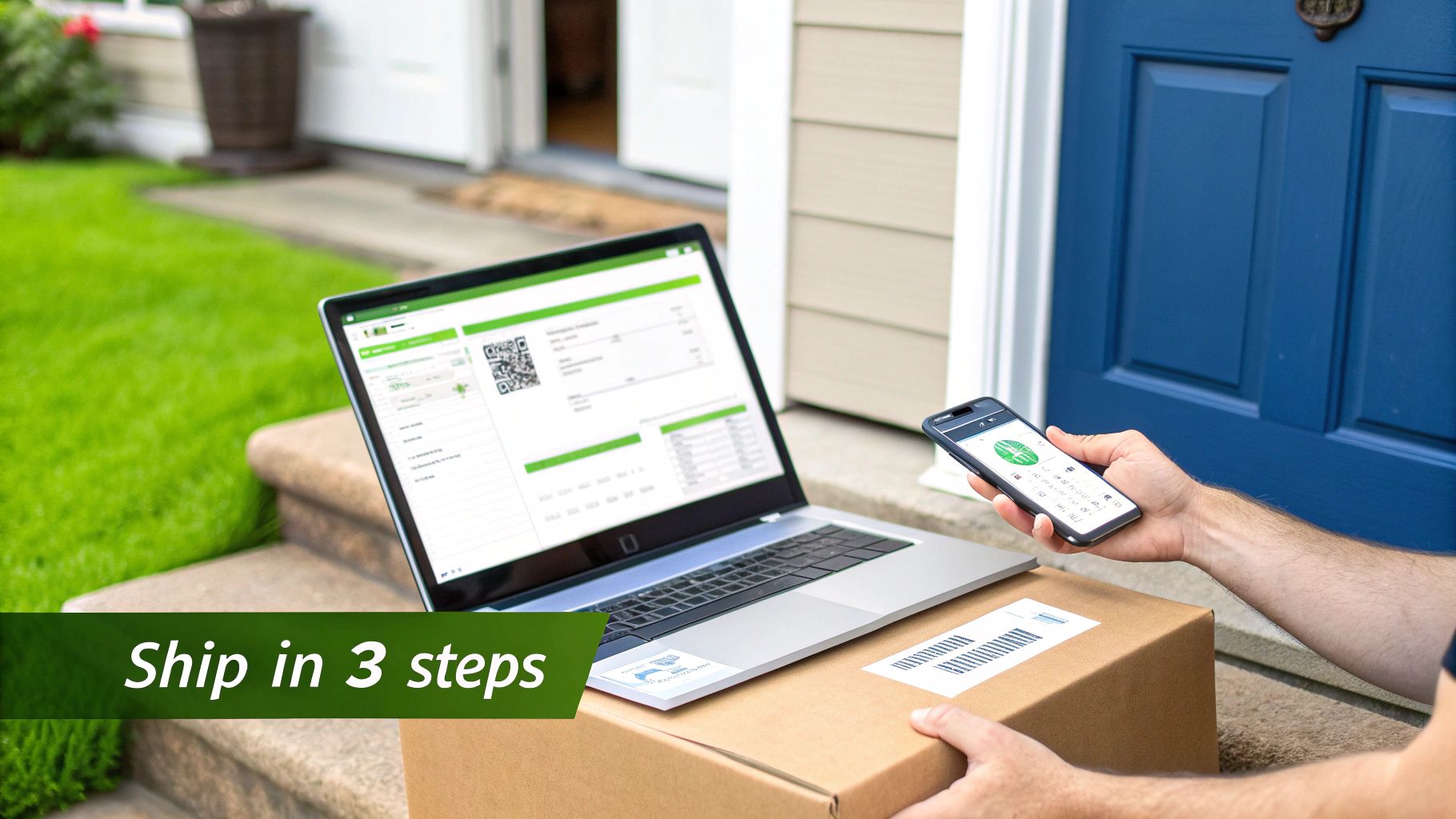
The best part? You can do all of this online in just a few minutes. What used to be a manual, time-consuming task is now just a handful of clicks, putting you firmly in control of your shipment from the first quote to the final delivery scan.
Step 1: Getting Your Instant Quote
Everything starts with getting a clear, upfront price. No need to fill out long sign-up forms or create an account just to see how much it will cost. Simply punch in the pickup and delivery postcodes, along with your parcel's dimensions and weight.
This is where understanding cubic weight really comes in handy. When you enter accurate measurements, the system instantly works out the chargeable weight and shows you a list of the sharpest prices from different carriers for that specific route. You can easily compare standard and express services to find that sweet spot between cost and speed.
Step 2: Booking and Printing Your Label
Found the perfect option? Great! The next step is just as straightforward. You'll enter the full street addresses for the sender and receiver, add a quick description of what’s inside, and complete the booking with a secure payment.
As soon as your booking is confirmed, your shipping label is ready to download as a PDF. Think of this label as your parcel's passport for its trip across Australia. Just print it, attach it securely to your package, and make sure the barcode is flat and easy to scan. It’s that one little document that holds all the information the network needs to get your parcel where it needs to go.
Step 3: Scheduling Pickup and Tracking Your Parcel
With your parcel packed and labelled, you can book a pickup right from your doorstep. No more trekking to the post office and waiting in line. The courier will show up on your chosen day to collect the package, and its journey officially begins.
From that moment on, you’re never in the dark. With a unique tracking number, you can log into a central dashboard and watch your parcel’s progress in real-time. You'll see every scan—from leaving the local depot to arriving in the destination state—giving both you and your recipient complete peace of mind.
This whole process shows that sending something across Australia doesn't have to be a hassle. It can be a surprisingly smooth and efficient experience.
If you’re ready to see just how easy it is, you can send your parcel with an an instant online quote and get started right now.
Going Beyond Delivery with Rewards and Support
Let’s be honest, choosing an interstate courier often boils down to two things: how fast and how much. It can feel like a simple, transactional choice. But what if that necessary expense could start working for you, actually giving something back?
A truly great courier partner sees shipping as more than just a cost centre for your business. They help turn it into a strategic part of your operation, building a relationship where your loyalty is genuinely recognised and rewarded.
Turning Shipping Costs into Valuable Rewards
This is where a modern rewards program completely changes the game. Instead of your shipping budget just being another line item on a spreadsheet, every dollar you spend starts to accumulate. Suddenly, you’re unlocking access to thousands of items—from new office gear to electronics and branded merchandise for your team.
It’s a powerful but incredibly simple concept. You’re offsetting a regular business expense and getting real, tangible value in return.
For businesses sending parcels across Australia day in and day out, these points add up fast. It’s a clever way to stock up on marketing materials or reward your staff without touching other budgets. You can explore how earning reward points on your shipments can transform a necessary cost into a surprising benefit.
Shipping is an unavoidable part of doing business in Australia. A great rewards program doesn't just reduce that cost—it converts it into an opportunity, making your logistics budget work harder for you.
The Importance of Real Australian Support
When a delivery hits a snag, the last thing you want is to be stuck navigating a frustrating chatbot or waiting on hold for an overseas call centre. This is where having access to real, local Australian support makes all the difference.
It’s about being able to talk to a real person who understands the lay of the land—someone who can give you clear, helpful advice right when you need it. That human touch provides a peace of mind that technology alone just can’t replicate.
This focus on value is becoming more important than ever. With the domestic parcel market growing rapidly, smart shippers are looking for every advantage. Using a platform that combines great rewards with reliable local support is the key to getting the most out of every dollar you spend. You can discover more insights on international trade data from the Australian Bureau of Statistics to see the bigger picture.
Got a Question? We've Got Answers
Stepping into the world of interstate shipping can feel a bit like learning a new language. Don't worry, it's simpler than it looks! We've put together some plain-English answers to the questions we hear most often, so you can send your parcels across Australia like a pro.
What’s the Absolute Cheapest Way to Send a Parcel Interstate?
Hands down, the smartest way to find the best price is to use an online comparison tool. Think of it like a price-checker website for flights—it pulls live quotes from a bunch of different couriers at once, showing you deals you'd never find by checking them one by one.
If you’re serious about saving every dollar on your box and parcel deliveries, here are a few golden rules:
- Think small. Always use the smallest box that will still keep your item safe and sound. Why pay for empty space?
- Go with the flow. If your delivery isn’t urgent, choose a standard road service. It’s significantly cheaper than express and just as reliable.
- Be precise. Double-check your parcel's weight and measurements before booking. Getting it right the first time helps you dodge any unexpected adjustment fees later on.
How Do I Figure Out the Cubic Weight of My Parcel?
Ah, cubic weight! It sounds complicated, but it's just the courier industry's way of measuring how much space your parcel takes up in a van. Getting this right is crucial for an accurate quote.
First, grab a measuring tape and note down your box's length, width, and height in metres. So, if your box is 40cm long, you'll write that down as 0.4m.
Then, just follow this simple formula: Length (m) x Width (m) x Height (m) x 250.
Let's walk through a quick example. Say your box is 0.4m x 0.3m x 0.2m. The calculation would be 0.024 x 250, giving you a cubic weight of 6kg. Easy as that!
Ready to see just how simple, affordable, and reliable shipping can be? With Aeros Couriers, you can grab an instant quote and book your next fast interstate box and parcel delivery in under a minute—and earn great rewards while you do it. Head over to Aeros Couriers to get started.
