The monthly freight bill usually doesn’t arrive with drama. It lands in your inbox, and then you open it and realise half your margin has gone into boxes, cubic weight, pickup fees, and charges you didn’t expect.
That’s where most Australian small businesses get stuck. They treat shipping like background admin. Pack the order, print the label, send it out, hope the customer’s happy. The trouble is that this “just get it out the door” habit is exactly what keeps costs high.
If you’re searching for how to reduce shipping costs small business in Australia, the answer isn’t one trick. It’s a set of practical decisions. Better packaging. Smarter carrier selection. Cleaner workflow. Fewer avoidable returns. A sharper look at where your shipping spend can give something back.
Move Beyond the Basic Postage Mentality
A lot of businesses start the same way. They walk parcels into the post office, pay whatever the counter says, and move on. That works for a while. Then order volume grows, parcel sizes drift upward, and shipping turns into a monthly leak.

In Australia, that leak gets expensive fast. Small businesses can cut shipping costs by up to 40% by moving from retail rates to negotiated commercial rates. SMEs often pay $15 to $25 per domestic parcel at retail, but volume-based access can bring that down to $9 to $15 for the same metro-to-metro shipment, according to this Australian small business shipping analysis.
That’s not a minor saving. It changes pricing, margins, and how aggressively you can compete.
Stop buying shipping one parcel at a time
The basic postage mentality says every shipment is separate. It isn’t. Your courier spend is a category. It should be managed the same way you manage stock, labour, or ad spend.
Three habits usually keep costs inflated:
- Retail-rate thinking means you pay sticker price instead of accessing business pricing.
- Single-carrier habit means you keep using the same service even when the parcel profile has changed.
- Manual process creep means staff spend time chasing quotes, fixing labels, and dealing with invoice surprises.
Practical rule: If you’re still treating shipping as a transaction instead of a system, you’re probably overpaying.
Build a shipping setup that fits the business you have now
The right move isn’t always opening direct accounts with multiple carriers. For some businesses, that makes sense. For many, it creates admin, minimums, and a messy dispatch process.
A cleaner option is to use a centralised business shipping setup that gives access to commercial pricing without making you negotiate with everyone yourself. If that’s the stage you’re at, it’s worth looking at an Australian business postage account structure that suits regular parcel sending.
What works and what doesn’t
A quick comparison helps.
| Approach | Usually works when | Common downside |
|---|---|---|
| Paying over the counter | Very low volume, irregular sending | Highest rates, no flexibility |
| Direct carrier account | Consistent parcel profile, enough volume, admin capacity | Time-consuming setup and management |
| Aggregated shipping access | Mixed parcel sizes, changing destinations, need for fast comparison | You still need internal discipline on packaging and workflow |
The big shift is mental. Shipping isn’t just a cost to be endured. It’s one of the easiest operational areas to tighten when margins are under pressure.
Master Your Packaging to Beat Dimensional Weight
Most small businesses think heavy parcels are expensive parcels. In practice, the box is often the problem.
Carriers across Australia charge on dimensional weight, which means they bill for the space your parcel takes up when that’s greater than the actual weight. If you send a light item in an oversized carton, you can pay like it’s a much heavier shipment.
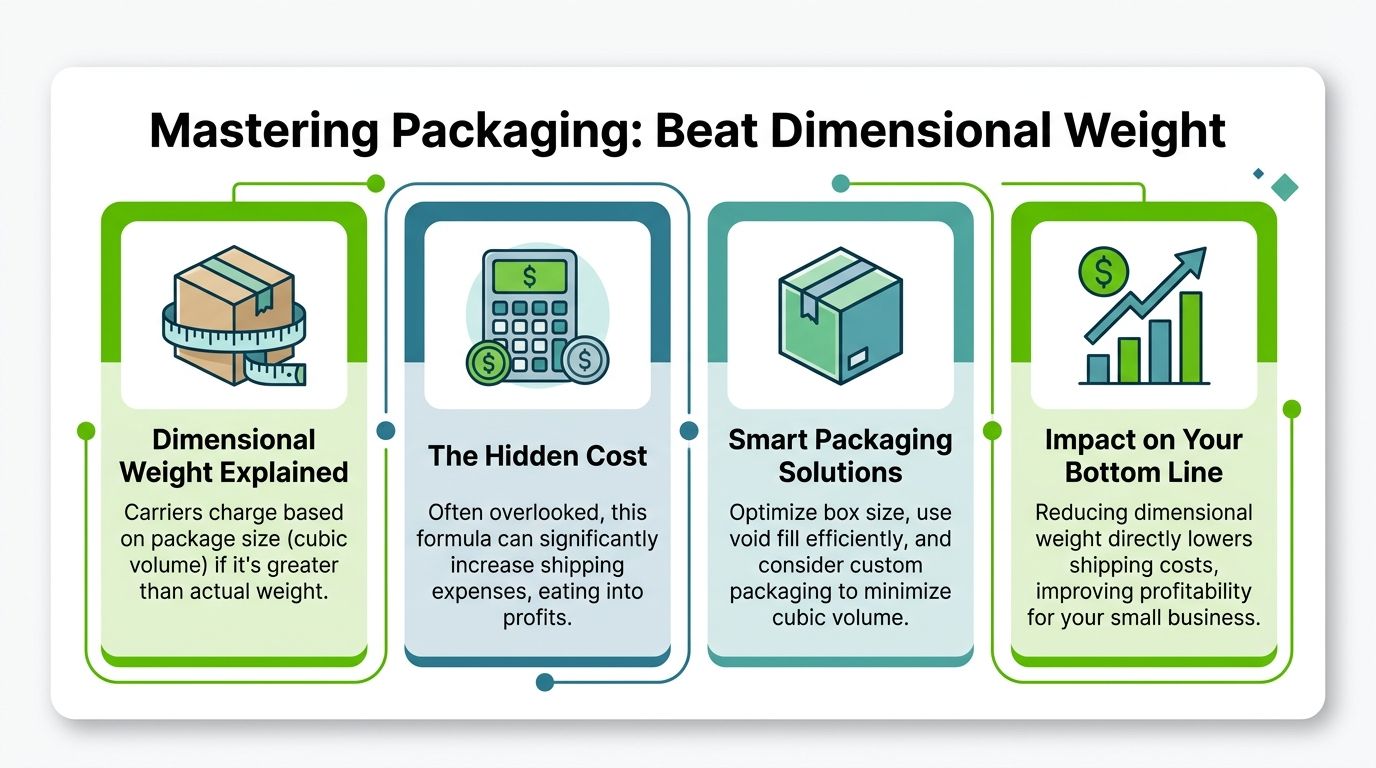
Optimising packaging can significantly lower dimensional weight charges for Australian small businesses. One example is blunt: a 0.5kg item in an oversized 30x20x10cm box can incur a $12 fee based on volume, versus an $8 fee based on actual weight, which is a 50% overpayment on that shipment alone, according to this dimensional weight guide.
Start with a packaging audit
Don’t overcomplicate this. Pull a sample of your regular orders and look at what you’re sending.
Check these first:
Which products are going into boxes that are clearly too large
If the product rattles around and needs lots of void fill, the box is probably costing more than it should.Which items could go in satchels or poly mailers instead
Soft goods and non-fragile products often don’t need a carton.Which box sizes you keep using out of convenience
This is one of the most common warehouse habits. Staff reach for the familiar box, not the right one.Whether your packed dimensions are being measured properly
A badly measured parcel creates adjustment charges later.
If you only fix one thing this month, fix the oversized carton problem. It’s the easiest waste to spot and the fastest to remove.
Standardise fewer packaging options
Too many packaging choices create inconsistency. Too few create wasted space. The sweet spot is a short range of packaging sizes that fits most of your order profile.
A practical setup often looks like this:
- Small satchel or mailer for compact soft goods
- Small carton for dense items with minimal void
- Medium carton for multi-item orders
- Protective option for fragile orders that need it
The goal isn’t fancy packaging. The goal is repeatable packing decisions.
Reduce air before you reduce spend
A lot of businesses spend time trying to negotiate rates while ignoring the empty space in every second parcel. That’s backwards.
Look for these packing errors:
- Big boxes for small products because the team wants one default carton
- Excess bubble wrap or paper used to compensate for poor box fit
- Double boxing when a single well-fitted outer carton would do
- Packing for appearance, not freight efficiency
Pretty unboxing doesn’t help if the shipping line item wipes out the sale.
Use satchels where they make sense
For local Australian parcel work, satchels are often the simplest win. They weigh less, take up less space, and usually avoid the wasted dimensions that drive cubic pricing.
That doesn’t mean “use satchels for everything”. It means use them where the product can handle it. Apparel, fabric-based goods, and other non-fragile items often fit this model well. Fragile stock doesn’t.
Tighten your label and declaration process
Good packaging isn’t only about cost. It also affects downstream accuracy. If staff are guessing dimensions or weighing after the box is sealed badly, invoice corrections follow.
A reliable dispatch bench should have:
- A clear measuring point with tape measure always available
- A scale that’s used for every parcel
- Pack rules by SKU or product type
- Consistent label placement so carriers can scan without delay
If your team needs a simple refresher on clean dispatch presentation, this guide on where to place a label on package is useful because poor placement often creates avoidable handling friction.
What works better than custom packaging for most small businesses
Many owners jump straight to custom printed boxes. Usually, that’s not the first place to save money.
This order is smarter:
| Priority | Focus | Why it matters |
|---|---|---|
| First | Right-size existing packaging | Immediate reduction in cubic waste |
| Second | Shift suitable items to satchels or lighter formats | Cuts bulk and handling |
| Third | Simplify box range | Makes staff faster and more accurate |
| Fourth | Consider custom packaging | Better once order patterns are stable |
Protect the product without paying for dead space
There’s no prize for shipping broken goods cheaply. The right target is a parcel that survives normal handling without paying for unused volume.
That usually means:
- Firm fit around the product
- Minimal but effective void fill
- Strong enough outer packaging for the item
- Accurate dimensions entered before booking
Packaging is where many courier costs hide in plain sight. Fix that, and the rest of your freight strategy gets easier.
Choose the Right Carrier Mix for Australia-Wide Delivery
A Melbourne brand shipping ten parcels a day can get caught out fast. Metro orders look profitable on paper, then a run of Far North Queensland, WA regional, and outer South Australian deliveries wipes out the margin because every job was pushed through the same carrier.
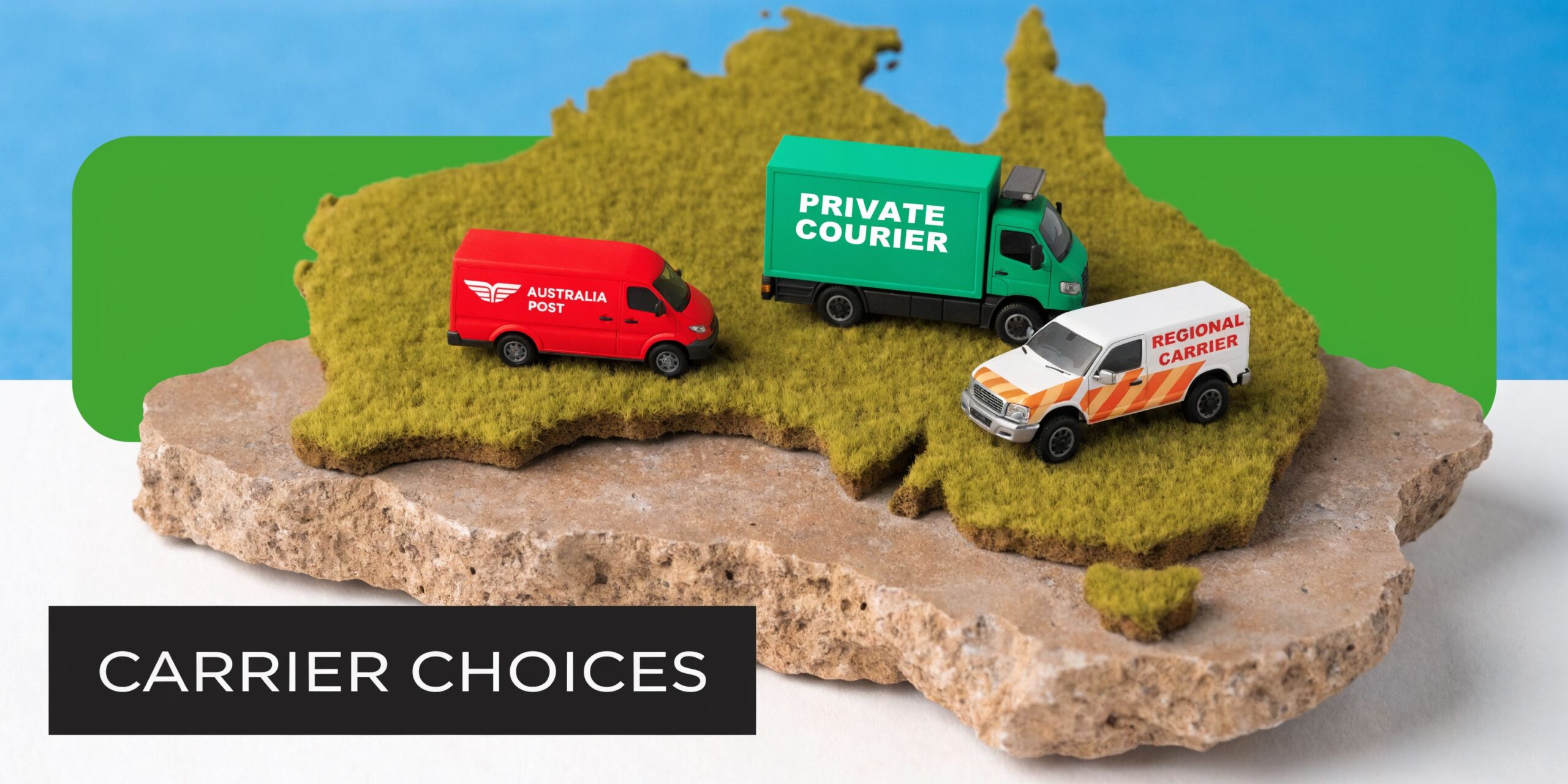
That is a common Australian freight problem. Our delivery market is too spread out, too postcode-sensitive, and too uneven between metro and regional areas for a one-carrier setup to stay cost-effective for long.
Retail rates versus commercial access
Plenty of small businesses start by opening one account and putting every parcel through it. That feels tidy, but it often means paying for convenience with missed savings.
Direct carrier accounts still have a place if your parcel profile is stable and your volume is strong enough to negotiate properly. If your order mix changes every week, a multi-carrier platform is usually more practical because it lets you compare service options without setting up and reviewing separate agreements with each provider.
Australia-wide delivery needs lane logic
Carrier choice should be based on where the parcel is going, what is inside it, and how much service risk you can tolerate.
The regional piece matters more in Australia than many generic shipping guides admit. The ACCC's report on the Australian parcels market makes clear that coverage, delivery conditions, and market structure vary across operators. In plain terms, a cheap metro service is not automatically a cheap regional service once handovers, delivery frequency, or exception handling start affecting the job.
Use a simple rule set:
| Delivery profile | Usually the better fit | Why |
|---|---|---|
| Capital city to capital city | National carrier or metro-focused courier | Wide coverage and more predictable transit performance |
| Intra-state metro and near-regional | State-based or regionally strong operator | Better fit for local lanes and pickup patterns |
| Far regional or remote | Carrier with stronger regional coverage | Fewer service gaps and fewer avoidable delivery issues |
| Mixed daily parcel book | Multi-carrier booking platform | Helps stop habit-based carrier selection |
The cheapest quote is often the wrong metric
Small business owners regularly focus on base price and ignore the full cost of a poor carrier fit.
The usual mistakes are familiar:
- Using one courier for every shipment because the account is already set up
- Choosing the lowest price without checking coverage strength by postcode
- Treating regional freight like metro freight even when service frequency is different
- Ignoring pickup cut-offs and depot handoff realities that affect same-day dispatch
A low rate into Dubbo, Devonport, or regional WA is not much use if the parcel sits, gets passed between networks, or triggers repeated customer follow-up.
Build a decision rule your team can follow
The businesses that keep shipping costs under control do not rely on memory or personal preference. They set clear booking rules.
A workable example looks like this:
- Metro cartons go with the lowest-cost option that has a reliable track record on those lanes
- Regional orders are checked for postcode coverage, delivery frequency, and handoff risk
- Higher-value shipments go through services with clearer tracking and stronger proof-of-delivery
- Urgent jobs are separated from standard freight so speed is bought only when it matters
That approach holds up far better than sticking with the carrier your team used last quarter.
Local transport still affects your courier costs
Some Australian businesses run their own vans for store transfers, local drops, or stock movement between warehouse sites. In that setup, courier savings can disappear if vehicle use is poorly planned or pickup timing is chaotic. A practical reference point is this guide to fleet management software, especially for businesses juggling both third-party couriers and their own local transport.
Compare each job against the lane in front of you
Good freight buying is routine, not occasional. Use a tool that lets your team compare couriers for different Australian delivery lanes instead of bouncing between carrier sites and guessing from memory.
That gives you a carrier mix built for Australia as it works. Metro, near-regional, remote, bulky, urgent, low-risk, and high-value jobs all need different decisions if you want lower shipping costs without creating service problems.
Streamline Your Workflow with Automation and Batching
At 2:30 pm, the warehouse looks flat out. One staff member is retyping an address from Shopify into a carrier portal. Another is hunting for a label that printed to the wrong printer. Customer service is asking where an Adelaide order is, and pickup is due in half an hour. The team is working hard, but the dispatch process is burning money.
That cost rarely shows up in the freight rate. It shows up in wages, missed cut-offs, duplicate handling, and avoidable support tickets.
For Australian small businesses, workflow matters even more once you’re shipping across mixed metro and regional lanes. If booking a parcel takes too many clicks, your team will default to the familiar carrier, even when another option suits that postcode or service level better. Admin friction pushes freight spend up.
Batching gives dispatch a repeatable rhythm
Processing orders one by one feels responsive. In practice, it creates constant context switching. Staff pack, book, print, answer a tracking question, then return to the bench and start again. Errors creep in because nobody stays in one task long enough to do it cleanly.
A better setup groups the work into short dispatch runs during the day.
That usually means:
- Set fixed booking and packing windows instead of handling each order the moment it lands
- Group similar parcels together by carton size, product type, or destination pattern
- Print labels in batches so printers, benches, and pick slips stay aligned
- Stage cartons by pickup sequence so the driver collects quickly and nothing is left behind
This sounds simple because it is. Simple processes usually hold up better under pressure.
Automation only pays off when it reduces admin, not control
Software should cut keystrokes and stop repeat mistakes. It should not hide important exceptions.
The first jobs to automate are the repetitive ones your team does dozens of times a day:
- Import orders directly from your ecommerce or ERP system
- Pre-fill shipment details for standard SKUs and packaging types
- Create labels in bulk
- Send tracking updates automatically
- Keep shipment history in one place so support staff can check status without logging into three different portals
A tool-based workflow is useful here. The main gain is consistency. Your team follows the same path for standard orders, and manual attention is saved for damaged stock, address issues, authority-to-leave requests, and time-sensitive jobs.
Flexible carrier use only works if the workflow can support it
Carrier choice is one part of the saving. Dispatch design is the other.
I see this often with growing Australian retailers. They know certain regional postcodes are cheaper or more reliable through a different service, but they avoid using it because the booking process is clunky and staff are already stretched. The result is predictable. They keep sending freight through the easiest portal, not the most economical lane.
Automation matters most when your carrier mix can change without creating extra steps at the bench. Platforms that compare services and centralise booking make that easier, especially if you’re juggling metro same-state volume, interstate parcels, and lower-frequency regional freight in the same day. If some orders need added cover, build that into the process with clear rules around courier shipping insurance options so staff are not making that call on the fly.
Process comes before software
A messy dispatch routine does not become efficient because you added another app.
Set the order first. Define who checks exceptions, when labels are printed, where completed cartons wait, and what happens if a pickup is missed. Then use software to remove duplicate entry and manual chasing. That’s the practical value behind a workflow management system. It gives the team a clear sequence instead of a pile of tasks.
A workable dispatch model for many small Australian senders looks like this:
| Stage | What happens |
|---|---|
| Order review | Check stock issues, delivery notes, and exceptions |
| Batch packing | Pack similar orders together using standard materials |
| Label run | Generate bookings and labels in one session |
| Pickup staging | Sort freight by carrier, service, or collection order |
| Tracking support | Let customers receive updates automatically |
Done properly, this lowers labour per parcel, cuts booking mistakes, and makes pickup windows easier to hit. It also gives you room to use a broader carrier mix without turning dispatch into chaos.
Gain Hidden Value Through Rewards and Loyalty
Most businesses look at shipping as a pure expense. That assumption is too narrow.
Once you’ve tightened packaging, chosen carriers properly, and cleaned up workflow, there’s another layer to shipping efficiency. It’s not about cutting the gross cost further. It’s about improving the value you get back from spend you’re already going to make.
Shipping spend can do more than move parcels
Here, loyalty and rewards become commercially useful. Not gimmicky. Useful.
If your business sends parcels every week, that spend is recurring. Recurring spend should be working twice. First, by getting the order to the customer at a sensible rate. Second, by returning some form of business value instead of disappearing into the freight line.
That matters more as volume grows. For a small business shipping 1,000 parcels per month, implementing packaging and carrier optimisation strategies can lead to annual savings of between $24,000 and $48,000, according to this packaging and optimisation guide. Once you’re thinking at that level, it makes sense to examine every part of shipping economics, including what your platform gives back.
Why most businesses ignore this
They’ve been trained to ask one question only: “What’s the rate?”
That’s fair, but incomplete.
A better question is: “What is my net value after shipping?” That includes:
- the freight rate
- the admin time around booking
- the packaging efficiency
- the risk exposure
- any reward value earned through normal sending activity
A cheaper label isn’t automatically the better commercial outcome if another setup returns practical value your business would have paid for elsewhere.
What good reward structures do
The useful kind don’t distract from operations. They sit in the background and accumulate while you dispatch normally.
The strongest reward programs usually help businesses offset other running costs, such as merchandise, team items, promotional materials, or office-related purchases. That’s real value because those costs don’t vanish just because freight is expensive.
A shipping reward program only makes sense if the core freight offer is already commercially sound. Rewards don’t fix bad rates. They improve the outcome on top of a disciplined shipping process.
Where this fits in a mature shipping strategy
Think of it as the last layer, not the first.
| Stage | Priority |
|---|---|
| First | Stop retail-rate leakage |
| Second | Fix packaging and dimensional waste |
| Third | Improve carrier choice by lane and postcode profile |
| Fourth | Automate and batch dispatch |
| Fifth | Recover extra value from recurring spend |
That order matters. Rewards are powerful when they sit on top of a system that’s already under control.
One platform can simplify multiple cost levers
For businesses that want commercial pricing access, centralised booking, and value back through regular use, platforms such as Aeros Couriers combine carrier comparison, online dispatch workflow, included freight insurance, and a reward structure tied to shipping activity. Their customer loyalty reward programs are relevant if you want your parcel volume to generate something tangible beyond delivery itself.
That doesn’t replace the basics. You still need disciplined packaging, clear dispatch rules, and sensible carrier choices. But once those are in place, it’s a smart way to stop treating shipping as a one-way cost.
The bigger lesson is simple. Shipping shouldn’t sit in the business as an unavoidable drain. Managed properly, it becomes a controllable operating lever. In some cases, it even becomes a source of extra business value.
If your business is sending boxes and parcels Australia-wide and you want lower rates without a clunky setup, Aeros Couriers is worth a look. You can compare courier options, book online, print labels, track deliveries, and build a more efficient shipping process without treating every parcel like a separate problem.
Courier quotes, tracking and support
Ready to send a parcel? Compare the available services for your postcodes, parcel dimensions and weight. For an existing delivery, use your consignment number to check tracking or ask our team for help.