


For any Australian business, choosing between Australia Post and a modern courier comes down to one key question: do you value familiarity over efficiency? For decades, AusPost has been the default, the name everyone knows. But newer platforms, like Aeros Couriers, have entered the scene offering a level of flexibility and sharp pricing specifically designed for domestic business shippers.
This guide will break down the key differences to help you decide which model truly fits the way you operate.
Australia Post vs. Modern Courier Platforms
Your choice of shipping partner is a big deal. It directly affects your bottom line, your customer's happiness, and how smoothly your day-to-day operations run. For a long time, Australia Post was the only real game in town for many small to medium-sized businesses (SMEs), thanks to its massive network and familiar drop-off process.
But the game has changed. The rise of multi-carrier platforms introduces a completely different way of thinking—one built around choice, genuine cost savings, and smarter workflows. The real dilemma for many businesses is weighing the perceived safety of a household name against the tangible benefits of a more agile, tech-focused alternative.
To make a smart call, you need to look at what really matters:
- Pricing Structures: How are you actually being charged? Are there sneaky fees hiding in the fine print?
- Service Flexibility: Are you stuck with a one-size-fits-all service, or can you pick the best option for each individual parcel?
- Operational Workflow: How much of your team's valuable time is spent booking, printing labels, and getting shipments out the door?
- Value-Added Benefits: What else is on offer? Are there loyalty programs or other perks built for businesses?
This decision often boils down to a simple trade-off, as shown below.
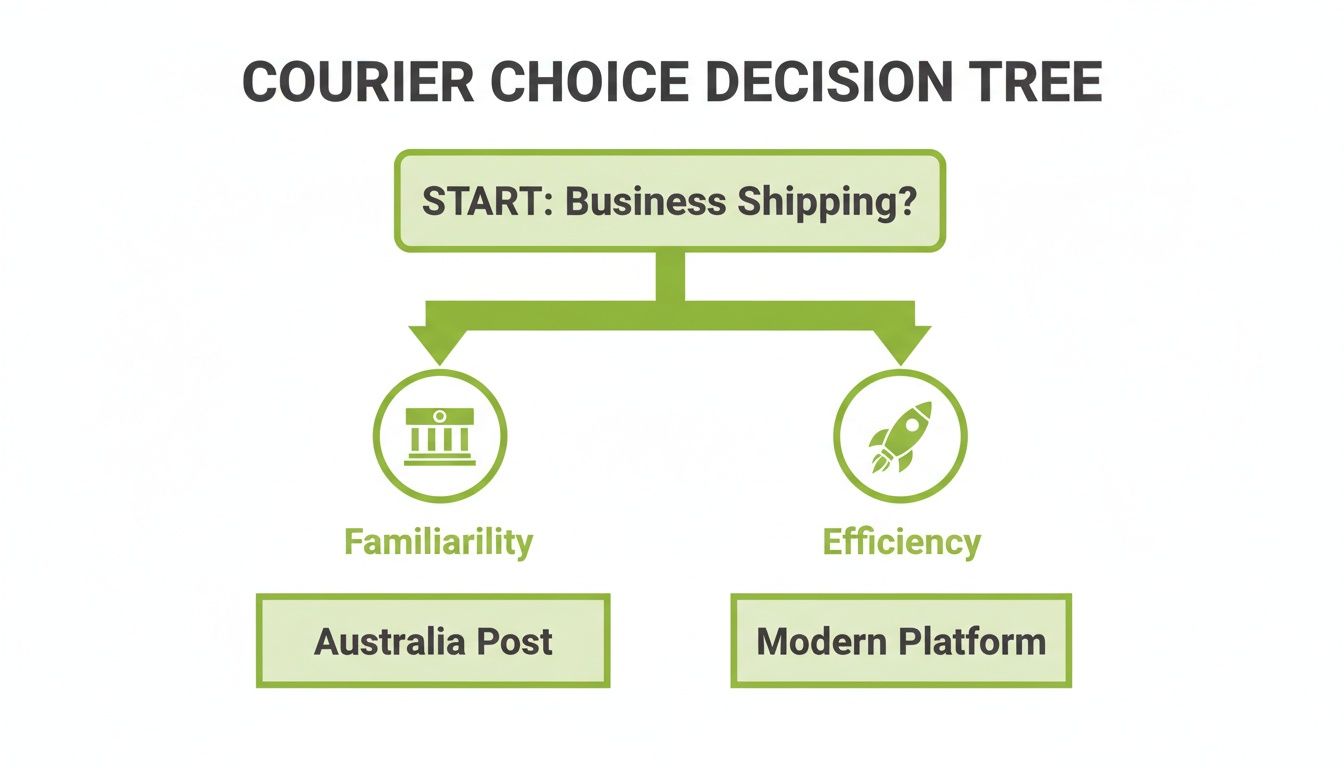
As the flowchart shows, businesses that prioritise a familiar, traditional process tend to stick with Australia Post. Those looking for greater efficiency and control are better suited to a modern platform.
Key Differences at a Glance
Even as the national carrier, Australia Post is navigating a shifting landscape. It reported a slim pre-tax profit of $18.8 million in FY2025, a figure propped up almost entirely by the boom in parcel deliveries. This profit stands in stark contrast to the massive $230.4 million loss from its traditional letters business, highlighting just how much the market has moved towards parcel logistics.
The table below breaks down the fundamental differences between the two shipping models at a high level.
Australia Post vs Modern Courier Platforms at a Glance
| Feature | Australia Post | Modern Courier Platform |
|---|---|---|
| Service Model | A single-carrier network offering its own fixed domestic services, like Parcel Post and Express Post. | A multi-carrier marketplace giving you access to dozens of different Australian services on one platform. |
| Ideal User | Individuals or micro-businesses with low and infrequent shipping volumes who prefer dropping off at a post office. | SMEs and e-commerce stores looking for competitive rates, operational efficiency, and total flexibility for local shipping. |
| Core Value | Wide accessibility and brand recognition for standard, everyday shipping needs within Australia. | Cost savings via aggregated volume, streamlined booking tools, and the power of choice for domestic deliveries. |
This at-a-glance comparison sets the stage for a deeper dive. While AusPost offers a simple, known quantity, modern platforms are built to give businesses the tools they need to ship smarter, not just harder.
A Look at Local Shipping Services and Flexibility
When you’re looking at couriers, Australia Post is often the first name that comes to mind. Their domestic network is built around two core services: Parcel Post and Express Post. Each is designed for a different need, and knowing when to use which is key to getting your shipping strategy right.
Parcel Post is your standard, go-to option for anything that isn’t time-sensitive. It’s a solid, budget-friendly choice for everyday deliveries that can comfortably arrive within a 2-6 business day window. On the other hand, Express Post is their premium, faster service, designed for next-business-day delivery within major metro areas.
But this is where it can get a bit restrictive. You’re essentially locked into their network, which means the same service has to handle everything—from a tiny satchel to a heavy, awkward box. That isn't always the most efficient or cost-effective way to do things.
The Multi-Carrier Advantage
This is where courier platforms have really shaken things up. Instead of sticking with just one provider, services like Aeros Couriers work as a multi-carrier marketplace. Think of it as having dozens of specialised courier services from different companies all available in one spot.
The difference this makes is huge. You’re no longer stuck choosing between just "standard" and "express." You can pick the perfect carrier for every single shipment based on its size, weight, destination, and how fast you need it there.
This move from a single network to a multi-carrier system is more than just convenient—it's a real strategic edge. It gives your business resilience. If one carrier is snowed under with delays, you can just switch to another one instantly without skipping a beat.
For instance, a business in Melbourne might find one carrier has the best price for a 5kg box heading to Sydney, but a different carrier offers a cheaper, faster service for a small satchel going to regional Victoria. A platform lets you make that smart choice every time, right from one dashboard. You can read more about finding the right fit in our guide to choosing a courier service in Melbourne.
Going Beyond Just Standard Parcels
The "one-size-fits-all" problem really shows when your freight gets more complicated. A lot of businesses aren't just sending simple parcels. They need to move larger cartons, shipments with multiple pieces, or even goods on pallets.
- Specialised Freight: Australia Post is built for parcels and satchels. If you need to ship pallets or heavy items, a multi-carrier platform connects you with carriers who have the right equipment to handle those bigger loads safely and without breaking the bank.
- Service Optimisation: Platforms let you match the right carrier to the right job. Sendle might be the cheapest for a small, carbon-neutral delivery. Allied Express might be your best bet for an urgent same-day carton. You just can't get that level of fine-tuning from a single-carrier system.
- Network Resilience: Putting all your eggs in the Australia Post basket means any disruption—like Christmas peak delays or network issues—hits your entire operation. A multi-carrier strategy spreads that risk, keeping your business moving.
The explosive growth in this space shows just how much businesses are looking for smarter logistics. The Australian courier market hit AUD 19.87 billion in 2025 and is expected to climb to AUD 33.94 billion by 2035. This growth is fuelled by e-commerce and intense competition in last-mile delivery, making an adaptable shipping partner more important than ever. You can dig into more insights on the competitive courier market in Australia on ResearchAndMarkets.com.
Ultimately, it comes down to a choice between the familiar simplicity of one provider and the strategic flexibility of a platform built for modern business.
A Detailed Analysis of Cost Structures and Pricing Models
For any Australian business, understanding what you’re really paying for shipping is critical. It’s a direct hit to your profit margin, and when you compare the traditional courier Australia Post model to a modern courier platform, the differences in how you’re charged are night and day.
Australia Post runs on a tiered pricing system. If you’re just a casual sender walking into a post office, you’ll pay standard retail rates—the most expensive option. For businesses, the MyPost Business account offers discounts, but there’s a catch: they’re tied directly to how much you ship. The more you spend over a rolling four-week or twelve-month period, the higher your "band" gets and the better your rates become.
This volume-based model can be a real hurdle, especially for small or growing businesses. If your sales are seasonal or just inconsistent, you might struggle to hit those higher discount tiers. You end up paying rates that aren't much better than what a regular person pays at the counter. In short, you have to spend a lot to start saving.
Unlocking Wholesale Rates Instantly
This is where platforms like Aeros Couriers come in. We operate on a completely different model: instant wholesale pricing. By pooling the shipping volume of thousands of businesses, these platforms get access to massive bulk-rate discounts from major carriers. Those savings are then passed straight on to you.
It’s a total game-changer. You don't need a special contract, a minimum monthly spend, or a long history of shipping high volumes to get fantastic rates. From the very first parcel you send, you're tapping into the collective buying power of a huge network.
The core difference is simple: Australia Post makes you earn discounts through your own volume, while a platform like Aeros Couriers gives you access to top-tier rates from day one. This levels the playing field, allowing smaller businesses to compete on shipping costs with larger enterprises.
This kind of pricing is a lifesaver for businesses with fluctuating sales. Whether you ship five parcels one week or fifty the next, you always get competitive rates without feeling the pressure to meet a spending target. For a closer look at the numbers, you can find a detailed breakdown in our article on Australia Post courier charges.
Real-World Cost Scenarios
Let's see how this all plays out with a few common local shipping jobs. The table below compares typical costs for a standard business sender who doesn't have a high-volume contract with Australia Post against the instant quotes you’d get on a platform.
Scenario-Based Cost Comparison for Local Australian Routes
| Shipment Scenario | Typical Australia Post Cost | Aeros Couriers Instant Quote | Potential Savings |
|---|---|---|---|
| 5kg Carton (Sydney to Melbourne) | ~$22 – $28 | ~$14 – $18 | Up to 35% |
| 20kg Carton (Brisbane to Perth) | ~$80 – $95 | ~$55 – $65 | Up to 31% |
| 1kg Satchel (Adelaide to Canberra) | ~$15 – $19 | ~$10 – $13 | Up to 32% |
Note: Prices are estimates and can vary based on specific dimensions, fuel surcharges, and service selection.
The savings are immediate and pretty substantial. If your business ships a 20kg carton from Brisbane to Perth, saving around $25 to $30 on that one shipment is a huge operational win. Now, multiply that across hundreds or even thousands of orders a year, and you’re looking at a much healthier bottom line.
Beyond the Label Price: Uncovering Hidden Costs
A true cost comparison has to go deeper than just the price on the label. You need to watch out for the 'hidden' fees and sneaky charges that can easily inflate your shipping budget.
With some services, you might find yourself paying for:
- Monthly Account Fees: Some high-tier courier accounts charge you a monthly fee, whether you ship anything or not.
- Credit Card Surcharges: It seems small, but paying for labels with a credit card can sometimes tack on an extra percentage-based fee.
- Fuel Levies: These are common across the industry, but how they’re calculated isn’t always transparent, making your final costs hard to predict.
Platforms like Aeros Couriers are built around an all-inclusive pricing structure. The quote you see is the price you pay—no surprise surcharges for using your credit card and no unexpected account-keeping fees. This kind of transparency is vital for accurate budgeting and gives you full control over your shipping spend. It shifts the focus from just finding a cheap label to securing predictable, genuinely low-cost logistics.
Evaluating Daily Operations and Workflow Efficiency
Beyond just price and speed, the real value of a shipping partner shows up in your day-to-day operations. How much time and effort do they actually save you? This is where the gap between a traditional courier Australia Post setup and a modern, integrated platform becomes incredibly clear. One way involves a lot of manual legwork and trips out the door; the other is built from the ground up for digital efficiency and control.
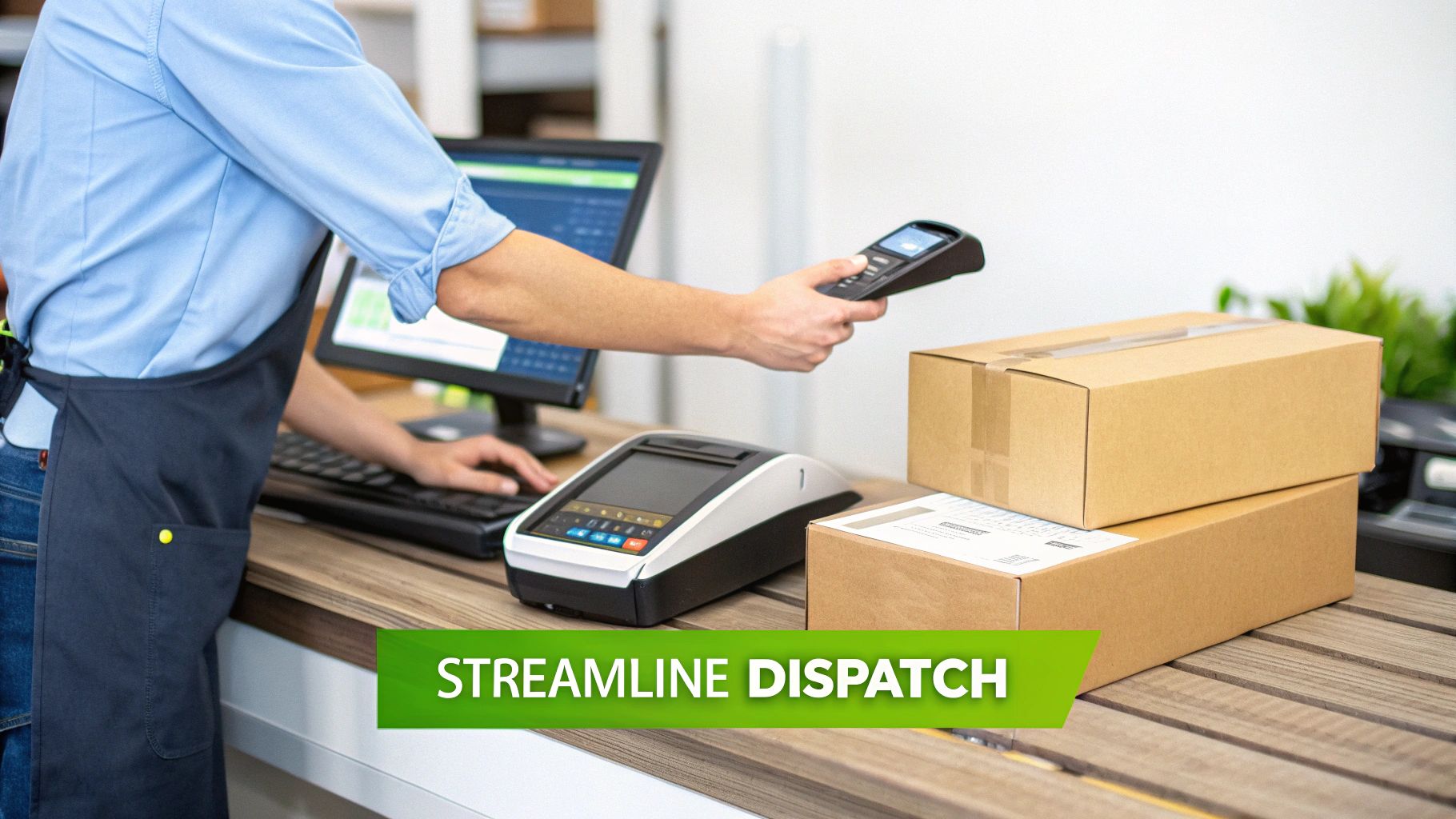
Think about what a typical dispatch day looks like with the standard Australia Post model. It often starts with plugging addresses and weights into the MyPost Business portal, one by one. After printing each label, you’re off to pack the orders, then load them up for the daily run to the local post office to drop them over the counter. It's a disjointed workflow that eats up staff hours—time you could be using to actually grow your business.
A Modernised Day in the Life
Now, let's compare that to a day with a platform like Aeros Couriers. Your work starts and ends in a single dashboard. Instead of tedious manual entry, you can upload a CSV of orders in one go or simply let your e-commerce store integration pull them in automatically.
From getting a quote to booking the pickup and printing the labels, the whole thing takes just a few clicks.
- Instant Quoting: You can see real-time prices from multiple carriers at once, so you know you're getting the best rate for every single parcel, every time.
- Online Booking: Forget post office runs. You can schedule a pickup directly from your warehouse, shop, or home office.
- Automated Label Generation: Create and print all your shipping labels in a single batch. If you want to dive deeper, our guide on streamlining your shipping labels and printing process has more detail.
- Centralised Tracking: Keep an eye on every shipment, no matter which carrier it’s with, all from one place.
Making this shift from a fragmented, manual process to a unified digital one is a massive step up in efficiency. It's not just about making life easier; it's about clawing back valuable hours every single week.
The Power of Flexible Pickups
One of the biggest operational headaches with a traditional postal service is simply getting your parcels into their network. Australia Post does offer paid pickup services, but they often have strict cut-off times and can be less accommodating, especially if you’re running your business from a residential address.
A modern courier platform, on the other hand, is designed for how businesses actually operate today. You can schedule pickups from almost anywhere—a commercial warehouse, a retail shop, even a home office. For small businesses and e-commerce stores that don't fit the traditional mould, this flexibility is a game-changer.
The ability to schedule a pickup from your doorstep, whether it's for one parcel or fifty, fundamentally changes your daily logistics. It transforms shipping from a time-consuming errand into a simple, integrated part of your fulfilment process.
This operational advantage is even more pronounced for businesses with multiple sites. Trying to manage shipments from different warehouses through Australia Post can be a logistical mess, often forcing you to use separate accounts. With a platform like Aeros Couriers, you can manage all outbound freight from every location under a single account. That top-down view of your entire shipping operation is a huge win for any growing enterprise.
Getting Serious About Insurance and Compliance
When you're sending anything valuable or tricky to handle, the game changes. It's no longer just about getting a package from A to B; it’s about managing risk. For any business, getting your head around insurance coverage and freight compliance isn't just a good idea—it’s essential. This is what stands between a small inconvenience and a massive financial headache.
If you’ve used a courier Australia Post service, you’ll know about their standard insurance. It typically covers loss or damage up to $100. That’s fine for sending a book or a t-shirt, but it leaves you exposed when you’re shipping more valuable goods.
Sure, you can buy Extra Cover from AusPost, but that means another manual step and an extra cost for your dispatch team. For a business shipping hundreds of items, managing that parcel by parcel is a recipe for mistakes and wasted time.
A Better Way to Handle Insurance
This is where modern courier platforms really pull ahead. A service like Aeros Couriers builds freight insurance right into the booking process. You simply declare the value of your goods, and the insurance cost is calculated on the spot. It's transparent, simple, and ensures every single parcel is properly covered without creating more admin work.
When you're picking a courier, you need to look past the headline numbers. Understanding the fine print of their coverage, like what Motor Truck Cargo Insurance actually covers, is key to protecting your shipments. It’s not just about the insured value but also how straightforward the claims process is. Business-focused platforms usually have dedicated support teams to sort out claims fast, keeping disruptions to a minimum.
The real win isn't just the dollar amount of the insurance; it's how seamlessly it fits into your workflow. An integrated system protects your business without slowing you down, making proper coverage an effortless default instead of a chore.
This kind of built-in approach frees up your team to focus on getting orders out the door, knowing that every shipment is automatically protected.
Staying on Top of Chain of Responsibility Laws
Insurance is one thing, but freight compliance is a whole other level of responsibility. In Australia, the Chain of Responsibility (CoR) laws mean that everyone in the supply chain is legally on the hook for breaches of road transport laws. This includes making sure goods are packed properly, weighed accurately, and restrained safely for transit.
For a smaller business, these rules can feel pretty overwhelming. While Australia Post offers some general guidelines, platforms designed for business often provide practical advice built right into their booking system. They’ll give you clear instructions on things like:
- Correct Packaging: Guidance on using the right boxes and filler to stop things from getting damaged or moving around.
- Accurate Declarations: Prompts to make sure the weight and dimensions you enter are spot on—a critical CoR requirement.
- Palletisation Standards: For bigger shipments, they provide clear rules for stacking and wrapping pallets so they travel safely.
Dealing with Dangerous and Restricted Goods
Compliance gets even more serious when you’re shipping dangerous goods (DG) or anything on the restricted list. Trying to send items like lithium batteries, aerosols, or flammable liquids requires you to follow very strict rules. Getting it wrong can lead to heavy fines and create genuine safety risks.
This is where a business-focused courier really proves its worth by acting as a compliance partner. Instead of leaving you to wade through dense regulations, a platform like Aeros Couriers will give you clear warnings and instructions if you try to ship something potentially hazardous. This proactive guidance helps you avoid costly mistakes and meet your legal duties. It's also crucial for making sure all your documents, like the consignment note, are filled out correctly. If you're not familiar with this document, it's worth learning what a consignment note is and why it's so vital for compliance.
At the end of the day, the right courier partner does more than just move your parcels. They give you the tools and framework to ship safely and legally, turning complex obligations into a simple, manageable part of your everyday operations.
Customer Support & Business Perks: Where the Real Value Lies
When you're choosing a courier, it’s easy to just look at the shipping rates. But what happens when something goes wrong? A lost parcel, a confused customer, an urgent delivery stuck in transit—this is where the true value of your courier partner shows.
With a massive operation like Australia Post, getting help often means navigating a large call centre. While they have a huge network, it’s built to serve millions of individual consumers. For a business, this can feel slow and impersonal, like you're just another ticket in a very long queue.
On the other hand, modern courier platforms are built from the ground up for business clients. That means you get direct access to local support teams who actually get it. They understand the commercial pressures you're under. When a delivery is critical, you need someone who can take charge of the problem right away, not just promise to "look into it".

This isn’t just a small difference; it’s a fundamental one. One support model is designed for the masses, the other is tailored to protect a business's revenue and reputation. For any small or medium-sized enterprise, fast, effective problem-solving isn’t a nice-to-have; it's absolutely essential.
Moving Beyond Delivery: A Look at Tangible Rewards
Great customer support is one thing, but the real mark of a modern courier partner is how they add value beyond just moving boxes. Australia Post's MyPost Business offers volume-based discounts, which is standard practice. But that's usually where the value stops. There aren’t any built-in loyalty schemes or tangible rewards that give back to your business in a meaningful way.
This is a huge missed opportunity and where forward-thinking platforms really stand out. Aeros Couriers, for instance, has a unique rewards program where every dollar you spend on shipping earns points. This isn't some gimmicky gesture; it's a direct financial perk that can benefit your entire organisation.
Turning a necessary expense like shipping into a source of value for other departments is a game-changer. It shifts your courier from being just another supplier to a genuine strategic partner for your business.
This creates a cycle of value that traditional postal services just can't match. It’s an acknowledgement that shipping is a major cost for businesses and offers a practical way to get some of that investment back.
How a Rewards Program Adds Real-World Business Value
The points earned through the Aeros Couriers program can be redeemed for thousands of branded merchandise items from our partner, Simply Merchandise. This creates tangible, budget-relieving value for multiple teams within your company:
- Marketing Teams: Imagine getting your next batch of branded pens, drink bottles, or tote bags for a trade show without touching your marketing budget. You can redeem points to get them, directly offsetting campaign costs.
- Procurement Teams: Need new office supplies or branded apparel for the team? The rewards program can cover it, freeing up operational funds for other priorities.
- HR Departments: Points can be used to source branded gear for new starter kits or staff recognition awards, boosting team morale without adding to the HR spend.
This value-add is a clear point of difference from the standard courier Australia Post model. It reframes the entire conversation around shipping—it's no longer just a cost centre, but an investment that delivers a measurable return.
By picking a partner that actively helps you hit your marketing and procurement goals, you’re not just sending parcels. You're making a smarter business decision that benefits your bottom line in multiple, creative ways.
Your Courier Questions, Answered
Choosing the right shipping partner feels like a big decision, and it is. There's a lot to weigh up. To help you get it right, we've tackled some of the most common questions Australian businesses ask when looking at Australia Post versus more modern courier platforms.
What’s Genuinely the Cheapest Way to Send a Parcel in Australia?
For most businesses, especially those shipping regularly, going direct to a single provider isn't the cheapest route. You'll almost always find better rates for metro deliveries on multi-carrier platforms that give you access to services like Sendle or Aramex.
The real advantage here is comparison. A good platform lays out all the options for your specific parcel in an instant. Instead of being locked into a single price list, you can see multiple live quotes side-by-side and simply pick the most cost-effective one. It’s a simple way to make sure you’re not overpaying.
Can I Get a Courier to Pick Up from My House?
Absolutely. This is one of the biggest practical differences you'll find. While Australia Post does offer a pickup service, it can be a bit rigid and sometimes comes with extra fees that aren't immediately obvious.
Modern courier platforms, on the other hand, are built for this. They offer flexible, reliable pickups from pretty much anywhere—be it a commercial warehouse or a home garage. This is a game-changer for home-based ecommerce businesses or anyone running things without a traditional shopfront. You just book the pickup from your computer, and you're done. No more daily post office runs.
The ease of booking residential pickups highlights a core difference in philosophy. One system is designed for the public mailing letters, the other is built from the ground up to support how modern businesses actually operate—from anywhere.
Is It Better to Use a Single Courier or Multiple Couriers?
Sticking with a single provider like Australia Post might feel simpler at first, but it's a classic case of putting all your eggs in one basket. If their network hits a snag or has a backlog—which happens—your entire operation grinds to a halt with it.
A multi-carrier strategy gives you options and makes your business far more resilient. You can spread the risk and, just as importantly, pick the right service for each job. Maybe you use an express specialist for your urgent metro deliveries but a budget-friendly carrier for standard, non-critical parcels. It’s about using the best tool for the job every single time, not making one tool fit every problem.
Ready to see what a smarter shipping strategy looks like? Aeros Couriers gives you direct access to competitive rates from a whole network of trusted carriers, all managed from one simple platform. Get an instant quote and see what you could be saving.
