



Welcome. If you're a small business owner or run an e-commerce store in Australia, you already know that shipping isn't just about moving boxes. It's about reputation, customer happiness, and ultimately, your bottom line. Getting it right can feel like a huge challenge, but with the right courier partner, it can be your greatest strength.
Let's dive in and demystify the world of Australian couriers. This guide is designed to show you how a smart, fast, and cheap shipping strategy for your boxes and parcels can set you apart.
Your Guide to Smarter Shipping Across Australia

The shipping industry can seem like a confusing maze of jargon, fluctuating prices, and hidden fees. But for any Australian business looking to grow, getting a handle on parcel delivery is non-negotiable. It’s the key to keeping customers happy, building trust, and competing effectively across the country.
This guide is here to give you the confidence to make sharp, budget-friendly shipping decisions every single time. We’re going to cut through the noise and focus squarely on what matters most for businesses like yours: getting parcels and boxes delivered quickly, reliably, and at the cheapest prices Australia-wide. No confusing logistics about heavy pallet freight here—just practical advice for the everyday items that drive your sales.
What This Guide Will Cover
This is all about putting you back in control of your shipping. You'll learn how to pick the right service for the job, get a clear picture of how pricing works, and pack your products like a pro so they always arrive in one piece. Most importantly, we'll show you how modern platforms have completely changed the game for small and medium-sized businesses across Australia.
By the time you're done, you'll be able to:
- Pinpoint the perfect courier service for any delivery, finding that sweet spot between speed and cost.
- Understand what drives shipping prices and learn a few tricks to keep your costs down.
- Navigate the booking and tracking process like you've been doing it for years.
- Transform your entire shipping operation into a smooth, positive experience for your customers.
Our goal is simple: to give you the insight to turn every package you send into a powerful message about your brand’s commitment to quality and service.
Making Shipping a Strength, Not a Stress
Think of your courier as a direct extension of your business. They are often the only 'face' of your company that your customer actually sees. A timely, professional delivery builds your reputation, but a single bad experience can damage it instantly.
The good news is that you no longer need the shipping volume of a corporate giant to access cheap rates and great service. Aggregator platforms like Aeros Couriers work by pooling the buying power of thousands of smaller businesses, giving everyone access to the kind of pricing that was once out of reach.
Curious about the savings? You can play around with an online shipping fee calculator to get instant quotes and see for yourself. This new way of working makes professional, fast Australia-wide delivery achievable for everyone, turning a potential headache into a genuine competitive advantage.
Understanding How a Courier Service Works
So, what really separates a modern courier from the old-school postal service? Think of a courier as a dedicated delivery partner for your business, built from the ground up for the speed, precision, and transparency your customers now demand. This is a world away from just dropping a letter in a post box; it's a dynamic, end-to-end logistics solution focused on local Australian delivery.
Unlike the standard mail system, a courier service is laser-focused on the fast, secure, door-to-door delivery of parcels and boxes. It's a specialised field that has become the absolute backbone of Australian e‑commerce, offering a level of care and accountability that traditional postal networks often can't match.
The Core Components of a Courier Service
At its heart, a great courier operation is a beautifully coordinated dance between smart technology and reliable transport. It brings together several key features to create a seamless experience for both you and your customer, always prioritising reliability and a great end result.
These core elements include:
- Real-Time Tracking: From the very first scan at pickup, you and your customer can follow the parcel's journey online. That visibility brings invaluable peace of mind.
- Signature on Delivery: For valuable or sensitive items, this gives you concrete proof that your package reached the right person, adding a crucial layer of security.
- Intuitive Booking Platforms: Gone are the days of fiddly paperwork. Modern couriers let you get instant quotes, book jobs, and print labels in minutes through simple online dashboards.
A courier doesn’t just move a box; they deliver a promise. Every successful delivery reinforces your brand's reputation for reliability and care, turning a simple transaction into a lasting customer relationship.
This focus on service and technology has fuelled some incredible growth. The Australian courier industry has exploded, with revenue climbing at a compound annual growth rate (CAGR) of 8.5% over the past five years to hit an estimated $13.7 billion in 2025. This surge is almost entirely driven by the e‑commerce boom, as more small businesses ship parcels nationwide than ever before. You can read the full report about the courier industry's rapid growth on IBISWorld.
Navigating the Australian Courier Ecosystem
The courier landscape in Australia is incredibly diverse. You’ve got the large national carriers with their own fleets of trucks and planes, right through to innovative aggregator platforms. These aggregators, like Aeros Couriers, are absolute game-changers for small and medium-sized businesses needing fast, cheap parcel delivery.
Think of an aggregator as a broker that unlocks the best deals from multiple carriers at once. By pooling the shipping volume of thousands of small businesses, they can negotiate wholesale rates you could never get on your own. It levels the playing field, allowing you to compete with the big players on shipping costs and service without being locked into a single provider. Every booking involves creating a specific document for the journey; you can learn more about what a consignment note is in our detailed guide.
Ultimately, choosing the right courier is one of the most important decisions you'll make. It directly shapes how customers see your brand and how smoothly your operations run. A strong courier partnership isn't just a service; it's a strategic asset that helps you build trust, earn repeat business, and grow with confidence.
Choosing the Right Courier Service Type
Every parcel you send has its own story and, more importantly, its own deadline. The real secret to happy customers and a healthy budget isn't just about shipping fast; it's about shipping smart. Picking the right type of courier service is a strategic decision—a careful balance of speed, cost, and the promise you make to your buyers. Get it right, and every delivery feels like a win.
Think of it like planning a trip. If you've got a crucial meeting across town, you'll grab a taxi for its speed and directness. But for a relaxed holiday up the coast, a scenic drive is the perfect fit. Your parcels are no different. The urgency and destination of your shipment should always dictate the service you choose.
This decision is more than just logistics; it's about matching the service to the situation to create a seamless experience for your customer. This simple decision tree can help you visualise whether a dedicated courier or standard post is the best path forward.
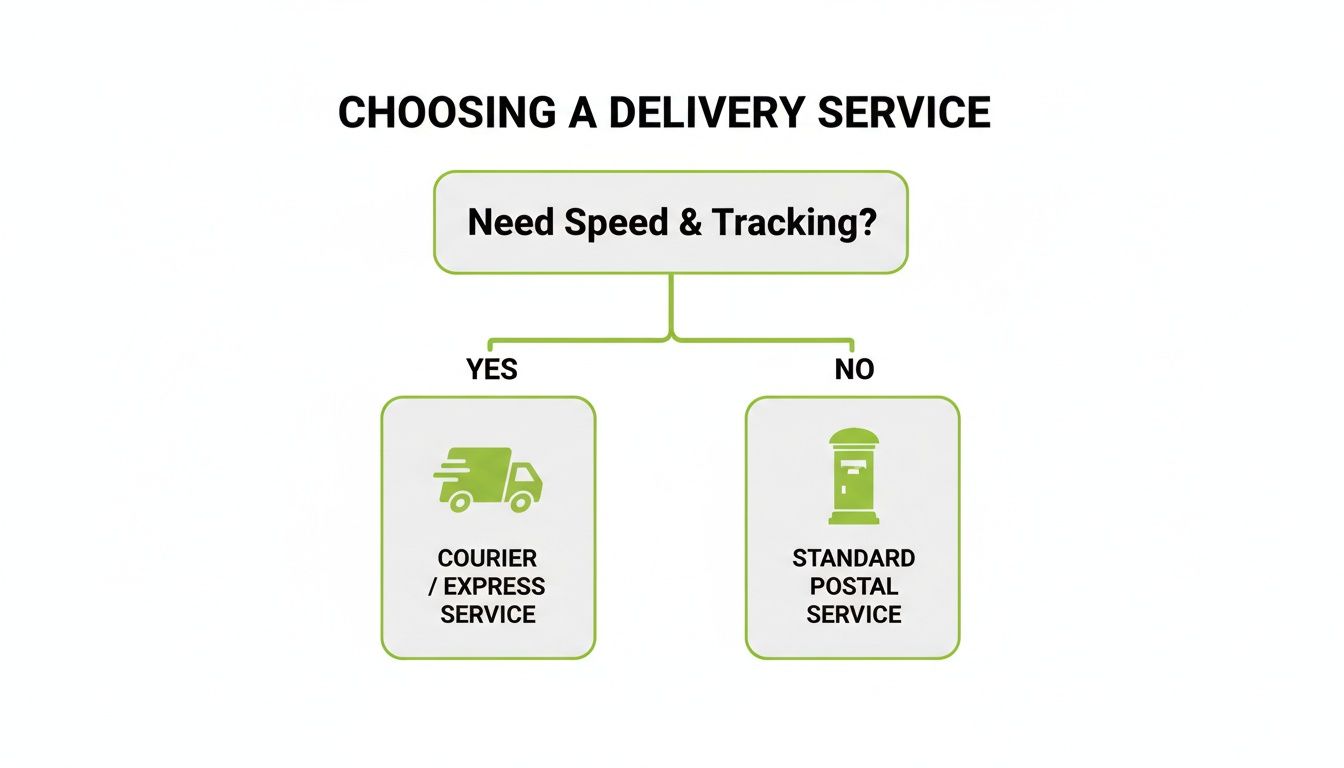
As the flowchart shows, when speed and real-time tracking are non-negotiable, a professional courier service is clearly the superior choice for any serious business.
Same-Day and Express Services for When It Absolutely Has to Be There
For those moments when time is the enemy, same-day and express courier services are your secret weapon. They’re built for the times when "tomorrow" just won't cut it, offering the fastest possible path for your parcels and boxes across Australia.
- Same-Day Courier: This is the ultimate service for ultra-urgent, local deliveries, typically within the same metro area. Picture a florist in Melbourne needing to get a last-minute anniversary bouquet to a customer in St Kilda. A same-day courier makes it happen, turning a potential disaster into a moment of pure delight.
- Express or Overnight Courier: Your go-to for speedy, next-business-day delivery between major Aussie cities. It’s perfect for a law firm sending critical documents from Sydney to a client in Brisbane or an online store that built its brand on the promise of lightning-fast shipping.
The demand for this kind of speed is exploding. Australia's last-mile delivery market is projected to grow at a CAGR of over 10.55% between 2025 and 2033. The same-day delivery segment alone, valued at AUD 1.52 billion in 2025, is on track to nearly double, proving just how much customers are willing to pay for immediacy. You can dive deeper into the rise of rapid delivery in Australia.
Standard and Economy Services for Smart, Cost-Effective Shipping
Speed is thrilling, but it isn't always the main character in the shipping story. For everyday, routine shipments, a sharp eye on the budget is far more important. That's where standard and economy services come in, giving you a reliable and affordable way to move goods when your timeline has a bit of breathing room.
Choosing a standard service for non-urgent shipments is one of the smartest financial moves you can make. You save on routine deliveries, which frees up your budget to wow customers with express options when it really counts.
These road services are the unsung heroes of the Australian courier network, quietly handling the vast majority of e-commerce orders and business-to-business stock transfers.
- Standard Road Service: This option strikes a fantastic balance between cost and a reasonable timeframe, usually delivering between capital cities in 2-5 business days. It's the ideal choice for a wholesaler sending regular stock replenishment to a retail partner.
- Economy Road Service: As the most budget-friendly choice, economy is perfect for non-urgent parcels and boxes. The delivery might take a little longer, but the savings can be massive.
To help you visualise your options, here’s a quick comparison of the most common service types.
Choosing the Right Australian Courier Service
A comparison of common courier service types to help you decide which is best for your specific shipping needs in Australia.
| Service Type | Best For | Typical Speed | Cost Level |
|---|---|---|---|
| Same-Day | Extremely urgent local deliveries, last-minute gifts, critical documents. | A few hours | Premium |
| Express/Overnight | Urgent interstate deliveries, time-sensitive e-commerce orders. | Next business day | High |
| Standard Road | Regular B2B shipments, non-urgent e-commerce orders. | 2-5 business days | Medium |
| Economy Road | Non-urgent boxes and parcels, non-time-sensitive stock transfers. | 5+ business days | Low |
This table makes it easy to see how each service fits a different piece of the puzzle.
Knowing when to invest in speed and when to lean into savings is the key to mastering your shipping strategy. For a closer look at what you can send, check out our guide on the essentials of a package courier service in Australia.
Ultimately, the perfect courier choice is about more than just moving a box. It’s about fulfilling your brand's promise and exceeding your customer’s expectations, one delivery at a time.
How Courier Pricing Works and How to Save Money
Ever sent two parcels that seemed almost identical, only to be hit with wildly different shipping costs? You're not alone. Unlocking the logic behind courier pricing is the first real step to getting your shipping budget under control. It's not magic; it’s a formula based on a few key factors, and once you grasp them, you'll see exactly where you can start saving money.
At the very heart of every courier quote is a concept that catches many people out: the difference between actual weight and cubic weight. This is the mechanism that stops someone from sending, say, a giant box of feathers across the country for pennies. Getting this right is absolutely fundamental to managing your parcel delivery costs.
Actual Weight vs Cubic Weight
Let's imagine you have two packages. The first is a small, dense box of books weighing 10 kg. The second is a huge, sprawling box of pillows that weighs only 5 kg. Which one do you think costs more to ship? It might just be the pillows.
Here's why: a courier cares about two things—how heavy your item is, and how much precious space it swallows up in their van. That space is what we call cubic weight (or volumetric weight). The courier will calculate both the actual weight and the cubic weight of your parcel, and then they'll charge you based on whichever number is higher.
Think of it like this: your parcel is paying rent for the space it occupies on the truck. A big, light item takes up valuable real estate that could have held several smaller, heavier packages.
This single principle is the key to smarter packaging. Simply by using the smallest box possible for your item, you shrink its cubic weight. That one small change can lead to some seriously big savings on every single thing you send.
The Main Drivers of Courier Costs
Beyond the weight and size puzzle, a few other elements come together to create the final price you see on the screen. Knowing what they are helps you make smarter choices to find the best rate for what you need.
- Distance: This one’s pretty straightforward. Sending a package from Sydney to Perth is naturally going to cost more than a quick trip across Melbourne. The further your parcel has to travel, the more it will cost.
- Delivery Speed: Urgency always has a price tag. An express, overnight service is a premium offering and will always be more expensive than a standard road service that might take a few days.
- Fuel Surcharges: Carriers have to account for the ever-changing cost of fuel. This is a variable surcharge that gets factored into your final price.
- Optional Extras: Things like requiring a signature on delivery or adding extra insurance for high-value items will add a little extra to the total.
Your Roadmap to Cheaper Shipping
Now for the good part—turning this knowledge into actual savings. You don't have to be a corporate giant to access cheap courier rates. The secret lies in using the right strategies and the right tools.
One of the most powerful moves you can make is to use a courier aggregator platform like Aeros Couriers. These platforms work by pooling the shipping volume of thousands of small businesses just like yours. This allows them to negotiate massive bulk wholesale rates with the major carriers, giving you instant access to the kind of cheap prices normally reserved for the big fish.
Here are a few more practical tips you can use right away:
- Compare, Compare, Compare: Don't ever just accept the first quote you see. An aggregator lays out the prices from multiple carriers side-by-side, so you can instantly spot the cheapest option for your specific delivery.
- Avoid Hidden Fees: Always look for a service that's transparent about costs. Hidden account fees or credit card surcharges are designed to catch you out and can add up fast.
- Embrace Rewards Programs: Why not get something back for your spend? Some platforms offer loyalty points on every dollar you spend on shipping. Aeros Couriers, for instance, lets you redeem points for over 10,000 merchandise items, which is a fantastic way to offset your shipping expenses.
When you combine smarter packaging with the power of an aggregator, you can genuinely slash your shipping expenses. To get a complete picture of all the factors in play, you can learn more about understanding Australian courier costs in our detailed guide. It’s all about empowering you to make every dollar you spend on shipping work harder for your business.
A Step-By-Step Guide to Booking and Tracking Your Parcels
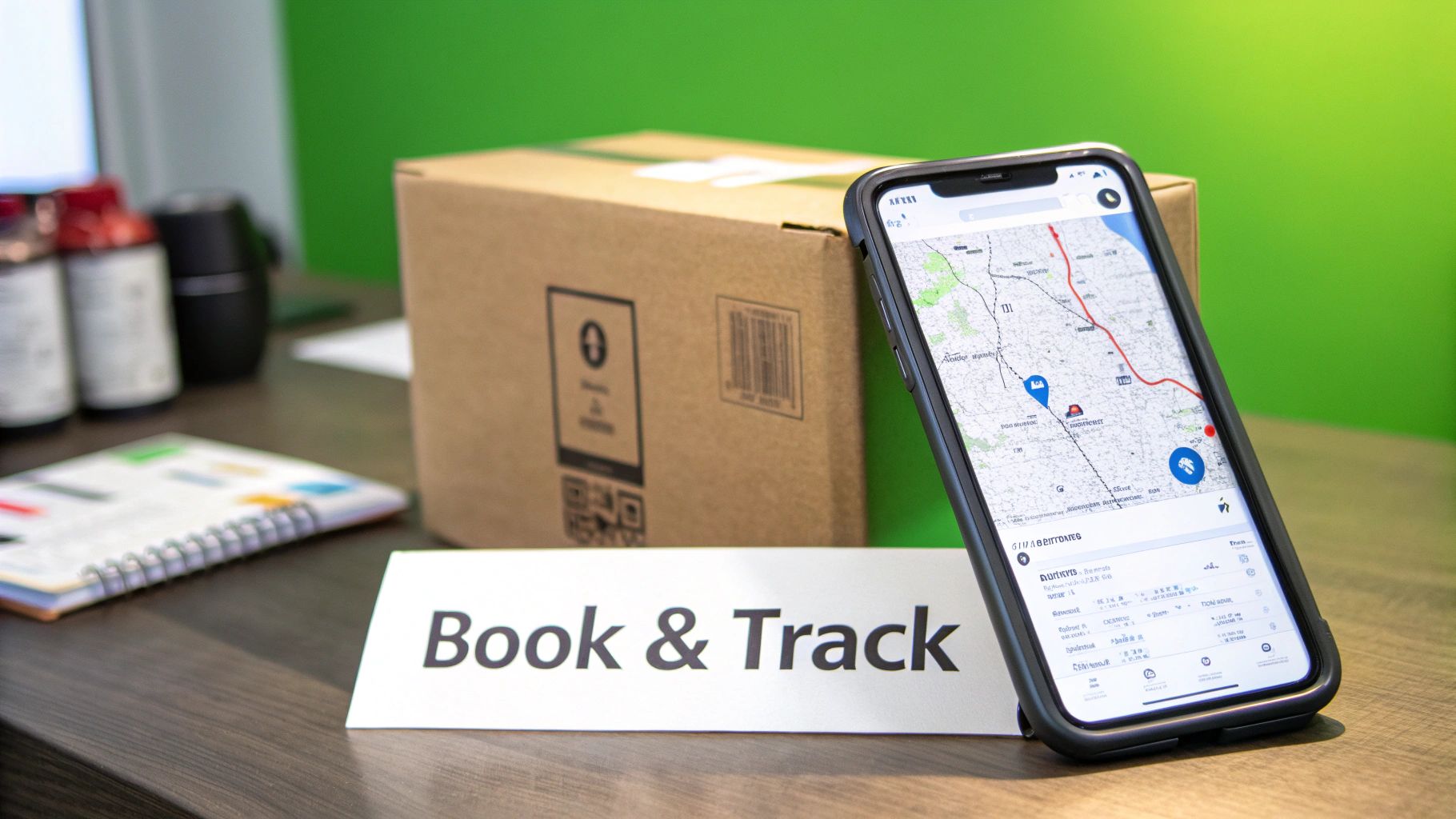
Sending a package anywhere in Australia shouldn't feel like a chore. It should feel simple, powerful, and completely in your control. Thanks to modern courier platforms, what used to be a complicated process is now just a few clicks away, giving you a direct line of sight from your door to its final destination.
Let’s break down the journey into five simple steps. Think of it as a clear roadmap—each turn is logical, efficient, and designed to get your parcel moving securely and keep you in the loop until it’s safely delivered. This is how you bring confidence and predictability to your shipping.
The Five Core Steps of Booking a Courier
Using a great online platform makes booking a courier service incredibly straightforward. You can manage the entire thing from a single dashboard, which is a massive time-saver. Here’s how it usually works:
- Get an Instant Quote: First up, punch in your parcel's details—where it’s coming from, where it’s going, and its size and weight. A good system will immediately give you a list of service options and prices.
- Select Your Service: Now you get to choose. You’ll see a range of options, from urgent overnight deliveries to more budget-friendly road services. It’s all about finding that perfect sweet spot between speed and cost.
- Print and Attach the Label: Once you’ve booked, you’ll get a shipping label to print. This is your parcel’s passport. It’s got all the barcodes and addresses the network needs to scan, sort, and track it automatically.
- Schedule a Pickup: Pick a time that works for you, and a courier will come right to your home or office to collect the parcel. Say goodbye to post office queues for good!
- Track Your Parcel in Real-Time: From the second your parcel is scanned at pickup, you can follow its journey with your unique tracking number. This kind of transparency is a game-changer for keeping your customers happy.
The shipping label is the single most important element in your parcel's journey. It’s the key that unlocks the entire courier network, ensuring your package is scanned, sorted, and tracked accurately at every stage.
Understanding Transit Times Across Australia
Ever wondered why sending a package to regional WA takes a bit longer than sending one across town in Melbourne? It all comes down to the sheer size of our beautiful country and the complex logistics needed to connect it all. This is where a transparent courier platform is worth its weight in gold, giving you clear Estimated Times of Arrival (ETAs) right from the start.
This incredible network is the lifeblood of Australian commerce. In fact, our nation's Courier, Express, and Parcel (CEP) market is set to hit a staggering AUD 33.94 billion by 2035, with domestic shipments accounting for over 62% of that. While roads do the heavy lifting, air freight is crucial, handling nearly half of all parcels to link up our most remote corners. You can explore more about the growth of Australia's CEP market for some fascinating insights.
Knowing the ETA before you even click "book" is incredibly empowering. It means you can confidently tell your customers when to expect their delivery, which builds massive trust and cuts down on those "where's my order?" calls. If you're curious about what all the tracking updates mean, our guide on what 'in transit' means for your parcel explains it all. This foresight transforms shipping from a guessing game into a reliable and powerful part of your customer promise.
Getting Your Packaging Spot-On for a Safe Journey
Think of great packaging as your shipment's first line of defence. In the hustle and bustle of a courier network, a well-packed parcel isn't just a nice-to-have—it’s the unsung hero that protects your products and, ultimately, your reputation. It's like dressing your item for a long road trip; it needs to be ready for every bump, slide, and handover along the way.
Spending a few extra minutes on packing can literally be the difference between a five-star review and a frustrating insurance claim. This is about more than just avoiding breakages. It’s about building trust and showing your customers you care, right from the moment their order leaves your hands. Let’s get into the essentials of doing it right.
Choosing the Right Box and Inner Protection
It all starts with the right container. Reusing that old, flimsy box from your last online order might seem like a good way to save a few cents, but it's a risky bet. Always start with a sturdy, new cardboard box that’s built to handle the journey.
The size of the box is just as important. If it’s too big, your item will slide around and risk getting damaged. Too small, and there’s no room for a protective buffer. You're looking for that 'Goldilocks' fit: a box that leaves just enough room to surround your product with a good layer of cushioning on all sides.
Here’s what every packing station should have:
- Sturdy Boxes: Go for high-quality, corrugated cardboard. For anything heavy or delicate, a double-walled box is your best friend.
- Good Cushioning: Bubble wrap is the classic go-to for protecting surfaces from scratches and scuffs. To fill any empty space, use void-fill like air pillows or packing peanuts to stop things from moving around inside.
- Strong Tape: This is not the place to cut corners. Use proper packing tape that’s at least 48 mm wide to seal every seam. The 'H-tape' method (taping across the middle seam and both edge seams) gives you the strongest seal.
Remember, your package will be handled many times and travel with hundreds of others. Proper cushioning is its personal shock absorber, protecting it from all the vibrations and bumps it will encounter.
Declaring Your Goods and Playing by the Rules
Once your item is packed up safe and sound, the next critical step is declaring exactly what’s inside. This isn't just about good business practice; in Australia, it's a legal requirement under the Chain of Responsibility (CoR) laws. These rules make everyone in the supply chain—including you, the sender—responsible for safety.
That means being completely upfront about what you're sending. Never, ever try to send prohibited or dangerous goods through a standard courier service. Trying to sneak something through by mis-declaring it to save a bit of money is a serious offence that can result in hefty fines, delays, or even having your shipment destroyed.
A clear, honest declaration ensures the courier knows how to handle your parcel, helping it move smoothly through the network without a hitch. It’s a simple act of integrity that keeps transport workers safe and shows you’re a professional, trustworthy business.
Got Questions About Courier Services? We’ve Got Answers.
Jumping into the world of shipping can feel a bit daunting. You want the best service, the best price, and zero headaches. We get it. To help you send your next parcel with complete confidence, we’ve put together answers to some of the most common questions we hear from people all across Australia.
Think of this as your practical, no-nonsense guide to getting your stuff from A to B.
What’s the Cheapest Way to Send a Parcel in Australia?
For the absolute best price, your go-to is almost always a standard road service. But the real secret to getting the rock-bottom rate isn't just about picking the slowest option—it's about comparing your options. This is where a courier comparison platform becomes your most powerful tool.
These platforms tap into pre-negotiated wholesale rates that you simply can't access on your own. In a single search, you can see every available service side-by-side and instantly grab the cheapest one for your parcel's exact size, weight, and destination. A couple of extra tips? Always use the smallest packaging possible to minimise cubic weight, and stick to road freight for anything that isn't time-sensitive.
How Do I Choose the Best Courier for My Small Business?
The perfect courier for a small business is more than just a delivery service; it's a partner that's reliable, affordable, and incredibly easy to work with. You should be looking for a platform that gives you instant online quotes, a booking process that takes seconds, and real-time tracking that keeps you (and your customers) in the loop.
Having access to multiple carriers on one platform is a game-changer. It gives you the flexibility to choose the right service for the right price, every single time, without being locked in.
Your best bet is to find a provider with no lock-in contracts or sneaky monthly account fees. Look for added perks like built-in freight insurance and loyalty rewards programmes—like the one we offer at Aeros Couriers. These features provide that crucial safety net and deliver real savings over time, which is exactly what a growing business needs.
Can I Send a Parcel Without a Printer for the Label?
Honestly, in almost every case, you'll need to print the shipping label yourself. That label is your parcel's passport. It holds the unique barcode and delivery details that the automated sorting machines and drivers depend on to get your shipment where it needs to go.
You’ll need to stick it securely onto your parcel before the courier shows up for the pickup. While some retail drop-off points might offer printing for a fee, it’s not a standard service for courier pickups. To make sure everything goes off without a hitch, it's always best to have a printer ready when you confirm your booking.
What Happens If My Parcel Gets Lost or Damaged?
If the worst happens and a parcel goes missing or arrives damaged, the very first thing you should do is contact the booking platform or courier to lodge a claim. Make sure you have your tracking number and some proof of the item's value handy, as they'll need it to get the process started.
This is exactly why freight insurance is so non-negotiable. A good courier platform will often include a certain level of cover with their service. This means there's already a clear, simple process in place for you to claim compensation up to a set value, giving you that vital peace of mind every time you ship.
Ready to see how easy and affordable sending parcels across Australia can be? Aeros Couriers plugs you directly into the cheapest wholesale rates from the country's most trusted carriers. Get a free quote in seconds and discover how much you could save.
