


Finding a great deal on parcel delivery across Australia isn't about luck—it's about being strategic. The smartest way to slash your shipping bill is to compare real-time quotes from several carriers and then make sure your packaging is the perfect fit for your item. This simple two-pronged attack stops you from paying to ship empty air and ensures you're tapping into the best rates available.
How to Find Australia's Cheapest Parcel Delivery
Let’s be real for a moment: shipping costs can be a killer. If you’re running an online store, they can eat into your profit margins. If you’re just sending a gift to a mate, the price can be surprisingly steep. The good news? Securing a cheap parcel delivery service doesn't have to mean sacrificing reliability.
The trick is to stop using the same old carrier out of habit. The courier that gave you the best price on a parcel from Sydney to Perth last week might not be the cheapest for a similar package heading from Melbourne to Brisbane today. Rates are constantly shifting based on things like a carrier's available space, fuel costs, and how busy a particular route is.
Why Getting Smart With Shipping Is a Game-Changer
For any business, getting a handle on shipping costs gives you a real edge. Every dollar you don't spend on freight is a dollar you can put back into your product, marketing, or looking after your customers. For the rest of us, it’s just more money in our back pocket. This guide is all about giving you practical, no-fluff advice to help you navigate the Australian courier world without getting ripped off.
Here's the key thing to remember: 'cheap' doesn't have to mean 'nasty'. With the right tools and a bit of know-how, you can use the best courier services in the country at prices that make sense. It’s about working smarter to find genuine value.
What This Guide Will Show You
We're going to cut through the jargon and give you a clear path to lowering your shipping expenses. We’ll cover everything you need to know, from the basics to some more advanced tricks.
Here's what you can expect to learn:
- Smart Packaging Essentials: Find out how picking the right box and packing materials can dramatically cut your costs before you've even booked a courier.
- The Power of Comparison: Learn how to use online platforms to your advantage, getting instant quotes from multiple couriers. For a deep dive, check out our guide on how to find a cheap courier in Australia.
- Next-Level Savings: We’ll get into tactics for bulk shipping, dodging surprise fees, and making sense of the price differences between metro and regional areas.
By the time you're done, you'll have a solid plan to make every single parcel you send as cost-effective as possible.
How Smart Packaging Reduces Shipping Costs
One of the most common—and costly—mistakes people make is paying to ship empty space. It sounds basic, but sending oversized boxes filled with a small item and a lot of air is a massive drain on any shipping budget. This is exactly why mastering the art of smart packaging is your first and best move for genuinely cheap parcel delivery.
The key concept you need to get your head around is dimensional weight, sometimes called cubic weight. Couriers will always charge you based on whichever is greater: the actual, physical weight of your parcel or its dimensional weight.
Think about it this way: a big, lightweight pillow takes up a lot more precious room in a delivery van than a small, heavy box of tools. Even if the pillow weighs next to nothing, its size costs the courier money, so they pass that cost on to you.
Understanding Dimensional Weight in Australia
Calculating dimensional weight is pretty straightforward. Couriers use a formula that multiplies the length, width, and height of your parcel, then divides that number by a specific factor. For most domestic Aussie services, this factor is 5000. The result is the parcel's "weight" in kilograms based purely on its size.
So, if your parcel's actual weight is 2kg but its dimensional weight works out to be 5kg, you're going to be charged for a 5kg parcel. That's how an unnecessarily large box can instantly double or triple your shipping cost without you even realising it.
The whole process, from packing right through to shipping, is about making smart choices at every step.
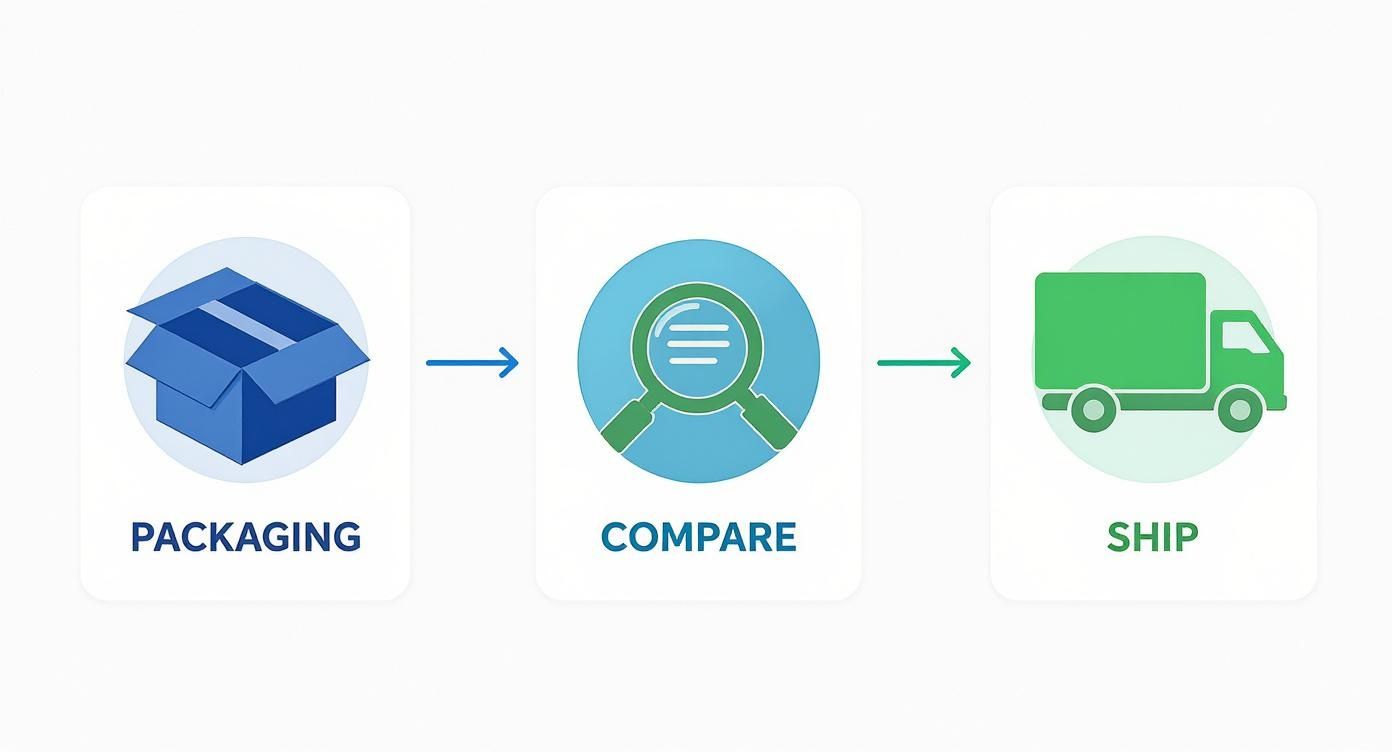
As you can see, getting the cost down starts with intelligent packaging long before you even start looking for a courier.
Practical Steps for Cost-Effective Packaging
Shaving even a few centimetres off your parcel's size can lead to serious savings, especially if you're shipping regularly. It’s a small habit that really pays off over time.
Here are a few actionable tips to get you packing smarter:
- Right-Size Your Boxes: Keep a few different box sizes on hand. Don't just default to a single large box for everything. You want the box to fit your product as snugly as possible, with just enough room for protective padding.
- Embrace Lightweight Fillers: Ditch heavy packing materials. Things like crushed paper, air pillows, or bubble wrap are fantastic because they add protection without adding much weight.
- Use Courier Satchels: For smaller, durable items like clothing, documents, or books, courier satchels are often the most economical option. They usually come with a fixed price based on size, which completely takes dimensional weight out of the equation.
- Don't Be Afraid to Modify: If you can’t find the perfect box, just alter one! Trimming a box down to size can be the difference that drops you into a lower, cheaper price bracket.
Every centimetre you trim from your package dimensions is a potential cost saving. For a business sending hundreds of parcels a year, this simple attention to detail can easily translate into thousands of dollars saved.
How Packaging Choices Impact Your Bill
Let's look at a real-world example. The table below shows how simply choosing the right box for the same item can dramatically change your shipping bill.
| Item Example | Poor Packaging Choice (Oversized Box) | Smart Packaging Choice (Right-Sized Box) | Estimated Cost Impact |
|---|---|---|---|
| Pair of boots (Actual weight: 1.5kg) | Box: 40cm x 30cm x 20cm Dimensional Weight: 4.8kg |
Box: 35cm x 25cm x 15cm Dimensional Weight: 2.6kg |
You are billed for nearly double the weight, potentially adding $5-$10 to the cost of a single domestic shipment. |
| Small electronic device (Actual weight: 0.8kg) | Box: 30cm x 30cm x 15cm Dimensional Weight: 2.7kg |
Padded Mailer/Small Box: 25cm x 20cm x 10cm Dimensional Weight: 1.0kg |
The oversized box triples the billable weight. This mistake could easily turn a $9 shipment into a $15 one. |
As you can see, the financial penalty for using the wrong box is immediate. By getting your packaging right from the start, you ensure the quotes you get are as low as they can possibly be.
Once you’ve got your parcel packed perfectly, you can send a parcel and see for yourself how these smart choices directly slash your final price.
Choosing the Right Courier Service for Your Needs
Once your parcel is perfectly packed and ready to go, you’ve hit a critical crossroad: picking the right courier. The Australian courier market is crowded, and it’s easy to feel overwhelmed by the sheer number of options, all claiming to be the best.
But here’s the secret from those of us who've been in the game a while: finding genuinely cheap parcel delivery isn't about loyalty to a single brand. It's about matching the right service to the specific needs of that one shipment. You don't need to be a logistics whiz to get this right.
Standard Versus Express Services
Your first and most important decision is choosing between a standard (road) service and an express (air) one. Think of a standard service as your everyday workhorse. It’s perfect for non-urgent deliveries where keeping costs down is the main goal. Your parcel travels by ground transport, so it takes a little longer, but the savings can be substantial.
Express services, on the other hand, are all about speed. These shipments usually go by air, promising next-day or even same-day delivery between major cities. That speed comes at a price, so it's best saved for things that genuinely can't wait—time-sensitive documents, an urgent replacement part for a customer, or high-value items where fast delivery is part of the premium service.
For most day-to-day shipping, a standard road service hits the sweet spot between reliability and affordability. Before you book, just ask yourself: "Does this really need to be there tomorrow?" If the answer is no, you've just found an easy way to save money.
This choice is more relevant than ever in Australia's massive parcel market. It’s now an AUD 18.83 billion industry, fuelled by the 5.6 million Aussie households who shop online every month. That huge volume means the demand for both cheap and reliable shipping is through the roof, forcing couriers to stay competitive.
The Power of Courier Aggregator Platforms
So, how do you find the best rate without spending your afternoon clicking through a dozen different courier websites? This is where courier aggregator platforms are a game-changer. Services like Aeros Couriers pull live quotes from multiple carriers and display them all on a single, clean interface.
Instead of doing all the legwork yourself, the platform handles it in seconds. You just enter your parcel's details—dimensions, weight, and destination—and you’ll instantly see a list of services from different couriers, sortable by price or speed.
This gives you two massive advantages:
- Access to Wholesale Rates: Aggregators process a huge volume of parcels, allowing them to negotiate bulk discounts with carriers. They pass those savings directly to you, so you often pay less than you would by booking direct.
- Unbiased Comparison: You can see, at a glance, which company is offering the best value for your specific parcel on that particular day. It takes the guesswork and brand bias completely out of the equation.
Essentially, when you use an aggregator, you’re tapping into the collective buying power of thousands of other senders to get a better deal for yourself. It’s one of the smartest strategies for locking in consistently cheap parcel delivery.
Smart Booking Tips The Pros Use
Beyond just comparing prices on a screen, a few simple habits can trim your costs even further and save you a lot of headaches.
Keep these pointers in mind every time you book:
- Pickup vs. Drop-off: Having a courier pick up from your home or office is incredibly convenient, but check if there’s a local drop-off point nearby (like a depot or partnered newsagent). Sometimes, dropping it off yourself can shave a few extra dollars off the price.
- Schedule in Advance: If you can, booking your parcel a day ahead of time can unlock better rates than a last-minute, same-day request. It also gives you peace of mind that you won't miss the daily pickup cut-off.
- Know Your Cut-Off Times: Every courier has a daily deadline for booking a same-day pickup, which is often around midday. If you book after that time, your parcel will likely sit there until the next business day. Always double-check this when you're booking an urgent shipment.
By being deliberate about the service you choose and using modern tools to compare your options, you take back control of your shipping costs. To dive deeper into what makes a great delivery partner, have a look at our guide on what to look for in a courier company.
Advanced Cost-Saving Strategies for Businesses
For any Australian business shipping products regularly, small savings on each parcel can snowball into a significant boost for your bottom line. Once you’ve nailed the basics of packaging and simple price comparisons, it’s time to level up. These are the tactics that make a real difference for operations that rely on frequent, cost-effective delivery.
The principle is simple: volume is your biggest bargaining chip. Whether you create that volume by bundling shipments or by committing to a platform that pools it for you, it’s the best way to access cheaper rates.
The Power of Shipment Consolidation
One of the smartest moves you can make is shipment consolidation. Let’s say you have five separate orders going to customers in the same general Melbourne suburb. Instead of sending five individual parcels on a long journey from your warehouse, you can bundle them into one larger shipment.
This single, consolidated box is sent to a local depot in Melbourne. From there, a local courier takes over for the 'last mile' delivery to each customer. You’re essentially paying for one long-haul trip instead of five, which is where the real savings kick in. It takes a bit more planning, but for businesses with customer hotspots in cities like Sydney, Brisbane, or Perth, the cost reduction is well worth the effort.
Knowing When to Palletise Your Freight
As your business grows, you'll hit a point where sending dozens of individual cartons just doesn't make sense anymore. This is your cue to start palletising your freight. By stacking and shrink-wrapping multiple boxes onto a single pallet, you create one stable, easy-to-handle unit for freight carriers.
So, how do you know it's time to make the switch?
- The Weight Test: If you're regularly sending shipments over 100-150 kg to a single commercial address, get a quote for pallet freight. It’s often surprisingly cheaper.
- The Box Count: Sending more than 10-15 boxes to the same place? The time and money saved by moving one pallet almost always beats handling each box individually.
- Safety and Security: A well-wrapped pallet is incredibly secure. It dramatically lowers the risk of individual boxes getting damaged or going missing in transit compared to loose items.
Moving from parcels to pallets is a natural step for any scaling business looking to get serious about its logistics.
The decision to palletise isn't just about weight; it's a strategic choice. It signals a shift from reactive shipping to proactive freight management, directly impacting your bottom line and operational efficiency.
For businesses, understanding these nuances is key. You can find more detailed advice on mastering shipping logistics and costs, which dives deeper into how to manage freight for maximum efficiency, even for niche products.
Negotiating Rates and Leveraging Business Accounts
Never accept the first price you see as the final word, especially if you're shipping often. Your volume gives you leverage. While you could try to negotiate discounts directly with major carriers, they usually want to see a massive, consistent monthly spend before they'll offer special rates.
For most small and medium businesses, a much easier route is using a platform with pre-negotiated business accounts. At Aeros Couriers, for instance, we’ve already done the hard work. We pool the shipping volume of all our users to secure wholesale rates, giving you immediate access to discounts you couldn’t possibly get on your own. It's the simplest way to get bulk pricing power without needing bulk volume. See the difference for yourself with our shipping quote calculator for an instant comparison.
Unlocking Value with Loyalty and Rewards Programs
Finally, don’t ignore the long-term perks. A good initial rate is great, but some platforms offer loyalty programs that keep delivering value. With every parcel you book, you can earn points that translate into real-world business benefits.
Think of it as a cashback program for your logistics. With the Aeros Couriers rewards program, the points you earn can be redeemed for over 10,000 items, including custom-branded merchandise for your own business. This turns a standard operational cost into a smart investment in your marketing. It’s a savvy way to make your shipping budget work harder and smarter for you.
Avoiding Hidden Fees and Regional Surcharges

We’ve all been there. You find what looks like a bargain for shipping, click through the booking process, and then—BAM. The final price on the payment screen is suddenly much higher than the quote you started with. It's a frustratingly common experience, usually caused by a minefield of hidden fees and surcharges that aren't always clear upfront.
If you want to secure a genuinely cheap parcel delivery, you have to look beyond the initial number. That first price is just the base rate; plenty of other factors can inflate the final bill if you're not paying attention.
Why Regional Deliveries Cost More
Let's be practical. Sending a package from Sydney to Melbourne is a world away from shipping something to Port Hedland. The major capital city routes are high-volume, well-oiled machines, which naturally keeps the costs down. But getting a parcel to a regional or remote town? That’s a whole different logistical beast.
This is exactly why the remote area surcharge exists. Couriers add this fee to cover the extra fuel, time, and operational costs needed to service postcodes outside their main delivery networks. It’s a legitimate charge, but it can certainly sting if you weren't expecting it.
With regional e-commerce booming, these costs are more relevant than ever. In one recent peak season alone, Australia Post handled nearly 103 million parcels, with a huge chunk of that growth coming from places like the Northern Territory and Tasmania. It just goes to show how vital transparent pricing is for everyone, especially as more Aussies outside the big cities shop online.
Common Surcharges and How to Prevent Them
It's not just about geography, though. A whole host of other little fees can pop up and derail your budget. Knowing what they are is the first step to sidestepping them.
Before we dive into the specifics, it's worth noting that most of these extra charges are triggered by simple, avoidable mistakes. Here’s a quick rundown of the usual suspects.
Common Surcharges and How to Avoid Them
| Surcharge Type | Typical Reason | Prevention Strategy |
|---|---|---|
| Futile Pickup Fee | The courier shows up for a booked pickup, but the parcel isn't ready or available to be collected. | Be realistic with your pickup time. Always make sure your package is good to go well before the driver's arrival window. If you need to reschedule, cancel the pickup in advance. |
| Manual Handling Fee | This gets applied to parcels that are oddly shaped, too big, or poorly packed, meaning they can't go on the automated sorting belts and need to be handled by a person. | Stick to standard, sturdy cardboard boxes. Make sure your parcel is sealed up tight and stays within the courier's dimension and weight limits. |
| Redelivery Fee | A delivery is attempted, but no one's home to sign for it, and there's no safe place or authority to leave it. | If it’s safe, always provide an "Authority to Leave" (ATL) instruction. Another great option is to ship to a business address where you know someone will be there during work hours. |
| Address Correction Fee | The address is wrong or incomplete (think missing unit numbers or a typo in the postcode), forcing the courier to spend time fixing it. | Triple-check every part of the address before you book. A tiny mistake here can easily turn into a costly one. |
As you can see, a little bit of care during the booking process goes a long way in keeping your costs down.
The single most effective way to avoid unexpected fees is to be meticulous with the details you provide. Accurate dimensions, weight, and a complete, correct address are your best defence against bill shock.
The Importance of an All-Inclusive Quote
Ultimately, the only way to budget properly is to know the full cost before you hit "confirm." This is where a good quoting tool becomes your best friend.
When you use a platform like Aeros Couriers, the price you see is the price you pay. Our system is built to factor in all the potential costs right from the start. If your destination is considered remote, that surcharge is automatically calculated and included in the quote you get. No guesswork, no nasty surprises. This transparency means you can compare your options and find the truly cheapest parcel delivery with confidence.
Ready to see for yourself? Get an instant, all-inclusive price with our tool to calculate shipping charges.
One last thing: don’t forget about transit insurance. It might seem like an optional extra, but for anything valuable, skipping it is a false economy. The small upfront cost protects you from the much larger financial hit if your parcel gets lost or damaged. That’s the kind of "hidden cost" you really want to avoid.
Got Questions About Cheap Parcel Delivery? We've Got Answers.
Even after you've nailed down the basics, you'll always have those specific, nagging questions when you’re trying to find the best deal on sending a parcel in Australia. Let's tackle the most common ones we get asked, giving you straight, practical answers to get you over the line and lock in a great price.
We've covered everything from smart packaging to pro-level business tactics, so think of this as your go-to cheat sheet for solving those tricky little shipping hurdles.
What's Genuinely the Cheapest Way to Send a Small Parcel in Australia?
For a small, non-urgent parcel heading between major hubs like Sydney and Melbourne, your best bet is almost always a courier comparison website. The rates you'll find on platforms like Aeros Couriers for standard road services can often be surprisingly cheaper than what you'd pay at the post office, especially if you can drop the parcel off at a local point instead of booking a home pickup.
The secret to saving money on smaller items is flexibility. If you’re not in a rush, a standard road service will always be significantly lighter on your wallet than express air freight. Before you even think about getting a quote, though, do this one thing: measure and weigh your item accurately. Honestly, this is the single most important step to getting a precise, low-cost quote that won't come back to bite you later.
Are Courier Comparison Websites Really Cheaper Than Booking Direct?
Yes, almost every single time. It seems a bit odd at first, but it comes down to buying power. These platforms work on a massive volume model, negotiating wholesale rates with major carriers that an individual or a small business just can't get on their own.
They then pass most of those savings directly on to you. But the real value isn't just the dollar figure; it's the time and headache you save. Instead of bouncing between half a dozen courier websites to manually compare prices, you get one simple screen showing all your options. This lets you instantly see the perfect balance of price and speed for what you need.
Think of a comparison platform as your personal logistics negotiator. It uses the combined buying power of thousands of people to get you a better deal, turning a tedious job into a quick, two-minute task.
How Do I Dodge Unexpected Fees for Regional Deliveries?
Accuracy is your best friend when it comes to avoiding surprise charges for regional shipments. When you’re getting a quote, always use the full, validated address, and double-check that postcode. A simple typo can easily trigger an address correction fee down the track.
Your best strategy is to use a quoting tool that clearly shows all the potential costs, including any 'remote area surcharge,' before you pay. That transparency is crucial for sticking to your budget. If you're sending to somewhere seriously out in the sticks, it might even be worth seeing if you can ship it to a central depot in a larger regional town nearby. The person receiving it might have to drive to collect it, but this can sometimes sidestep the priciest last-mile delivery fees.
Is It Really Worth Paying Extra for Tracking and Insurance?
Absolutely. For anything of value, it’s not even a question. In today’s world, basic tracking comes standard with any decent courier service—if a company doesn’t offer it, you shouldn't even consider using them.
As for insurance, often called transit cover, it's an incredibly smart and affordable investment. The cost is usually just a tiny percentage of your item's value, but it gives you complete peace of mind, protecting you from a total financial loss if your parcel gets lost or damaged on its journey.
Skipping insurance is a classic case of being penny-wise and pound-foolish. The few dollars you might save are just not worth the risk of losing the entire value of what you're sending. Just take a moment to check the insurance policy before you book to make sure the cover is high enough for your item.
Ready to put this advice into action and see just how much you could save? Aeros Couriers gives you the power to instantly compare quotes from Australia's top carriers, so you know you're always getting the best deal. Get your free, all-inclusive quote now and start shipping smarter.
