


When you're looking for a cheap courier in Australia, it’s not just about grabbing the lowest price you can find. It’s about securing the smartest value for what you need to send. Real affordability is that sweet spot where a great price meets the peace of mind that your parcel will get there safely and on schedule.
What a Cheap Courier Really Means in Australia

Think of it like booking a flight. You wouldn't expect a quick hop from Sydney to Melbourne to cost the same as a long-haul flight from Perth to Cairns, especially if you’re lugging extra baggage. The cheapest option for one journey would be completely wrong for the other.
It's the exact same story with shipping parcels. The most budget-friendly service for a small document zipping across a major city is almost never the right choice for a heavy, awkward item heading to a regional town. It all comes down to finding the perfect balance.
The True Meaning of Value
A genuinely cheap courier service is one that nails the trifecta of cost, speed, and reliability. If you compromise too much on any one of these, you'll run into hidden costs down the line. We’re talking about lost customers due to frustrating delays or damaged goods from a handler who just doesn’t care.
This guide is designed to give you the confidence to navigate the Aussie courier market. We'll show you how to find services that save you money without forcing you to gamble on the quality your business or personal deliveries rely on.
The goal isn’t just to find a low price, but to lock in a service that actually delivers on its promises. This protects your reputation, keeps customers happy, and ultimately helps your bottom line.
For online businesses, a good courier experience boosts customer satisfaction and can even drive sales, much like the benefits of live chat for e-commerce. Both are simply smart investments in a better customer journey.
Balancing Cost and Quality
Getting your head around this balance is the first step to making better shipping decisions. A bargain-basement price tag quickly loses its appeal when a parcel goes missing or arrives late.
To make it work, you need to understand the relationship between affordability and dependability. You can find a reliable courier service in Australia that fits your budget, and this guide will show you exactly how to do it. The aim is to make every dollar you spend on shipping a dollar well spent.
Understanding What Drives Courier Costs
Ever get a courier quote and scratch your head, wondering how they landed on that exact number? It’s not just plucked out of thin air. The final price is a mix of a few key ingredients, and knowing what they are is the first step to actually finding a cheap courier that doesn't cut corners.
Think of it like building a custom sandwich. The bread and main fillings—size, weight, and distance—make up the base price. Then you have the extras, like speed and special handling, which are like adding premium toppings. Each one tweaks the final cost. Once you understand the recipe, you can start making smarter choices to get the best value.
The Big Three: Dimensions, Weight, and Distance
Most of what you pay for comes down to the physical reality of your parcel and where it's headed. These are the factors that determine how much space, fuel, and time your shipment will take up in the carrier's network.
- Weight and Dimensions (aka Volumetric Weight): It’s not just about how heavy your parcel is. Couriers are just as concerned with how much room it takes up in their van or plane. This is where volumetric weight (sometimes called cubic weight) comes in. A big, light box of styrofoam might actually cost more to ship than a small, heavy box of bolts because it eats up so much precious cargo space.
- Distance and Destination: This one’s pretty straightforward—the further your parcel travels, the more it costs in fuel and labour. But here’s the crucial part: there’s a massive difference between metro and regional deliveries. Sending a package from a warehouse in Western Sydney to an office in the CBD is always going to be cheaper than sending that same item to a remote farm in rural Queensland.
Service Level and Speed
The next big piece of the pricing puzzle is how fast you need it to get there. Just like booking a flight, you’ll always pay more for speed and priority.
In Australia, you’ll generally see services broken down into these tiers:
- Standard/Road Express: This is your go-to for non-urgent deliveries. It's the most budget-friendly option and usually takes a few business days.
- Express/Overnight: Need it there faster? Express services get your parcel prioritised, often guaranteeing next-business-day delivery between major cities.
- Same-Day/Urgent: This is the premium, top-tier service for when it absolutely has to be there now. Think critical documents or emergency parts, with pickup and delivery happening within hours.
Honestly, choosing the right service level is one of the easiest ways to find a cheap courier rate. If your delivery isn't time-sensitive, just opting for the standard road service can slash your costs significantly.
Australia's courier market is booming, thanks in large part to the explosion of e-commerce. It's set to grow from AUD 18 billion to over AUD 30 billion by 2034. For you, this means more competition and choice, but it also makes it more important than ever to understand the pricing game to find the genuine bargains.
Demystifying Surcharges and Hidden Fees
Finally, there are the surcharges—those little extras that can unexpectedly inflate your bill. Knowing about them helps you avoid them or at least factor them into your budget from the start. For a deeper dive, check out our complete guide to understanding Australian courier costs.
Here are some of the usual suspects:
- Fuel Levy: A variable percentage tacked on to cover the ever-changing price of fuel.
- Residential Delivery: It often costs a bit more to deliver to a house than a business, simply because there are fewer deliveries in one area and potential access issues.
- Futile Pickup: If the driver shows up to collect a parcel and it isn't ready to go, you might get pinged with a fee for the wasted trip.
- Manual Handling Fee: This gets applied to items that are awkwardly shaped, poorly packed, or just too clunky to go through the automated sorting machines.
Beyond these direct costs, remember that the true expense of shipping can also be impacted by hiccups in the delivery process. Properly securing your supply chain with logistics support can be a smart investment, protecting you from costly damages or delays that add to your total spend. By getting a handle on these core components, you shift from just accepting a price to actively controlling it, putting you in the best position to find real value.
How Smart Packaging Can Slash Your Shipping Fees

When hunting for a cheap courier, it’s easy to focus only on the quotes. But one of the most powerful and often overlooked tools for cutting costs is sitting right on your packing bench. How you pack your shipment isn't just about keeping things safe; it's a direct way to lower your costs before a courier even lays eyes on it.
From the box you choose to the way you secure your items, every decision directly influences the final price. Think of it as an investment in savings.
Avoiding the Volumetric Weight Trap
Here’s the biggest mistake people make: thinking only the actual weight of their item matters. In the world of logistics, space is money. This is where volumetric weight (or cubic weight) comes into play—it’s how couriers charge you for the space your parcel takes up in their truck or plane.
Imagine you’re sending a single fluffy pillow. It weighs next to nothing, but you put it in a massive box. That box now takes up the same amount of room as a much heavier, denser item. The courier isn't going to charge you for a few hundred grams; they'll charge you for the bulky space it consumes.
To sidestep this trap, you need to shrink your parcel's footprint. Always pick a box that’s just big enough to safely house your item with a bit of protective filler, and not an inch more. Shaving off even a few centimetres from each dimension can lead to surprisingly big savings, especially when you're shipping regularly.
Secure Packing Is Your Best (and Cheapest) Insurance
A bargain courier quote becomes meaningless the moment your item arrives smashed to bits. The cost and headache of dealing with returns, replacements, and insurance claims will quickly erase any initial savings.
Proper packing is your first and best line of defence. It’s a non-negotiable step that protects your bottom line and your reputation.
- Go for a Sturdy Box: Always start with a new, double-walled corrugated cardboard box for maximum strength.
- Wrap Items Individually: Give each item its own protective layer of bubble wrap or foam.
- Fill All the Gaps: Use packing peanuts, air pillows, or even scrunched-up paper to fill every void. Nothing inside should be able to shift, rattle, or slide around during its journey.
- Seal It Like a Pro: Use strong packing tape and apply it using the 'H-taping' method to secure all seams and edges.
Packing your items correctly isn't just about preventing breakage. You're actively reducing the total cost of the delivery by eliminating the financial sting of returns and unhappy customers.
For any business, optimising this process is a cornerstone of achieving genuinely cheap parcel delivery across Australia. It’s a simple, practical part of a smart shipping strategy.
Pallets and Dangerous Goods: Getting the Big Stuff Right
These core principles of smart preparation are even more critical for larger or more complex shipments, where a small mistake can lead to some seriously big fees.
Palletising for Bulk Shipments
If you’re sending a large number of items to a single destination, consolidating them onto a pallet can be much more cost-effective. The catch? An improperly prepared pallet will get hit with non-conformance fees. You must ensure your goods are stacked squarely within the pallet’s footprint, are completely stable, and are shrink-wrapped securely to the base. This makes them easy for machinery to handle and keeps you clear of manual handling surcharges.
Declaring Dangerous Goods
It is absolutely vital that you declare any Dangerous Goods (DGs) you are sending within Australia. Many people don't realise this includes common, everyday items like:
- Perfumes and aftershaves (flammable liquids)
- Aerosol cans
- Anything with a lithium battery (laptops, phones, power tools)
Failing to declare DGs isn't just breaking a courier's rules—it’s a major safety hazard and a legal issue. The consequences can range from massive fines and shipment seizures to putting transport workers in real danger. Always check the domestic regulations and declare your items correctly. The small fee is nothing compared to the penalties for getting it wrong.
Getting to Know the Australian Courier and Parcel Scene
To find a genuinely cheap courier, you first need to get a lay of the land. The Australian shipping market is a busy mix of huge national networks, quick-on-their-feet local specialists, and the ever-present Australia Post. Knowing what each one does best is the secret to making a smart choice that actually saves you money.
Think of it like choosing how to get around a new city. You could take the national train line for a long-haul trip, hop on a local bus for a quick ride downtown, or use a ride-sharing app for flexibility. No single option is perfect for every journey; it all comes down to where you're going.
Major National Carriers
These are the household names you see everywhere—the big rigs on the highway and the branded vans in every city. Companies like Toll, TNT (now part of FedEx), and StarTrack (owned by Australia Post) are built for massive scale. They have the depots, trucks, and planes to move anything from a small satchel to a full pallet load right across the country.
Their biggest advantage is their sheer reach. They connect major cities and most regional hubs with reliable, trackable services, offering everything from standard road freight to urgent overnight air express. While they might not always be the absolute cheapest for a simple one-off job, their massive infrastructure makes them a rock-solid choice for consistent, nationwide shipping.
Specialised Local and Regional Couriers
Working in the shadows of the giants are countless smaller couriers who have carved out a specific niche. These operators often focus on a single area, like the Sydney metro region or just regional Victoria. A local courier that only does Melbourne deliveries can often provide incredibly sharp pricing and much faster service within that zone because their entire operation is fine-tuned for it.
Their focus is their superpower. By not trying to be everything to everyone, they can offer a service that feels more personal and is often more efficient for specific routes. If you're a business that ships mostly to customers in your own city, teaming up with a local specialist can be a fantastic way to slash costs and speed up deliveries.
The Australian courier market isn't a one-size-fits-all system. The cheapest and most efficient option is often found by matching your specific delivery need—whether it’s metro, regional, or interstate—to the right type of provider.
The Role of Australia Post
Of course, no conversation about Australian shipping is complete without mentioning Australia Post. As our national postal service, its ability to reach every single corner of the country, especially rural and remote areas, is second to none. It’s a massive player in the cheap courier market, particularly for e-commerce sellers sending small parcels. In a recent fiscal year, its revenue hit a staggering AUD 9.45 billion, partly fuelled by delivering a record 102.8 million parcels during a single Christmas rush.
To make things even easier, it also grew its Parcel Locker network by nearly 19%, now offering over 900 locations for 24/7 collections. While Australia Post is often a competitive choice for small packages and regional deliveries, it's just one part of a much bigger picture. You can read more about Australia Post's performance and market position to see just how significant its role is.
To help you decide, let's break down how these different service types stack up against each other. Each has its own sweet spot, and understanding them is key to not overpaying.
Comparing Courier Service Types in Australia
| Service Type | Best For | Typical Cost | Key Advantage |
|---|---|---|---|
| National Carriers | Interstate & consistent nationwide shipping | Moderate to High | Unmatched reach and comprehensive service options |
| Local/Regional Couriers | Same-city & short-haul deliveries | Low to Moderate | Speed, cost-effectiveness within a defined zone |
| Australia Post | Small parcels, e-commerce, remote areas | Low | Unbeatable coverage, especially in rural Australia |
| Comparison Platforms | All shipment types | Varies (finds the lowest) | Instantly compares all options to find the best deal |
As you can see, the "best" courier really depends on your specific needs for that particular parcel. The trick is having an easy way to see all your options at once.
The Smartest Tool in Your Kit: Courier Comparison Platforms
So, how do you decide between a national giant, a local hero, or Australia Post without spending hours on research? You don't have to. The most powerful tool for finding a genuinely cheap courier is a comparison platform like Aeros Couriers. These platforms are essentially marketplaces that pull in live quotes from dozens of providers and show them to you on one simple screen.
Instead of typing your parcel details into five different websites, you do it once and instantly see a whole list of prices and delivery timeframes. This is, without a doubt, the best way to ensure you're getting the sharpest rate for every single shipment you send. By exploring all your options, you can choose the perfect Australian courier company for the job, balancing cost and service without having to compromise.
Your Step-by-Step Guide to Booking the Best Rate
Okay, we've covered the theory. Now, let’s get practical and turn that knowledge into real savings. This is your hands-on guide to using a modern courier comparison platform like Aeros Couriers. We'll walk through the entire process, from getting a quick quote to booking and tracking your delivery, so you can lock in a great price without any of the usual guesswork.
The whole point of these platforms is to make shipping simple, transparent, and fast. Let's dive in.
Step 1: Get an Instant Quote
Finding a good rate starts with good information. Getting this first step right is the single most important thing you can do to avoid nasty surprises and extra fees down the track. A courier comparison platform gives you a simple form to fill out.
- Enter Pickup and Delivery Suburbs: Just pop in the origin and destination postcodes.
- Provide Precise Dimensions and Weight: This is crucial. Don't guess! Grab a measuring tape and scales to get the exact length, width, height, and weight of your parcel after it's been fully packed.
Once you’ve punched in those details, the platform does all the hard work. You can use a free shipping quote calculator to see live rates from a whole range of carriers in a matter of seconds.
Step 2: Compare Your Options
After submitting your parcel's details, you'll see a list of available courier services. This is where you get to be strategic and pick the service that perfectly matches what you need for this specific shipment.
Typically, you'll see a few different service levels to choose from:
- Economy/Standard: Your go-to, most budget-friendly option for deliveries that aren't in a massive rush.
- Express: A faster service, often promising next-business-day delivery between major Australian cities.
- Same-Day: The premium choice for those time-critical local drops that absolutely have to be there today.
Each option will clearly show the courier's name, the estimated delivery timeframe, and of course, the price. This side-by-side view lets you instantly find that sweet spot between cost and speed for every single thing you send.
This is how comparison platforms bring all your shipping options together, giving you the best of both worlds.
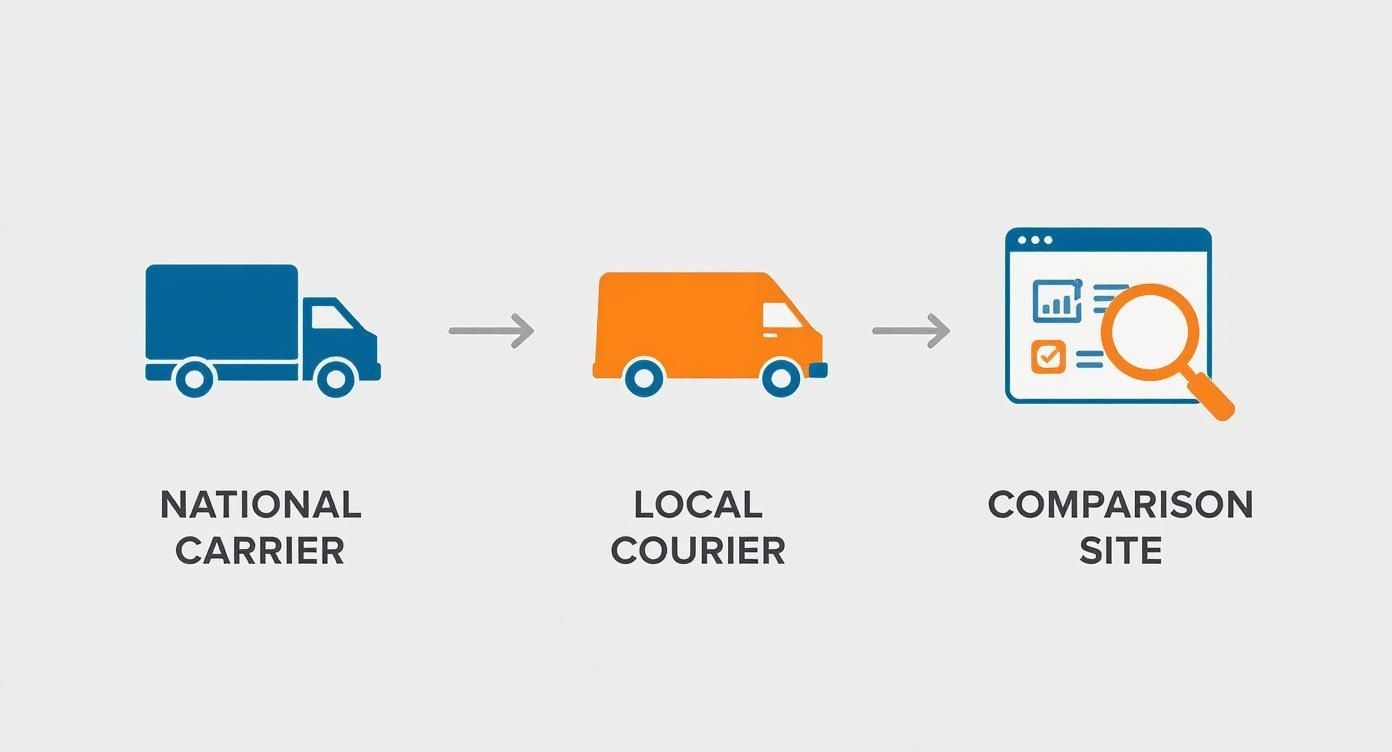
The real power here is that a comparison tool acts as a central hub. It gives you access to the big national players and the nimble local specialists without you having to visit a dozen different websites.
Step 3: Book and Prepare Your Shipment
Happy with your choice? Booking the service takes just a few more clicks. You’ll just need to confirm the sender and receiver details and then sort out the payment.
As soon as your booking is confirmed, your shipping label will land in your email inbox. This piece of paper is non-negotiable.
CRITICAL: You absolutely must print this shipping label and stick it securely onto your parcel. The barcode on that label is your package's passport—it’s what allows it to be scanned and tracked right across the courier network. No label, no shipment. It’s that simple.
Next, you'll schedule the pickup. Most platforms let you pick a convenient date for the courier to swing by your home or office, meaning no more annoying trips to the post office.
Step 4: Track, Insure, and Earn Rewards
Booking the delivery is just the start of the journey. A good platform will also have features that give you complete peace of mind and can even add a bit of value back to your business over time.
- Live Tracking: Once your parcel is picked up, you can follow its every move with a live tracking link. You’ll see every scan event, from the collection and transit depots right through to the final delivery.
- Transit Warranty: Sending something valuable or fragile? You can add a transit warranty (basically, shipping insurance) while you're booking. For a small extra fee, it protects you against loss or damage.
- Loyalty Programs: Many platforms, including Aeros Couriers, run rewards programs. If you're a business that ships regularly, you can earn points on every dollar you spend. These points can then be redeemed for merchandise, which is a great way to chip away at your overall shipping costs.
Australia's courier industry is a massive part of our economy, with a market size pegged at AUD 13.7 billion and growing at 8.5% annually over the last five years. With fuel surcharges and other operational costs always on the rise, using a comparison tool is easily the smartest way for any business to navigate this complex market and lock in the best possible rates. Follow these steps, and you’ll be booking with confidence every single time.
Your Top Questions About Cheap Couriers Answered
Trying to figure out shipping can feel a bit overwhelming, and you've probably got a few questions. Let's tackle some of the most common ones so you can find a great-value courier in Australia and ship with total confidence.
What’s Genuinely the Cheapest Way to Send a Parcel in Australia?
Honestly, there's no single "cheapest" courier for every situation. The best price always comes down to the size and weight of your parcel and its destination.
If you're sending a small, non-urgent package between major hubs like Sydney and Melbourne, a standard road service found on a courier comparison site is almost always your most affordable bet. But if your parcel is heading to a remote town, Australia Post can sometimes be surprisingly competitive thanks to its massive network. The main takeaway? Never assume one provider is always the cheapest. You have to compare quotes for each specific shipment.
When we talk about a "cheap courier," it’s about finding outstanding value, not settling for a dodgy, low-quality service. Good comparison platforms work with Australia's most trusted carriers, so you're getting access to their reliable networks, just at a much better price.
How Can I Avoid Getting Hit with Unexpected Extra Fees?
The number one way to steer clear of surprise charges is to be completely accurate when you book. Mismatched details are the single biggest reason people get a revised bill after their parcel is already on its way.
Get out a scale and a tape measure and get the exact weight and dimensions of your parcel after it’s fully packed. It's also smart to know about common surcharges, like fees for a failed pickup if the item isn't ready or for delivering to a home address. When the info you provide is spot on, the price you're quoted is the price you'll pay.
Is It Actually Possible to Find a Cheap Courier for a Really Large Item?
Absolutely, but this is where comparing quotes becomes non-negotiable. The cost will obviously be more than for a small satchel, but the price difference between carriers for big and bulky freight can be staggering.
Your best move is to use a courier platform that gives you instant quotes from several freight specialists at once. It saves you the headache of ringing around each company individually and helps you lock in the most affordable and appropriate service for your large item in just a few minutes.
Ready to stop guessing and start saving? Get an instant quote with Aeros Couriers and see just how simple and affordable your next shipment can be. Compare rates from Australia's top carriers and book in minutes at https://www.aeroscouriers.com.au.
