

A customer places an order at 2:47 pm. It’s for a birthday gift, a replacement part, or a last-minute event item. You’ve got the stock. You’ve got the box. What you don’t have is much time.
That moment is where a lot of Australian businesses feel stuck. They want to offer next day shipping because fast delivery wins trust, lowers buyer hesitation, and can turn a one-off order into a repeat customer. But they also worry it sounds expensive, technical, or only realistic for major retailers with warehouse teams and carrier contracts.
It doesn’t have to be.
For small and mid-sized businesses, next day shipping is often less about doing something fancy and more about doing a few simple things in the right order. Lodge early. Pack properly. Pick the right service for the route. Set honest expectations for metro and regional customers. That’s the difference between “we’ll try our best” and “your parcel is already on the way”.
The New Standard of Customer Delight
Many delivery promises sound the same until a customer needs one.
A boutique store owner gets an order late in the afternoon from a customer who forgot an anniversary. A parts supplier gets a booking from a tradie who needs an item before tomorrow’s first job. An online seller has a buyer message after checkout asking, “Any chance this can arrive tomorrow?” Those moments carry more emotion than the shipping line on an invoice.

Why speed feels personal
Customers rarely describe delivery in logistics terms. They talk about relief, confidence, and whether a business kept its word. If a parcel arrives the next business day, the customer usually remembers the outcome, not the route, scans, or depot handoffs that made it happen.
That’s why next day shipping has become such a strong service signal. It tells the buyer your business is organised. It tells them you respect their deadline. It also reduces the quiet doubt that can appear between checkout and delivery.
Practical rule: Fast delivery doesn’t just move parcels. It removes uncertainty.
There’s also a marketing layer to this. If you run time-sensitive campaigns, your offer becomes stronger when the delivery promise matches the urgency of the promotion. If you want ideas for that, these scarcity marketing examples are useful because they show how urgency works best when the fulfilment side can support it.
Small businesses can use it well
Many owners assume next day shipping belongs to brands with giant warehouses and in-house ops teams. In practice, smaller businesses often benefit more because fast delivery helps them compete on service instead of ad spend.
A quick dispatch can help you:
- Win the hesitant buyer: A customer choosing between two stores may pick the one that can deliver faster.
- Reduce support messages: Buyers are less likely to send “Where is my order?” emails when the parcel is already moving quickly.
- Build repeat behaviour: A good first delivery experience often becomes the reason someone returns.
- Create extra value from routine spend: Some businesses also look for shipping programs that tie fulfilment into broader customer retention or brand activity, such as customer loyalty reward programs.
The key shift is this. Next day shipping isn’t only a premium add-on. Used well, it’s a practical trust-builder.
Decoding Next Day Shipping Across Australia
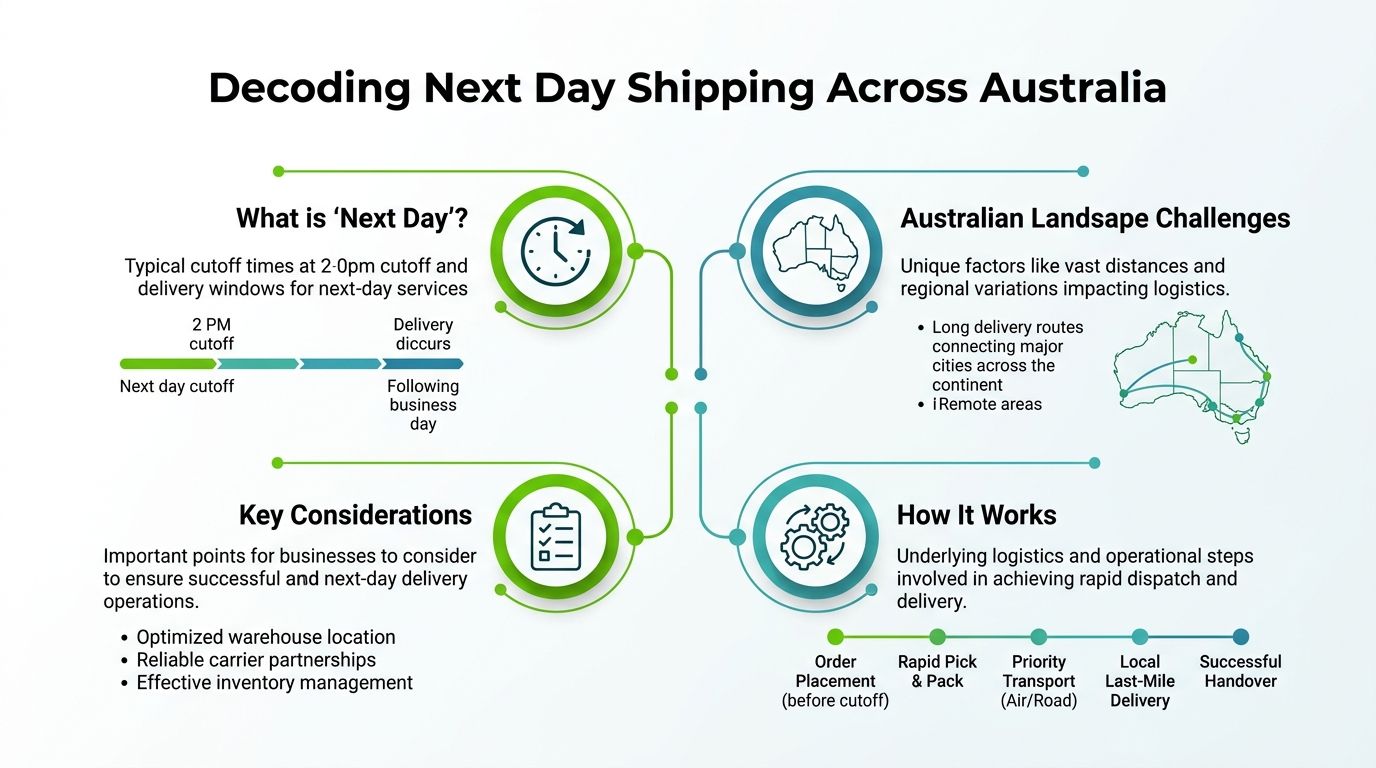
In Australia, “next day” usually means next business day, not “tomorrow no matter what”. That catches people out all the time. If you book on Friday afternoon, the next business day is usually Monday. If a route doesn’t support true next-business-day coverage, the fastest available service may still take longer.
That doesn’t mean the system is unreliable. It means the geography matters.
Think of it like a relay race
A parcel doesn’t travel from your hands to the customer’s door in one smooth motion. It moves through a chain.
One team receives it. Another team sorts it. Another moves it on a linehaul truck or flight. Then a local depot scans it in and passes it to the delivery driver for the final leg. If each handoff happens on time, the parcel keeps momentum. If one handoff misses its slot, the whole chain shifts.
That’s why next day shipping feels simple on the surface and tightly timed underneath.
Here’s the relay in plain language:
- Pickup or drop-off happens first: The parcel enters the network.
- Sorting happens quickly: The label is scanned and matched to the correct route.
- Overnight transport does the heavy lifting: This can be air, road, or a blend of both depending on the lane.
- Local delivery finishes the job: A driver completes the final leg on the next business day.
A missed handoff early in the journey usually causes the delay later.
Metro and regional are different worlds
In this situation, expectation-setting is paramount.
In Australia, next-day coverage is mostly concentrated in major metro areas that cover about 70% of the population but less than 30% of the landmass, while regional and rural businesses make up 28% of Australian SMEs and often face 2 to 5 day delays due to fewer flights and distribution hubs according to ShipMonk’s overnight shipping overview.
That single reality explains a lot of customer confusion. A parcel moving across Sydney or between dense urban areas has more route options, more scans, and more depot frequency. A parcel heading to a rural postcode may have fewer transport connections and a longer final-mile leg.
A simple comparison helps:
| Delivery context | What next day shipping usually means |
|---|---|
| Major metro to major metro | Often realistic if the service lane supports it and the parcel is lodged on time |
| Metro to regional | Fastest available service, but delivery may take longer |
| Regional to regional | Usually less predictable because network density is lower |
For businesses that regularly send to Queensland’s capital and surrounding areas, reviewing a local service page like Brisbane next day delivery options can help clarify what’s practical before you set checkout promises.
What customers need to hear
Customers don’t need a lecture on logistics. They need a clear promise.
Use simple wording like:
- Metro orders placed before cutoff: Eligible for next-business-day delivery
- Regional deliveries: Fastest available service applies
- Weekend orders: Processed on the next business day
That wording is honest, clear, and much easier to defend than vague “overnight anywhere” claims.
Meeting the Clock for On-Time Delivery
Most late next-day deliveries don’t begin with a truck problem. They begin with a sender problem. The booking came in too late, the parcel wasn’t packed properly, or the label wasn’t easy to scan.
That’s good news because those are the parts you can control.
Why cutoff times are so strict
A lot of senders treat a cutoff time like a soft suggestion. It isn’t. It’s the latest moment a parcel can still catch that night’s sorting and transport chain.
For metro areas, major carriers guarantee next-business-day delivery if parcels are lodged by strict 4 pm cutoffs, and missing that deadline results in a 2-day delivery in 85% of cases due to batch processing constraints at regional hubs. Early lodgement is what triggers priority sortation and dedicated transit.
If you think of the network as a train timetable, this makes sense. Your parcel doesn’t need “a bit more time”. It needs to catch a specific connection. Miss that connection and it joins the next batch.
Earlier is safer than just-in-time
If your stated cutoff to customers is 4 pm, your internal packing deadline should be earlier. Give your team a buffer for picking, packing, printing, and final checks.
A practical internal workflow often looks like this:
- Customer-facing promise: Orders by 4 pm
- Warehouse packing target: Finish packing before that final hour
- Dispatch check: Labels on, boxes sealed, pickups confirmed
Operational habit: Build your business around your real dispatch time, not the latest possible time.
That one change removes a lot of chaos.
Packaging decides whether the network can help you
Even a perfect booking can stumble if the parcel itself creates handling issues. Sortation systems rely on barcodes being visible, boxes staying intact, and parcels moving cleanly through depots.
Good packing for next day shipping is less about fancy materials and more about consistency:
- Use a sturdy outer box: Flimsy cartons crush, bow, or split under normal handling.
- Cushion the item well: Stop movement inside the parcel. If it rattles, it’s underpacked.
- Tape all openings securely: Don’t rely on a single strip down the middle.
- Keep the label flat and readable: Avoid wrinkled surfaces, curved edges, or tape across key barcode areas.
- Match the box to the item: Oversized boxes can increase movement and handling problems.
A short check before dispatch can save a lot of trouble later.
| Quick packaging check | Why it matters |
|---|---|
| Box holds shape | Prevents crushing and torn seams |
| Item doesn’t shift inside | Reduces damage risk |
| Label is flat and visible | Improves scan success |
| Address is complete | Avoids manual handling and delay |
If your customers are mostly residential, the final stage matters too. The parcel still has to make it from the local driver to the front door. That’s where clear delivery details and realistic handoff options make a difference. If you want a simple overview of that final stage, this guide to last mile delivery is useful.
The sender starts the delivery clock
Businesses sometimes speak about delivery reliability as if it only belongs to the carrier. In reality, the clock starts with the sender.
A well-prepared parcel enters the network cleanly. A rushed one often needs manual help. Manual help is slow. Slow is the enemy of next day shipping.
Understanding the True Cost of Fast Shipping
Fast shipping prices can look mysterious when you first compare quotes. One service seems cheap, another looks much higher, and it’s not always obvious why. The answer is usually a mix of route, timing, and how the carrier prices that particular parcel.
The useful way to think about cost is this. You’re not just paying for speed. You’re paying for access to a timed network.
What you’re usually paying for
A next day shipping quote often reflects several moving parts rather than one simple fee. Even without turning this into a pricing formula, there are a few common drivers worth watching:
- Base transport cost: The core charge for moving the parcel from origin to destination.
- Route complexity: Some lanes are simpler and denser than others.
- Parcel size and weight: A light but bulky carton can still cost more than expected.
- Residential or harder-to-serve destinations: These can change the final price.
- Optional delivery protections: Signature options and cover can affect value, even if they don’t always dominate the cost.
That’s why comparing services one by one is hard if you’re doing it manually.
Why comparison tools matter
Australian SMEs can achieve 15% to 30% cost savings by using dynamic carrier selection platforms, which use wholesale bulk purchasing and automatic carrier choice to find the most cost-effective route. The same verified data notes examples like StarTrack with 97% on-time performance in VIC/NSW metro versus Aramex for QLD routes.
That matters because the cheapest-looking carrier on one route won’t always be the best on another. A smart platform compares the lane for you rather than forcing you to guess.
If you want extra practical ideas outside of courier selection, this guide on how to reduce shipping costs is a helpful companion because it focuses on packaging, process, and spend control.
Cost and value aren’t the same thing
The lowest upfront rate isn’t always the cheapest business decision.
A delayed urgent parcel can create extra support work, refunds, replacement sends, and goodwill damage. A slightly better-fit service can end up costing less overall if it reduces failed deliveries, customer complaints, or manual chasing.
That’s also why it helps to look at the full quote environment rather than the top line only. A pricing page like courier prices in Australia is useful when you want to understand what different parcel scenarios can look like before checkout.
Shipping cost should be measured against customer outcome, not just the label price.
Add-ons can be smart, not wasteful
Some businesses hesitate over extras like signature confirmation or freight cover because they want to keep checkout attractive. That’s understandable, but the better question is whether the parcel justifies the protection.
For higher-risk deliveries, those options can buy clarity. If a parcel matters enough to send next day, it may matter enough to secure the handoff properly too.
Your Step-by-Step Aeros Couriers Workflow
Say you need to send a boxed gift from Perth to Brisbane. The buyer wants it fast, you want the best available rate, and you don’t want to spend half the afternoon switching between carrier websites.
A clean shipping workflow is beneficial. The goal isn’t to become a logistics specialist. It’s to move from quote to booked label without friction.
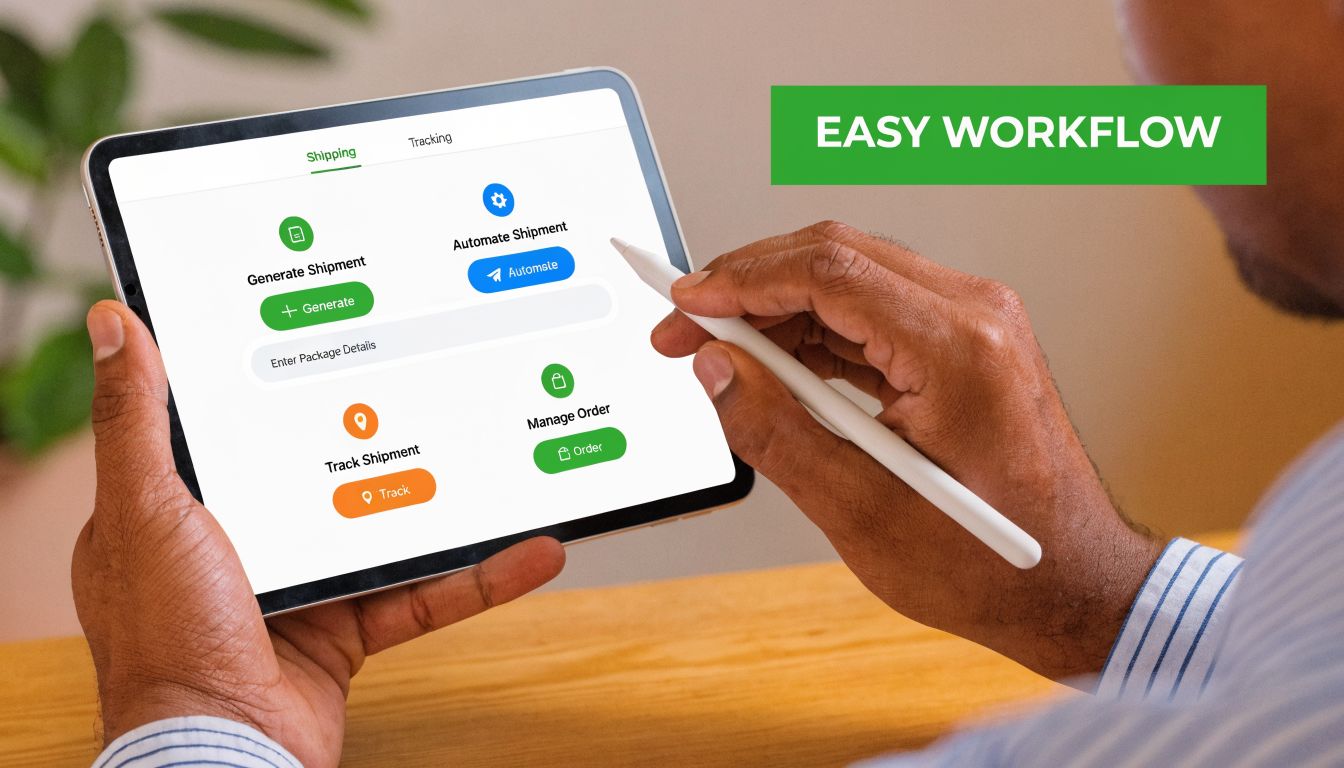
Step 1: Enter the parcel details carefully
Start with the basics. Measure the box, weigh it accurately, then enter the pickup and delivery postcodes.
This sounds obvious, but it’s where avoidable pricing surprises begin. If the dimensions are guessed and the box is larger than declared, the booked service may no longer fit the parcel well. A tape measure and scale are worth the effort.
Use this short pre-quote check:
- Box sealed first: Measure the parcel in its final packed state.
- Weight confirmed: Don’t estimate if the item is close to a pricing threshold.
- Addresses complete: Unit numbers, business names, and contact details matter.
Step 2: Compare the next-day options shown
Once the system returns available services, don’t just stare at the cheapest line. Look at the ETA window, the route fit, and whether the service aligns with what you promised the customer.
Platforms are useful because they put options side by side. You can compare speed and likely fit without hunting through separate carrier portals.
If your workflow includes label generation from your dashboard, a tool like print shipping labels online becomes handy because it keeps dispatch moving once you’ve chosen the service.
Step 3: Finalise the booking
Booking should only take a few minutes once the details are right. Confirm sender and receiver information, review any delivery instructions, then complete the shipment.
At this point, clarity beats cleverness. If the address has a business name, include it. If there’s an entry note that will help the driver, add it. Good data helps the parcel move cleanly.
Better shipment data at booking stage usually means fewer manual fixes later.
Step 4: Print and attach the label properly
Print the label at full size and place it on the largest flat face of the carton. Don’t wrap it around corners. Don’t cover the barcode with shiny tape if it makes scanning harder. Don’t let old labels remain visible.
Small physical mistakes can undo a good digital booking.
A simple label routine works well:
| Label task | Best practice |
|---|---|
| Placement | Largest flat side of the box |
| Visibility | No folds, wrinkles, or old labels nearby |
| Protection | Secure but still easy to scan |
| Match check | Confirm the label matches the correct parcel |
Step 5: Track the parcel and keep the customer informed
After pickup, tracking becomes part of the customer experience. A tracking link reduces uncertainty because the buyer can see movement rather than waiting in the dark.
For business owners, tracking also helps with exception handling. If something pauses, you know sooner. If delivery completes, your support team can confirm it quickly.
There’s another layer here that many businesses overlook. Shipping spend can create value beyond fulfilment. Aeros Couriers’ rewards program lets businesses redeem shipping-earned points on more than 10,000 branded merchandise items, which means routine dispatch activity can support marketing and operational needs instead of remaining a pure overhead cost.
That turns an everyday workflow into something more useful than “print label, send box, forget about it”.
Avoiding Common Pitfalls for Smooth Delivery
Most shipping issues are predictable. They don’t feel predictable when they happen, but they usually come from a short list of repeat mistakes. The good news is that once you know those patterns, they’re much easier to avoid.
The items that often cause trouble
Some parcels can’t move through standard next-day networks in the same way as ordinary boxed goods. Items like batteries, aerosols, perfumes, and other dangerous goods can trigger extra rules, refusal, or service limits. Even when a sender thinks an item is “small” or “harmless”, the transport category can still be restricted.
That’s why product type matters before you even compare speed.
If you’re unsure, stop and confirm first. The wrong item in the wrong service isn’t a minor technicality. It can mean refusal, return, or compliance issues.
CoR is not just for large operators
Chain of Responsibility, often shortened to CoR, can sound like something only big freight businesses need to think about. For parcel senders, it’s much simpler than that. If you’re preparing goods for transport, your packaging and labelling still need to meet the required standard for what you’re sending.
The ACCC has seen a 35% spike in next-day shipping complaints, with 62% of small businesses unaware of mandatory CoR compliance for packaging and labelling. The same verified data notes that non-compliance is a leading cause of refused shipments, and that integrated guidance and insurance can cut that risk by up to 40%, as referenced in Easyship’s next day shipping guide.
That doesn’t mean you need to become a compliance expert overnight. It means you shouldn’t treat packaging and declarations as an afterthought.
If a shipment is refused, the problem often started at packing bench level, not on the road.
A cleaner way to prevent failure
A simple pre-dispatch habit can eliminate a surprising amount of trouble:
- Check the item category: Confirm it’s suitable for standard parcel movement.
- Review packaging: Make sure the box, cushioning, and seal are appropriate.
- Read the label details: Wrong suburb, missing unit number, or incorrect postcode can derail a fast service.
- Consider delivery handoff: If nobody will be present, think carefully about Authority to Leave and whether it suits the item.
- Send tracking promptly: Customers who understand what’s happening are less likely to panic when they don’t see the parcel instantly.
The boring details do the heavy lifting
Businesses often chase fancy fulfilment improvements while ignoring the basics. But the basics are what protect next day shipping.
The right box. The right label. The right declaration. The right address. Those don’t feel glamorous. They’re still what keep parcels moving.
Your Next Day Shipping Questions Answered
Even after you understand the basics, a few practical questions tend to linger. These are the ones business owners ask when they’re about to book a parcel and want to avoid a nasty surprise.
Frequently Asked Questions
| Question | Answer |
|---|---|
| What does next day shipping actually mean in Australia? | It usually means next business day delivery, not calendar-day delivery. Weekend and public holiday timing can affect the service window. |
| Is next day shipping available everywhere in Australia? | No. It’s most realistic on dense metro routes. Regional and remote deliveries may use the fastest available service, but they can take longer. |
| If I book late in the day, is it still next day? | Only if the parcel can still meet the relevant cutoff and enter the network in time. Late bookings often miss the required handoff window. |
| Does pickup time matter as much as drop-off time? | Yes. The parcel has to enter the carrier network early enough to make the correct sort and transport cycle. |
| What’s the biggest mistake small businesses make? | They often promise speed before confirming route suitability, packing quality, or dispatch timing. The promise should follow the operational reality. |
| Can I use next day shipping for ordinary e-commerce parcels? | Yes, if the product is suitable for parcel networks, packed properly, and going to a route that supports fast movement. |
| Should I always choose the cheapest option? | Not automatically. The best choice depends on the route, parcel details, delivery expectations, and how much risk you’re prepared to carry. |
| What if the customer won’t be home? | Consider whether Authority to Leave is appropriate for that parcel. If the item is valuable or sensitive, a more controlled handoff may be better. |
| Do I need to notify the customer after dispatch? | Yes. Tracking details help reduce uncertainty and cut down support messages. |
| Is next day shipping only for urgent situations? | No. Many businesses use it selectively as a conversion tool, a customer retention tool, or a way to stand out in crowded product categories. |
A final practical note
You don’t need to offer next day shipping on every product, every route, or every order. Many smart businesses start with their strongest lanes, their easiest parcel types, and the customers who value speed most.
That keeps the service achievable. It also gives you room to build confidence without overpromising.
If your current process feels messy, simplify before you scale. Measure the parcel properly. Set an internal pack deadline. Use clear delivery wording on your site. Keep your labels clean. Those habits solve more than commonly anticipated.
If you want a practical way to compare rates, book fast box and parcel deliveries, print labels, and track shipments across Australia without making shipping feel complicated, take a look at Aeros Couriers. It’s a straightforward option for businesses that want next day shipping to feel affordable, realistic, and easy to manage.
Courier quotes, tracking and support
Ready to send a parcel? Compare the available services for your postcodes, parcel dimensions and weight. For an existing delivery, use your consignment number to check tracking or ask our team for help.