


Think of domestic courier services as the lifeblood of Australian commerce. They're the arteries connecting businesses in Perth with customers in Sydney, and artisans in the Barossa Valley with buyers in Brisbane. They specialise in moving parcels and boxes exclusively within Australia, giving businesses a faster, more flexible alternative to traditional post at the cheapest prices.
Why Mastering Australian Shipping is a Game Changer
Picture your business for a moment. It has a pulse, an energy, a promise. To truly flourish, it needs a powerful circulatory system to deliver on that promise, reaching every corner of the country. That's exactly what domestic courier services do. They are the vital network that can turn a local Melbourne startup into a household name nationwide.
In the last few years, the boom in e-commerce has completely reset what customers expect. Shipping isn't just about getting a box from A to B anymore; it's a huge part of the customer experience and a direct reflection of your brand's reliability. A speedy, affordable, and transparent delivery can be the one thing that turns a first-time buyer into a lifelong fan.
From Logistical Hurdle to Competitive Advantage
For so many growing businesses, shipping can feel like a massive headache. A necessary evil. But if you shift your perspective and see it as a strategic tool, it suddenly becomes a massive opportunity. When you nail your shipping, you can:
- Build real trust and loyalty: A smooth, fast delivery, from the moment they click "buy" to the second they unbox their order, shows customers you're a professional and dependable brand.
- Expand your reach: Efficient nationwide delivery smashes down geographical barriers, letting you compete for customers right across Australia.
- Get a serious competitive edge: Offering cheaper or faster shipping than the next guy is a powerful way to stand out and win the sale.
Mastering your domestic shipping isn't just logistics. It’s about forging connections, delivering on your brand promise, and creating an experience so good that customers can't help but come back.
The sheer growth of the industry tells the story. The Australian domestic courier market was valued at a staggering USD 1.17 billion in 2024 and is expected to hit USD 1.73 billion by 2033. This surge is fuelled by businesses and everyday Aussies looking for smarter, more reliable ways to send their parcels and boxes—which is exactly where services like Aeros Couriers come in. You can dig into more of the data on the Australian domestic courier market growth.
This guide is here to help you move past the basics. We want to show you how to transform the challenge of logistics into an engine for your business's growth, making every single delivery count. To get started, check out our guide on finding the best solutions for your parcel delivery Australia-wide.
How Australian Courier Services Actually Work
Sending a parcel across Australia might seem like a bit of magic, but behind the scenes, it's a finely tuned system built for speed and reliability. Let's pull back the curtain and follow your box on its journey, demystifying the whole process from your doorstep to its final destination.
Think of the national courier network like Australia’s airport system. Just as passengers fly between major city hubs before catching smaller connecting flights, your parcel is collected and channelled into a central sorting facility. Here, sophisticated technology scans barcodes to route each item onto the right truck or plane for the next leg of its trip.
The Three Stages of Your Parcel's Journey
Every delivery unfolds in three distinct phases, each playing a vital role in getting your package where it needs to go, safely and on time.
- The First Mile Pickup: This is where it all begins. A local driver picks up the parcel from your business or home, officially starting its journey into the broader courier network.
- The Middle Mile Transit: Now for the long haul. Your parcel travels between major cities and regional hubs, often overnight, through a coordinated web of trucks and sometimes aircraft.
- The Last Mile Delivery: This is the final and most critical step. From the local depot, a driver in the destination city or town takes your parcel and delivers it straight to the recipient’s door.
To really appreciate the efficiency, you have to look at the internal coordination. A big part of what makes it all work so smoothly is understanding how logistics teams centralize driver and dispatch communication to keep everything in sync.
Finding Your Ideal Delivery Speed
Not every shipment has the same level of urgency. That’s why domestic courier services offer a menu of options, letting you balance speed and budget to find the perfect fit for each fast box and parcel delivery.
To help you decide, here’s a quick look at the main service types you’ll find across Australia.
Choosing Your Delivery Speed a Quick Comparison
| Service Type | Best For | Typical Transit Time | Cost Level |
|---|---|---|---|
| Standard | Everyday, non-urgent shipments and e-commerce orders. | 2–7 business days, depending on the destination. | $ |
| Express | Time-sensitive boxes, high-value goods, or urgent orders. | Next business day between major capital cities. | $$ |
| Same-Day | Critical, last-minute deliveries within the same metro area. | A few hours from pickup to delivery. | $$$ |
Ultimately, the right choice comes down to your specific needs—whether it's keeping costs as cheap as possible for your customers or getting a critical item delivered before close of business.
The demand for these fast parcel services is only growing. The Australian courier market is on a steep upward trajectory, reflecting just how crucial reliable delivery is becoming for businesses of all sizes.
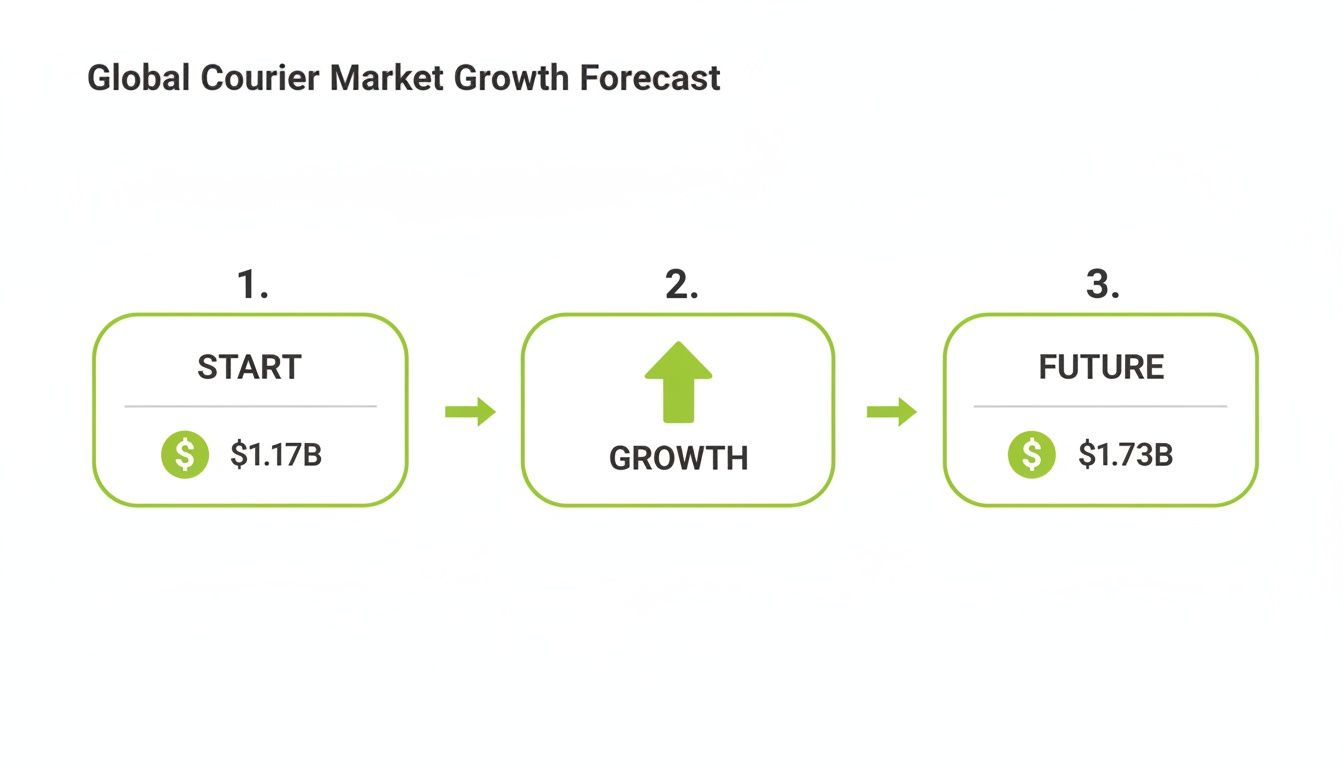
This forecast jump from $1.17 billion to $1.73 billion isn't just a number; it highlights the central role that fast, affordable shipping plays in the health of the Australian economy.
The Technology Powering Modern Deliveries
So, what’s the engine driving this complex network? Technology.
Modern courier platforms give you an easy-to-use online dashboard where you can get instant quotes, book a pickup, and print your shipping labels in minutes—often without even needing an account.
Real-time tracking is probably the most valued feature. It gives both you and your recipient total visibility of the parcel's journey. You can literally watch as it moves from the depot to the delivery truck, which provides fantastic peace of mind and a much more accurate delivery window. This kind of tech-first approach makes powerful services like our domestic freight express more accessible and user-friendly than ever before.
Choosing the Right Courier for Your Business
Picking a domestic courier isn't just about getting a box from A to B. Think of it as choosing a partner, someone who represents your brand at the most critical moment: the delivery. That final step, the handover at the customer's door, is a direct reflection of your promise. Get it right, and you solidify the trust you’ve worked so hard to build.
So, how do you make the right call? It's about looking past the price tag and building a simple framework to see what really matters for your business. You need a partner who can grow with you, flex when you need it, and ultimately, help you win with fast, cheap parcel deliveries.
First, Define Your Shipping Priorities
Before you even start looking at courier companies, you need to get crystal clear on your own shipping profile. Every business is unique. What works for a massive retailer is totally different from the needs of a small online store.
Start by asking yourself a few simple questions:
- What are you actually shipping? Are we talking small, light satchels or big, heavy boxes? We don't ship pallets, so our focus is on parcels and cartons. The size and weight of your items are the biggest factors influencing your costs.
- How often are you sending things out? A business dispatching hundreds of parcels a week needs a completely different setup than an office sending a handful of items a month. Your volume dictates whether you need a scalable, integrated solution or a straightforward, on-demand service.
- Where are your customers? If you're mainly shipping between Sydney and Melbourne, life is pretty simple. But if your customers are dotted across regional or remote Australia, you’ll need a courier with a network that can actually reach them quickly and cheaply.
Key Criteria for Sizing Up a Courier Service
Once you've got a handle on your own needs, you can start comparing your options. The goal is to find that perfect balance of reliability, cost, and a great user experience.
Here’s what you should be looking for:
- Network Coverage: Can they get to all your customers Australia-wide? Make sure they can reliably deliver to every postcode you ship to, especially regional and remote ones. There's nothing worse than having to tell a customer you can't deliver to them.
- Speed and Reliability: What are their on-time delivery stats like? Dig into customer reviews. Consistency is everything here. A reliable courier protects your brand's reputation with every single fast delivery.
- Pricing Transparency: You want cheap, clear, upfront pricing with absolutely no hidden fees. Sneaky surcharges for fuel or residential drop-offs can chew through your profit margins in no time.
- Technology and User Experience: A modern, easy-to-use booking platform is a must. You need to be able to get instant quotes, print labels without a fuss, and track parcels in real-time. It empowers you and keeps your customers happy.
Choosing a courier is like hiring a representative for your brand. Their performance in the final mile is a direct reflection of your commitment to customer satisfaction. Make sure their standards match yours.
It's no secret the Australian courier market is booming, thanks in large part to the explosion of online shopping. This e-commerce wave has created the perfect conditions for new, affordable platforms aimed squarely at small businesses and online retailers. The domestic scene dominates, holding a massive 62.21% market share, and business-to-consumer (B2C) deliveries make up more than half of all shipments. This trend shows just how vital cost-effective, standard services are—they account for nearly 75% of the market. You can see more on the Australian courier market landscape.
Matching the Service to the Real World
To bring this all to life, let’s look at a few common scenarios. Each one demands a different approach, proving that a one-size-fits-all shipping strategy just doesn't cut it.
A growing e-commerce store shipping small parcels all over the country needs an affordable solution that can scale. Their top priority is finding a courier with the cheapest rates, a system that plugs straight into their workflow, and reliable tracking that keeps their customers in the loop.
An office manager in Melbourne sending urgent contracts to a client in Sydney needs one thing above all else: speed. They’ll be looking straight at express services that guarantee next-day delivery, making sure that critical paperwork lands on the right desk, on time.
An individual sending a birthday gift to their nan in a regional town needs simplicity and reach. Their main worry is finding a courier with a dead-simple booking process and a network that can get the parcel to a non-metro address without any drama.
By thinking through these factors, you can find the perfect courier for your specific needs. For a more detailed guide, check out our article on how to choose the best courier in Australia and make sure your parcels are always in good hands.
4. Mastering Your Packaging Essentials
A successful delivery begins long before the courier even knocks on your door. The way you prepare and pack your parcels is your first—and best—line of defence against the inevitable bumps and rattles of transit. It’s about more than just protection; it’s about taking an active role in getting your items to their destination safely.
Think of it this way: proper packaging is your greatest ally. It helps prevent damage, sidesteps unexpected fees, and keeps your shipments moving smoothly through the automated sorting systems that are the backbone of modern domestic courier services. It’s the secret to keeping your costs predictable and your customers happy.
Choosing Your Armour: The Right Box
The foundation of any securely packed parcel is the box itself. It might be tempting to reuse an old one, but don't. Used boxes lose a significant amount of their structural strength after just one journey. Always start with a new, high-quality, double-walled cardboard box.
Finding the right size is crucial. You're looking for that "Goldilocks" fit—not too big, not too small. If it's too tight, there's no room for cushioning. Too loose, and your items will slide around, risking breakage. A good rule of thumb is to leave about 5-6 cm of space around your item on all sides. This gives you the perfect buffer zone for all your protective padding.
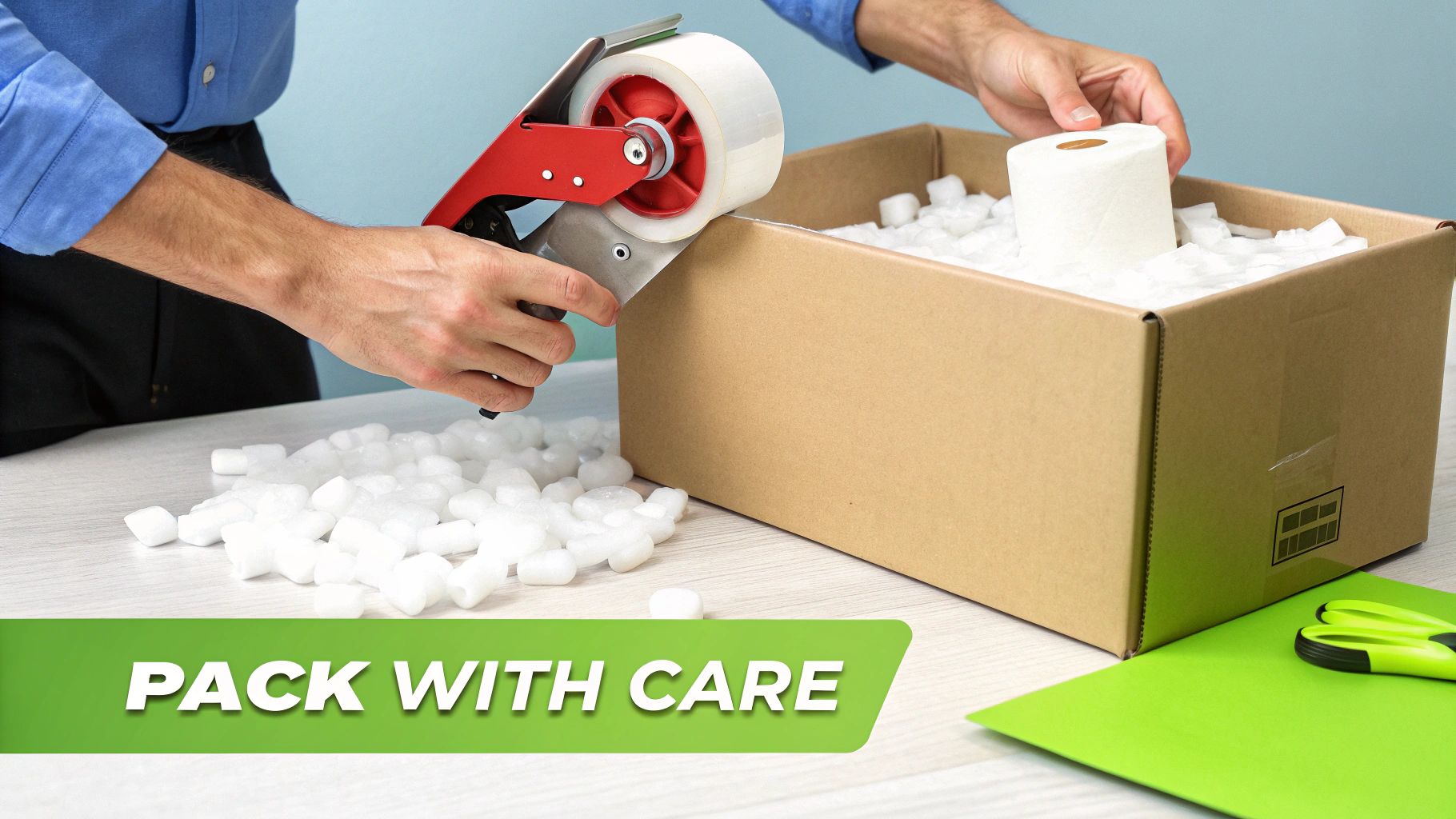
Your parcel's journey is a team effort between you and your courier. Proper packaging is your contribution to the team, setting the stage for a safe and successful delivery every time.
The Art of Cushioning and Sealing
With the right box in hand, it's time to create a protective cocoon inside. Learning how to pack boxes for shipping like a pro isn't difficult, but it makes all the difference. The goal is to absorb shock and eliminate any movement.
Just follow these simple steps:
- Build a Base: Start by lining the bottom of the box with a generous layer of cushioning material, like bubble wrap or packing peanuts.
- Wrap and Centre: Carefully wrap each item individually. Place the heaviest or largest item in the very centre of the box, right on top of your base layer.
- Fill the Voids: Now, stuff more cushioning material into all the empty spaces—around, between, and on top of your items. Give the box a gentle shake; nothing inside should move at all. It should feel snug and secure.
- Seal It Tight: Use a strong, pressure-sensitive packing tape (at least 48mm wide) to seal everything up. Tape along the centre seam and then across both edge seams on the top and bottom. This creates a capital 'H' pattern that reinforces the box's weakest points.
Understanding Your Compliance Responsibilities
Here in Australia, sending a parcel isn't just about packing it well; it also comes with legal responsibilities. The Chain of Responsibility (CoR) legislation means that everyone in the transport supply chain—and that includes you, the sender—is accountable for safety.
This starts with being completely honest about what you're sending. Correctly declaring your parcel's contents is a legal must-do, especially if you're shipping anything that could be considered dangerous or hazardous. Getting this wrong isn't just a breach of the courier's policy; it can create serious safety risks for everyone handling your package.
Finally, a perfectly packed box is useless without a clear label. For a detailed walkthrough on this final, crucial step, check out our guide on how and where to put a label on a package. By taking these steps, you can ship with complete confidence, knowing every parcel is protected, compliant, and ready for its journey.
Smart Ways to Save Money on Shipping Costs
Let's be honest, shipping costs can feel like a constant battle, a necessary expense that slowly eats away at your profits. But it doesn't have to be a losing fight. With a few clever strategies, you can take control of your domestic courier services budget, cutting costs without ever sacrificing the reliable, speedy delivery your customers have come to expect.
The secret isn't about finding a magic bullet; it's about shifting your mindset. Instead of just accepting the first price you're quoted, it’s time to start thinking like a logistics expert. Every choice, from the box you pick to the service you select, is an opportunity to be more efficient and find the cheapest prices.

Use a Comparison Platform to Unlock Cheaper Rates
This is single-handedly one of the biggest game-changers for small businesses. Online courier comparison platforms negotiate with all the major carriers, buying up shipping services in massive quantities. Think of it like a group buying club—their immense volume gives them access to wholesale rates that are completely out of reach for a small business sending a handful of parcels.
And the best part? They pass those incredible savings directly on to you. You get to tap into the collective buying power of thousands of businesses, levelling the playing field instantly. Suddenly, you can access the kind of cheap prices that were once only available to the big corporate players, even if you’re just starting out.
Optimise Your Package Size and Weight
Here’s a question that could save you a fortune: are you paying to ship air? It sounds silly, but using a box that’s way too big for your product is one of the most common ways businesses overspend. Couriers use a clever calculation called dimensional weight (or cubic weight). They look at the size of your parcel, not just its actual weight, and charge you based on whichever is greater.
To beat the system, always reach for the smallest box that can safely house your item with just enough protective padding. A snug, efficient fit ensures you're paying to ship your product, not a bunch of empty, expensive space.
By simply choosing the right-sized box for every shipment, you can consistently lower your costs. It’s a small change in process that delivers a significant and immediate impact on your shipping budget.
Consolidate Shipments and Plan Ahead
If you have multiple orders going to the same address, don't send them separately! It's almost always cheaper to send one larger parcel than several small ones. This might require a little more organisation in your dispatch workflow, but the savings add up fast, particularly if you have loyal, repeat customers.
On top of that, remember that not everything is a frantic, last-minute rush. If a delivery isn't time-sensitive, opting for a standard road service over an express one can slash your costs. Planning your shipping schedule allows you to use these wallet-friendly options for regular orders, keeping the premium fast services for when you genuinely need them. To see how these choices affect your bottom line, take a look at our detailed breakdown of Australian courier costs.
Your Next Step to Effortless Australian Shipping
You’ve made it this far, which means you’re no longer just sending parcels—you’re building a smarter, more resilient business. We’ve journeyed through the entire world of domestic courier services, and now you have a clear map to navigate it like a pro. You get how it all works, what to look for in a partner, and why great packaging is non-negotiable for fast, cheap deliveries Australia-wide.
The biggest takeaway? Getting your shipping right isn't just another box to tick on your to-do list. In today's market, it's a make-or-break factor for growth. Every single parcel that leaves your hands is a promise to your customer, a chance to build real loyalty and show them you care.
From Knowledge to Action
The theory is sorted. Now it's time to put all this powerful knowledge into practice and take full control of your shipping. You're now equipped to:
- Choose Wisely: Pick courier partners who genuinely fit your business needs, not just the ones with the cheapest headline rate.
- Pack for Success: Master the art of packaging to make sure your products arrive in perfect condition, every single time.
- Ship Smarter: Discover clever, practical ways to cut down on costs without ever compromising on quality or speed.
The next step isn’t just about shipping something from A to B. It’s about seizing a strategic advantage. It’s about deciding, right now, to turn a daily chore into a powerful tool for delighting customers and growing your brand.
The road to faster, more affordable, and truly reliable shipping across Australia is laid out before you. You have the insights to make confident decisions, turning every delivery into a win for your business. The power to create a genuinely effortless shipping experience is well and truly yours.
Your journey to transform shipping from a headache into a high point starts today. Ready to see how simple it can be? Get an instant quote with Aeros Couriers and discover just how easy it is to start building a stronger business, one perfectly delivered parcel at a time.
Frequently Asked Questions
Jumping into the world of domestic courier services can feel like there's a lot to learn, especially when you're trying to find that sweet spot between cost and reliability. We get it. To help clear things up, we’ve put together answers to the questions we hear most often, so you can send your boxes and parcels across Australia with complete confidence.
Think of this as your cheat sheet for making smarter shipping decisions, whether you're a growing business or just sending a one-off parcel.
What Is the Cheapest Way to Send a Parcel in Australia?
For the most wallet-friendly option, a standard road service is almost always your best bet. It’s the go-to choice for non-urgent deliveries where keeping costs down is the name of the game.
But how do you find the absolute rock-bottom price? Use an online comparison platform. These sites have serious buying power, which means they get wholesale rates that are usually out of reach for individuals and small businesses.
Here's another trick of the trade: pay attention to your parcel's "dimensional weight." By using the smallest box that still safely protects your item, you cut down on wasted space. Since couriers charge based on size and weight, a smaller box means a smaller bill. Booking online is the final piece of the puzzle, as it unlocks the most competitive rates.
How Long Do Domestic Couriers Take to Deliver?
Delivery times really come down to two things: the service you pick and how far your parcel has to travel. Australia is a massive place, so the distance is a major factor.
- Express Services: If you need it there fast, an express service between major cities like Sydney and Melbourne will typically get it there the next business day.
- Standard Road Services: This is your everyday workhorse service, usually taking between 2-7 business days to reach most destinations.
- Regional and Remote Deliveries: It stands to reason that sending a box to a regional town or a remote corner of the country will take a bit longer than a simple metro-to-metro run.
The best part about modern courier platforms is that there are no surprises. You’ll almost always get an Estimated Time of Arrival (ETA) when you get a quote, giving you a clear delivery window before you even book.
Do I Need an Account to Book a Courier?
Thankfully, no. The old days of needing to set up a business account, go through credit checks, and commit to minimum shipping volumes are long gone.
Today's online booking platforms have opened up the world of domestic courier services to everyone. You can get an instant quote, pay securely with a credit card, and have your shipping labels printed in minutes. This freedom from accounts is a huge win for individuals, start-ups, and small businesses that might only send parcels every now and then.
Is Insurance Included When I Send a Parcel?
This is a big one, and the answer really depends on the provider. It's something you should always double-check before you hit "book."
Some courier services will include a small amount of freight insurance as standard, giving you a baseline level of cover automatically. Others offer it as an optional extra that you can add on for a fee during the booking process.
If you’re sending anything valuable or fragile, it's absolutely vital to read the terms and conditions. Getting to grips with what’s covered—and what’s not—is the only way to get true peace of mind and know you’re protected if the unexpected happens.
Ready to put this all into practice and see just how simple shipping across Australia can be? Aeros Couriers helps you get instant quotes, book in a few clicks, and send your parcels and boxes anywhere in the country at the best possible prices.
