

To get a handle on your shipping costs in Australia, you really only need three key details to start: your parcel's dimensions (length, width, and height), its actual weight in kilograms, and the origin and destination postcodes.
With just that information, any courier's system can calculate a base rate, giving you a solid starting point that accounts for both the physical size of your item and the distance it needs to travel.
Understanding What Drives Australian Shipping Costs
Before you can estimate shipping costs with any real accuracy, you need to understand the fundamental factors that actually build the price. Getting this foundation right is the difference between a quote you can count on and getting hit with a nasty surprise on your invoice later on.
It doesn't matter if you're a small e-commerce store or a large wholesaler; every Australian business has to start with these same core principles to sidestep common (and costly) underestimation errors.
The Australian freight landscape has become more complex lately. We saw road freight prices jump significantly between 2021 and 2023, a trend fuelled by high fuel costs, strong domestic demand, and labour shortages. This has forced freight operators to pass on these extra expenses, which is why shipping quotes are generally higher across the country now.
Weight vs. Volume: The Cubic Weight Rule
The first and most critical concept to master is the difference between actual weight and cubic weight. It’s where most people get tripped up.
- Actual Weight is straightforward – it’s just how heavy your item is on a scale, measured in kilograms (kg).
- Cubic Weight (often called volumetric weight) is a calculation that reflects your parcel's density. In other words, it measures how much space your item takes up relative to its actual weight.
Couriers will always charge you based on whichever of these two figures is greater. This is known as the chargeable weight.
Think of it this way: a small, heavy box of steel bolts will be charged on its actual weight. But a huge, lightweight box of pillows will be charged on its cubic weight because it hogs so much valuable space in the van or truck. Misunderstanding this simple rule is the number one reason for quote discrepancies.
The Role of Postcodes and Distance
Naturally, the distance your parcel travels is a major cost driver, but it’s more nuanced than just the kilometres on a map. Couriers use postcode zones to categorise every single address in Australia, and these zones directly impact the price.
A shipment from Sydney to Melbourne (two major metro hubs) will almost always be cheaper and faster than sending the same package from Sydney to a regional town in Western Australia. Remote and regional postcodes invariably attract surcharges because of the extra time, fuel, and resources needed to get there.
Planning for Profitability
Getting a handle on these variables isn't just about dodging unexpected fees; it's about building a sustainable business. When you can confidently estimate your shipping costs, you can price your products correctly, offer competitive shipping rates to your customers, and ultimately protect your profit margins.
Of course, beyond just estimating, learning practical strategies to reduce shipping costs is a crucial next step for any small business looking to thrive. For a deeper look into all the components that make up a final price, check out our detailed guide on Australian courier costs.
This knowledge empowers you to use any online quoting tool effectively, ensuring the price you see is the price you actually pay.
How to Measure Your Parcels for an Accurate Quote
Getting your parcel's dimensions and weight wrong is the fastest way to turn a cheap quote into an expensive invoice. When you're trying to estimate shipping costs, guesswork is your worst enemy; precision is what saves you money. Even small errors can lead to serious cost blowouts, especially if you're sending bulky items or a large consignment.
But this isn't just about avoiding extra fees. It’s about making sure your shipment moves smoothly through the courier network without a hitch. The wrong details can cause delays, trigger manual handling surcharges, or even get your parcel rejected at the depot. Taking a few moments to measure and weigh everything properly gives you peace of mind and protects your budget.
This simple workflow breaks down the three foundational pieces of any accurate shipping estimate.
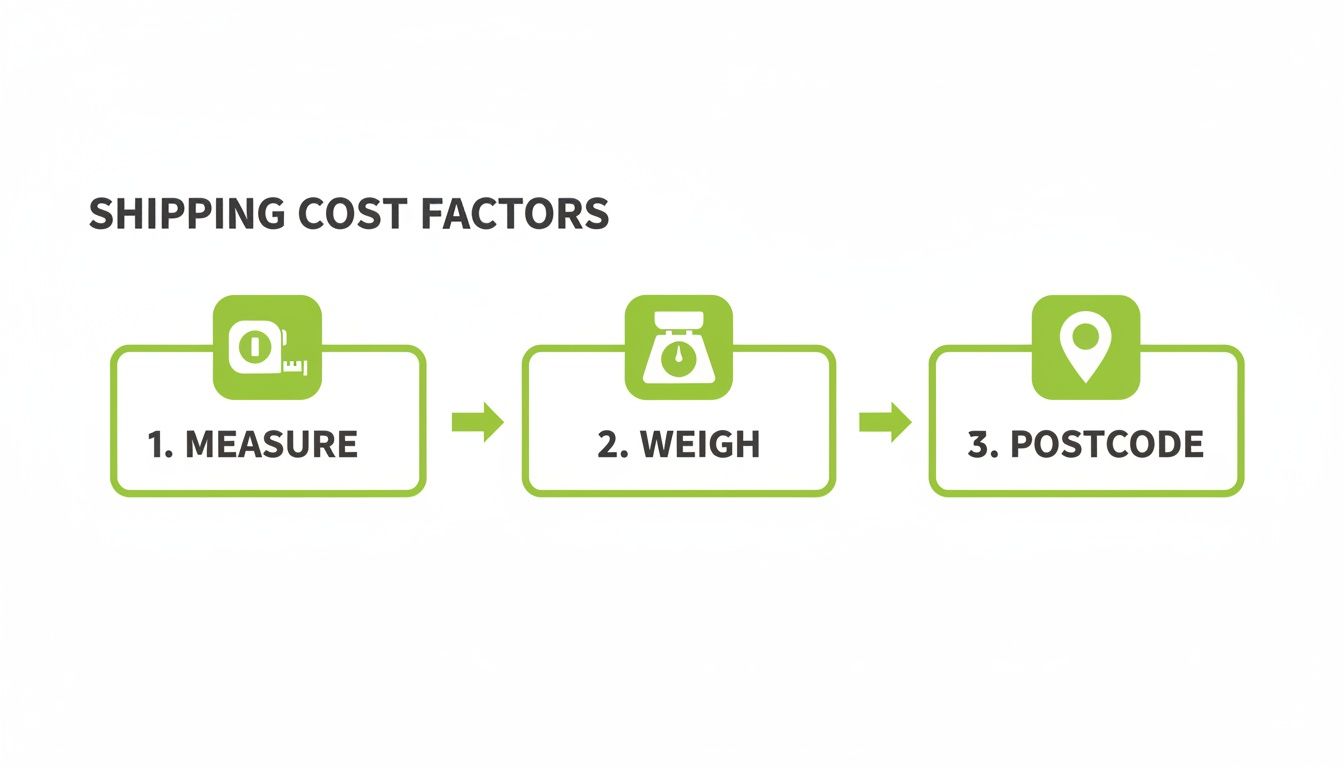
As you can see, the core of any quote starts with the measurements, the weight, and the destination postcode. These three things work together to calculate the final price you'll pay.
Mastering Parcel Dimensions
For any standard box, satchel, or carton, you’ll need to grab three key measurements: length, width, and height. Always measure in centimetres (cm) to get the most accurate result for Australian carriers.
- Length: The longest side of the parcel.
- Width: The second-longest side.
- Height: The shortest side, from the base to the top.
A classic mistake is measuring an empty box and forgetting to account for bulging. Once it's packed, a box can expand, which will slightly increase its dimensions. Make sure you always measure your parcel after it’s been fully packed and sealed to get the true figures.
What about odd-shaped items? If it’s not in a box, just measure the maximum length, width, and height as if it were inside an imaginary box.
The Importance of Cubic Weight
With your dimensions sorted, the next step is to figure out the cubic weight. This is often the deciding factor for items that are big but light, and it’s where many businesses get caught out.
Couriers charge based on the space an item takes up in their vehicle, not just its dead weight. Think about shipping a large box filled with lightweight foam parts. While it might only weigh 5 kg on the scales (its actual weight), its sheer size could give it a cubic weight of 25 kg. In that situation, the courier will always charge you for the higher of the two—in this case, 25 kg.
Pro Tip: Don't just trust the dimensions printed on the side of a box. Those are often internal measurements. Always use a tape measure on the outside of the sealed package for the most reliable data. A small difference of a few centimetres can easily push your parcel into a higher price bracket.
Calculating this yourself can be a bit of a pain. To simplify this crucial step, you can use a dedicated tool to calculate cubic weight for Australian freight and be confident you’re always using the correct chargeable weight for your quote.
Getting the Actual Weight Right
Of course, the actual weight of your shipment is just as critical. The equipment you'll need really depends on what you're sending.
- Small Parcels & Satchels: For anything under 5 kg, a good set of digital kitchen scales or a postal scale will do the job perfectly.
- Medium to Large Boxes: If you’re regularly shipping consignments between 5 kg and 50 kg, a set of industrial floor scales is a very worthwhile investment.
- Palletised Freight: For pallets, you'll need commercial-grade pallet scales. If you don't have access to these, the freight depot will weigh your pallet when it arrives, but it’s always better to know the weight beforehand to avoid any nasty surprises.
Remember to always weigh your items after they’re fully packed—that includes all the packaging materials, labels, and tape. A box of t-shirts might weigh 10 kg on its own, but once it’s packed with protective filler inside a sturdy cardboard box, the total weight could be closer to 11.5 kg. That extra kilogram can and will affect your final shipping cost.
Navigating Surcharges and Optional Shipping Extras
The base rate you see on a shipping calculator is just the starting point. To truly nail down what you’ll pay, you have to look beyond that initial number and factor in service levels, potential surcharges, and any optional extras you might need. Think of the base rate as the ticket price for a flight; your final cost will depend on whether you want to get there faster, check in extra bags, or choose your seat.
These additional charges aren't hidden fees—they’re tied to specific services or circumstances that cost the carrier more to handle. Getting your head around them beforehand is the secret to avoiding budget blowouts and keeping your own pricing accurate for your customers.
Choosing Your Service Level
The first big choice you’ll make is how fast you need your parcel to arrive. This decision is a direct trade-off between cost and transit time, and what’s right for one shipment might be completely wrong for the next.
Standard or Economy Service: This is your most budget-friendly option, hands down. It’s perfect for non-urgent shipments where keeping costs low is the absolute priority. Transit times will be longer, but for routine stock top-ups or customers who are happy to wait, it’s the most economical way to go.
Express or Premium Service: When time is money, express is the answer. This service puts your shipment at the front of the queue, often using air freight for the long hauls between capital cities to guarantee next-day or two-day delivery. That speed, of course, comes at a premium price.
The price gap can be massive. A standard service from Melbourne to Perth might take five to seven business days, whereas an express service could land it there overnight. You could easily be looking at double or even triple the cost for that speed.
Demystifying Common Surcharges
Surcharges are the biggest reason for invoice shock. Carriers apply these extra fees to cover the added costs of dealing with certain deliveries or types of freight. Learning to anticipate them is a crucial part of an accurate cost estimate.
A common mistake is assuming every delivery is a simple A-to-B job. The reality is that the delivery address, the nature of your goods, and even how you've packaged them can all trigger extra charges that won't show up in a basic quote.
Here are the surcharges you'll almost certainly run into when shipping around Australia:
Residential Delivery Surcharge: Sending something to a home address nearly always costs more than sending it to a business. Couriers find it less efficient because of tricky access, a higher chance of no one being home, and longer stop times compared to a commercial site with a dedicated receiving dock.
Remote Area Surcharge: If your destination postcode is outside a major metro or regional hub, expect this fee. It covers the extra fuel, time, and logistical headaches involved in getting to less-populated or hard-to-reach locations.
Manual Handling Fee: This is a big one, especially for freight. Automated sorting systems are built for standard, neat rectangular boxes. If your item is oddly shaped (like a tube or a tyre), poorly packed, or just too heavy for the conveyor belts, it has to be moved by a person. This fee pays for that extra labour.
Futile Pickup Fee: Booked a courier to collect a parcel and it wasn't ready when the driver showed up? You’ll likely be hit with this fee to cover the driver's wasted time and fuel. It’s an easily avoidable one with a bit of planning.
When shipping gets more complex, it's vital to know who is responsible for what. For anyone sending goods within Australia, ensuring you have the right processes in place is key to avoiding fees and delays.
Valuable Extras Worth Considering
Beyond just getting your parcel there, you can add optional services to protect your shipment and give your customer a better experience. They do add to the cost, but in some situations, their value is undeniable.
Signature on Delivery
This gives you concrete proof that your package was physically received by someone at the other end. For high-value items, it’s non-negotiable—it provides essential peace of mind and is your best defence against "item not received" claims.
Enhanced Insurance
Most courier services include some basic freight protection, but it’s often capped at a very low amount. If your goods are worth more than a hundred dollars or so, proper insurance is a smart investment. It covers the declared value of your items if they get lost or damaged in transit.
By taking a moment to factor in your service level, likely surcharges, and any extras you need, you can move from a rough guess to a solid financial plan. Using a detailed tool to calculate shipping charges is the best way to see these potential costs upfront, giving you a much clearer picture of your total spend before you commit.
Real-World Examples of Shipping Cost Estimates
Knowing the theory is one thing, but seeing it play out with real numbers is where it all clicks. To really get a handle on estimating shipping costs, it helps to walk through a few everyday scenarios that Australian businesses deal with constantly.
Let's break down three common shipments to see exactly how weight, dimensions, distance, and surcharges all add up to a final quote. Think of these as a practical, behind-the-scenes look at the quoting process.
Example 1: E-commerce Satchel from Melbourne to Sydney
Picture this: you run an online clothing store and need to get a t-shirt out to a customer. It's a classic metro-to-metro delivery, going from your Melbourne warehouse (VIC 3000) to a Sydney suburb (NSW 2000).
First, we need the basics for the quote:
- Item: A small e-commerce satchel
- Dimensions: 35cm (L) x 25cm (W) x 5cm (H)
- Actual Weight: 0.4 kg
Now, the crucial step is calculating the cubic weight. Using the standard formula (L x W x H in metres x 250), we get:
(0.35m x 0.25m x 0.05m) x 250 = 1.09 kg cubic weight.
Because the cubic weight of 1.09 kg is higher than the actual weight of 0.4 kg, the courier will base the price on 1.09 kg. This is a perfect example of why even small, light items are often billed on their volume, not just what they weigh on the scales.
For a non-urgent parcel like this, a standard road service is easily the most economical option. Since it's heading to a home, we also need to account for a small residential delivery surcharge. The final quote is a simple sum: the base rate for the chargeable weight and distance, plus that small extra fee.
Example 2: Multi-Box Order to a Regional Town
Let's look at something a bit trickier. A customer in Broome (WA 6725) has ordered several bulky but fairly light homewares from your warehouse in Brisbane (QLD 4000). The whole order is packed into three identical boxes.
Here are the details for each of the three boxes:
- Dimensions: 60cm (L) x 40cm (W) x 40cm (H)
- Actual Weight: 8 kg
Let's run the cubic calculation for a single box:
(0.6m x 0.4m x 0.4m) x 250 = 24 kg.
Once again, cubic weight wins. The 24 kg figure becomes the chargeable weight for each box. Since there are three boxes, the total chargeable weight for the entire shipment is 72 kg (3 x 24 kg).
This particular shipment brings two very common surcharges into play:
- Remote Area Surcharge: Broome is a long way from the main east-west freight routes. This fee covers the significant extra cost of getting the delivery to a regional location and is pretty much unavoidable.
- Residential Delivery Surcharge: It’s going to a home, not a commercial depot.
This example really drives home how vital it is to factor in surcharges when you estimate shipping costs. The base freight cost for sending 72 kg from Brisbane to Broome is already significant, but the remote area fee will add a hefty chunk on top, often becoming a major part of the total price.
Example 3: Palletised Freight from Adelaide to Perth
Finally, let's scale things up to a typical business-to-business (B2B) freight job. You're sending a standard pallet of goods from your Adelaide distribution centre (SA 5000) to a retail partner in Perth (WA 6000).
Here are the pallet's final specs:
- Dimensions: 1.2m (L) x 1.2m (W) x 1.0m (H)
- Actual Weight (Dead Weight): 350 kg
For pallet freight, the cubic conversion factor is a bit different. Instead of 250, we usually use 333.
Cubic weight = (1.2m x 1.2m x 1.0m) x 333 = 479.52 kg.
Even with a heavy pallet, volume comes out on top. The chargeable weight is 479.52 kg. This shipment is going between two major cities and to commercial addresses with forklifts ready, so we don't need to worry about residential or manual handling fees. However, a fuel levy—calculated as a percentage of the base freight cost—will definitely be part of the final invoice.
What this shows is that even with genuinely heavy freight, you can't assume the actual weight will be the deciding factor. You have to run the numbers every single time.
After working through these scenarios, the formula becomes clear: accurate dimensions and weight, plus your chosen service, plus the distance, plus any relevant surcharges all come together to give you the final cost.
The fastest way to put all this into practice is with a tool that does the calculations for you. You can get an instant price with our easy-to-use shipping quote calculator to see how these factors affect your own shipments.
Using a Shipping Platform to Your Advantage

While it’s good to know how shipping costs are calculated, doing it all by hand for every single parcel is a recipe for headaches and wasted time. This is exactly where technology comes in, turning what used to be a complex chore into a quick, simple, and far more cost-effective process. A dedicated shipping platform does all the heavy lifting for you.
Instead of jumping between different carrier websites or spending ages on the phone, a platform like Aeros Couriers gives you a single hub to access a whole network of trusted Aussie carriers. You pop in your parcel details just once, and the system instantly hunts down the cheapest and best-fit options for your specific delivery.
From Instant Quotes to Easy Booking
The real magic of a shipping platform lies in its ability to automate all those tricky calculations. When you punch in your parcel's length, width, and height, the system instantly figures out the cubic weight and pits it against the actual dead weight. This guarantees the correct chargeable weight is used every single time, wiping out the risk of manual errors that sneakily lead to extra fees later on.
But it’s about more than just getting a price. The entire process is built into one straightforward dashboard.
- Instant Quotes: Get real-time price comparisons from multiple carriers in a matter of seconds.
- Simple Booking: Found a service you like? You can book it in just a couple of clicks.
- Label Printing: Generate and print compliant shipping labels right from your account. No fuss.
- Real-Time Tracking: Keep an eye on your delivery’s journey from pickup all the way to its destination.
This all-in-one approach frees up a huge amount of admin time, letting you get back to what you do best—running your business.
More Than Just a Cheaper Rate
Finding a great price is obviously a huge plus, but a good shipping platform offers so much more than what you see on the initial quote. These platforms bundle in security, compliance, and support that are easy to miss when you’re just comparing the base shipping rate.
Recent disruptions in the Australian freight market really drove this point home. Volatility in fuel costs and labour shortages put a squeeze on businesses everywhere. Having a platform that brings some stability and transparency to your costs is more vital than ever.
One of the biggest unsung benefits is the built-in support. Instead of getting stuck in a massive call queue with a national carrier, a platform gives you a single, local point of contact who can actually help you solve problems quickly.
Here are a few other advantages people often overlook:
- Included Freight Insurance: Many bookings come with freight insurance included as standard, giving you a baseline of protection for your goods at no extra cost.
- Clear Packaging Guidance: Platforms offer easy-to-follow guides on packing your items correctly, helping you meet carrier rules and dodge those painful manual handling fees.
- Responsive Local Support: When something goes wrong, having an Australian-based support team on your side can make all the difference in getting a fast resolution.
To help you see exactly how a modern platform works, we've put together a quick checklist of the features you should be looking for.
Aeros Couriers Platform Feature Checklist
This table summarises the key features that not only simplify your shipping workflow but also help your business save money on every delivery.
| Feature | How It Benefits Your Business |
|---|---|
| Multi-Carrier Access | Compare quotes from a network of trusted carriers instantly. You get the best service at the most competitive price, every time. |
| Automated Calculations | The platform automatically works out the chargeable weight (actual vs. cubic), eliminating costly manual errors. |
| Centralised Dashboard | Manage everything from quoting and booking to label printing and tracking in one simple, user-friendly interface. |
| Included Insurance | Gain peace of mind with baseline freight insurance included on many standard services, protecting you against loss or damage. |
| Local Aussie Support | Get fast, helpful answers from a real person who understands the local landscape. No more frustrating call centres. |
| Bulk Booking Tools | Save hours of admin time by uploading and processing multiple shipments at once with simple CSV import features. |
Ultimately, a good shipping platform is designed to make every step of the process easier. The best way to see the difference is to try it for yourself. Have a go with a modern shipping rate calculator and see how quickly you can compare your options.
Got Questions About Shipping Costs? We've Got Answers
Even with the basics down pat, a few questions always seem to come up when you’re trying to lock in a shipping cost. Getting straight answers can save you a ton of hassle and money down the track, helping you sidestep common mistakes and find smarter ways to ship.
Here’s a look at some of the most frequent queries we get from Aussie businesses just like yours.
How Is Cubic Weight Calculated and Why Does It Matter So Much?
Think of cubic weight as a way for couriers to measure a parcel’s density. It’s all about charging for the space an item occupies in a truck or plane, not just what it weighs on the scales.
The calculation is pretty straightforward: multiply the dimensions in metres (Length x Width x Height) and then multiply that result by a cubic conversion factor. For most domestic road freight in Australia, this factor is 250.
If the cubic weight is higher than the actual, physical weight in kilograms, that’s the number you’ll be billed on. This is a game-changer for anyone shipping large but light goods—think pillows, empty plastic containers, or bulky homewares. The final cost for these items is almost always driven by their volume, not their weight.
It's a classic rookie error to only look at the dead weight. A big, feather-light box can easily have a cubic weight five times its actual weight, which can lead to some serious bill shock if you haven't factored it in.
What Are the Sneaky Surcharges I Need to Watch Out For?
When a shipping bill comes in higher than expected, it’s usually down to one of a few common culprits. Knowing what they are ahead of time is the best way to keep your budget in check.
- Residential Delivery: Delivering to a home address almost always costs more. It’s due to trickier access and the simple fact that there are fewer deliveries in one area compared to a commercial district.
- Remote Area: If the destination is outside a major metro zone, this fee covers the extra fuel and time needed to get there.
- Manual Handling: This one gets applied to anything that can’t fly through the automated sorting machines. We’re talking about oversized, unstable, or oddly-shaped parcels that need a human to move them.
- Futile Pickup: A courier will charge this if they show up for a scheduled collection and the freight isn't ready to go.
A quality shipping platform should be upfront about these potential costs, flagging them for you during the quoting stage so there are no surprises.
Can Better Packaging Genuinely Lower My Shipping Bill?
One hundred percent. Smart packaging isn't just about protecting your goods; it directly cuts your shipping costs. The golden rule? Use the smallest box that can safely house your item. This keeps its cubic dimensions—and therefore its chargeable weight—to an absolute minimum.
If you have several small items heading to the same place, try to consolidate them into a single, larger box. It's almost always cheaper to send one consignment than to pay for multiple separate shipments.
Finally, make sure your packaging is tough and rectangular. This helps you dodge those pesky manual handling fees that get slapped on flimsy or weirdly shaped parcels. For pallet freight, ensure your load is stable, tightly wrapped, and fits within standard pallet dimensions (1.2m x 1.2m) to avoid being stung with expensive oversized freight charges.
Ready to put all this into practice and see what you could save? Aeros Couriers gives you instant, competitive quotes from a network of trusted Aussie carriers. It’s time to stop the guesswork and start shipping smarter.
Get your free, no-obligation quote online in just a few clicks at https://www.aeroscouriers.com.au.
Courier quotes, tracking and support
Ready to send a parcel? Compare the available services for your postcodes, parcel dimensions and weight. For an existing delivery, use your consignment number to check tracking or ask our team for help.