Ever wondered why sending a parcel within Australia isn't as simple as just popping it on a scale? It’s a common question. The final price you pay is a mix of a few key things: the parcel's size and weight, how far it has to travel, and how quickly you need it to get there.
Decoding How Post Parcel Rates Are Calculated
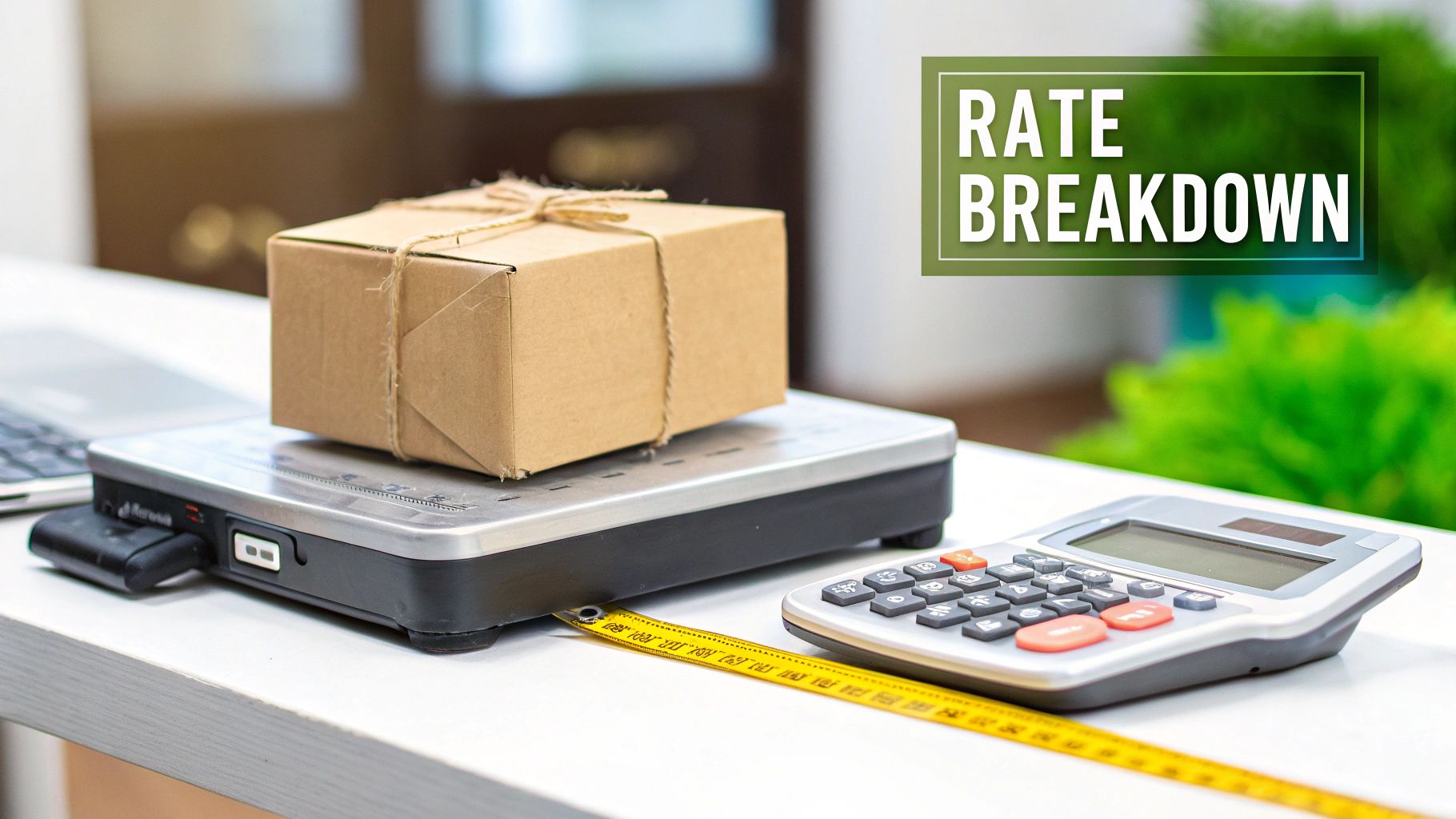
If you’ve ever sent two packages of the exact same weight but received two totally different bills, you're not alone. It’s because every carrier, whether it's Australia Post or a private courier, uses a specific formula to work out the cost. There’s rarely a single flat rate because every package is unique.
Think of it like a recipe. The final cost is the result of adding different ingredients together. Once you understand this "recipe," you're on your way to becoming a smarter shipper and finding real savings for your business.
The Core Ingredients of Your Shipping Bill
At its heart, the calculation for post and parcel rates comes down to a handful of variables. Get your head around these, and you'll have the power to control your shipping expenses.
- Parcel Weight: This is the straightforward one – the actual physical weight of your package in kilograms.
- Physical Size: The length, width, and height of your parcel. This tells the carrier how much room it's going to take up on the truck or plane.
- Destination: Simply put, the distance your parcel needs to travel from you to the recipient.
- Delivery Speed: How urgently does it need to arrive? Standard, express, or same-day services all have different price points.
These elements blend together to create a unique price for almost every single parcel. For instance, a big, lightweight box of pillows going from Perth to Sydney will often cost more to send than a small, heavy box of books travelling across Melbourne. Why? Because carriers have to charge for both the weight and the physical space a parcel occupies.
Even small items like letters need careful attention to size. This handy guide on A6 envelope dimensions and postage tips shows how even slight differences can affect mailing costs.
By understanding how weight, size, and distance interact, you can start making strategic choices that directly lower your shipping costs. The key is to look beyond just the number on the scale and consider the entire profile of your shipment.
The Australian parcel market is always shifting. Just look at the latest figures: Australia Post's domestic parcels revenue hit $6.46 billion in FY24, up 3.3%, even though parcel volumes only grew by 1.8%. This shows that the average cost per parcel is rising, making it more critical than ever to understand the pricing.
For some practical tools to get started, you can check out our guide on how to calculate shipping charges.
The Three Pillars of Your Shipping Costs

Alright, now that we've covered the basics, let's get into the nitty-gritty. When it comes to your final post and parcel rates, pretty much everything boils down to three key factors: how big and heavy your item is, how far it's going, and how fast you need it to get there.
Getting your head around these three pillars is the secret to predicting your costs, keeping your customers happy, and making sure you're not spending a dollar more than you need to on shipping. They all play off each other, so understanding them individually—and as a team—is your first step towards smarter shipping.
Pillar 1: Weight vs. Space
One of the most common traps for new business owners is just looking at the number on the scales. While the actual weight of your parcel definitely matters, couriers are just as concerned with how much room it takes up in their van or plane. This is where the idea of cubic weight (sometimes called dimensional weight) becomes so important.
Think about it this way. You've got two packages to send: a small, 10kg dumbbell and a massive but very light 1kg lampshade. The dumbbell is heavy but doesn't take up much real estate. That lampshade, on the other hand, is a space-hog, taking up precious room that could have been filled with dozens of other items.
To make it fair, couriers calculate both the actual weight and the cubic weight, and—you guessed it—they charge you for whichever is greater. It’s their way of making sure they get paid for the space your parcel uses. This is why learning to pack your items snugly and efficiently is one of the quickest ways to save money.
Pillar 2: The Zone Game
The second major piece of the puzzle is distance. But in the logistics world, we don't just charge by the kilometre. Australia is a huge place, so carriers have carved it up into a series of shipping zones that radiate out from your pickup location.
It’s a bit like the fare zones on a public transport map. A short trip within the same zone (say, from one Sydney suburb to another) is your cheapest ticket. But as your parcel travels further and crosses into new zones—from Sydney to regional NSW, then up to Brisbane, and all the way across to Perth—the price climbs with each boundary it crosses.
Shipping from a major city to a remote town in Western Australia can cost significantly more than sending the same parcel twice the distance between two East Coast capital cities. This is because remote zones often involve more complex logistics and fewer deliveries.
The key takeaway is simple: the further the destination and the more remote it is, the higher the zone number and the greater the cost. You can’t get a truly accurate quote for your courier costs without first knowing the destination postcode.
Here’s a rough guide to how zones usually stack up:
- Local/Intra-Zone (Zone 1): Shipping within the same city or a very tight radius. This will always be your most affordable option.
- Regional (Zones 2-3): Sending parcels to nearby towns or regional centres just outside a major metro area.
- Interstate (Zones 4-7): Shipping between capital cities or across state lines. Costs here jump noticeably the further you go.
- Remote (Zone 8+): This is the most expensive tier, covering those far-flung rural and remote locations that are tough and costly to get to.
Knowing where you ship most often helps you budget properly and can even influence where you focus your marketing efforts.
Pillar 3: The Speed Factor
The final pillar is speed, and it’s a classic trade-off: the faster you need a parcel to arrive, the more you will pay. It’s that simple. Couriers offer a menu of services to match different levels of urgency, each with its own price tag.
For things that aren't time-sensitive, a standard or road service is the most budget-friendly choice. These services usually get the job done in 2-8 business days, depending on the destination, and are the workhorse option for most e-commerce businesses.
When you need it there a bit quicker, express services are the next step up, typically delivering in 1-3 business days between major hubs. You’ll pay a premium for the priority treatment, but it's often essential for keeping customers happy.
And for those "get it there yesterday" moments, same-day or next-flight services offer the fastest possible delivery, sometimes in just a few hours. These are, by far, the most expensive options and are usually reserved for critical business documents or high-value parts. The trick is to match the service level to the situation so you’re not paying for speed you don’t actually need.
To bring it all together, here’s a quick summary of how these factors influence your final price.
How Key Factors Impact Your Parcel Rate
| Factor | How It's Measured | Impact on Cost | Example Scenario |
|---|---|---|---|
| Size & Weight | The greater of actual weight or cubic weight. | High: Large, light items can be surprisingly expensive. | A 1kg pillow in a big box may cost more to ship than a 5kg book. |
| Distance & Location | Shipping zones based on postcodes. | High: Cost increases as the parcel crosses more zones, especially to remote areas. | Sydney to Perth (Zone 7) is much pricier than Sydney to Melbourne (Zone 4). |
| Delivery Speed | Service level (e.g., Standard, Express, Same-Day). | High: Faster services have a significant premium. | An express overnight parcel can cost 2-3 times more than a standard 5-day road service. |
As you can see, each pillar has a direct and significant impact on the final quote. Mastering the balance between them is the key to an efficient and cost-effective shipping strategy.
Uncovering Surcharges and Hidden Shipping Fees
The quote you get upfront is rarely the final price you pay. It’s frustrating, but the bill that lands in your inbox can often be a bit of a shock, padded with extra charges you didn't see coming. Getting a handle on these common surcharges is the only way to accurately forecast your shipping costs and protect your profit margins.
These fees aren't just plucked out of thin air. Carriers use them to cover the costs of anything that falls outside their standard, automated delivery process. Think of the fuel needed to run a nationwide fleet or the extra legwork it takes to get a parcel to a rural farmhouse—every surcharge has a reason. Let’s pull back the curtain on the most common ones so you can see them coming and manage them better.
The Most Common Surcharges Explained
Imagine your base shipping rate covers a smooth, predictable, A-to-B journey for your package. Any little detour or complication—a tricky destination, an awkward-shaped box—is where surcharges tend to pop up. Knowing what they are is the first step to avoiding nasty surprises.
Here are the usual suspects that can inflate your shipping bill:
- Fuel Surcharge: This is a variable fee that fluctuates with local fuel prices. Carriers tack it on to cover the ever-changing cost of fuel for their planes and trucks. It’s applied as a percentage of your base shipping cost and is pretty much unavoidable, so it's best to factor it into your budget.
- Remote & Regional Area Surcharge: Getting a package to the outer reaches of Australia is a massive logistical effort. This fee covers the extra time, fuel, and resources needed to reach addresses well outside the major city networks where delivery runs are less frequent.
- Manual Handling Fee: Modern shipping depots are marvels of automation, with conveyor belts and scanners sorting thousands of parcels an hour. If your parcel is too big, too heavy, an odd shape (like a tube or a sphere), or not packaged securely, it gets pulled off the line and has to be sorted by a real person. This surcharge pays for that extra manual labour.
While these are the big three, the list certainly doesn't stop there. Other fees can appear depending on the specifics of the job, making it even trickier to pin down your final costs.
The bottom line is that carriers price their services for maximum efficiency. Anything that slows down their automated systems—from a hard-to-reach address to a non-standard box—will almost always cost you extra.
Optional Extras and Penalty Fees
Beyond the day-to-day operational surcharges, there are a couple of other costs to keep in mind. Some are optional services you can choose to add for extra security, while others are straight-up penalties for things like failed delivery attempts.
For instance, you might choose to add Signature on Delivery for proof that your package arrived safely, which is great for high-value items. Likewise, Transit Insurance gives you a safety net in case your goods are lost or damaged on their way. They add to the initial cost, but for the right shipment, they’re a smart investment.
Penalty fees, on the other hand, are completely avoidable. The classic example is the futile delivery fee. This stinger gets charged when a courier shows up, but no one is home to sign for the parcel and there’s nowhere safe to leave it. The driver has no choice but to take it back to the depot, which means more work for them and a big delay for your customer.
This is a huge pain point for online sellers, as the cost of redelivery can chew through your profits. That's why we've put together a guide on how to find carriers with a policy of no courier redelivery fees—a simple change that can save you a surprising amount of money and headaches. By being smart about the services you choose, you can keep these nasty surprises off your final invoice.
Australia Post vs Couriers: Who Wins for Your Business?
Picking your shipping partner is one of those make-or-break decisions for any Australian business. It has a direct line to your costs, your delivery speed, and, most importantly, your customer’s happiness. In Australia, the two main players are the familiar face of Australia Post and the wide, varied world of private courier services.
There’s no single "winner" here. It’s all about finding the right fit for how you do business. Let’s break down their strengths and weaknesses to help you make a smarter call for your company.
The Case for Australia Post
The biggest advantage Australia Post brings to the table is its sheer, unmatched reach. As our national postal service, its network is designed to get to every single address in the country, a challenge that most private couriers can't (or won't) take on without a hefty price tag.
This universal service obligation means they’ll deliver to places many couriers consider out-of-bounds or slap with a surcharge, like PO Boxes, Parcel Lockers, and remote properties deep in the outback.
Another huge plus, especially for smaller businesses, is the simplicity of their flat-rate satchels. If you’re sending items under 5kg, these prepaid bags give you predictable, upfront pricing. You know exactly what it costs before you even stick the label on, which makes budgeting a whole lot easier.
Australia Post is the reliable backbone of national logistics. Its strength is in that universal reach and simple pricing for common parcel sizes. This makes it a fantastic starting point for businesses shipping all over the map, especially to non-standard addresses.
It's also worth remembering the bigger picture influencing its post parcel rates. As a government-owned entity, its pricing is a balancing act. Losses from the old-school letters business are often subsidised by the more profitable parcels side of things. This can affect how competitively their parcel services are priced, a dynamic explored in detail in this analysis of Australia Post's operations presented to the Australian Parliament.
The Power of Private Couriers
If Australia Post offers breadth, private couriers deliver specialisation and flexibility. They thrive by excelling in the areas where the national carrier is more restricted, giving businesses some powerful alternatives to get their shipping just right.
Some of the biggest advantages of going with a courier often come down to:
- Speed: Many couriers built their entire reputation on getting things there faster. They offer same-day and overnight services that can be quicker and more dependable than standard post.
- Specialised Handling: Got something fragile, expensive, or just plain awkward? Couriers usually offer better handling options and more comprehensive insurance to protect your high-value goods.
- Bulk Discounts: This is a big one for growing businesses. Couriers are almost always open to negotiating better rates based on volume. The more you ship, the more you save.
- Technology Integration: Modern courier platforms are often miles ahead with real-time tracking, easy online booking, and slick integrations with e-commerce stores like Shopify or WooCommerce.
Think of private couriers as specialists in a very competitive market. That competition forces them to be innovative and cater directly to what businesses need. If you’re looking for a service that can be moulded to your unique requirements, it’s well worth exploring the best courier service options available.
Feature Comparison: Australia Post vs Private Couriers
To make the choice clearer, here’s a side-by-side look at what each option typically offers.
| Feature | Australia Post | Private Courier Services (e.g., Aeros) |
|---|---|---|
| Reach | Unrivalled. Covers all of Australia, including PO Boxes and Parcel Lockers. | Excellent in metro and major regional areas. Can be limited or expensive for remote locations. |
| Speed | Standard and Express options available, but express isn't always a next-day guarantee. | Specialises in speed. Same-day, overnight, and time-sensitive delivery are common. |
| Pricing | Simple flat-rate options for common sizes. Standard pricing can be less competitive for bulk. | Highly competitive, especially for businesses with consistent volume. Rates are negotiable. |
| Specialised Services | Limited options for fragile, oversized, or high-value items. | Strong focus on specialised freight, including fragile goods, pallets, and dangerous goods. |
| Technology | Basic tracking and online tools. Integrations can be less flexible. | Advanced platforms with real-time tracking, e-commerce integrations, and analytics. |
| Customer Support | Large call centres, can be difficult to get personalised help. | Often provides dedicated account managers and more direct support channels. |
Ultimately, the table shows there's no single "best" choice for everyone. Australia Post is a fantastic, reliable all-rounder, while couriers offer the specialised tools and pricing power that growing businesses need.
Real-World Price and Speed Scenarios
Let's put this into practice. Imagine you’re a business in metro Sydney needing to ship a 2kg shoebox-sized package.
Scenario 1: Shipping to Metro Melbourne
- Australia Post (Standard): You're probably looking at a delivery time of 2-4 business days. The cost will be decent, particularly if your item fits into a flat-rate satchel.
- Private Courier (Standard Road): A courier could easily match or even beat the price here, often delivering a day or two quicker, in around 1-3 business days.
- Private Courier (Express): Need it there tomorrow, guaranteed? This is where couriers shine. For a higher price, they can lock in next-day delivery with far more certainty.
Scenario 2: Shipping to Regional WA (e.g., Broome)
- Australia Post (Standard): This is AusPost’s home turf. Delivery might take 7-10 business days, but the cost will almost certainly be the most affordable standard option you’ll find.
- Private Courier (Standard Road): Most couriers will apply a significant remote area surcharge for this journey, which can make them much more expensive than Australia Post for a similar delivery window.
It’s also crucial to be aware of the "hidden" fees that can pop up with any carrier, as this infographic highlights.
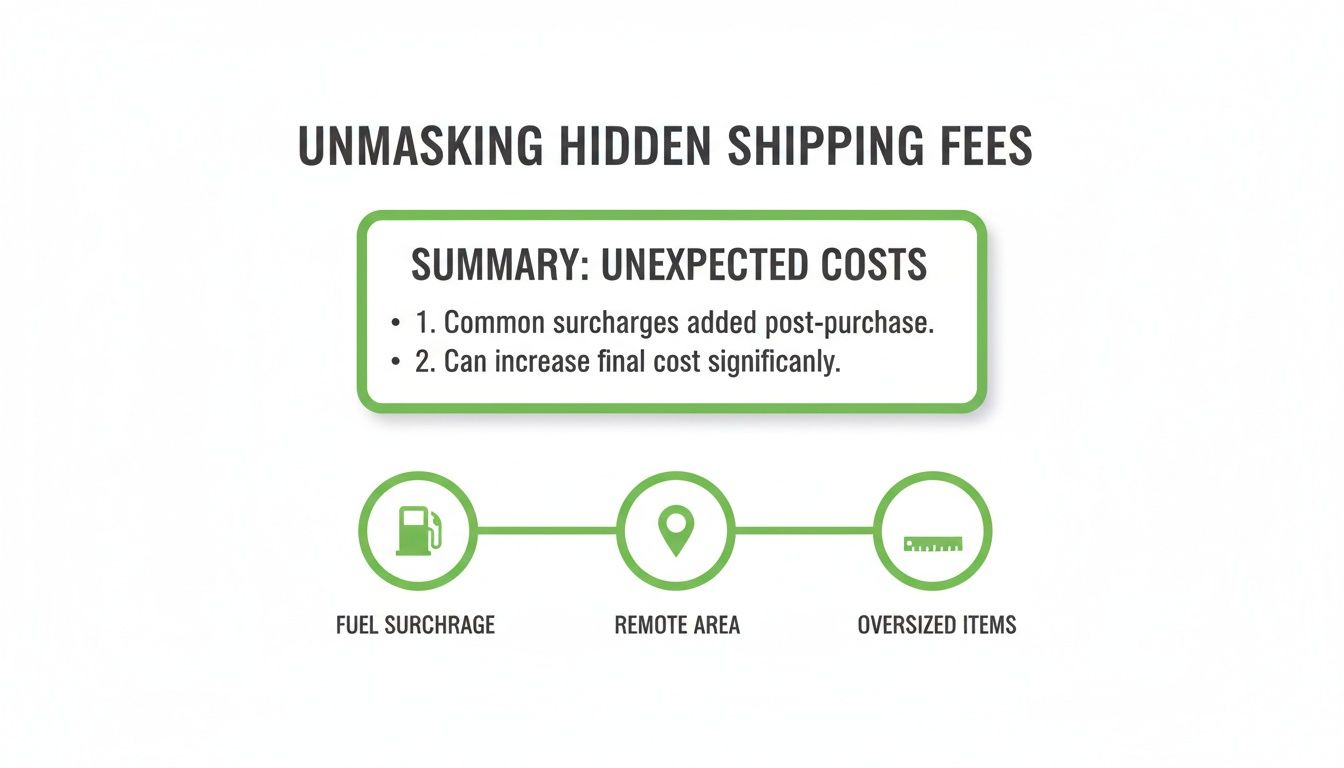
Getting your head around how fuel levies, remote delivery zones, and oversized dimensions add extra charges is the key to avoiding bill shock.
The main takeaway here is pretty clear: for your everyday metro-to-metro shipments, private couriers often deliver a winning combination of price and speed. But when you’re sending parcels to the far-flung corners of the country, Australia Post’s universal network is hard to beat for cost-effectiveness. In reality, many of the smartest businesses don't just pick one; they use a hybrid approach to get the best of both worlds.
Practical Strategies to Lower Your Shipping Costs
Alright, so you understand the "why" behind shipping costs. Now for the fun part: making them smaller. Knowing how rates are calculated is one thing, but actually putting that knowledge to work is where you'll see a real difference on your balance sheet.
Think of your shipping process less as a fixed cost and more as a series of levers you can pull. By getting smarter with your packaging, order handling, and choice of courier, you can actively cut down what you spend without ever sacrificing service quality. Let's look at some real-world tactics you can use today.
Optimise Your Packaging
One of the fastest ways to save money is to take a hard look at your boxes. We’ve already seen how carriers use cubic weight, meaning you literally pay for empty space. It's time to stop shipping air.
- Ditch the "One-Size-Fits-All" Box: It’s tempting to buy one box size in bulk, but it’s a trap. Putting a small item in a big box means you're paying a penalty in cubic weight. Keep a small range of box sizes on hand to match your products.
- Lighten Your Void Fill: That heavy bubble wrap or scrunched-up paper adds to the parcel's actual weight. Switch to ultra-light air pillows. It might only be a few grams per parcel, but that adds up fast, especially when you’re sending dozens of orders a day.
- Embrace Satchels and Mailers: For anything that isn't fragile—think clothing, books, or soft goods—a poly mailer or padded satchel is your best friend. They're incredibly lightweight, take up almost no cubic space, and are far cheaper to send.
Every centimetre you trim from your box dimensions and every gram you shave off its weight is money that stays in your business. Smart, consistent packaging isn't just about presentation; it's one of the most powerful cost-control tools you have.
Streamline Your Order and Shipment Management
How you manage orders before they even hit the courier van can impact your shipping costs just as much as the box you use. A bit of planning can unlock some serious savings.
For example, a customer places two separate orders on the same day. Do you ship them separately? Don't. Consolidating them into a single, larger shipment is a no-brainer. Instead of paying a base rate and fuel surcharge twice, you only pay it once. This not only saves you money but also gives your customer a better experience—one delivery, one tracking number.
Another smart move is using prepaid satchels for standard items under 5kg. This gives you predictable, flat-rate pricing that makes budgeting a breeze. Thinking about how your orders flow from click to courier can make a massive difference. For a deeper look at this, it's worth reading up on efficient order fulfillment strategies.
Leverage a Multi-Carrier Shipping Platform
Sticking with a single courier is like only shopping at one supermarket—you're stuck with their prices, even when there's a better deal just down the road. This is where a multi-carrier shipping platform completely changes the game for small and medium businesses.
Think of these platforms as a shipping aggregator. They bring together a whole range of couriers—from the big national names to smaller, specialised services—all under one roof. Here’s why that’s so powerful for cutting costs:
- Instant Rate Shopping: Instead of wasting time getting quotes from five different websites, you enter your parcel details once and instantly see a list of every available service and what it costs. You can then pick the cheapest or fastest option for every single shipment, whether it's going to the next suburb or across the country.
- Access to Bulk-Buy Discounts: Aggregators have massive shipping volumes, which gives them the power to negotiate incredible discounts with couriers. They then pass those savings directly to you. Suddenly, your small business gets access to the kind of shipping rates that were once only available to the big players.
- A Simpler Workflow: It’s not just about the money. These platforms make life easier. You can book shipments, print all your labels, and track every parcel from one simple dashboard. That’s a huge time-saver you can pour back into growing your business.
When you use a multi-carrier strategy, you’re no longer locked into one provider’s rates. You gain the power and flexibility to always find the cheapest way to send a parcel, making sure you get the absolute best value for every dollar you spend on shipping.
Got Questions About Parcel Rates? We've Got Answers
Sending parcels in Australia can feel like a bit of a minefield, especially when the costs seem to change every time you ship. Whether you're sending a one-off gift or running a full-scale e-commerce store, a few questions always pop up. Here are some straight-talking answers to the most common ones.
Why Do My Shipping Costs Seem to Change Randomly?
It’s a common frustration, but believe it or not, the costs aren't random. Every single price is a direct calculation based on a few key variables that can shift with each parcel.
The big three are always the parcel's weight and size (what carriers call cubic weight), the distance it’s travelling (its shipping zone), and the delivery speed you’ve chosen. Even something as simple as using a slightly larger box can tip the scales and change the final price.
Is an Express Service Always Faster?
Mostly, yes, but it’s not an iron-clad guarantee of overnight delivery. When you pay for an "express" service, you're essentially buying your parcel a priority pass. It gets to jump the queue and is pushed through the carrier’s network ahead of standard road freight. Between major cities like Sydney and Melbourne, this usually means next-business-day delivery.
But here’s the catch: once that parcel needs to get to a regional or remote town, it has to join the local delivery run. That final leg might only happen a couple of times a week. Your parcel will still get there faster than it would on a standard service, but "express" to a remote farm isn't the same as "express" to a CBD office. Always check the carrier’s own ETA for the destination postcode.
A key takeaway for businesses is that delivery speed is relative to the destination. While express services significantly cut down transit time on major routes, the "last mile" to a remote location can add unavoidable delays.
Can I Just Avoid Paying a Fuel Surcharge?
In a word, no. The fuel surcharge is one of those non-negotiable costs that’s almost impossible to sidestep. It’s a standard industry practice, and you’ll see it tacked on by just about every courier and postal service in Australia, including AusPost.
This fee is just a variable percentage added to your base shipping cost. It’s the carrier’s way of dealing with fluctuating petrol and diesel prices. As fuel costs go up or down each week, the surcharge is adjusted to match. While you can't get rid of it, the best you can do is find the lowest base rate to minimise its impact.
Why Are My Letters and Stamps Getting So Expensive?
This one comes down to simple economics and our changing habits. With emails and instant messaging, far fewer people are sending traditional letters. The problem is, the massive cost of maintaining the national delivery network—the posties, the vans, the sorting facilities—hasn't gone away. To cover that operational gap with less mail, Australia Post has to increase prices.
The ACCC has approved these regular price hikes. To put it in perspective, the Basic Postage Rate jumped from $1.10 in 2020 to $1.50 in 2024, and another increase is on the cards for 2025. If you’re curious about the numbers, you can dive into the details by reading the ACCC's official decision document, which explains the economic factors behind Australia Post's pricing.
What’s the Best Way to Get Cheaper Rates?
There's no single magic trick, but a combination of smart habits will make a huge difference.
- Optimise Your Packaging: Always use the smallest and lightest box that will safely hold your item. This is the number one way to minimise those cubic weight charges.
- Consolidate Shipments: If you have multiple orders going to the same person, box them up together. You'll avoid paying the base rate and surcharges more than once.
- Compare Carriers: This is the big one. Don't just stick with one provider out of habit. A multi-carrier platform lets you instantly compare post parcel rates to find the cheapest and fastest option for that specific delivery.
By actively managing these three things, you can take back control of your shipping budget and find some serious savings over time.
Ready to stop overpaying and start shipping smarter? Aeros Couriers gives you instant access to discounted rates from Australia's top carriers, all in one easy-to-use platform. Get your free, no-obligation quote in seconds and see how much you can save at https://www.aeroscouriers.com.au.
Courier quotes, tracking and support
Ready to send a parcel? Compare the available services for your postcodes, parcel dimensions and weight. For an existing delivery, use your consignment number to check tracking or ask our team for help.