At its core, parcel delivery is simply the business of getting a package from Point A to Point B. But for Australian businesses and individuals, it’s a lot more than that. It’s about choosing the right service—like Standard, Express, or Same-Day—to move your goods within Australia, juggling costs based on size and destination, and making sure everything is packed securely for a safe trip.
Understanding Australian Parcel Delivery Services
Parcel delivery is the engine room of Australian e-commerce and a lifeline for countless other businesses. It's much more than just sending a box; it's a finely tuned machine of logistics, tech, and customer service that keeps our national economy moving. Whether you're sending a one-off gift or shipping hundreds of online orders a day, getting your head around the basics is essential.
And this system isn't just big—it's getting bigger, fast. The Aussie courier and parcel market is currently worth a massive USD 11.75 billion, and it's on track to hit USD 15.02 billion by 2030. This growth is almost entirely driven by the boom in online shopping, with domestic shipping accounting for over 62% of the action.
The Core Service Types Explained
Think of domestic parcel delivery services like different travel options, each built for a specific purpose. Understanding how they differ is the key to balancing speed against your budget. For example, the wide variety of Shopify businesses in Australia have completely different needs—a boutique selling handmade jewellery has different priorities than a retailer drop-shipping electronics.
Here’s a breakdown of the main options you’ll come across when shipping within Australia:
Standard Delivery: This is your workhorse service—the most common and budget-friendly choice. Think of it as the scenic road trip for your parcel. It’s reliable and gets the job done without breaking the bank, making it perfect for non-urgent items where cost is the main concern.
Express Delivery: Need it there quicker? Express is your direct flight. These parcels get priority treatment across the courier network, guaranteeing a much faster arrival. You can typically expect delivery within one to three business days between major metro areas.
Same-Day Delivery: For those can't-wait shipments, this is like calling a dedicated taxi for your package. It’s a premium service where your parcel is picked up and delivered on the very same day, ideal for critical documents, last-minute gifts, or urgent local orders.
Picking the right service isn't just a logistical choice; it's a strategic one. It has a direct impact on your customer's happiness, your operational costs, and the reputation of your business. The trick is to find that sweet spot between what your customer wants and what your budget can handle.
Getting this right is a huge part of running a successful business. By knowing the difference between these services, you can make smarter decisions that benefit your customers and your bottom line. If you need a hand figuring it all out, our detailed guide can help you find the best courier service in Australia for what you do.
How Parcel Weight and Location Determine Your Shipping Costs
Ever wondered why sending a small, heavy box of books can sometimes cost less than a huge, feather-light doona? The world of courier pricing can seem a bit mysterious at first, but it really boils down to two key things: how much space your parcel takes up and how far it needs to go.
Getting a handle on these two factors is the first and most important step to mastering your shipping budget. Think about it from the courier's perspective. Their most precious resources are the space inside their vans and planes, and the fuel it takes to move them. A heavier item burns more fuel, while a bulky one takes up space that could have been used for other parcels. Couriers have to account for both.
Dead Weight vs Cubic Weight: The Critical Difference
To make things fair, every parcel is measured in two ways to figure out its "chargeable weight." This ensures the price reflects the resources needed to send it, whether it's a dense little package or a big, airy one.
Dead Weight: This is the simple one. It’s just what the parcel weighs when you pop it on a scale. A 5 kg dumbbell has a dead weight of, you guessed it, 5 kg.
Cubic Weight (or Volumetric Weight): This one is a clever calculation based on your parcel's dimensions (length x width x height). It essentially converts the parcel's volume into an equivalent weight, representing how much room it hogs in the van. That big box of pillows might only weigh 1 kg (its dead weight), but because it's so large, its cubic weight could be calculated as 10 kg.
The golden rule of shipping is this: couriers will always charge you based on whichever is greater—the dead weight or the cubic weight. That small box of books will be charged on its dead weight, but the big, light doona will be charged on its cubic weight.
This is why understanding both is so crucial. The type of service you choose also plays a big part, as different networks are optimised for speed, size, and distance.
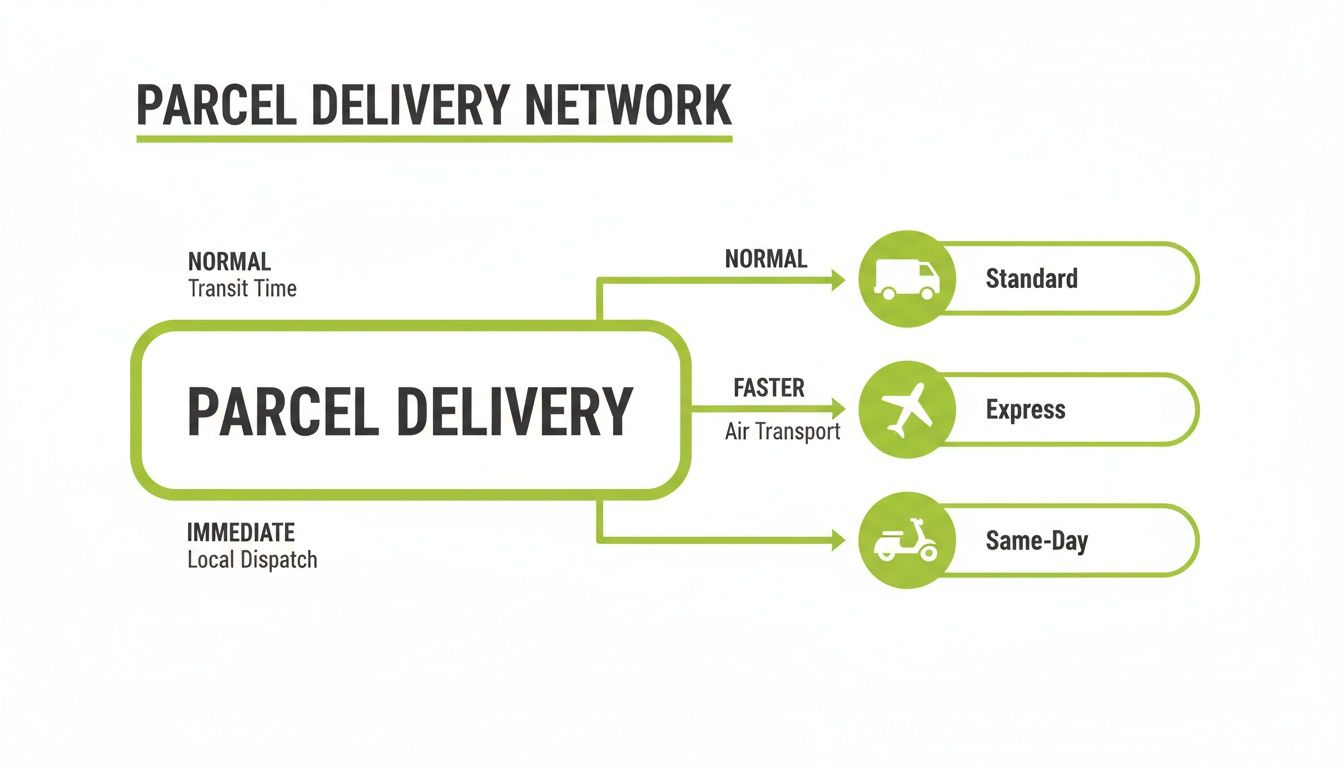
As you can see, whether your parcel travels by road or air has a massive impact on the logistics, which in turn influences how costs are calculated based on its size and weight.
How Your Postcode Impacts the Price
After you've figured out the chargeable weight, the next big piece of the pricing puzzle is the destination. A parcel's journey across Australia is a huge driver of the final cost, with clear price tiers based on delivery zones.
Here's a look at the main factors that go into calculating your final shipping price, beyond just the basics we've covered.
Primary Parcel Delivery Cost Factors in Australia
This table breaks down how different variables influence your total shipping cost, helping you understand and manage your expenses.
| Cost Factor | What It Means | Impact on Price | Practical Example |
|---|---|---|---|
| Chargeable Weight | The greater of the parcel's dead weight or cubic (volumetric) weight. | High | A 2kg box of pillows measuring 50x50x50cm has a cubic weight of 25kg, so you're charged for 25kg. |
| Delivery Zones | The origin and destination postcodes, grouped into metro, regional, and remote areas. | High | Sending a parcel from Sydney to Melbourne (metro-to-metro) is far cheaper than Sydney to Broome (metro-to-remote). |
| Service Speed | How quickly you need the parcel to arrive (e.g., Same-Day, Express, Standard). | Medium to High | An overnight express service using air freight will cost significantly more than a standard 5-day road service. |
| Fuel Surcharge | A variable percentage added to the base cost to cover fluctuating fuel prices. | Medium | When global oil prices rise, the fuel surcharge increases, adding a few extra dollars to every shipment. |
| Surcharges & Fees | Extra costs for things like residential delivery, dangerous goods, or oversized items. | Variable | A parcel over 1.2m long might attract a 'manual handling' surcharge because it can't go on automated conveyor belts. |
Understanding these factors gives you the power to make smarter shipping decisions.
Sending a parcel between major cities like Sydney and Melbourne is almost always your cheapest option. These are high-volume, super-efficient routes with trucks and planes running constantly, creating an economy of scale that keeps the per-parcel cost down.
But the moment your parcel heads into a regional or remote area, the costs start to climb. That "last mile" of the journey becomes much longer and more expensive. A single driver might have to travel hundreds of kilometres just to deliver to a few addresses in a country town—a world away from the dozens of deliveries they could make on a single city street. All that extra fuel, time, and labour is factored into the price.
This is why it's so important to use a tool to accurately calculate your shipping charges before you send anything. A good online calculator will factor in the chargeable weight and the specific postcodes to give you a precise quote, so there are no nasty surprises.
Packaging Parcels, Pallets, and Dangerous Goods Safely
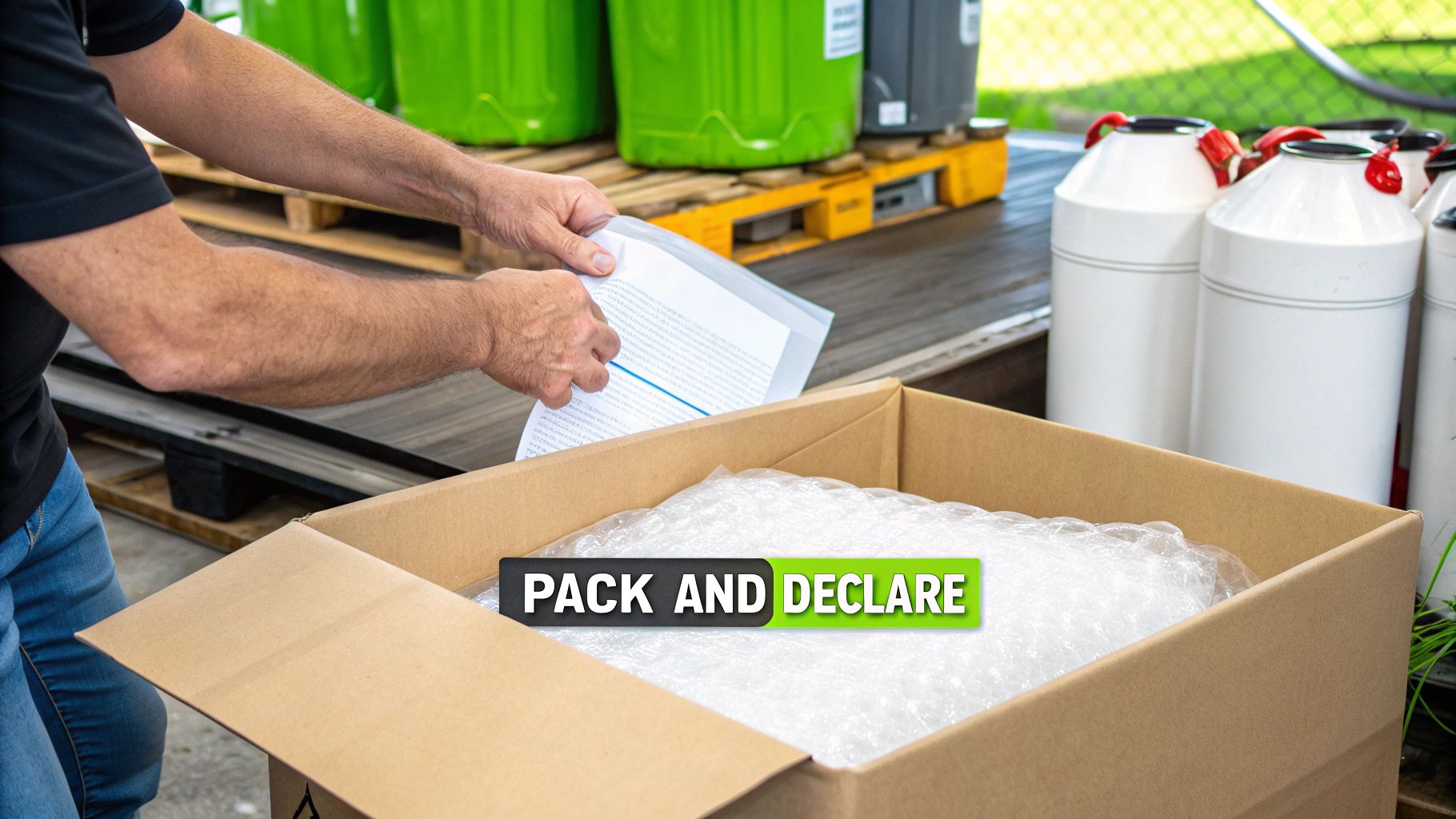
A successful delivery actually begins long before a courier even lays eyes on your parcel. Getting the packaging right is your first and best line of defence, making sure your items can handle the inevitable bumps, drops, and automated sorting machines they’ll meet on their journey across Australia.
Think of your parcel’s box as its suit of armour. A flimsy bag or an oversized box with no padding is like sending it into battle unprotected. The whole point is to create a solid, compact unit that stops the contents from moving around inside and protects them from knocks from the outside.
Mastering the Basics of Parcel Packaging
Nailing the fundamentals is surprisingly simple, but it makes all the difference. It’s what prevents breakages, keeps your parcel from damaging others, and ensures the courier accepts it without any fuss. Following a few key steps can save you the massive headache of damage claims and unhappy customers.
Here’s the essential checklist for prepping any standard parcel:
Choose the Right Box: Start with a new, high-quality corrugated cardboard box that’s just a little bigger than your item. It's tempting to reuse old boxes, but they can lose up to 60% of their strength after just one trip.
Cushion the Contents: Pack at least 5cm of cushioning material—like bubble wrap, packing peanuts, or even just scrunched-up paper—all around your item. The goal here is to completely immobilise it. If you can hear or feel anything shifting when you give the box a gentle shake, you need more filler.
Seal It Securely: Use a strong, pressure-sensitive packing tape (at least 48mm wide) to seal everything up. A great technique is the 'H' pattern: tape along all the seams on the top and bottom. This reinforces the whole box and stops it from bursting open under pressure.
Label Clearly: Your shipping label is basically the parcel's passport. Stick it onto the largest, flattest side of the box, making sure it’s completely smooth with no wrinkles. Never, ever put labels over seams or edges where they can get torn or become unreadable by scanners.
Preparing Larger Shipments with Pallets
When you’re sending goods in bulk, pallets are your best friend. Palletising your shipment doesn't just make it a breeze for freight carriers to move with forklifts; it consolidates all your boxes into a single, stable unit, offering far better protection.
A well-packed pallet is so much more than just stacking boxes. It’s about creating a solid, interlocked cube that can withstand the forces of transport. Incorrectly stacked pallets are a common cause of freight damage and can even be rejected by carriers if they are deemed unsafe.
To get it right, stack your boxes in an interlocking brick-like pattern, always putting the heaviest items at the bottom. The final stack should be flat on top and must not hang over the pallet's edges. To finish, wrap the entire load tightly to the pallet base with multiple layers of industrial stretch wrap. This turns dozens of loose boxes into one solid block. When you need to book a courier, platforms that let you easily send a parcel or a pallet in the same system make life much simpler.
Understanding Dangerous Goods Compliance
This is one of the most critical parts of shipping, and getting it wrong has serious consequences. You need to understand your legal duties when it comes to dangerous goods (DGs). Heaps of common household and business items fall into this category because, if not handled correctly, they can pose a real risk during transport.
Forgetting to declare these items isn’t just breaking a courier's rules—it’s breaking the law. It can lead to massive fines, your shipment being seized, and major delays. At the end of the day, you are legally responsible for what you send.
Common items that are classified as dangerous goods in Australia include:
- Flammable Liquids: Think perfumes, nail polish, some paints, and alcohol-based hand sanitisers.
- Aerosols: Deodorants, hairspray, and spray paints are all in this category.
- Lithium Batteries: These are in almost everything now—laptops, phones, power tools, and cameras.
- Corrosive Substances: Many heavy-duty household cleaners and, of course, car batteries.
If you’re shipping anything that might be on this list, you must declare it when you make your booking. This gives the courier the heads-up to use the right handling procedures, slap on the correct warning labels, and choose the appropriate transport method to keep everyone in the delivery chain safe. If you're ever in doubt, always check the official guidelines before you send.
Understanding Delivery Times and the Last Mile
Ever wondered why a package can travel from a Sydney warehouse to a Melbourne doorstep overnight, yet take a full week to find its way to a quiet town in rural WA? It all comes down to the logistics network and that final, crucial step of the journey. Getting your head around this helps you set realistic expectations for your customers, which is half the battle.
The speed of any delivery is really about the infrastructure between point A and point B. Think of the major metro routes—like Sydney to Brisbane—as the superhighways of Australian logistics. They’re buzzing with a constant flow of trucks and planes, making the trip fast and predictable.
But the moment a parcel turns off that highway, the journey changes. The path to regional and remote postcodes is often a winding one, involving more handovers between different carriers. This naturally adds time to the delivery.
Metro vs Regional: What to Expect
Australia’s sheer size creates a few distinct delivery realities, and each has its own timeline. Understanding these zones is key to giving your customers accurate ETAs and keeping them happy.
- Metro to Metro: This is as good as it gets. Parcels zipping between capital cities benefit from high volumes and frequent services. For express post, you’re often looking at next-day or two-day delivery.
- Metro to Regional: Here's where things slow down a bit. Your parcel will travel quickly along the main freight line to a regional depot. But from there, a local contractor takes over, and they might only service that final route a few times a week, adding a couple of days to the trip.
- Regional to Remote: This is the most complex leg. A parcel might pass through multiple regional hubs before being handed to a specialised local carrier covering a huge, sparsely populated area. It’s not unusual for these deliveries to take a week or more.
The Final Hurdle: Last-Mile Delivery
No matter how efficiently a parcel crosses the country, its journey always ends with the same challenge: the last mile. This is the final step, from the local depot to the customer's front door. It’s often the most expensive and trickiest part of the whole operation.
Think about it: one B-double can haul thousands of parcels between cities, but it takes an entire fleet of vans and drivers to deliver those same parcels to individual addresses. This final stage eats up a huge chunk of the total shipping cost and, more importantly, has the biggest impact on whether your customer has a good experience.
A slow, disorganised, or failed last-mile delivery can sour an otherwise perfect purchase. This is the moment of truth where your brand’s promise is either kept or broken, right on the customer's doorstep.
The focus on this final stage is reshaping the whole delivery game in Australia. The last-mile sector is booming, projected to grow at over 10.55% annually through to 2033 as e-commerce keeps climbing. With over 80% of Aussie households now getting regular parcel deliveries, the big players are scrambling to build the infrastructure to keep up. You can find more insights into Australia's last-mile market and what it means for logistics. It just goes to show how critical that final step is for a smooth, timely delivery.
From Your Doorstep to Theirs: A Step-by-Step Guide to the Delivery Workflow
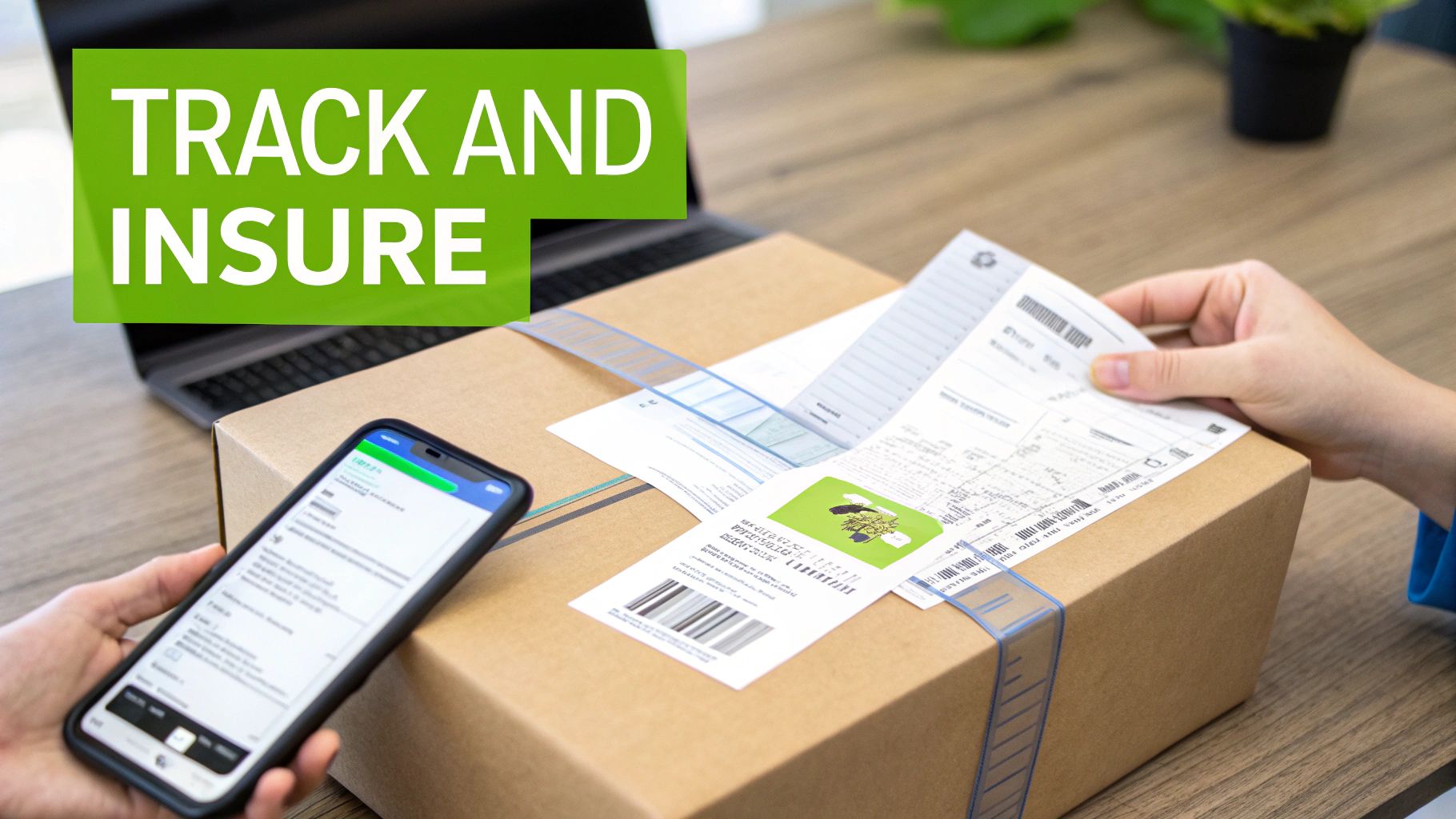
Once your item is perfectly packaged and sealed, you're ready to get it into the courier network. This is where a simple box is transformed into a traceable piece of freight, and understanding the workflow—from booking a job to tracking its progress—is the key to a smooth, headache-free experience for both you and your customer.
Think of it as a logical sequence. It all starts with you giving the courier the correct information and ends with everyone being able to watch the parcel’s journey right to the final destination.
Step 1: Booking Your Parcel Delivery Online
The first move is to formally book the pickup. These days, online platforms make this incredibly simple, but getting the details right at this stage is absolutely critical. Any small mistake here can cause frustrating delays or surprise surcharges later on.
When you book, you'll be asked for the core details of your shipment, including:
- Sender and Receiver Details: Full names, complete addresses (including postcodes!), and contact numbers.
- Parcel Dimensions and Weight: The exact length, width, height, and dead weight you measured earlier.
- Service Selection: Your choice between standard, express, or other specialised services on offer.
Seriously, double-check everything, especially the postcode and the dimensions. A simple typo can send a parcel to the wrong side of the country, while incorrect measurements will almost certainly lead to a price adjustment once the courier’s automated scanners pick up the discrepancy.
Step 2: Generating and Attaching the Shipping Label
After you’ve confirmed the booking, the system will generate a shipping label. This isn't just a sticker with an address; it’s your parcel's passport, ID card, and GPS all rolled into one. It holds every piece of critical information the courier's network needs to sort and deliver your shipment automatically.
The most important part of that label is the barcode. This unique code gets scanned at every key handover point in the journey—at pickup, entering a sorting depot, arriving in the destination city, and finally at the delivery point. Each scan is what updates the tracking system.
Think of the shipping label as the parcel’s brain. If it's smudged, unreadable, or falling off, the automated sorting machines can't process it. This forces a manual intervention, which always means delays and a much higher risk of something going wrong.
Attaching the label correctly is a non-negotiable step. Print it clearly on a single sheet of paper, making sure it’s not creased or faded. Stick it securely to the largest, flattest surface of your box, and never, ever put sticky tape over the barcode—the reflection can mess with the scanners. For a deeper dive, our guide to shipping labels and printing best practices has more tips.
Step 3: Tracking the Journey
With the label on and the parcel collected, the tracking process officially begins. The moment the pickup driver scans that barcode for the first time, your tracking number comes to life. From that point on, you can follow its progress online. Each new scan is like a digital handshake, confirming the parcel's location as it weaves its way through the network.
This visibility is powerful stuff. It lets you give your customers accurate updates, manage their expectations around delivery times, and quickly spot if a shipment has stalled somewhere along the way. The tracking history tells the complete story of its route.
Step 4: Understanding Shipping Insurance
Finally, let's talk about a little peace of mind. Let’s be honest, things can occasionally go wrong—parcels can get damaged in transit or, in very rare cases, go missing. This is where shipping insurance provides a crucial financial safety net.
It's important to know the difference between the two main types of cover:
- Standard Carrier Liability: Most courier services include a very basic, limited amount of cover by default. This often only provides minimal compensation (e.g., up to $100) and probably won't cover the full value of your goods.
- Extra Cover: This is proper insurance you can purchase when you book to cover the full declared value of your item. If you're sending anything valuable, this is an absolute must.
If the worst happens and you need to make a claim, the process is usually straightforward, but you’ll need your paperwork in order. You'll typically have to provide proof of the item's value (like a sales invoice), photos of the damage and packaging, and a claim form. The key is to act fast, as most carriers have a strict window for submitting claims after the delivery date.
How to Streamline Your Shipping and Slash Costs
Let’s be honest, juggling parcel delivery in Australia can feel like a full-time job. Between figuring out weights, navigating different delivery zones, and making sure everything is packed correctly, it’s easy to get bogged down.
The good news? You don't have to. With a few smart strategies and the right tools, you can turn this daily headache into a genuine advantage for your business. The trick is to stop handling each shipment one by one and start using a centralised platform.
Think of it as bringing all the scattered pieces of your shipping puzzle together in one place. Instead of jumping between multiple courier websites to hunt for the best price, a multi-carrier system does the legwork for you. It instantly pulls in real-time quotes from a range of providers, so you can see the best deal for speed and price on every single parcel you send.
The Power of Instant Rate Comparison
Imagine this: you've got two packages ready to go. One is a small, dense item heading to Melbourne CBD. The other is a big, bulky (but light) box destined for regional Queensland. The best courier for the first job is almost never the best for the second. This is where a dedicated platform becomes your secret weapon, letting you compare your options side-by-side so you never overpay.
This ability to pick the right service for the right job is single-handedly the most effective way to drive down your shipping bill. You suddenly have access to a much wider variety of services—including ones you might not normally consider—giving you the flexibility to perfectly match your budget and your customer’s delivery expectations, every single time.
When you centralise your shipping, you stop making one-off decisions and start building a smart, cohesive strategy. This doesn't just save you money; it cuts down your admin time dramatically, freeing you up to focus on what really matters: growing your business.
Unifying Your Workflow for Peak Efficiency
Beyond the bottom-line savings, a unified system brings a sense of calm and order to your entire workflow. Forget juggling different booking portals, logins, and tracking numbers. Everything happens in one spot.
- Centralised Booking: Punch in your parcel details once to see all your courier options, then book your preferred service in just a few clicks.
- Automated Label Printing: The system generates compliant shipping labels for you instantly. This all but eliminates manual errors and ensures your parcels are good to go.
- Unified Tracking: Keep an eye on all your shipments from a single, easy-to-read dashboard, no matter which carrier is handling the delivery.
This kind of unified approach is becoming essential as customer expectations for fast, convenient delivery continue to climb. The big players are constantly raising the bar; for instance, Australia Post delivered a record-breaking 102.8 million parcels during a recent peak season and grew its Parcel Locker network by nearly 19% to keep up with demand. This points to a clear trend: delivery networks are getting smarter and more accessible.
To keep up, you need the right tools. For businesses managing complex routes and schedules, using a specialised trucking virtual assistant can be a huge help in optimising logistics and cutting operational overheads.
By embracing these smarter practices and using powerful tools like an online shipping quote calculator, you can slash errors, lower your costs, and deliver the kind of experience that keeps your customers happy and coming back for more.
Got Questions About Parcel Delivery? We’ve Got Answers
Sending parcels around Australia can feel like a bit of a minefield, especially when you're just starting out. Whether you’re running a small business or just sending a gift to a mate, a few common questions always seem to pop up. Let's run through them.
What’s the Absolute Cheapest Way to Send a Parcel in Australia?
If you're looking to save money, your best bet is almost always a standard road service between major cities. Think Sydney to Melbourne, or Brisbane to Adelaide. These are the busiest freight routes in the country, so they're incredibly efficient and cost-effective.
But to really get the price down, you need to do a few more things:
- Pack small and light. Couriers charge based on size and weight (whichever is greater). A smaller box can make a surprisingly big difference to your bill.
- Shop around. Don't just stick with one provider. Prices for the exact same delivery can vary wildly between carriers, so using a comparison tool is a no-brainer.
- Book it online. Walking into a post office or depot is usually the most expensive way to send something. Booking online is nearly always cheaper.
How Long Does It Actually Take to Deliver a Parcel in Australia?
This really comes down to the service you pick and where the parcel is headed. Here’s a rough guide to keep in mind:
- Same-Day Delivery: This is for super urgent, local jobs within the same city. Your parcel should arrive in just a few hours.
- Express Delivery: Between major capital cities, you’re typically looking at 1-3 business days.
- Standard Delivery: For those same metro-to-metro routes, it’s more like 3-7 business days.
Just remember: sending anything to a regional or remote town will always take longer. The "last mile" of the journey is way more complex out there, so it's smart to tack on a few extra days to your estimate to be safe.
Can I Send a Parcel if I Don’t Have a Printer?
Technically, yes, but it makes things a lot harder. A handful of carriers offer a "printer-less" option where the driver brings the label, but it’s not common and usually costs more. Some services also have partnerships with local drop-off points like newsagents who can print the label for you on the spot.
But honestly, for almost all online courier bookings, you absolutely need to print your own label. That label is your parcel’s passport. It has the barcode that automated sorting machines scan to get it where it needs to go. A missing or incorrect label is the number one reason parcels get delayed.
What Do I Do if My Parcel Is Lost or Damaged?
The second you realise something is wrong, contact the courier or the platform you booked through. Don't wait. Most carriers have a tight window for making a claim, often just 14 to 30 days from the delivery date.
When you file a claim, they'll ask for:
- The tracking number.
- Proof of the item's value (like an invoice or receipt).
- Photos showing the damage to both the item and the box it came in.
Most standard services come with a very basic level of liability cover (often just up to $100). If you're sending something valuable, buying extra transit insurance when you book is the only way to make sure you're covered for its full value if the worst happens.
We've put together some quick answers to the most common questions our customers ask.
Common Parcel Delivery Questions
Quick answers to help you navigate the shipping process.
| Question | Answer |
|---|---|
| What's the best way to save money on shipping? | Use a standard road service, keep your parcels small and light, and always compare quotes from multiple carriers online. |
| How long does express post take? | Between major Australian cities, you can generally expect your parcel to arrive in 1-3 business days. |
| Do I need a printer to send a parcel? | In most cases, yes. The shipping label is crucial for tracking and sorting, and you'll usually need to print and attach it yourself. |
| What if my item is worth more than $100? | Always purchase extra transit insurance when you book. Standard liability is very limited and won't cover the full value of expensive items. |
| Why is shipping to a regional area so much slower? | The final delivery leg (the 'last mile') is less frequent and covers a larger area, which naturally adds time to the journey. |
Hopefully, that clears a few things up! Getting your head around the basics makes the whole process much smoother.
Ready to take the guesswork out of your shipping? Aeros Couriers brings everything into one place so you can instantly compare quotes, book deliveries, print labels, and track every single parcel. Get your free quote today and find a smarter, cheaper way to send parcels across Australia.
Courier quotes, tracking and support
Ready to send a parcel? Compare the available services for your postcodes, parcel dimensions and weight. For an existing delivery, use your consignment number to check tracking or ask our team for help.