



Trying to find the cheapest small parcel courier for shipping within Australia can feel like searching for a needle in a haystack. But here’s the thing: there isn't one single "cheapest" carrier for every job. The real secret is understanding the local market and knowing how to play it to your advantage.
For most city-to-city routes, you'll find private couriers often have the sharpest pricing. But if you're sending something out to a regional area, Australia Post frequently comes out on top. It all comes down to your parcel's specific size, weight, and where it's headed within Australia.
Decoding Australia's Crowded Courier Market

Before you can find the cheapest domestic shipping, you need a handle on the playing field. The Australian courier market is incredibly competitive, especially along the high-volume corridors connecting major hubs like Sydney, Melbourne, and Brisbane. This is fantastic news for you, as it means carriers are constantly fighting for your business with better prices.
This fierce competition is driven by the non-stop growth of e-commerce and the fact that most of Australia's population is clustered along the east coast. We're talking about a domestic courier market valued in the billions, creating a fast-paced environment where every dollar matters.
The Major Players and Their Strengths
Broadly speaking, the Australian domestic market is split between two kinds of providers, and they each have their own pros and cons that directly affect their pricing.
- National Carriers (e.g., Australia Post): Their superpower is their unmatched reach. Nobody else can get a parcel to practically every postcode in the country as reliably. This makes them a go-to, and often the most affordable, choice for regional and remote deliveries where private couriers tack on hefty surcharges.
- Private Couriers: These guys are all about efficiency, especially on routes within and between major cities. By zeroing in on dense, profitable delivery zones, they can often beat the national carriers on both speed and price for metro-to-metro shipments.
The key to saving money consistently is knowing which service to use and when. Sending a small package from Melbourne CBD to an address in Sydney's CBD? A private courier is almost certainly your cheapest and fastest option. But send that same parcel to a small town in Western Australia, and suddenly Australia Post’s network looks a lot more attractive.
Grasping this fundamental difference is the first real step to making smarter, more cost-effective shipping decisions. It’s not about being loyal to one brand; it’s about picking the right tool for the job, every single time. To dive deeper, you can check out our detailed guide on finding the best courier service in Australia.
Understanding What Really Drives Your Shipping Costs
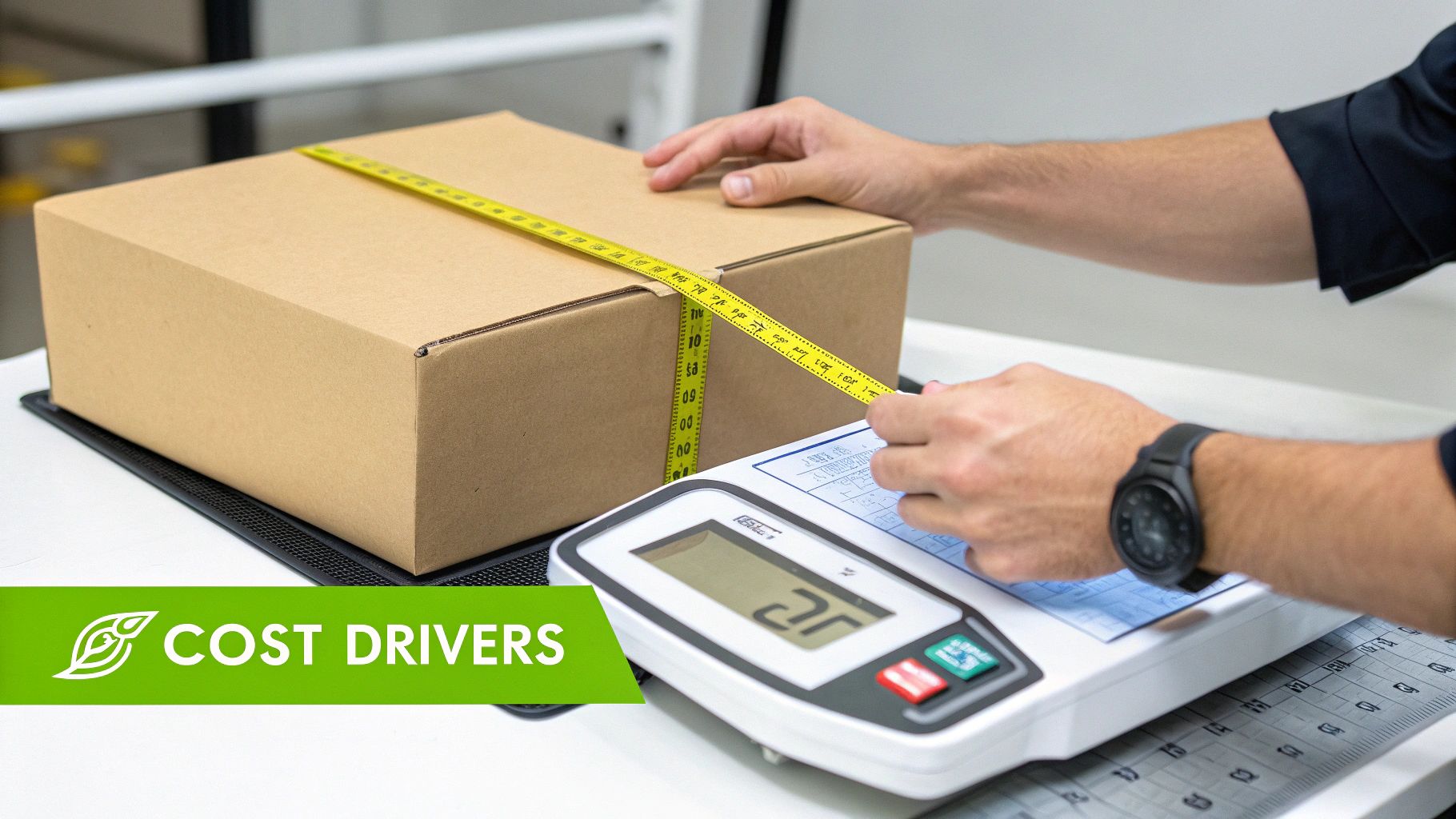
Ever been stumped by a shipping quote that just didn't make sense for your parcel's weight? You're not alone. It's a common frustration, and it usually happens because the final price is about much more than what the bathroom scales tell you.
Before you can find the truly cheapest small parcel courier, you need to get your head around the hidden factors that can seriously inflate your bill. The biggest one is a little concept called cubic weight.
The Cubic Weight Puzzle
In the world of logistics, space is money. Couriers charge for the amount of room a parcel takes up in their van or plane, not just its actual weight. This is what's known as cubic weight (or dimensional weight). They calculate both the "dead weight" (what it weighs on a scale) and its cubic weight, and you get charged for whichever is higher.
This is exactly why a big, light item—say, a decorative cushion or a lampshade—can cost a fortune to ship compared to a small, heavy box of books. The cushion hogs valuable real estate, meaning the courier can't fit as many other parcels in their vehicle for that run.
Let’s put it into a real-world context:
- Parcel A: A compact box of textbooks weighing a solid 5 kg.
- Parcel B: A huge teddy bear in a box, weighing only 1 kg.
Even though it’s five times lighter, Parcel B will almost always cost more to send. Its sheer size gives it a massive cubic weight, making it the more "expensive" item to transport from the courier's point of view. Grasping this is the absolute first step to packaging your items smarter, which we'll dive into later. If you want to see the maths behind this, you can check out our guide on how to calculate shipping charges.
The Surcharges That Add Up
On top of size and weight, a few other surcharges can sneak onto your invoice and drive up the final cost. These are pretty much non-negotiable fees that shift with the market and where you're sending your parcel.
A major one is the fuel surcharge. Fuel is a massive and unpredictable cost for any delivery network. Couriers pass this on by applying a surcharge based on current fuel prices, which can change week to week. For example, back in March 2024, average retail petrol prices across Australia’s five biggest cities jumped to 193.2 cents per litre. Brisbane even saw prices crack 200 cents per litre in April 2024. When operational costs like these rise, you can bet they get passed on to the customer.
Key Takeaway: The price you pay is a mix of your parcel's size (cubic weight), its destination (regional vs. metro), and wider economic factors like fuel costs. Your packaging is the one thing you have direct control over.
Finally, the destination itself plays a huge role. It simply costs a courier more in fuel, wages, and vehicle wear-and-tear to deliver to a regional or remote address than it does to zip between two metro suburbs. This is why you’ll see regional delivery fees or remote area surcharges tacked onto your quote, often making a big difference to the bottom line.
How to Pack and Measure Parcels to Cut Costs
Believe it or not, your biggest chance to save money on shipping happens before you even look for a courier. The way you pack and measure your parcel can single-handedly turn an expensive delivery into a surprisingly affordable one. It’s the one part of the whole process where you’re completely in control.
Nailing down the cheapest small parcel courier rate isn’t just about picking the right company; it’s about giving them a parcel that’s as efficient as possible. This all comes down to optimising for cubic weight, not just what the scales say.
Master the Art of Cubic Weight
As we mentioned earlier, couriers charge for the amount of space your parcel takes up in their van or plane. The formula they use is simple, but understanding it is absolutely critical for keeping your costs on the ground.
Here’s the calculation for cubic weight in kilograms:
(Length x Width x Height in metres) x 250 = Cubic Weight in kg
Let's look at a real-world example. Say you have a box that’s 40cm x 30cm x 20cm. In metres, that's 0.4m x 0.3m x 0.2m. Pop that into the formula, and you get (0.4 x 0.3 x 0.2) x 250, which gives you a cubic weight of 6 kg.
Here's the catch: even if the item inside only weighs 2 kg, you're going to be billed for the 6 kg cubic weight.
This is exactly why your choice of box is so vital. Using a box that’s way too big for your item is literally paying to ship empty air. A smaller, more appropriate box will immediately lower the cubic weight and, as a result, your shipping cost.
Practical Tips for Smart Packing
Getting your packing right is a simple habit, but it pays dividends on every single parcel you send out the door. It’s the best way to avoid nasty surprise fees and lock in the best possible rate from the get-go.
- Choose the Smallest Box Possible: Always aim for a box that gives your item a snug fit. You want just enough room for a bit of protective cushioning, and that's it. Never toss a tiny item into a massive box.
- Use Lightweight Void Fill: If you need to fill some empty space, reach for lightweight materials like air pillows or bubble wrap. Heavier options like scrunched-up paper can sometimes tip the actual weight over the cubic weight, costing you more.
- Measure Accurately: Once your box is all packed and taped up, measure it. Get the dimensions from its longest, widest, and tallest points. Always round up to the nearest centimetre and use these precise numbers when you get an instant quote to send your parcel.
One of the most common—and costly—mistakes we see is people under-declaring their parcel's dimensions. Couriers use automated scanners that check every single item. If their machines find your box is bigger than what you stated, you'll be stung with an extra re-weigh or re-measure fee, and those are never cheap.
At the end of the day, these small, consistent habits add up to a huge saving over time. By making smart packing and accurate measuring the very first step in your shipping process, you take direct control over your costs before you even start comparing quotes.
Comparing Courier Quotes Like a Seasoned Pro
Here's a hard-earned lesson from anyone who's ever shipped a parcel: never, ever settle for the first price you see. Finding the genuinely cheapest small parcel courier for your needs means you have to get good at comparing quotes. It’s not just about the sticker price, but understanding the real value behind it.
The most efficient way to do this? Use a courier aggregator platform. Think of them as the Skyscanner or Webjet of the shipping world. Instead of plugging your details into five different courier websites, you do it once and get a side-by-side comparison of real-time rates from multiple carriers.
This isn’t just about saving time—it’s about saving money. These platforms handle such a massive volume of parcels that they get access to wholesale rates. Those are discounts you simply can't get as an individual or small business booking directly.
Direct vs. Aggregator: Which Is Cheaper?
So, should you book directly with a courier or use a comparison platform? For one-off or infrequent senders within Australia, the answer is almost always an aggregator. While going direct might feel straightforward, it rarely gets you the best deal.
Imagine you're sending a small gift from Perth to Adelaide. If you go straight to a major carrier's website, you'll pay their standard public rate. But pop those same details into an aggregator, and you’ll almost certainly find a cheaper option because you're tapping into their bulk buying power.
It all starts with the basics, though. Simple decisions, like choosing a smaller box, have a direct and immediate impact on your costs before you even get to the comparison stage.
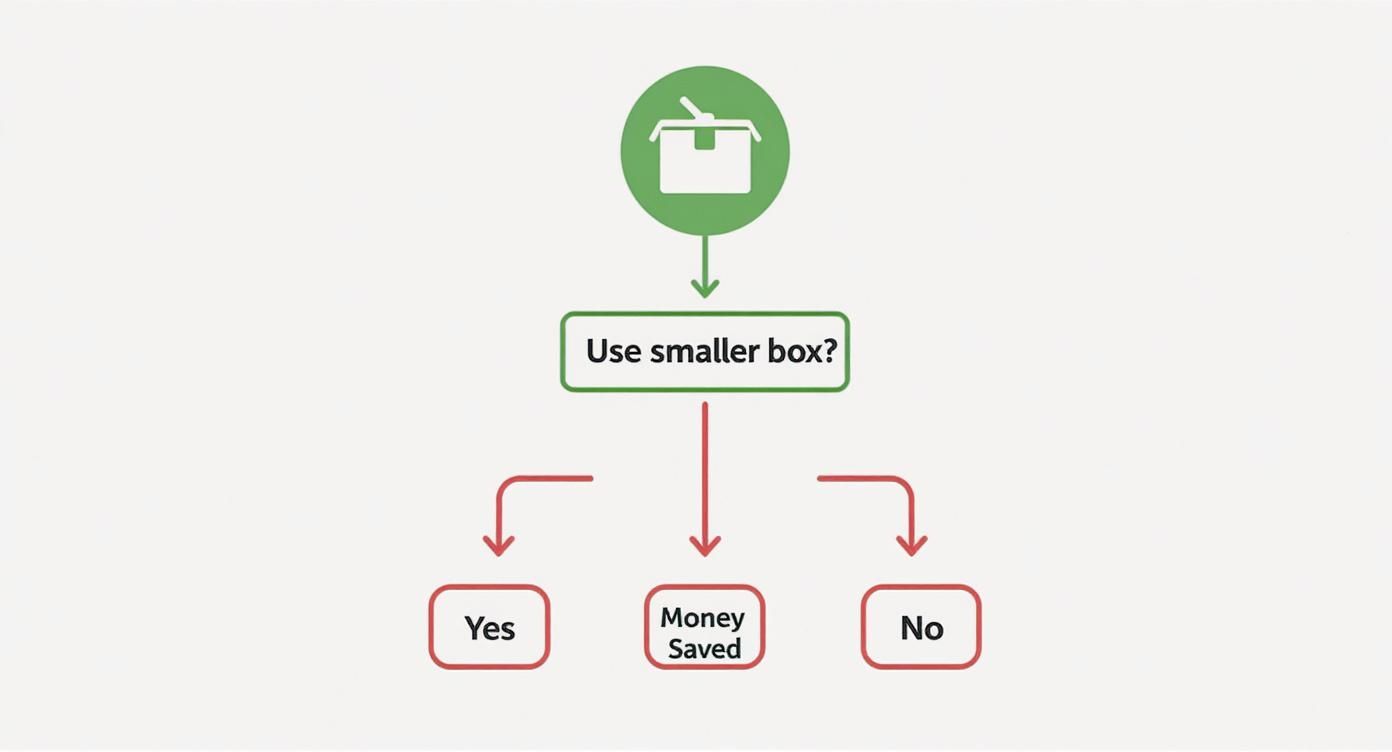
As you can see, getting your packaging right is the first domino to fall. Nailing this reduces your cubic weight, which is the foundation of a cheaper quote.
Here’s a quick table to break down the key differences between the two booking methods.
Direct Carrier vs. Aggregator Platform Comparison
| Feature | Booking Direct (e.g., AusPost) | Using an Aggregator |
|---|---|---|
| Price | Standard public rates, rarely the cheapest for single parcels. | Access to discounted, wholesale rates from multiple carriers. |
| Choice | Limited to the services offered by that one carrier. | Wide selection of couriers and service levels in one place. |
| Convenience | Requires visiting individual websites for each quote. | Enter details once to compare all options simultaneously. |
| Support | Direct customer service with the carrier handling the parcel. | Centralised support through the platform for booking queries. |
| Best For | High-volume businesses with negotiated direct contracts. | Individuals, small businesses, and infrequent senders. |
Ultimately, for most people sending small parcels, aggregators provide a clear advantage in both cost and convenience, making it easier to find the best possible deal every time.
Expert Tip: The cheapest quote isn't always the best quote. A price that seems too good to be true might come with a five-day transit time, no tracking, and zero included insurance. Always weigh the cost against the service level you actually need.
Look Beyond the Price Tag
When you’ve got a list of quotes in front of you, the dollar value is just one piece of the puzzle. A seasoned shipper knows to scan for a few other critical details before hitting "book". These are the things that make all the difference between a smooth delivery and a frustrating experience.
Before you make a decision, make sure you check these three things:
- Estimated Transit Times: How quickly does it really need to get there? An ultra-cheap service might take a week, which is perfectly fine for a non-urgent item but a total dealbreaker for a birthday present.
- Tracking Reliability: Does the service offer proper point-to-point tracking? Some basic services only update at "in transit" and "delivered," while others give you much more detailed, reassuring updates along the way.
- Included Insurance: Most couriers include a base level of cover, often up to $100. If your item is more valuable, you need to check how much is included and what it costs to purchase extra protection.
Thinking about these factors helps you shift from just finding a cheap price to finding the best value. The best way to see this in action is to try it yourself. Use a real-time shipping quote calculator and compare how the different services stack up for your exact parcel. This hands-on approach is the most effective way to find that sweet spot between cost, speed, and features.
Unlocking Deeper Savings with Smart Shipping Tactics
If you're running a small business or just find yourself sending parcels regularly, you know that even small savings on each shipment add up fast. We're talking about significant figures over a year. Once you've nailed the basics of packing and comparing quotes, it's time to dig into the savvier tactics that can really move the needle. This is how you transform shipping from a simple cost centre into a real competitive advantage.
One of the best ways to cut costs is by getting access to wholesale rates, which are usually reserved for the big players sending thousands of parcels. While aggregator platforms are a great start, some courier services give smaller businesses a way to tap into these pre-negotiated discounts without the high-volume commitment. This move alone can instantly drop your baseline cost for every single parcel you send.
Another surprisingly effective tactic is to consolidate your shipments. Think about it: instead of sending five small parcels to the same business customer throughout the week, could you hold them and send one larger package? It might seem simple, but doing this can slash your per-item cost and makes your own packing and tracking process a whole lot easier.
Navigating Delivery Zones and Pickups
You have to get your head around how couriers classify their delivery zones. The price difference between sending a parcel to a metro, regional, or remote area can be massive, and it all comes down to the carrier's operational costs.
- Metro Zones: These are your cheapest destinations. High population density means efficient delivery routes for the courier, and that saving gets passed on to you. Always double-check if an address falls within a courier’s metro classification.
- Regional & Remote Zones: This is where surcharges often creep in. If you send a lot of parcels to these areas, it’s absolutely critical to compare carriers. Some have much stronger and more cost-effective regional networks than others.
I’ve seen it happen countless times: someone assumes a suburb is "metro" only to find out their chosen courier classifies it as "regional." Always, always verify the destination postcode in the courier’s system before you book. It’s a simple check that can save you from a nasty surprise on your invoice.
How you schedule your pickups also offers a clear path to savings. Many couriers charge a fee just for booking a pickup. If your workflow allows, try batching your outgoing parcels for a single pickup once or twice a week instead of daily. This simple change cuts out those redundant fees.
Even better? Dropping your parcels off at a designated collection point can often eliminate pickup fees altogether. Sure, it takes a little extra effort, but it’s a guaranteed cost reduction every single time.
While we're focused on small parcels, it's helpful to understand the bigger picture of logistics costs. For example, reading about how data analysis and a free market approach can slash fuel costs for fleets gives you a fascinating look into the economics of transport. This kind of thinking helps you see why every little optimisation you make truly matters.
Finally, protect your bottom line from post-shipment surprises by knowing your courier's policies inside and out. A classic example is the dreaded redelivery fee. Take a few minutes to learn how to avoid courier redelivery fees if a recipient isn't home—it’s a small bit of knowledge that can save you a lot of headaches and money.
Got a Question? We’ve Got Answers
When you're trying to lock in the cheapest small parcel courier in Australia, a few questions always seem to pop up. We get it. You want to make smart choices and get the best value for every single package you send.
Here are the straightforward answers to the most common queries we hear, designed to give you the confidence to finalise your shipping strategy.
Who's Actually the Cheapest for Small Parcels in Australia?
Honestly, there's no single courier that's the cheapest all the time. The best choice really comes down to the specifics of what you're sending, where it's from, and where it's going.
For a small, lightweight item zipping between major cities like Sydney and Melbourne, you’ll often find the sharpest rates with private couriers through a comparison platform. But if you're sending that same parcel out to a regional town or a remote property, Australia Post’s massive network can frequently work out to be the more economical option. The only way to be certain is to compare quotes for every single shipment based on its unique size, weight, and destination.
Is it Better to Use a Courier Aggregator or Go Direct?
For most people and small businesses, a courier aggregator is almost always going to be cheaper. Think of it this way: these platforms have already done the hard yards, negotiating bulk wholesale rates that just aren't offered to the public when you book directly with a courier.
Sure, a large business dispatching hundreds of parcels a week might eventually be able to strike a better direct deal. For everyone else, though, aggregators provide the best bang for your buck right out of the gate. They instantly scan all those discounted prices for you, saving you time and money.
Using an aggregator is like getting the shipping discounts of a massive company without having to send thousands of parcels yourself. It’s a great way to level the playing field and make genuinely cheap shipping accessible to everyone.
How Can I Cut Costs If I Only Ship a Few Parcels Here and There?
Even if you’re only an occasional sender, you can still slash your shipping costs by focusing on a few simple things you have direct control over. Nailing these fundamentals means you won't pay a cent more than you have to.
- Become a Packing Pro: This is your biggest weapon. Always, always use the smallest and lightest box that will safely house your item. Paying to ship empty space is the most common and easily fixed mistake people make, and it directly inflates your costs through cubic weight.
- Compare, Every Single Time: Don't get complacent. The courier that was cheapest last week might not be today. Rates fluctuate, so jump on a comparison website for every shipment to find the best deal for that specific trip.
- Drop It Off Yourself: If there's a depot or collection point nearby, consider dropping the parcel off. It’s a small effort that can often knock off the pickup surcharge, giving you an easy, instant saving.
- Go with Standard Service: Unless it absolutely has to be there tomorrow, stick with standard or economy shipping instead of express. The price difference can be huge, and for most non-urgent items, a slightly longer transit time is well worth the money saved.
Ready to see how much you could save on your next shipment? At Aeros Couriers, we make it incredibly easy to compare discounted quotes from Australia’s best carriers. There are no account fees and no hidden charges—just fast, cheap shipping. Get your instant quote and book your delivery in under a minute at https://www.aeroscouriers.com.au.
