


When you need to get a parcel from A to B in Australia, you've got options. But if speed, security, and a bit of peace of mind are high on your list, a package courier service is what you're looking for. Think of it as the premium, express lane for your packages.
Unlike standard mail, which handles a massive volume of letters and parcels, a courier is a specialised service. It’s designed to get your items—whether it’s a time-sensitive contract for a client or an order for your e-commerce store—delivered faster and with more care. For businesses and individuals who can't afford delays or mishaps, it’s an essential tool.
So, What Exactly Is a Package Courier Service?
It’s best to think of a courier service less as a delivery option and more as a dedicated logistics partner. Imagine having a personal concierge whose only job is to get your package to its destination as quickly and safely as possible. That’s the real essence of a courier.
While Australia Post is built to handle the sheer scale of our national mail system, couriers operate on a different philosophy. Their focus is squarely on time-sensitive, high-value, or important shipments that need a higher level of service. This is why couriers are the lifeblood for so many Aussie businesses—e-commerce stores, law firms, and medical clinics all rely on them to keep things moving and customers happy.
The Boom in Courier Services Across Australia
It’s no secret that the demand for fast, reliable local shipping has exploded here. This surge is almost entirely thanks to the boom in online shopping and our own growing expectations for quick delivery. We see a product online, we click "buy," and we want it—fast.
The numbers back this up. Australia's courier, express, and parcel (CEP) market was recently valued at a whopping USD 12.8 billion, and it's on track to hit USD 17.7 billion by 2033. The domestic market is the powerhouse here, making up nearly 63% of the total, which makes sense given our major population hubs along the east coast. For a deeper dive, you can explore more data on the Australian CEP market and its incredible growth. This trend really drives home just how vital a dependable package courier service has become.
Courier vs. Post: What’s the Real Difference?
On the surface, it seems simple: both couriers and the post office move parcels. Dig a little deeper, though, and you’ll find the differences in their service, speed, and overall approach are huge. A courier is built from the ground up for speed and precision, while the postal system is designed for broad, affordable access for everyone.
The key difference really comes down to the promise. A postal service promises to deliver your item. A courier, on the other hand, promises to deliver it on your terms—with the speed, transparency, and specialised care that standard mail just isn’t set up to provide.
For any Australian business, getting your head around these differences is critical. It shapes customer expectations and your own operational efficiency. The right choice always depends on what matters most to you: cost, speed, security, or a mix of all three.
To make it even clearer, let's break down the key distinctions.
Courier Service vs Standard Post At a Glance
This table gives a quick snapshot of where each service shines.
| Feature | Package Courier Service | Standard Postal Service |
|---|---|---|
| Speed | Typically much faster, with options for same-day or express next-day delivery. | Standard delivery times are measured in days and can be less predictable. |
| Tracking | Offers detailed, real-time tracking from the moment of pickup to the final delivery. | Basic tracking is available, but updates are often less frequent and detailed. |
| Handling | Provides specialised handling for fragile, valuable, or urgent items. A more hands-on approach. | Generalised handling designed for a massive volume of mixed mail and parcels. |
| Cost | Generally higher, reflecting the premium, faster, and more personalised service. | More economical, particularly for non-urgent parcels and smaller items. |
| Flexibility | Highly flexible, with options for scheduled pickups and customised delivery solutions. | Less flexible, with fixed drop-off points (post offices) and standard delivery schedules. |
Ultimately, choosing between a courier and the post isn't about which one is "better," but which one is the right fit for the specific job at hand.
Decoding Australian Courier Service Types

Not all deliveries are created equal. That's why Australian couriers offer a whole menu of options, each tailored to a specific shipping need. Choosing the right package courier service is about more than just getting a parcel from A to B; it’s about making smart decisions that align with your budget, your timeline, and the promises you’ve made to your customers.
Getting your head around these different tiers is the first step to building a shipping operation that’s both efficient and cost-effective.
The Australian courier industry is absolutely booming right now. The number of businesses in the game has shot up, growing at a massive annual rate of 18.3% between 2020 and 2025. That brings the total to around 56,550 businesses! All this competition has pushed the market size to a whopping $13.7 billion, which is fantastic news for businesses like yours—it means more choice and better service.
With so many players on the field, you need to know exactly what you’re looking for. Generally, services are broken down by speed, distance, and the size of what you’re sending.
Same-Day and Express Delivery
For those times when "tomorrow" just won't cut it, same-day and express services are your saving grace. These are the premium, top-tier options designed for time-critical shipments, usually within the same metro area or between major hubs like Sydney, Melbourne, and Brisbane.
Think of it as the emergency service of the logistics world. It's what a law firm uses to get urgent documents across town for a last-minute signature, or what a local florist relies on to make sure a birthday bouquet arrives looking its best.
Here’s what you can expect:
- Rapid Turnaround: Your parcel is picked up and delivered within just a few hours, or on the next business day.
- Enhanced Tracking: You get pinpoint, real-time updates so you can see exactly where your delivery is.
- Higher Cost: This speed and white-glove handling naturally come at a premium.
This is the go-to for high-value goods, perishable items, or any scenario where delivery speed is directly tied to customer happiness or a business deadline. You can explore how using a fast courier service can make a real difference for your urgent deliveries.
Standard National Delivery
Standard national delivery is the reliable workhorse of the Australian courier world. It’s the perfect blend of affordability and speed, offering a cost-effective way to get parcels to customers anywhere in the country. For most e-commerce businesses shipping everyday orders, this is their bread and butter.
Picture an online clothing shop in Adelaide sending a new jacket to a customer in Perth. It doesn't need to be there in a few hours, but the customer still expects it to arrive within a reasonable, predictable timeframe. Standard delivery makes that happen without blowing the budget.
This service is the foundation for most e-commerce logistics. It’s the dependable backbone that allows businesses to reach a national customer base, making it a non-negotiable for anyone selling online in Australia.
This option is ideal for any non-urgent shipment where keeping costs down is a priority. Delivery times will vary depending on where it’s going—parcels travelling between the east and west coasts will naturally take a bit longer than those moving between closer capital cities.
Palletised and Bulk Freight Services
When you’re moving more than just a handful of boxes, you need a completely different solution. Palletised and bulk freight services are built for large, heavy, or high-volume shipments, typically from one business to another (B2B). Instead of handling hundreds of individual items, your goods are neatly consolidated onto a pallet for safer, more efficient transport.
A great real-world example is a beverage maker in regional Victoria shipping a huge order of their craft drinks to a distributor’s warehouse in Sydney. Loading everything onto a few pallets is far more practical and secure than trying to ship hundreds of separate cartons.
This B2B-focused service is essential for:
- Wholesalers who are stocking up their retail partners.
- Manufacturers moving raw materials or finished products.
- Businesses that are relocating equipment or shifting inventory.
By understanding these core service types, you can start making smarter shipping choices. Matching your parcel’s urgency, size, and destination to the right service ensures you’re not overpaying for speed you don’t need or, worse, letting a customer down with a slow delivery on an urgent order.
Breaking Down Courier Costs and Pricing
Shipping costs can feel like a moving target, making it a real headache for businesses trying to stick to a budget. But the price you see on a courier invoice isn't just a number pulled out of thin air. It’s a carefully calculated figure based on several key factors. Getting a handle on these is the first step to taming your shipping spend and protecting your profit margins.
Once you understand how couriers work out their fees, you can stop reacting to unexpected charges and start proactively planning your logistics. It’s about being able to forecast your expenses accurately and make smarter decisions that directly benefit your bottom line. Let's pull back the curtain on what really goes into that final shipping price.
The Concept of Volumetric Weight
One of the biggest head-scratchers in courier pricing is volumetric weight (you might also hear it called dimensional or cubic weight). This is exactly why a big, light box of pillows can cost more to send than a small, heavy box of books. Couriers will always charge you based on whichever is greater: the actual dead weight of your parcel or its volumetric weight.
So, why the two-pronged approach? Simple. A delivery van can only hold so much. A truck packed with bulky but lightweight items will fill up and run out of space long before it gets close to its maximum weight limit. Volumetric weight is the industry’s way of making sure they get paid for the space your parcel takes up, not just how heavy it is.
The calculation is pretty straightforward:
(Length x Width x Height in cm) / Cubic Conversion Factor = Volumetric Weight in kg
That conversion factor can differ from one carrier to another, but a common one is 5000. If you sell large or awkwardly shaped products, getting your head around this concept is non-negotiable for estimating your shipping costs accurately.
Key Factors That Influence Your Quote
Beyond a package's size and weight, a few other variables have a big say in the final cost. Knowing what they are is crucial for any business sending goods around Australia.
- Distance and Destination: It's no surprise that the further your parcel needs to go, the more you'll pay. Deliveries to remote or rural postcodes almost always come with a surcharge because of the extra fuel and time needed to get there.
- Fuel Surcharges: These are variable fees tacked onto the base rate to account for the ever-changing price of fuel. It’s a standard practice across the industry, and since it can change monthly, it will directly affect your overall costs.
- Service Speed: As we've already touched on, express and same-day services come with a premium price tag. You're paying for urgency and priority treatment.
- Extra Services: Optional add-ons like requiring a signature on delivery, taking out extra insurance, or asking for special handling will all add to the final bill.
Budgeting for Success
Keeping these costs in check is vital for staying profitable. To really get a grip on how courier fees impact your business, it’s worth exploring different profit calculation tools online. They can help you run the numbers on different scenarios to see how shipping costs eat into your margins on every sale.
Better yet, a solid understanding of these pricing elements empowers you to make strategic moves. You might find smarter packaging to reduce volumetric weight or give your customers a choice between fast, pricey shipping and a slower, more affordable option. For a more detailed look, our guide to understanding Australian parcel postage costs offers even more tips to help you ship smarter. When you take control of these variables, shipping stops being an unpredictable expense and becomes a manageable part of your growth strategy.
Mastering the Shipment Workflow from Booking to Delivery
https://www.youtube.com/embed/088tKYu7kKY
Knowing the different types of courier services is one thing, but really getting a handle on your shipping means understanding the entire journey from the moment you book a job to the final handshake at the destination. The life of a package is a surprisingly precise sequence of events. When you know what happens at each stage, you can manage your logistics like a pro, keep your customers happy, and stop problems in their tracks.
Think of it like a relay race. Every step—from booking your parcel to its final delivery—is one runner passing the baton to the next. A smooth handover at each point is what gets your package to the finish line on time and in one piece. Let’s walk through that race together so you get a clear picture of the whole shipment process.
The Booking Process: Kicking Off the Journey
The first, and arguably most important, stage is booking the shipment. This is where you feed the courier network all the crucial details it needs to get your package where it’s going. Nailing this part is fundamental to a successful delivery.
It all starts with getting an accurate quote. You'll need to enter the parcel's dimensions (length, width, and height), its actual weight, and the postcodes for both the pickup and delivery addresses. Thankfully, modern online platforms have made this incredibly simple. Using a straightforward shipping quote calculator, for instance, gives you an instant price. No more guesswork, just clear costs to help you budget.
Once you’ve accepted a quote, you'll fill out a consignment note. This document is basically your package's passport. It contains all the vital information for its journey, like sender and receiver details and a description of what’s inside. Finally, you just need to schedule a pickup time that slots neatly into your workday.
This infographic breaks down the core elements that determine your initial shipping quote.
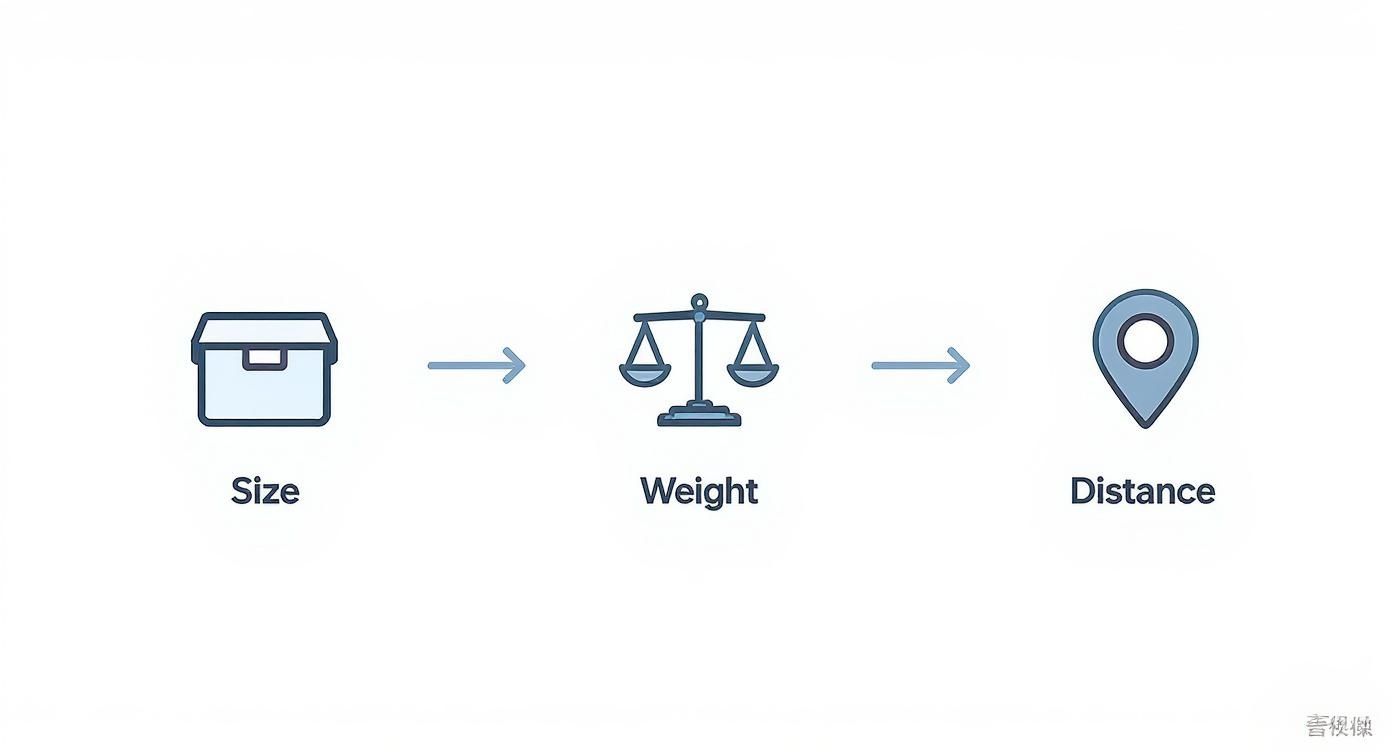
As you can see, it's the interplay between a parcel's size, its weight, and how far it needs to travel that forms the bedrock of every courier quote.
The Power of Real-Time Tracking
After your package is collected, it moves into the tracking phase. This is where a modern package courier service really flexes its muscles, offering a level of transparency that builds trust and dials down customer anxiety. The days of sending a parcel off into the void and just hoping for the best are long gone.
Every package gets a unique tracking number, which acts as its digital fingerprint. As it moves through depots and sorting facilities, its barcode is scanned at each checkpoint, instantly updating its status online. This creates a live, digital trail that both you and your customer can follow from anywhere.
This kind of visibility isn't a perk anymore; it's a core expectation. For any e-commerce business, providing proactive tracking updates is one of the easiest and most effective ways to create a great customer experience. It answers the inevitable "Where is my order?" question before your customer even has a chance to ask.
Ensuring a Secure Handover: Proof of Delivery
The final leg of the journey is the delivery itself, which officially ends with Proof of Delivery (POD). This is your formal confirmation that the package has been successfully received by the intended person. It's also a critical piece of evidence if any disputes pop up later.
In Australia, POD usually comes in a few different forms:
- Signature on Delivery: The classic method. The recipient signs for the package on a digital scanner or a paper form to confirm they've got it.
- Photo POD: This is becoming more and more common. The courier snaps a quick photo of the package left in a safe place or being handed over.
- Authority to Leave (ATL): As the sender, you can give permission for the courier to leave the parcel in a designated safe spot if no one is home to receive it.
Proof of Delivery is your safety net. It provides undeniable evidence that you fulfilled your end of the bargain, protecting your business against claims of non-delivery and ensuring a clear, accountable end to the shipment workflow.
Getting this whole process down pat turns shipping from a routine chore into a genuine strategic advantage. It gives you the confidence to manage your logistics smoothly and provide an experience that keeps customers coming back. And while the focus is often on getting goods out the door, a complete logistics approach also includes efficient reverse logistics solutions for managing returns, which closes the loop and makes your entire operation more robust.
Navigating Packaging Rules and Restricted Items
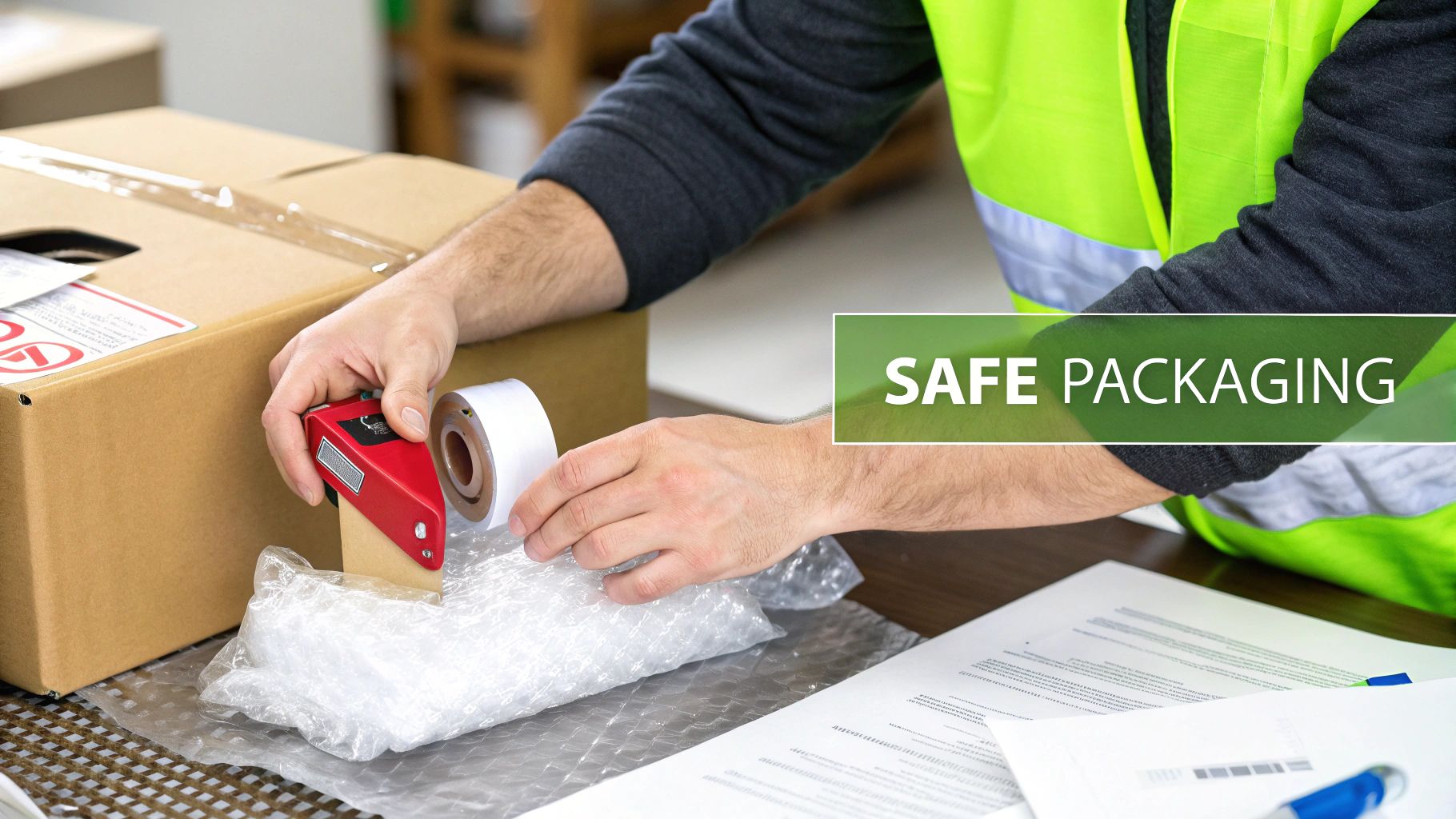
Getting your parcel to its destination safely involves more than just picking a good package courier service. The real work starts before the driver even shows up, with how you package your items. Good packaging isn't just about preventing bumps and breakages; it's about meeting Australian transport laws and protecting your business's reputation.
Let's be honest: a poorly packed item is a recipe for disaster. It can lead to damaged goods, angry customers, and even have your shipment rejected by the courier outright. Think of the box as armour for your product. Its job is to take all the hits so the item inside arrives in perfect condition. For any business that sends physical goods, getting this right is non-negotiable.
Best Practices for Secure Packaging
The secret to great packaging is to make sure the item inside can't move. At all. Picture your parcel on a bumpy road in the back of a delivery van—you don’t want your product rattling around like a pinball. A few simple steps can make a world of difference.
First, choose the right box. A fresh, sturdy, double-walled cardboard box is your best bet for strength. It's tempting to reuse old boxes to save a few cents, but they lose a huge amount of their structural integrity after a single journey. Don't risk it.
Next, it's all about the cushioning. Fill every last bit of empty space with bubble wrap, packing peanuts, or even scrunched-up paper. The goal is to create a snug cocoon so the item is completely immobilised. If you're sending multiple items in one box, wrap each one separately before you put them in.
Finally, seal it up like you mean it. Use a strong, high-quality packing tape and apply it in an ‘H’ pattern, covering the middle seam and both edge seams. This technique reinforces the box's weakest points, stopping it from bursting open under pressure. Our guide on parcel delivery preparation has even more tips to get your shipments ready for the road.
Understanding Restricted and Dangerous Goods
While smart packaging protects your items from the outside world, knowing what you can't send is a matter of safety and law. Every courier network in Australia has a strict list of prohibited items to keep their people, vehicles, and all the other parcels safe. Trying to send something on that list without declaring it properly is a serious mistake.
These rules aren't just guidelines; they're legal requirements under Australian transport safety laws. If you're caught sending undeclared dangerous goods, you could face hefty fines, have your shipment confiscated, and be held liable for any damage it causes.
Adhering to dangerous goods regulations is a core part of your Chain of Responsibility. It’s not just the courier's job to ensure safety; as the sender, you are legally accountable for declaring the contents of your shipment accurately.
So, what kind of things are we talking about? Here are a few common examples of items that are either banned or need special handling:
- Flammable Liquids: Think aerosols like deodorant or hairspray, perfumes, nail polish, and alcohol.
- Lithium Batteries: These are in almost everything these days—laptops, phones, power tools. They pose a fire risk and require specific packaging and labels.
- Corrosive Materials: This includes things like car batteries and some powerful industrial cleaners.
- Explosives and Firearms: An absolute no-go for standard courier networks.
Before you book a shipment, always double-check the courier's specific list of dangerous and prohibited goods on their website. If you're ever in doubt, just call their support team and ask. Getting this part right keeps everyone safe and the whole delivery network running smoothly.
How to Select the Right Courier for Your Business
Choosing a courier isn't just about finding the cheapest rate. Think of it as hiring a logistics partner, someone who will directly represent your business and influence what your customers think of you. Get it right, and you'll boost your efficiency and keep customers happy. But a bad choice can quickly lead to a mess of late deliveries, damaged stock, and a reputation you've worked hard to build going down the drain.
This isn't a decision to rush. You've got to look past the headline price and really dig into what each provider offers. The goal is to find a service that fits your business like a glove and helps you keep the promises you make to your customers.
Evaluating Key Service Capabilities
Before you even think about signing a contract, you need to kick the tyres on a courier's core services. The first thing to check is their delivery network. Do they actually have solid coverage where your customers are? Whether that's in the heart of Sydney, a regional town in Queensland, or a remote corner of WA, a courier with a strong footprint means you can count on them to get the job done.
Next up, get real about their on-time performance. Any courier can talk a big game, but you want to see the numbers. Look for providers who are upfront about their delivery success rates. In this business, consistency is everything—it's the bedrock of customer trust.
A courier isn't just a vendor; they are an extension of your brand. Every successful, on-time delivery reinforces your reputation for reliability, while every delay or issue reflects directly back on you.
Finally, think about how their tech will play with yours. If you're running an e-commerce store, a courier that seamlessly connects with platforms like Shopify or WooCommerce is a game-changer. It automates the tedious stuff like printing labels and sending tracking updates, freeing you up to focus on growing your business.
Comparing Providers Effectively
To make a smart choice, you need a way to compare your options apples-to-apples. A simple checklist can help you cut through the marketing fluff and focus on what really counts. For a bit of a head start, you can check out expert breakdowns on the best courier services in Australia to see how the major players compare.
Here's a handy checklist to help you evaluate and choose the right courier partner for your Australian business.
Courier Provider Evaluation Checklist
| Evaluation Criteria | What to Look For | Why It Matters |
|---|---|---|
| Responsive Customer Support | Australian-based team? Easy to reach a real person? Clear issue resolution process? | When a delivery goes wrong, you need fast, effective support, not a robotic chatbot or an overseas call centre. |
| Value-Added Services | Is transit warranty included? Are there options for extra shipping insurance for high-value items? | These extras provide a critical safety net, protecting your bottom line if a parcel gets lost or damaged. |
| Scalability | Can they handle your volume now and during peak seasons? Is there a growth path for your account? | Your courier needs to grow with you. A partner that can handle five parcels a week and five hundred is invaluable. |
| Clear Pricing Structure | Are fuel surcharges, remote area fees, and other add-ons clearly explained? No hidden costs? | You need to be able to accurately predict your shipping costs. Nasty surprises on an invoice are never welcome. |
By methodically working through these points, you can find a package courier service that does more than just move boxes. You'll find a genuine partner that helps you delight your customers and sets your business up for long-term success.
Frequently Asked Questions About Courier Services
Jumping into the world of shipping in Australia can definitely bring up a few questions, especially when you're trying to nail down the best and most budget-friendly package courier service for your business. To help cut through the noise, we've pulled together answers to the questions we get asked most often.
Think of this as your go-to cheat sheet—just clear, simple answers to give you the confidence you need to get your parcels moving.
What Happens If a Delivery Is Missed?
So, the driver shows up, but no one's home to sign for the parcel. What next? Thankfully, the process is pretty straightforward and designed to keep you in the loop. The driver will typically leave a card explaining the attempted delivery and what the recipient needs to do.
Usually, the next steps are one of these:
- Book a Re-delivery: The person receiving the parcel can hop online or call to schedule another delivery for a day that suits them better.
- Pick It Up from a Depot: The package might be taken to a nearby depot or collection point (like a post office or newsagent) for the recipient to collect at their convenience.
- Authority to Leave (ATL): If you gave an 'Authority to Leave' when booking, the driver will have already left the parcel in the safe place you specified.
How Does Courier Insurance Work?
Most courier bookings come with a basic level of what's called transit warranty or carrier liability. This is a safety net that covers your goods up to a certain dollar value if they get lost or damaged while in the courier's hands. But—and this is a big but—that base coverage is often quite limited.
For anything valuable, it's a smart move to purchase extra shipping insurance. This bumps up the protection to match the actual value of your items, giving you proper peace of mind. Just be sure to read the terms and conditions so you know exactly what’s covered and if any excess applies.
Think of the included transit warranty as basic third-party car insurance. It’s better than nothing. For your valuable shipments, buying extra cover is like getting a comprehensive policy—it offers far more protection if things go sideways.
Is There a Difference Between Metro and Regional Deliveries?
Absolutely, and it's a big one. Sending a parcel across Sydney, Melbourne, or Brisbane is almost always going to be quicker and cheaper. Why? Because the delivery routes are well-established and there are thousands of drop-offs in a small area. This efficiency means you can get precise ETAs, with same-day or next-day delivery being common.
On the other hand, shipping to regional or remote Australia is a different ball game. It involves much longer travel times and usually costs more due to a regional surcharge. The logistics are just trickier—covering vast distances with fewer stops along the way naturally stretches out the delivery time and adds to the cost.
Ready to make your shipping simple? At Aeros Couriers, we focus on reliable, low-cost local and nationwide delivery that’s built for Australian businesses. Get an instant quote and see just how easy it can be.
