Couriers Explained: How to Choose the Right Service for Your Business
If you’re an Australian business owner comparing couriers right now, you already know the frustration: dozens of providers, pricing that makes no sense until you’re halfway through checkout, and no clear way to compare speed against cost against actual coverage in your area. The courier market isn’t short on options – it’s short on clarity.
Most people searching for “couriers” fall into one of two camps. Either they need a specific provider for a shipment sitting on their desk, or they’re trying to figure out whether a courier is even the right choice versus standard postal shipping. This article is built for both groups, but especially for the second – the business buyer who wants to make a smarter shipping decision, not just a faster one.
Here’s the tension worth understanding upfront: couriers cost more than postal services on a per-parcel basis. That’s true. But once you factor in real-time tracking, included insurance, fewer failed deliveries, and faster transit, the math often flips. A “cheap” postal shipment that requires a redelivery, generates a customer complaint, and arrives without proof of delivery can end up costing more than a courier that lands on time with a signature.
This guide breaks down courier types, pricing mechanics, a decision framework for when couriers make sense (and when they don’t), and a five-step selection process built specifically for Australian business buyers. Whether you’re shipping 10 parcels a month or 500, the goal is the same: match the right courier to the right shipment, every time.
The stakes are real. Australia’s courier, express, and parcel (CEP) market was valued at USD 12.8 billion in 2024 and is projected to reach USD 17.7 billion by 2033, growing at a CAGR of 3.30% during 2025-2033. Your choice of courier partner isn’t a line item – it’s a long-term operational decision.
Key Takeaways
Couriers vs. postal services – Couriers collect from sender and deliver door-to-door with dedicated tracking and defined service windows, while postal services aggregate shipments through shared sorting networks with less accountability.
Six courier types cover most business needs – Local, express, standard, specialty, international, and pallet-capable couriers each serve different shipment profiles, and choosing the wrong type is one of the most common reasons businesses overpay.
Pricing is built from multiple variables – Weight, dimensional weight, distance zone, speed tier, fuel surcharges, remote area fees, insurance, and redelivery charges all shape the final cost, which is why the cheapest quote isn’t always the cheapest shipment.
Test before you commit – Book one real shipment before choosing a primary carrier, and evaluate pickup punctuality, tracking accuracy, delivery speed versus quoted window, and support quality.
Courier platforms reduce operational friction – Multi-carrier platforms let you compare quotes, book across carrier types, and manage tracking in one place, turning shipping from a manual chore into a scalable workflow.
What Couriers Are and How They Differ from Postal Services
A courier is a service that picks up a parcel directly from the sender and delivers it directly to the recipient, with dedicated tracking and a defined delivery window. That sounds simple, but the “directly” part is what separates couriers from postal services. There’s no bulk sorting center, no shared mail truck making 200 stops. Your parcel gets a route, a timeline, and accountability from pickup to drop-off.
Postal services work differently. They aggregate millions of items into a shared network – sorting facilities, distribution hubs, local delivery rounds. That infrastructure is built for volume and reach, not speed or individual parcel accountability. It’s why postal shipping is cheaper for lightweight, non-urgent items, and why it falls short when delivery timing, tracking, or security matters.
For business buyers, five practical differences drive the decision between courier and postal:
| Factor | Courier Service | Postal Service |
|---|---|---|
| Speed | Same-day to 7 business days; express in 1-2 days | 3-10+ business days domestic |
| Tracking | Real-time, event-by-event updates | Batch updates, often limited to scans at major hubs |
| Pickup model | Door-to-door collection and delivery | Drop-off at post office or scheduled collection |
| Shipment types | Parcels, documents, pallets, fragile, oversized | Letters, small parcels, standard dimensions |
| Typical use case | E-commerce, urgent B2B, high-value, fragile items | Bulk mail, lightweight non-urgent parcels |
On speed alone, the range is wide. Express courier delivery typically takes one to two days, standard courier delivery spans one to seven days, and international courier services can range from one day (air express) to two weeks (economy). Those windows are tighter and more predictable than what postal networks can offer for equivalent distances.
The Main Types of Couriers Businesses Actually Use
Choosing the wrong courier type is one of the most common reasons businesses overpay or disappoint customers. A same-day local service is wasted on a bulk B2B restock. A standard road courier is the wrong call for a time-sensitive interstate delivery. Here are the six categories that cover the full range of Australian business shipping needs.
Local Couriers
Point-to-point delivery within a metro area, typically completed within hours. Best for: urgent documents, food, flowers, medical samples, and time-critical B2B handoffs. Pricing is premium – you’re paying for speed and exclusivity. If the delivery isn’t genuinely urgent, you’re overspending.
Express Couriers
Overnight or one-to-two-business-day services across metro and some regional routes. Best for: e-commerce orders where fast delivery is part of the brand promise, high-value parcels, and customer-facing shipments. Express pricing typically runs 30-60% higher than standard. Always confirm regional coverage before booking – express doesn’t mean express to every postcode.
Standard Couriers
Road freight with one-to-seven-business-day windows. The most cost-effective option for non-urgent parcels and bulk shipments. Best for: regular B2B restocking, wholesale orders, and any shipment where delivery timing is flexible. This is the workhorse tier for businesses shipping consistently.
Specialty Couriers
Built for fragile goods, temperature-controlled shipments, dangerous goods, and high-value items requiring chain-of-custody documentation. Best for: pharmaceuticals, fine art, lab samples, and electronics. Standard couriers often void insurance on fragile or prohibited items shipped without specialty handling – that’s a risk worth checking before booking.
International Couriers
Delivery windows range from one day (air express) to two weeks (sea or economy air) depending on destination and service tier. Best for: cross-border e-commerce and B2B trade. Key considerations include customs clearance, prohibited items, volumetric weight calculations, and declared value for insurance.
Large-Item and Pallet-Capable Couriers
Most parcel couriers cap items at 25-30 kg or one meter in any dimension. Anything larger – bulk B2B orders, furniture, equipment, manufacturing supplies – requires a pallet-capable carrier. Best for: wholesale logistics, office fit-outs, and supply chain freight. Platforms like Aeros Couriers handle cartons, satchels, and palletised freight through a single booking interface, which means you don’t need separate accounts for parcels and pallets.
When to Use a Courier Instead of Standard Shipping
The question isn’t “what is a courier?” – it’s “should I use one for this shipment?” Couriers consistently outperform postal options in eight scenarios:
Urgent delivery – The recipient needs it today or tomorrow, and a delay has real consequences.
High-value items – The replacement cost justifies tracking, insurance, and proof of delivery.
Fragile goods – Fewer handling points mean fewer chances for damage.
Confidential documents – Chain-of-custody and signature requirements aren’t optional.
B2B critical supply chain – A delayed part or component stops a production line.
Regional or remote destinations needing tracking – Postal visibility often drops off outside metro zones.
Customer-experience-critical orders – The delivery is the brand impression.
Returns management – Trackable returns reduce disputes and speed up refunds.
Before choosing between a courier, postal shipping, or a mixed strategy, ask three questions:
Does the delivery window matter to the recipient? If a late arrival costs you money, reputation, or a customer, use a courier.
Is the item’s value or fragility above your risk threshold? If you can’t afford to lose or replace it without tracking and insurance, use a courier.
Does the destination require door-to-door accountability? If you need proof it arrived – not just proof it entered the network – use a courier.
If you answered “no” to all three, standard postal shipping is fine. If you answered “yes” to even one, a courier is the safer bet. Many businesses use a mixed strategy: couriers for high-value and time-sensitive shipments, postal for low-cost bulk.
What Courier Pricing Really Depends On
A courier quote is not a fixed price. It’s an estimate built from multiple variables, and the final invoice can look different from the initial number if those variables aren’t declared accurately upfront. Understanding what drives courier pricing is the fastest way to avoid surprises.
| Pricing Factor | What It Means | When It Applies | Estimated Impact |
|---|---|---|---|
| Actual weight | The physical weight of the parcel on a scale | Every shipment | Base rate driver |
| Dimensional (cubic) weight | Length x width x height ÷ volumetric divisor (typically 4,000 or 5,000 in Australia) | When cubic weight exceeds actual weight | Can double the quoted rate for light, bulky items |
| Delivery zone | Metro, regional, or remote destination | Every shipment | Regional adds 15-40%; remote can add 50%+ |
| Speed tier | Same-day, express, or standard | Every shipment | Express is 30-60% above standard |
| Pickup model | Door-to-door vs. depot-to-depot | Depends on service chosen | Depot drop-off can reduce cost by 10-20% |
| Fuel surcharge | Variable percentage based on current fuel prices | Applied by most carriers | Typically 5-15% of base rate |
| Remote area surcharge | Extra fee for postcodes outside metro zones | Regional and rural deliveries | $3-$12+ per parcel |
| Signature on delivery | Requires recipient to sign at handover | When selected or required by item value | $1-$4 per parcel |
| Insurance | Declared value coverage for loss or damage | When value exceeds standard coverage | Varies by declared value |
| Redelivery fees | Charge for second delivery attempt if first fails | Failed first delivery | $5-$15 per attempt |
Why quotes differ: Two businesses sending the same 1 kg parcel from Sydney to Melbourne can receive quotes ranging from $7.46 to over $25.00, depending on the courier, speed tier, and included surcharges. The cheapest headline rate doesn’t always mean the cheapest delivered cost once fuel, insurance, and potential redelivery are added.
For Australian businesses, a few local pricing conventions matter. Cubic weight calculations use a volumetric divisor (typically 4,000 or 5,000) rather than the international standard of 6,000, which means bulky items cost more here than shippers sometimes expect. Business invoicing is typically shown ex-GST, so confirm whether quoted prices include or exclude GST before comparing. And remote or rural surcharges apply outside metro zones – they’re standard, but they’re not always visible at the quote stage.
Aeros Couriers addresses this directly with transparent upfront pricing – all surcharges shown before you book, starting from A$4.90 for a box up to 25 kg. That visibility is worth more than a low base rate that surprises you on the invoice.
What to Look for in a Courier Service Before You Book
This is your operational checklist – the eight criteria that experienced Australian business shippers weigh before choosing a provider.
Real-time tracking granularity – Event-by-event updates (picked up, in transit, out for delivery, delivered) versus batch scans at major hubs. The difference matters when a customer asks “where’s my order?”
Proof of delivery (POD) – Signature or photo confirmation at delivery. Without it, disputes become he-said-she-said.
Insurance coverage and claims process – What’s covered, what’s excluded, and how quickly can you lodge and resolve a claim?
Pickup reliability – On-time collection rate and same-day pickup availability. A missed pickup delays everything downstream.
Geographic coverage – Does the provider serve your regional and remote postcodes, or just metro areas?
Customer support – Australian-based or offshore? Phone, email, or chat? What’s the response time?
E-commerce integration – Shopify, WooCommerce, API access for custom setups. Manual label creation doesn’t scale.
Transparent fee disclosure – Are all surcharges visible before checkout, or do they appear on the invoice?
Use a weighted scoring matrix to compare providers side by side:
| Criteria | Weight (%) | Provider A | Provider B | Provider C |
|---|---|---|---|---|
| Cost | 25% | /10 | /10 | /10 |
| Speed | 20% | /10 | /10 | /10 |
| Coverage | 15% | /10 | /10 | /10 |
| Tracking | 15% | /10 | /10 | /10 |
| Insurance | 10% | /10 | /10 | /10 |
| Support | 10% | /10 | /10 | /10 |
| Ease of booking | 5% | /10 | /10 | /10 |
Score each provider out of 10, multiply by the weight, and compare totals. Adjust weights based on your priorities – if you ship high-value items, insurance might deserve 20% instead of 10%.
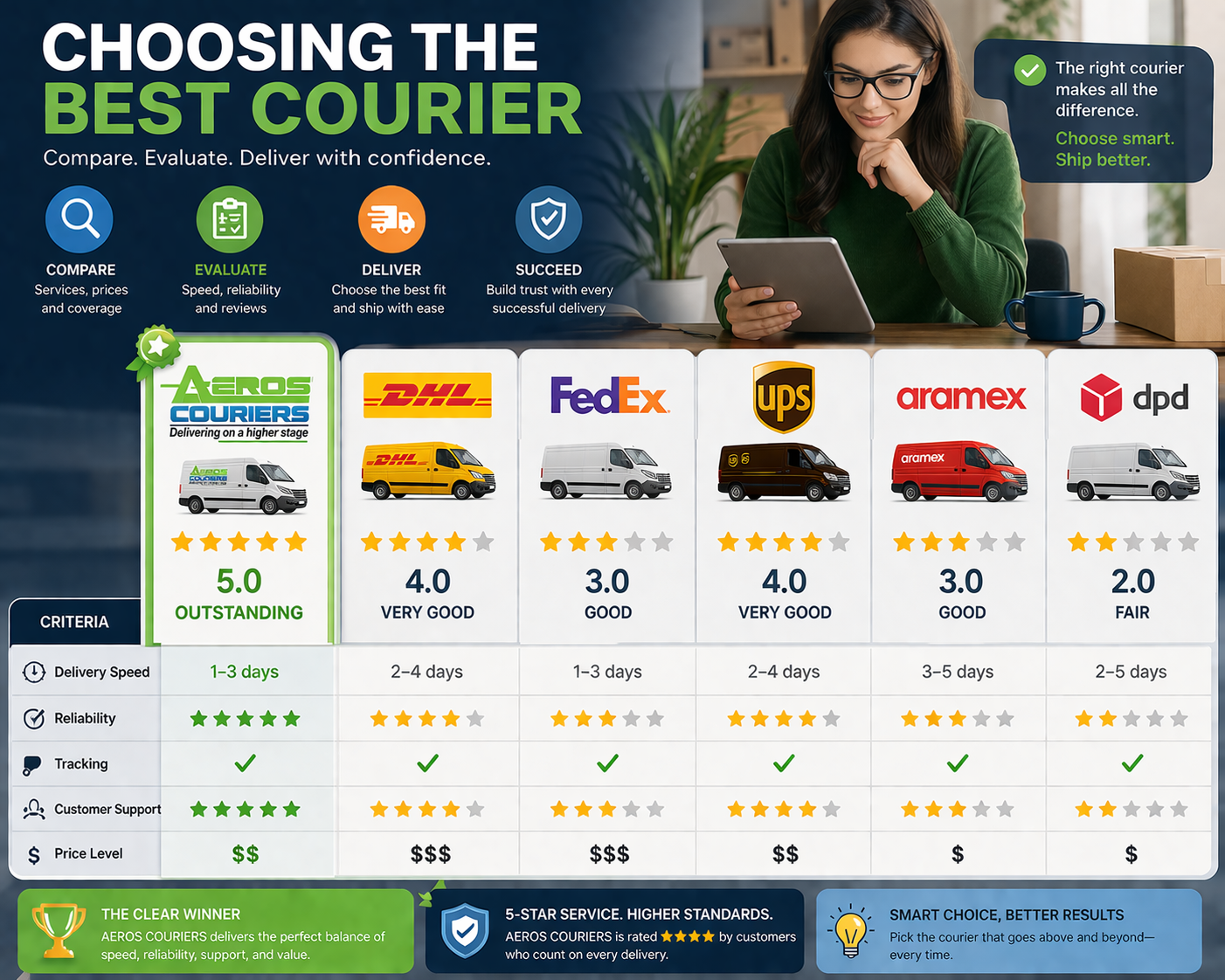
Aeros Couriers scores well on several of the most common objections: free insurance up to $500 per consignment, active parcel monitoring, no-cost first redelivery, and Australian-based support. Those features map directly to the criteria that usually separate a good courier experience from a frustrating one.
Practical tip: Test one route before committing to any provider as your primary carrier. Book a real shipment and evaluate on actual performance, not just the quote page.
Courier Trends Shaping 2026
Consumer delivery expectations have moved faster than carrier infrastructure can keep up. That gap is creating opportunity for businesses that get delivery right – and cost pressure from wages, fuel, and last-mile investment for everyone else.
2026 Courier Industry Snapshot:
The Australian CEP market was valued at USD 12.8 billion in 2024 and is projected to reach USD 17.7 billion by 2033
Courier and messenger employment is projected to grow 17.9% from 2022 to 2032 – the fastest growth among all transportation and warehousing industries
41% of global online shoppers want orders within 24 hours; 24% prefer delivery in under two hours (Statista)
USPS launched its bidding platform in January 2026, opening more than 18,000 destination delivery units and local processing centers nationwide to a broader range of commercial shippers
Four trends are reshaping how couriers operate and how businesses should think about shipping partnerships:
Same-day and sub-two-hour expectations are no longer a nice-to-have. Consumer research shows nearly a quarter of online shoppers prefer delivery in under two hours. That’s pushing last-mile investment toward micro-fulfillment and dense urban courier networks.
AI-driven route optimisation is cutting costs and improving ETA accuracy. Carriers using machine learning to plan routes dynamically can reduce fuel spend and failed delivery attempts simultaneously – a win for margins and customer experience.
Postal networks opening to commercial shippers is a structural shift. USPS delivers to more than 170 million addresses at least six days a week, and the organisation expects to notify winning bidders in the second calendar quarter, with service beginning in the third calendar quarter of 2026. While this is a U.S. development, it signals a global trend toward postal-commercial hybrid delivery models.
Wage and fuel cost pressure is driving consolidation among smaller regional carriers. Driver shortages, higher wage expectations, and regulatory scrutiny of gig-economy contracts are inflating delivery costs across the Australian CEP market. For business shippers, the takeaway is clear: the carriers investing in tracking technology, route optimization, and last-mile density now are the ones most likely to maintain service levels as volumes grow.
How to Choose the Right Courier in 5 Steps
Everything above is context. This is the action plan. If you follow these five steps, you’ll avoid the most common mistakes and land on a courier that fits your business – not just your next shipment.
Step 1: Map your actual shipment needs. Before comparing providers, list your typical parcel dimensions, weight ranges, destinations (metro, regional, remote), urgency levels, and weekly or monthly volumes. You can’t compare quotes meaningfully without knowing what you’re quoting for.
Step 2: Identify must-have service features. From the checklist in the previous section, pick your non-negotiables. If you ship high-value items, insurance and POD are mandatory. If you sell through Shopify, e-commerce integration saves hours. If you serve regional customers, confirm postcode coverage before anything else.
Step 3: Compare quotes on a like-for-like basis. Use a platform that shows multiple carrier quotes side by side with all surcharges included – not just base rates. A $7.90 quote that becomes $14.50 after fuel, signature, and insurance isn’t cheaper than a $12.00 all-inclusive quote.
Step 4: Test one route first. Book a real shipment on your most common lane. Note pickup punctuality, tracking update frequency, actual delivery speed versus the quoted window, and how support handles a question. One real shipment reveals more than 10 quote comparisons.
Step 5: Review tracking data, claims handling, and support quality. The post-delivery experience often reveals what the quote page hides. Was the POD clear? Did tracking stay accurate through the entire journey? If something went wrong, how quickly did support respond?
Mistakes to avoid:
Assuming the cheapest quote includes all surcharges
Booking without confirming postcode coverage for regional destinations
Choosing the fastest service without verifying carrier reliability on that specific lane
Skipping insurance on high-value items to save a few dollars on the quote
Aeros Couriers simplifies steps one through three by offering instant multi-carrier quotes without account signup, upfront pricing with all fees visible, and coverage across metro, regional, and remote Australia. You can compare, book, and ship without committing to a single carrier relationship.
Why Courier Platforms Matter for Growing Businesses
When you’re shipping through three or four individual carrier accounts, the operational drag adds up fast: fragmented tracking dashboards, inconsistent pricing structures, manual label creation for each carrier, and no single place to manage claims. Every extra step in the fulfillment workflow is a step that can break at scale.
Courier platforms solve this by consolidating the shipping workflow into one interface. The practical benefits for a growing business come down to five things:
Unified quote comparison – See rates from multiple carriers side by side, for the same shipment, in one screen.
Single booking interface – Book a local same-day courier and an interstate standard service from the same dashboard.
Automated label generation – No more logging into separate carrier portals to create and print labels.
Consolidated tracking – One view for every shipment, regardless of which carrier is moving it.
Centralized account management – Review spend, volume trends, and rate performance in one place.
Those workflow improvements translate to specific business outcomes: fewer manual tasks in daily fulfillment, better budget control through predictable upfront pricing, easier scaling as order volumes grow, and a single support contact instead of managing multiple carrier relationships.
Aeros Couriers is built around this model for Australian businesses. You get instant quotes without account applications, pricing from A$4.90 for a 25 kg box, transparent surcharges shown before booking, and support for cartons, satchels, and palletised freight – all through one platform. Wholesale bulk purchasing discounts make pricing sharper as volume grows. And their reward points program turns every dollar spent on shipping into points redeemable for future freight or branded merchandise through Simply Merchandise – over 10,000 products. It’s a practical way to turn a cost center into something that gives back.
The Bottom Line
Choosing the right courier isn’t about finding the cheapest rate – it’s about matching the right service to each shipment based on speed, cost, coverage, and risk. The cheapest quote with hidden surcharges, no insurance, and unreliable tracking will cost you more than a slightly higher rate that delivers predictably and protects your goods.
Start by understanding what you ship, where you ship it, and what your customers expect. Use the decision framework and scoring matrix in this guide to compare providers on what matters, not just what’s cheapest. Test one route before committing. And look for a courier platform that gives you multi-carrier access, transparent pricing, and the flexibility to scale without operational drag.
The Australian courier market is growing, delivery expectations are rising, and the businesses that treat shipping as a strategic decision – not an afterthought – will be the ones that keep their customers coming back.
FAQ
What is a courier?
A courier is a delivery service that collects a parcel directly from the sender and delivers it directly to the recipient, with dedicated tracking and a defined service window. Unlike postal services, couriers provide door-to-door accountability, faster transit times, and real-time visibility into where your shipment is at every stage.
How is a courier different from a postal service?
The core differences are pickup model, tracking, speed, and accountability. Couriers collect from your door and deliver to the recipient’s door with event-by-event tracking. Postal services aggregate items through shared sorting networks with batch tracking updates and longer delivery windows. See the comparison table in the first section for a side-by-side breakdown.
How much do couriers cost in Australia?
Courier pricing depends on weight, dimensional weight, delivery zone (metro vs. regional vs. remote), speed tier, fuel surcharges, insurance, and signature requirements. As a concrete anchor: a 1 kg parcel from Sydney to Melbourne can range from $7.46 for a standard service to over $25.00 for express, depending on the carrier and inclusions. Platforms like Aeros Couriers start from A$4.90 for a box up to 25 kg.
What is same-day courier service and when should I use it?
Same-day courier service delivers your parcel within hours of pickup, typically within the same metro area. It’s ideal for urgent documents, medical samples, legal filings, and time-critical B2B handoffs. Same-day is premium-priced and usually limited to metro zones – use it when the cost of a delayed delivery exceeds the cost of the service.
How do I choose the best courier for a small business in Australia?
Follow the five-step framework: map your shipment needs, identify must-have features (tracking, insurance, coverage), compare quotes on a like-for-like basis with all surcharges included, test one route with a real shipment, and review post-delivery performance. A multi-carrier platform like Aeros Couriers lets you compare quotes from multiple providers without committing to a single account, which is the most efficient way for small businesses to find the right fit.
Courier quotes, tracking and support
Ready to send a parcel? Compare the available services for your postcodes, parcel dimensions and weight. For an existing delivery, use your consignment number to check tracking or ask our team for help.