


Hazardous goods classification is simply the way we figure out the specific dangers a substance presents when it’s on the move. We then assign it to one of nine nationally agreed-upon classes. Think of it as a universal safety language, making sure everyone, from the person packing the box to the courier driving the truck, understands the potential risks—like flammability or toxicity—through a system of standard labels, numbers, and paperwork. In Australia, getting this right isn’t just good practice; it’s a legal requirement you can't ignore.
Why Hazardous Goods Classification Is More Than Just Red Tape
It's easy to see hazardous goods classification as just another pile of complicated rules to follow. But that’s missing the point. It’s better to think of it as a shared safety language used right across Australia’s supply chain. This isn't about memorising codes for the sake of it; it's about protecting people, your business, and the public from accidents that are entirely preventable.
This system is what allows a courier in Perth to instantly grasp the risks of a package that came all the way from Sydney, without ever having to peek inside. A quick look at the label tells them everything they need to know—whether the contents could catch fire, are poisonous, or might burn through other materials. That knowledge dictates exactly how they need to handle, load, and transport it safely.
The Payoff Goes Beyond Compliance
Nailing your classification from the get-go brings a whole host of benefits that go far beyond just ticking a regulatory box. It's a cornerstone of your business's operational integrity. When you consider the bigger picture, like the role of robust safety management systems in high-stakes environments like chemical processing, you can see how a structured approach to safety is vital. For logistics, correct classification is the very first step in that chain.
The real-world benefits of getting it right are clear:
- Avoids Hefty Fines: Australian authorities don't mess around, and penalties for misdeclared or undeclared dangerous goods can be severe.
- Builds Customer Trust: When you handle compliance properly, it shows you're a professional and reliable business, giving your clients peace of mind.
- Keeps Everything Moving: An incorrectly classified shipment will almost certainly be stopped, delayed, or sent back, throwing a spanner in your operations and timelines.
- Protects Your People and the Public: This is the most important one. It prevents accidents that could injure your staff, courier drivers, and the wider community.
Turning a Hassle into an Asset
At the end of the day, getting a handle on the basics of hazardous goods classification makes your entire shipping process smoother. Once you know exactly what you're sending and can communicate its risks clearly, you eliminate guesswork and friction for everyone involved.
This knowledge can turn a potential regulatory headache into a real competitive edge. Businesses that get shipping compliance right build a strong reputation for reliability and safety—and those are powerful assets to have.
In this guide, we'll dive into why this 'safety language' is so critical for Australian businesses. We'll break down what the different classes mean, show you how to classify your own products, and walk you through preparing them for safe transit across the country.
Decoding the 9 Classes of Dangerous Goods
Getting your head around the hazardous goods classification system can feel a bit intimidating at first, but it’s far more straightforward than you might think. This isn't about memorising a dry, technical manual. It's about understanding the real-world risks of products you might already be handling every day. Think of it as a universal safety language spoken throughout the Australian supply chain.
The whole system is built around one simple idea: grouping items into nine distinct classes based on their primary hazard. Is it flammable? Explosive? Corrosive? Knowing the class gives everyone—from your warehouse team to our courier drivers—a clear, instant understanding of the risks involved and how to handle the package safely. It’s the absolute bedrock of safe transport.
The 9 Classes of Dangerous Goods at a Glance
To really get to grips with this, let's break down what each of the nine classes actually means in practice. You’ll probably spot a few familiar items from your own stockroom.
| Class Number | Hazard Description | Common Examples |
|---|---|---|
| Class 1 | Explosives | Fireworks, ammunition, safety flares |
| Class 2 | Gases | Aerosol cans (hairspray), propane cylinders, fire extinguishers |
| Class 3 | Flammable Liquids | Hand sanitiser, perfumes, nail polish, paints, some adhesives |
| Class 4 | Flammable Solids | Matches, some self-heating substances, firelighters |
| Class 5 | Oxidising Substances | Swimming pool chemicals, some fertilisers, hydrogen peroxide |
| Class 6 | Toxic & Infectious Substances | Pesticides, certain lab chemicals, medical waste |
| Class 7 | Radioactive Material | Medical isotopes, some industrial testing equipment |
| Class 8 | Corrosives | Car batteries, strong drain cleaners, hydrochloric acid |
| Class 9 | Miscellaneous Dangerous Goods | Lithium-ion batteries (in laptops, phones), dry ice, airbags |
This table is just a starting point, but it shows how many everyday commercial products carry a hidden risk during transport. Getting the classification right is the first and most critical step.
Why This Classification Matters So Much
It all comes down to a hierarchy of safety. Correctly identifying a product's class is the first line of defence, protecting not just your workers but your business and the general public from potential harm.
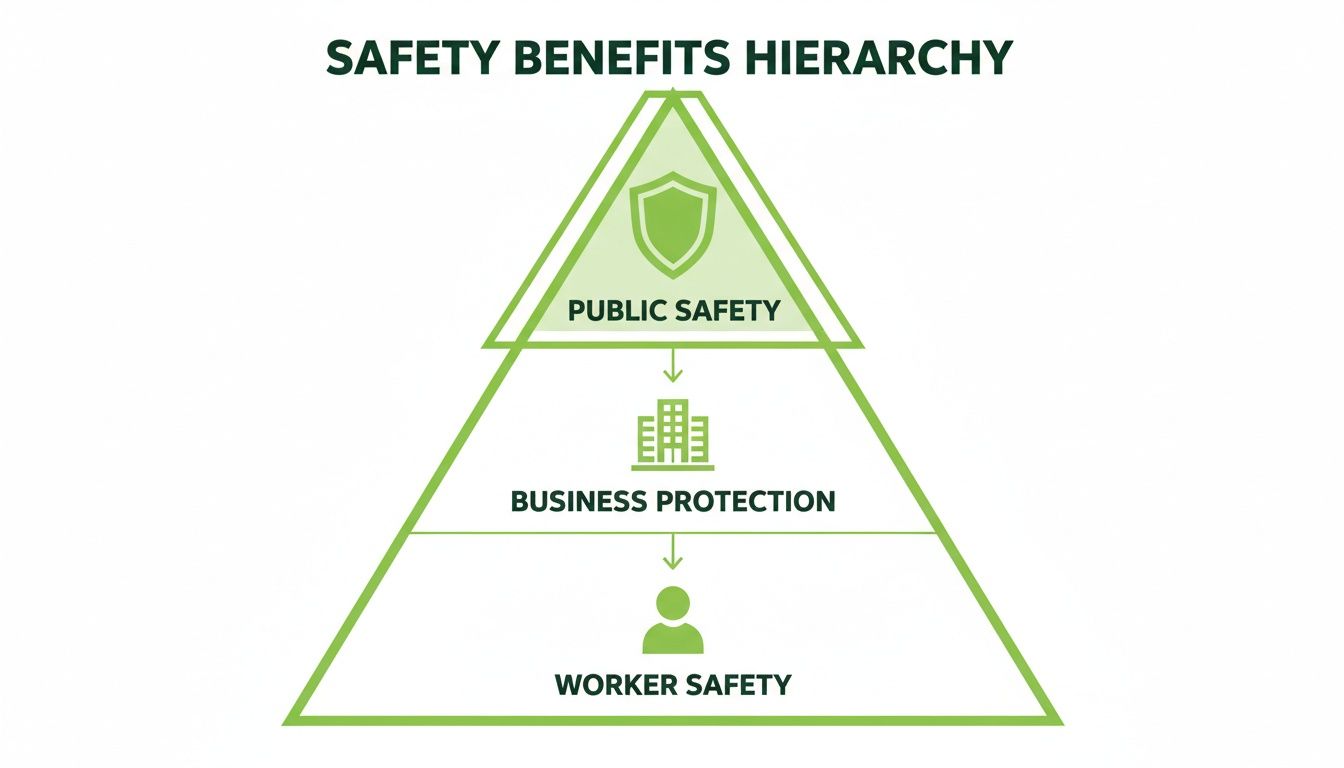
As you can see, that one simple act of classification creates a ripple effect of safety that extends from your team right through to the community.
A Closer Look at Some Key Classes
While some classes like explosives are quite specialised, others pop up all the time for small businesses.
Class 3 Flammable Liquids, for instance, is one of the most common. It covers any liquid that can easily ignite, which includes things like hand sanitiser, perfumes, nail polish, paints, and many adhesives.
Another crucial one is Class 8 Corrosives. These are substances that can cause severe chemical burns to skin or seriously damage other goods and even the transport vehicle itself. We’re talking about things like strong acids, heavy-duty drain cleaners, and car batteries. If you handle these types of products, our detailed guide on Class 8 Corrosive Dangerous Goods is a must-read.
And you can’t talk about modern freight without mentioning Class 9 Miscellaneous Dangerous Goods. This is the catch-all category, and its most famous resident today is the lithium-ion battery. Found in everything from laptops and smartphones to power tools and e-scooters, these items pose a unique fire risk that needs careful management.
The guiding principle is simple: if a product could cause harm during transport, it needs to be classified. This isn't about creating red tape; it's about taking responsibility and preventing accidents before they even have a chance to happen.
This 9-class system is the backbone of compliance here in Australia. It’s formalised in the Australian Dangerous Goods (ADG) Code, which sets the rules for road and rail transport. This ensures that everyone, including courier services like Aeros Couriers, follows a consistent, national standard for keeping dangerous goods shipments safe.
Getting to Grips with Australia's Regulatory Framework
Navigating the rules for hazardous goods in Australia can feel a bit daunting at first. The official documents are dense, but the core principles are actually pretty straightforward and all point to one thing: safety. If your business is shipping goods by road or rail, there are really only a few key regulations you need to get your head around to stay compliant.
The big one is the Australian Dangerous Goods (ADG) Code. This is essentially the rulebook for moving dangerous goods on land. It spells out all the nitty-gritty details on everything from how you classify and package your goods to the specific labels you need to use. The whole point is to create a consistent safety standard that everyone, in every state and territory, understands.
Think of it this way: when your package follows the ADG Code, every person who handles it—from the depot worker to the truck driver—knows exactly what’s inside and how to manage it safely. It’s a shared language of safety for the entire local supply chain.
How the ADG Code and GHS 7 Work Together
While the ADG Code is king on the road, another standard governs how chemical hazards are communicated before they even get on the truck: the Globally Harmonized System of Classification and Labelling of Chemicals (GHS). Australia has adopted this system to make sure our workplace safety rules are in line with best practices.
You’ve probably seen the impact of this already. As of 1 January 2023, Australia moved to the 7th edition of the GHS (GHS 7). After a two-year transition, all manufacturers and importers now must use GHS 7 for classifying chemicals, labelling them, and creating their Safety Data Sheets (SDS). For a courier like Aeros, this means every parcel we handle with hazardous materials must have GHS 7-compliant labels, complete with the right pictograms and safety warnings. You can get more details on this safety classification update for chemical substances at SafeWork SA.
So, the information on your product’s SDS comes from GHS 7. Then, when you’re ready to ship it, you use that very same information to figure out the correct classification under the ADG Code. The two systems are designed to work hand-in-glove.
The Chain of Responsibility: It’s Everyone’s Job
A concept you absolutely must understand in Australian transport law is the Chain of Responsibility (CoR). This legal principle is a game-changer for anyone sending goods, especially hazardous ones. In short, it means legal responsibility for safety doesn't just sit with the driver or the courier company.
The Chain of Responsibility extends to every single person who has influence over the transport task. This includes the person who packs the box, the manager who organises the freight, and the business sending the goods. Everyone shares the legal obligation to ensure safety.
Under CoR, if something goes wrong—like undeclared or badly packed dangerous goods—multiple people in the chain can be held legally accountable and face some seriously hefty penalties. It’s a shared-responsibility model that forces everyone to prioritise safety.
This is precisely why getting your hazardous goods classification right is so critical. It's your first and most important duty in the Chain of Responsibility. Nailing the classification shows you’ve done your bit to ensure the shipment is safe. It protects your business from massive fines, builds your reputation as a trustworthy sender, and most importantly, it keeps people from getting hurt.
For a deeper dive into the specific rules for land transport, you can explore our resources on the ADG Code. Following these regulations isn't just about ticking boxes; it's about being a responsible partner in Australia’s supply chain.
A Practical Guide to Classifying Your Shipment
Understanding the theory of hazardous goods is one thing, but actually classifying a shipment is where the rubber meets the road. This is the point where regulations turn into real-world actions. Thankfully, there’s a straightforward, repeatable process you can follow to classify any product with confidence before it ever leaves your hands.
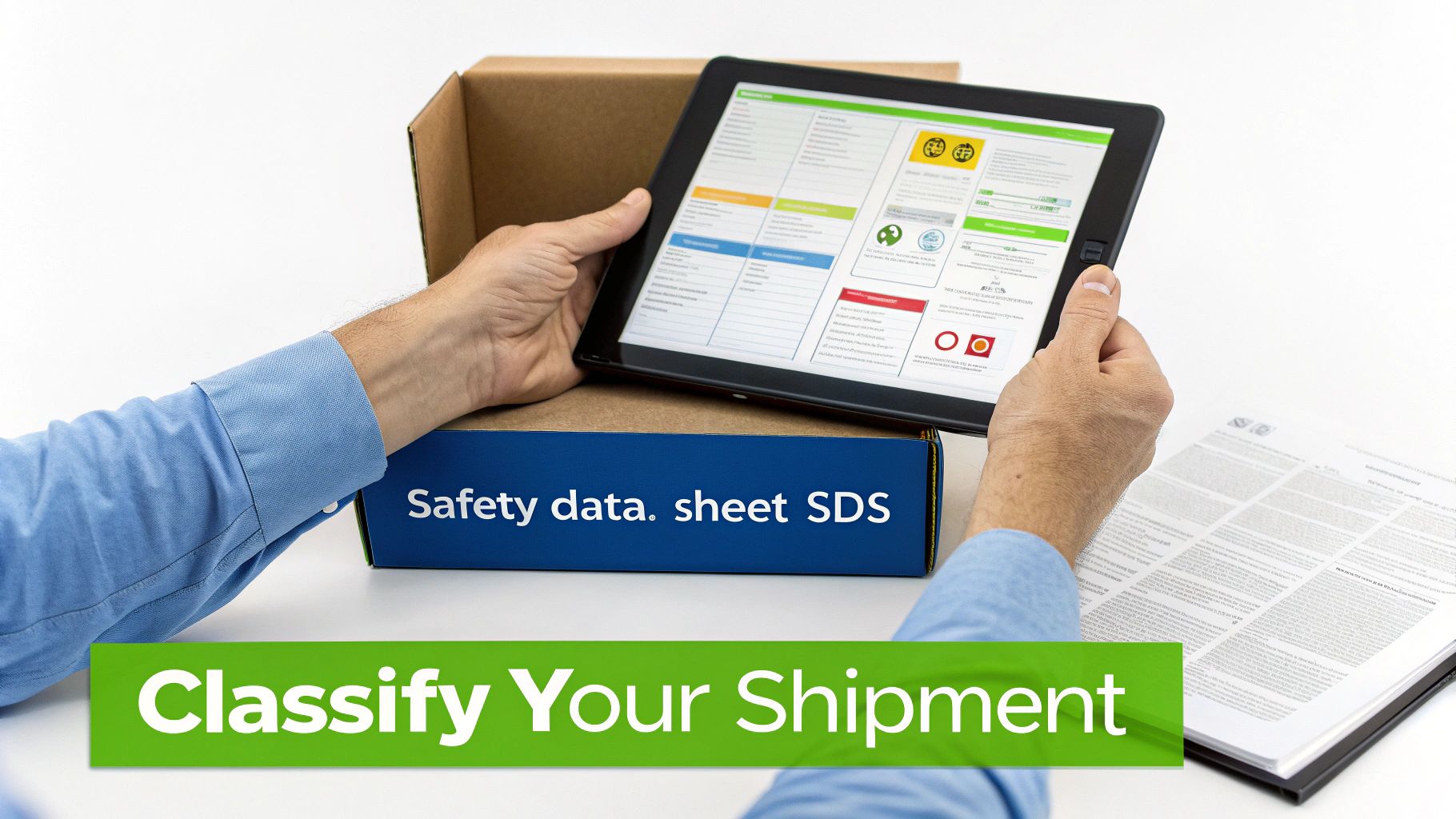
The whole process hinges on one absolutely critical document: the Safety Data Sheet (SDS). Think of the SDS as the product's official biography, written by the manufacturer. It holds everything you need to know about its chemical makeup, potential hazards, and—most importantly for us—how to transport it safely.
Finding and Reading a Safety Data Sheet
By law, the manufacturer or supplier of your product must provide you with an up-to-date SDS. If you don't have one, your first step is simply to ask them for it. Many suppliers also make these documents easy to find and download on their websites.
An SDS is usually a comprehensive, 16-section document. While every part contains valuable safety information, for transport purposes, you can zero in on one key area.
Section 14: Transport Information is your treasure map for shipping. This section is specifically designed to give you all the details required by the Australian Dangerous Goods (ADG) Code.
When you look at Section 14, you're on the hunt for three crucial pieces of information that form the "three pillars" of hazardous goods classification.
Identifying the Three Pillars of Classification
These three details are non-negotiable for any dangerous goods shipment. They are the universal language that tells couriers, regulators, and emergency services exactly what you're sending.
-
UN Number: This is a four-digit number that identifies a specific hazardous substance or a group of similar substances. For example, UN 1170 always refers to Ethanol solutions, like alcohol-based hand sanitisers.
-
Proper Shipping Name (PSN): This is the standardised, official name used on all transport documents. It's not the brand name; it's a specific technical name, like "ETHANOL SOLUTION".
-
Packing Group (PG): This tells you the degree of danger the substance presents. It's assigned a Roman numeral:
- Packing Group I: High danger
- Packing Group II: Medium danger
- Packing Group III: Low danger
Once you've found these three details on the SDS, you have officially classified your item. It's that simple.
Let's Walk Through an Example
Imagine you need to ship a common commercial-grade surface cleaner. It seems harmless sitting on the shelf, but you suspect it might be classified as a dangerous good.
Here’s the process in action:
-
Obtain the SDS: You get in touch with the manufacturer and they send over the Safety Data Sheet for "SuperClean Pro."
-
Navigate to Section 14: You open the document and scroll straight down to "Section 14: Transport Information."
-
Extract the Data: You carefully read the details provided and find the following information:
- UN Number: UN 1993
- Proper Shipping Name: FLAMMABLE LIQUID, N.O.S. (contains Isopropyl Alcohol)
- Class: 3
- Packing Group: II
With this information in hand, you now know everything required to prepare your shipment correctly. You know it's a Class 3 Flammable Liquid of medium danger and you have the exact identifiers needed for all your paperwork.
This simple, repeatable process takes the guesswork out of compliance. Getting this right is a key part of your responsibility when booking any domestic freight express service, as it ensures carriers have the correct information to handle your goods safely from start to finish.
Mastering Packaging, Labelling, and Segregation
Okay, so you've navigated the Safety Data Sheet (SDS) and correctly classified your shipment. That’s a huge first step, but it's really only half the battle. To get your goods safely across Australia, the physical prep—how you pack, label, and separate your items—is every bit as important.
Think of these three pillars as the bridge between theory and reality. They ensure the classification you found on paper translates into real-world safety on the road. Getting this right not only protects your product and the people handling it but also makes sure you’re ticking all the boxes for your legal duties under the Chain of Responsibility. It’s about making your shipment speak the universal safety language of logistics.
Choosing the Right UN-Approved Packaging
Remember that Packing Group (I, II, or III) you found on the SDS? It’s not just an abstract code; it’s a direct command telling you how tough your packaging needs to be. Each group corresponds to a specific UN performance standard, guaranteeing the container can handle the knocks and bumps of transit based on how dangerous the contents are.
- Packing Group I (High Danger): This demands the toughest packaging available, which will be marked with the letter 'X'.
- Packing Group II (Medium Danger): This requires strong, durable packaging, marked with the letter 'Y'.
- Packing Group III (Low Danger): This can be transported in standard-strength dangerous goods packaging, marked with the letter 'Z'.
Here's the crucial part: you can always overpack. Using a 'Y' rated box for a Packing Group III item is perfectly fine. But you can never go the other way and use a 'Z' rated box for something in Packing Group I or II. The packaging must always meet or exceed the standard required.
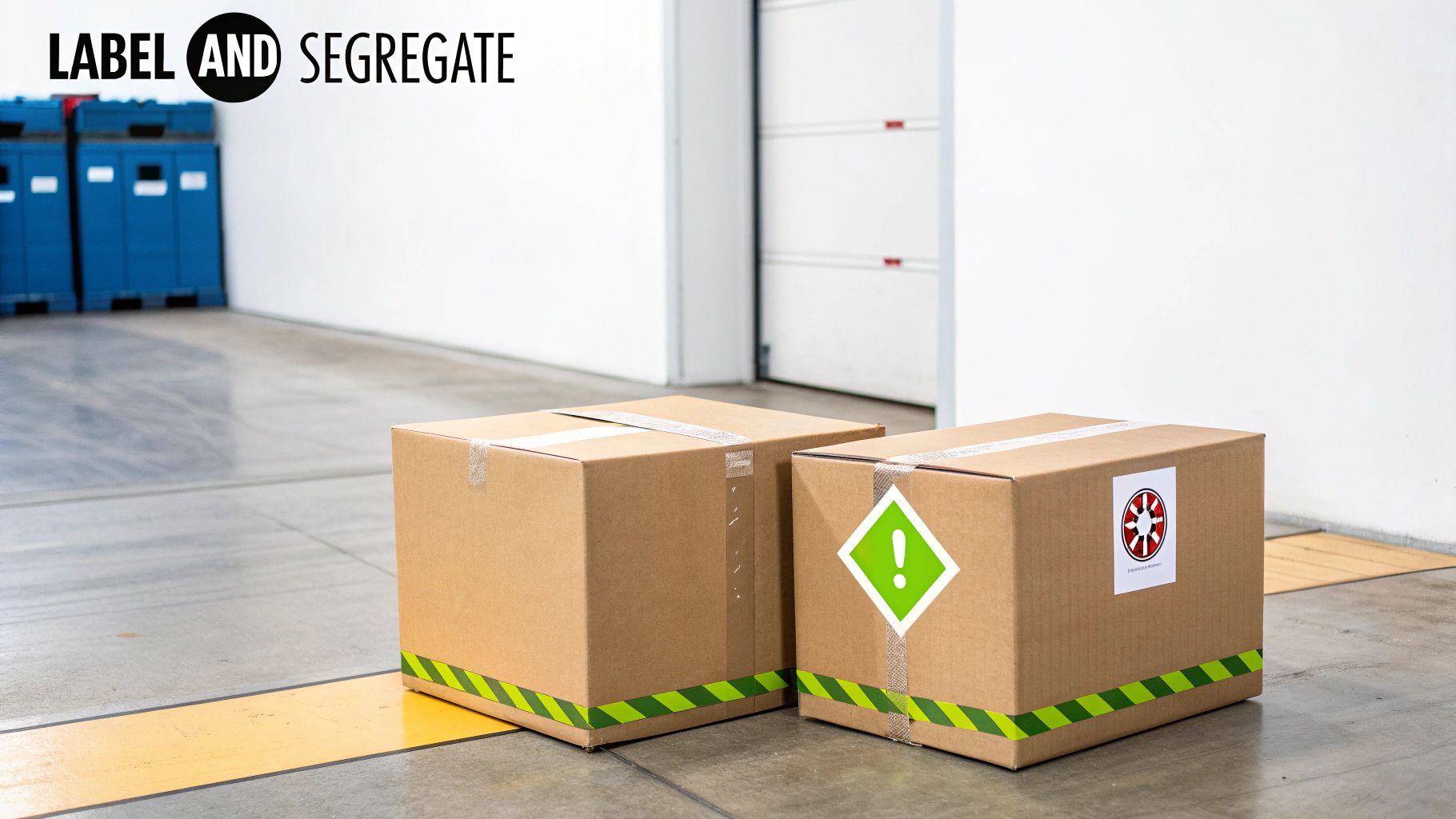
Applying Labels and Marks Correctly
Labels are the most obvious part of the whole system. They're the frontline communication, giving anyone who handles your package an instant heads-up about what's inside.
Your labels need to be applied correctly—meaning they’re clear, easy to see, and tough enough to last the entire journey without peeling off or becoming illegible. This includes the famous diamond-shaped hazard class label and any other required marks, like the UN Number.
The recent move to GHS 7 in Australia has also tightened up some of these labelling rules. It brought in new hazard categories, like desensitised explosives, and updated the precautionary statements on labels for many common products. For an e-commerce store shipping things like paints or industrial cleaners, this means handlers get much more specific guidance on storage and how to react to a spill, which helps cut down on mistakes. You can learn more about the specifics of the GHS 7 transition on the SafeWork Australia website.
If you need a quick refresher on the basics, our guide on how to properly label a package is packed with practical tips.
Understanding the Importance of Segregation
Finally, we have segregation. It’s a simple concept with potentially life-saving consequences: keeping incompatible dangerous goods away from each other. Most of us know not to store bleach and ammonia next to each other under the sink; the same logic applies here, just on a much bigger scale.
A simple way to think about segregation is like planning the seating at a very volatile dinner party. You have to keep certain guests at separate tables to prevent a massive fight from breaking out.
For instance, flammable liquids (Class 3) must always be kept away from oxidising substances (Class 5), because the oxidisers could turn a small spark into a major fire. The ADG Code provides detailed segregation charts that map out exactly which classes can't be near each other. As the sender, your job is to declare your goods correctly so your courier can manage this process and keep everyone safe.
How to Ship Hazardous Goods Within Australia
So, you’ve got your head around the classification, packaging, and labelling of your hazardous goods. Great. The final piece of the puzzle is actually getting them from A to B. This part doesn't need to be a logistical nightmare. In fact, modern courier platforms are designed to take the sting out of this process, helping you stay compliant without needing to become a logistics guru yourself.
Platforms like Aeros Couriers are built specifically to handle the complexities of dangerous goods transport. Instead of getting bogged down trying to decipher different carrier rules, you can get instant quotes that already factor in the special handling requirements and surcharges that come with hazardous materials. This means no more nasty surprises with your shipping costs.
The booking process on a good platform is more than just a form; it's a compliance tool. As you enter your shipment details, the system guides you, prompting for the right documentation and declarations. This is a massive help in meeting your legal obligations under the Chain of Responsibility laws.
Making Compliance Simple
Working with a courier service that knows its stuff is about more than just booking a truck. It’s about having a support system. If you're ever second-guessing a classification or feel unsure about the paperwork, having a local Australian support team to call can be a real lifesaver.
This kind of partnership is invaluable because you're essentially sharing the compliance load. A well-designed courier platform acts like a safety net, with built-in checks and balances to catch common errors. It frees you up to focus on running your business, giving you confidence that your shipments are moving safely and legally.
Choosing the right courier partner turns what could be a stressful legal headache into a manageable part of your business operations. You're effectively using their expertise to safeguard your business, your customers, and the public.
Documentation and Final Steps
Getting the paperwork right is absolutely critical. Every single dangerous goods shipment must be accompanied by a properly completed transport document. You can get a better handle on the details in our guide on what a consignment note is and why it’s so vital.
For those who want to dive deeper into the world of logistics, there are advanced training options available, such as a Diploma of Logistics. While this level of training isn't necessary for everyone, it shows just how much detail goes into this field. At the end of the day, a reliable courier partner provides the practical, on-the-ground support you need to get every shipment right, every time.
Frequently Asked Questions
When you're new to shipping hazardous goods, it’s natural to have a few questions. We get asked a lot about the specifics, so we've put together some straightforward answers to the most common queries from Australian businesses. The goal is to give you the confidence to get it right.
What’s the Difference Between Hazardous Goods and Dangerous Goods in Australia?
You’ll hear these terms thrown around, and while they seem similar, the context is everything in Australia.
Think of it like this: ‘Hazardous chemicals’ is the term used in a workplace setting, governed by Work Health and Safety (WHS) laws. This covers any substance that could pose a risk while it’s being stored or used on your premises.
‘Dangerous goods’ is the official term for transport, falling under the Australian Dangerous Goods (ADG) Code. Once that same substance is loaded onto a truck, its classification and the rules that apply shift. So, while most dangerous goods are also hazardous chemicals, the label—and the regulations—change the moment they hit the road.
Do I Need Special Training to Ship Dangerous Goods Within Australia?
You don't need a specific licence just to send a properly packaged dangerous good with a courier. However, the legal responsibility for getting it right stays firmly with you, the sender.
Under Australia's 'Chain of Responsibility' laws, the sender has a non-delegable duty to ensure the goods are correctly classified, packed, and declared. This is a big deal—you can't simply pass that legal responsibility on to your courier.
For businesses that regularly ship these items, getting some awareness training on the ADG Code is a very smart move. Working with a knowledgeable courier partner like Aeros Couriers also makes a huge difference. We provide the guidance and system checks to help you fulfil your legal obligations without the guesswork.
What Happens If I Send Undeclared Hazardous Goods?
This is something you never want to do. Sending undeclared hazardous goods is illegal and incredibly dangerous. It puts transport workers, the public, and emergency services in the line of fire.
If your undeclared shipment is discovered, it will be stopped in its tracks. The fallout can be severe, including:
- Hefty fines that can run into the thousands of dollars for individuals and significantly more for companies.
- Potential prosecution for serious breaches of the law.
- Your freight insurance being voided, leaving you personally liable for any damage caused.
The bottom line? Always, always declare hazardous materials before you ship. It’s the only way to ensure they’re handled safely and legally.
Where Can I Find the Safety Data Sheet for My Product?
The manufacturer or the original supplier of the product is legally obligated to provide you with a Safety Data Sheet (SDS). If you don't have one, the first thing you should do is contact them directly and ask for it.
Many manufacturers also have their SDS documents available to download on their websites, which can be a quick fix. Just make sure you check that the SDS is up-to-date and compliant with Australia's GHS 7 standards before relying on it for your shipment.
Getting your head around hazardous goods classification is a crucial part of running a safe, compliant business. At Aeros Couriers, we’ve built our platform to simplify the complexities of local Australian freight. You can get instant quotes, clear guidance, and the reliable support you need to ship your goods safely and affordably.
