


When you need to send large, time-sensitive goods like cartons and pallets across Australia, domestic freight express is your best bet. It strikes the perfect balance between speed, cost, and reliability for those business-critical deliveries that are too hefty for parcel post but can't wait for standard road freight.
What Is Domestic Freight Express and When Should You Use It?
Think of domestic freight express as the business-class version of shipping within Australia. It’s like choosing an express satchel over a regular stamp at the post office, but on a much larger scale for cartons, skids, and pallets. This service is purpose-built for getting goods between Australian cities and regional hubs with genuine priority.
It’s the ideal middle ground for shipments that absolutely must arrive faster than the typical 5-10 day window offered by standard road freight. This need for speed is precisely where express freight proves its worth—it's less about moving boxes and more about solving urgent business challenges.
And it's a growing need. The Australian express cargo market hit USD 10.07 billion and is forecast to soar to USD 24.13 billion by 2033, largely thanks to the boom in e-commerce. As Aussie businesses race to meet ever-faster customer expectations, efficient shipping is no longer a luxury; it's a competitive necessity. You can dive deeper into these trends in the Australian freight and logistics market report.
Common Scenarios for Australian Businesses
So, how do you know when to pay the premium for express? The decision almost always comes down to one thing: preventing a costly delay or jumping on a valuable opportunity. It becomes the obvious choice when the cost of not getting your goods there quickly is far greater than the shipping fee itself.
Here are a few classic examples from businesses around Australia:
- Urgent Restocking: A Melbourne retailer is about to sell out of a hot-ticket item. Their Sydney supplier uses domestic freight express to land a pallet of new stock in-store overnight, preventing lost sales and keeping customers happy.
- Critical Equipment Repair: A remote mine in Western Australia has a crucial piece of machinery go down. A week-long wait for a replacement part via standard road freight would mean hundreds of thousands in lost production. Express freight gets the part there the next day, getting them back up and running with minimal downtime.
- Time-Sensitive Marketing Events: An events company in Brisbane preparing for a major Adelaide trade show realises key promotional materials were left behind. An express shipment ensures their brochures and banners arrive well before the doors open.
In each case, the service is a strategic business tool. The focus isn't just on the package; it's on maintaining operational continuity, hitting critical deadlines, and meeting customer demand without a hitch.
To help you decide which service fits your situation, here’s a quick comparison.
Express Freight vs Standard Freight at a Glance
| Factor | Domestic Freight Express | Standard Road Freight |
|---|---|---|
| Typical Use Case | Urgent restocks, critical parts, event materials, high-value goods | Routine stock replenishment, non-urgent orders, bulk materials |
| Transit Time | 1-3 business days between metro areas | 5-10 business days, depending on the route |
| Cost | Higher premium for speed and priority handling | More economical, budget-friendly option |
| Best For… | When the cost of delay is greater than the cost of shipping | When you can plan ahead and cost is the primary concern |
This table shows that while standard freight is great for planned, cost-sensitive shipments, express freight is the problem-solver for time-critical logistics.
Finding the Right Balance
At the end of the day, domestic freight express fills a crucial gap in the Australian logistics network. Your standard parcel services can't handle the size and weight, and general road freight often can't deliver on the tight timelines that modern business demands.
This service offers a smart blend of speed and practicality, making sure your most important shipments arrive precisely when they need to. It keeps your supply chain fluid, your operations humming, and your customers satisfied—a savvy choice for any Australian business where time truly is money.
How Transit Times and Shipping Costs Are Calculated
Whenever you send a shipment within Australia, two questions immediately pop into your head: "How fast will it get there?" and "How much is this going to cost me?" In the world of domestic freight express, the answers aren't one-size-fits-all. Every shipment gets its own unique calculation based on a mix of distance, weight, size, and urgency.
Getting a handle on these factors is the key to accurate quotes and no nasty surprises on your invoice. It lets you plan your logistics budget with confidence and give your customers realistic delivery timeframes.
Decoding Transit Time: The Journey of Your Freight
The transit time for your freight is all about the journey it has to take across Australia. A good way to think about it is to picture the nation's carrier network as a web of major highways connecting the capital cities, with smaller local roads branching off to regional areas.
Imagine you're sending a pallet from a warehouse in Sydney to a business in Melbourne using an overnight service. This is a primary, high-traffic route. The path is direct, which means the transit is incredibly fast—it'll often be there the very next business day.
Now, let's take that same pallet and send it from Sydney to a small regional town in Queensland. The journey is a bit more complicated. It will likely travel overnight to the major Brisbane depot, get sorted, and then loaded onto a smaller local truck for the final leg of its trip. That extra handling and travel naturally adds a day or two to the delivery time.
The core principle is simple: the more direct the route and the closer you are to a major transport hub, the faster the delivery. Express services always prioritise these shipments, but the realities of Australian geography and network capacity play a big role.
Unpacking the Costs: Weight vs. Volume
When it comes to cost, freight carriers look at two different kinds of weight: dead weight and cubic weight. The golden rule is that you’ll be charged based on whichever is greater. This is what the industry calls "chargeable weight."
-
Dead Weight: This is just what your item weighs on the scales. Simple. A small, heavy box of machine parts that weighs 25 kg has a dead weight of 25 kg.
-
Cubic Weight (or Volumetric Weight): This is all about how much space your item takes up in the truck. A big, light box of styrofoam might only weigh 5 kg, but its bulk stops the carrier from loading other parcels around it. They calculate its cubic weight to charge for that occupied space.
Understanding this is so important. A shipment of fluffy pillows will almost certainly be charged on its cubic weight, whereas a pallet of bricks will be charged on its dead weight. This is why providing accurate dimensions—length, width, and height—is every bit as crucial as the actual weight when you're getting a quote. To make it easy, you can use an online tool to calculate shipping charges before booking.
Additional Factors That Influence Your Invoice
Beyond just the weight and distance, a few other things can pop up on your invoice. These often appear as surcharges or separate line items, so it pays to know what they are.
Common cost variables include:
- Fuel Levy: This is a variable surcharge that moves up and down with the price of diesel, helping carriers manage fluctuating fuel costs.
- Residential Delivery: Delivering to a home is usually more expensive than a business address. This is because of things like tricky access for big trucks and fewer deliveries clustered in one area.
- Tail-Lift Service: If the pickup or delivery site doesn't have a forklift, you'll need a truck with a special hydraulic lift. That service comes with an extra fee.
- Futile Pickup: If the driver shows up to collect your freight and it isn't ready to go, a fee might be charged to cover the cost of their wasted trip.
Australia's Road Freight Transport industry is the backbone of express shipping and is projected to hit $73.0 billion in revenue, largely thanks to the boom in e-commerce. This growth makes it more important than ever for businesses to get a grip on these cost factors to manage their logistics spend. By mastering these details, you can make sure every shipment you send is as cost-effective as possible.
Getting Your Freight Packed and Palletised Correctly
Getting your goods ready for their journey is arguably the most important part of the whole express freight process. This isn't just about slapping some tape on a box. It's about building a suit of armour for your shipment, protecting your products, keeping handlers safe, and staying on the right side of Australian transport laws.
If you cut corners here, you’re asking for trouble. Damaged goods, rejected shipments, and frustrating delays are just the start. More seriously, poor packaging can create real safety hazards on the road. Following these simple, practical guidelines will make sure your freight arrives in one piece and that you’ve met your legal duties.
Mastering the Basics: How to Pack a Carton
It all begins with the humble cardboard box. Choosing the right one and sealing it properly is your product's first line of defence. A weak or poorly sealed carton is a disaster waiting to happen.
For packaging that actually protects, always follow these steps:
- Choose the Right Box: Always start with new, high-quality, double-walled corrugated cardboard boxes. A used box might look okay, but it has lost a huge amount of its structural strength and can easily be crushed under the weight of other freight.
- Cushion Everything: Don't leave empty space inside the box. Fill any gaps with bubble wrap, packing peanuts, or foam inserts to stop your items from shifting around and absorbing every bump along the way.
- Seal It Like You Mean It: Grab some strong, pressure-sensitive packing tape and use the 'H-tape' method. This means you tape down the centre seam and then across both edge seams. It creates a capital 'H' shape that reinforces all the weak points.
Getting this foundation right is essential, because a well-packed carton is the first step to building a solid, stable pallet.
The Art of Building a Secure Pallet
Once your cartons are packed and sealed, it's time to stack them on a pallet. A well-built pallet becomes a single, stable unit that a forklift can move safely and quickly. It's the secret to handling bulk shipments efficiently in the express freight network.
The trick is to create a solid, interlocked structure. Think of it like building a brick wall—you stagger the bricks to give the wall strength. Do the same with your cartons, alternating the pattern with each layer. This distributes the weight evenly and locks the whole stack together.
The goal of palletising is to create a single, solid block of freight that is perfectly stable. An unstable or poorly wrapped pallet is a significant safety risk that carriers will refuse to transport, and rightly so.
Keep the stack as square as you can, and make sure no cartons are hanging over the pallet's edges. Any overhang is just asking to be snagged, torn, or crushed by machinery or other freight. Also, try to keep the top surface flat, as another pallet might need to be stacked on top of yours. Getting these details right is how you protect your freight. You can learn more about how to calculate the cubic weight of your palletised goods to ensure you get an accurate quote.
Australian Pallet Standards and Why They Matter
In Australia, the standard pallet size is 116.5 cm x 116.5 cm. Sticking to this standard is a big deal because all the local racking, forklifts, and trucks are built to handle this size. Using a non-standard pallet can create huge handling headaches and might even land you with extra fees from the carrier.
And always, always use a sturdy, undamaged pallet. Before you even think about loading it, give it a quick once-over. Look for missing boards, nails sticking out, or any cracks. A damaged pallet can collapse mid-journey, which means a total loss of your shipment and a serious safety risk for everyone involved.
Understanding Your Chain of Responsibility
Finally, you need to know about your legal duties under Australia’s Chain of Responsibility (CoR) laws. These aren't just for the transport companies; they make everyone in the supply chain legally responsible for safety on our roads. That includes you, the sender.
What this means in practice is that if you pack a carton poorly or build an unstable pallet that leads to an accident, you can be held legally liable. The responsibility doesn't just fall on the driver—it starts with you.
By packing and palletising your freight correctly, you’re doing more than just protecting your goods. You’re playing an active part in making our transport industry safer and ticking off your legal obligations as a responsible Australian shipper. It’s a non-negotiable part of using any domestic freight express service.
Navigating the Booking and Tracking Process
Sending a large pallet or carton across Australia with domestic freight express used to be a real headache. Thankfully, modern online platforms have turned what was once a complex ordeal into a surprisingly simple workflow. From getting a price to watching your delivery happen in real-time, every step is now designed to give you complete control and visibility.
It all starts with getting a quote. These days, you can get instant pricing just by punching a few details into an online calculator: the pickup and delivery postcodes, along with the weight and dimensions of your shipment. It pays to be accurate here—these numbers are what the final cost is based on and they ensure the correct vehicle shows up for collection.
Once you’re happy with the quote, booking is just as straightforward. You’ll confirm the sender and receiver details, print out the shipping labels and consignment note, and stick them securely onto your freight. Think of this paperwork as your shipment's passport; it contains all the vital info the carrier needs to handle it correctly at every depot along the way.
From Your Door to the Open Road
With your goods all packed up and labelled, it's time to book the pickup. Most systems let you choose a pickup date right there during the booking, so you can easily fit it into your own schedule. On the day, a driver will arrive, scan your freight to officially kick off its journey, and load it onto the truck.
That first scan is a big deal. It’s the moment the real-time tracking kicks in, letting you follow your shipment’s progress from your desk.
This is more important than ever when you consider just how much stuff is moving around the country. Australia's domestic freight task recently hit a staggering 786 billion tonne-kilometres, with road freight accounting for 253 billion of that total. As e-commerce and population growth push these numbers higher, a transparent and efficient booking system isn't just a nice feature—it’s an absolute must-have. You can dig deeper into these figures in this report on the Australian road freight industry.
Tracking Your Freight Every Step of the Way
Once your shipment is in the carrier's hands, you can watch its entire journey unfold through a series of tracking scans. These updates are fantastic for peace of mind and allow you to keep your customers in the loop with reliable information.
For any business sending multiple items, a centralised tracking dashboard is a game-changer. It pulls all your active jobs into one place, so you’re not stuck hunting for individual consignment numbers. You get a clear, single view of your entire logistics operation.
You’ll typically see a few key tracking milestones pop up:
- Picked Up: Confirmation that the freight has left your premises.
- In Transit: The shipment is on the move between depots, often travelling overnight on the main interstate corridors. If you're curious about the different stages, we break down what ‘in transit’ means in our detailed guide.
- At Depot for Delivery: It’s arrived at the local depot closest to its final destination.
- Out for Delivery: The package is on board with a local driver for the last mile.
- Delivered: Your freight has safely arrived.
Before you even get to the booking stage, though, you need to get your goods ready. This simple visual guide breaks down the essential prep work.
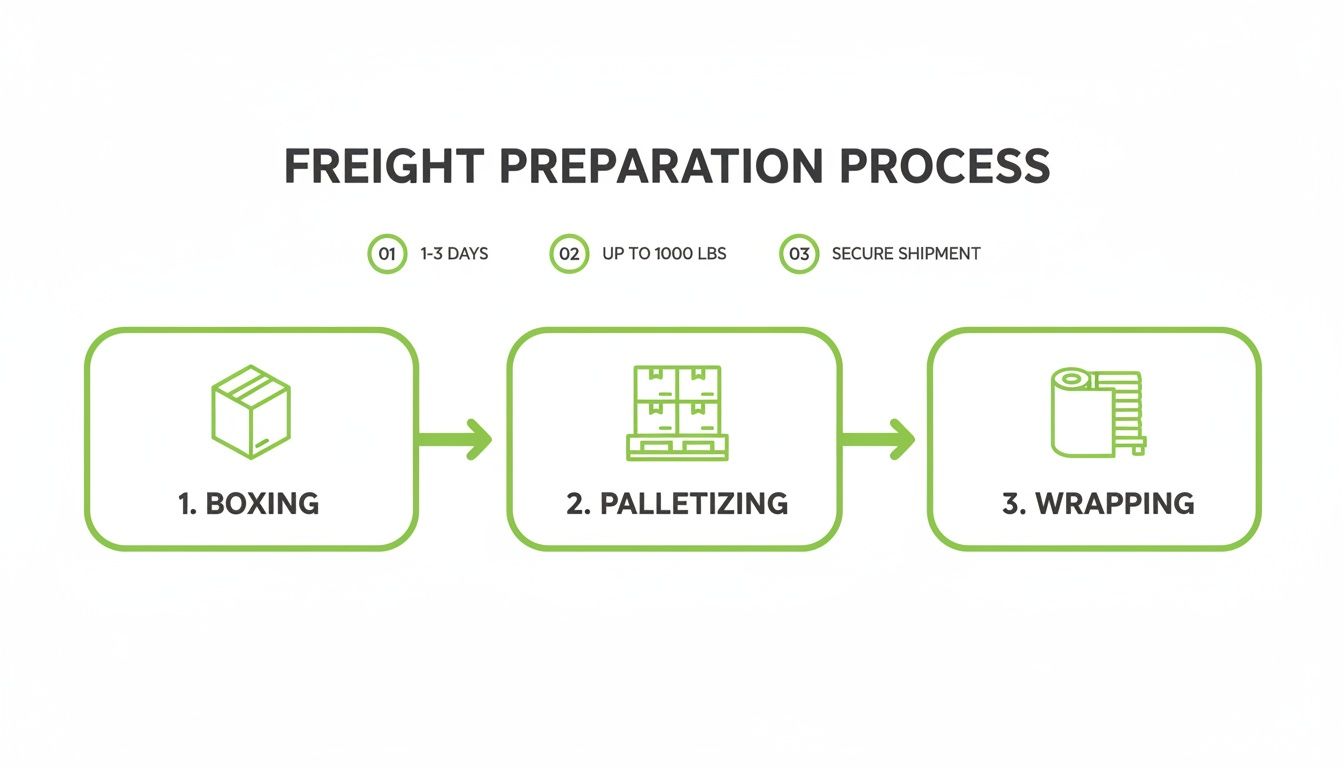
As you can see, it comes down to three core steps: first, pack your goods into a sturdy box, then stack them onto a pallet, and finally, wrap it all up securely. Nailing these fundamentals is the key to a smooth journey and helps make domestic freight express a reliable and manageable part of your business.
Smart Strategies to Lower Your Express Freight Costs
Using an express freight service doesn't have to break the bank. Sure, it’s a premium option for when things absolutely have to get there fast, but with a few clever tactics, you can chip away at those costs without sacrificing speed or reliability. It all comes down to optimising how you pack, book, and send your goods within Australia.
The key is to think ahead before you hit that 'book' button. Small adjustments to your process can lead to big savings over time, turning shipping from a necessary expense into a real competitive edge for your business.
Consolidate Your Shipments
This is one of the most effective tricks in the book. Instead of sending out lots of small, individual orders as they come in, try to consolidate them into fewer, larger shipments. Sending one big pallet is almost always cheaper than sending several smaller cartons to the same place over a few days.
Why? Two reasons. First, you get better rates from carriers for larger volumes, which brings down your cost-per-item. Second, it means less handling, which naturally reduces the risk of something getting lost or damaged along the way. A little bit of planning in your dispatch schedule can make a massive difference.
Be Precise with Weight and Dimensions
When it comes to declaring your freight's details, accuracy is everything. Carriers calculate their charges based on the weight and dimensions you give them. If they spot a discrepancy at the depot—and they often do—you’ll be hit with expensive re-weigh and re-measure fees. These penalties can sting, often costing much more than the original price difference.
Always use a calibrated scale and a tape measure. Get the exact figures for every single carton and pallet. Taking a moment to double-check these details ensures you pay the right price the first time and saves you from a headache down the track.
This simple bit of due diligence is fundamental to keeping your freight costs in check. For anyone looking to consistently find great rates, it's also worth reading up on how to find the cheapest courier services in Australia for more cost-saving tips.
Ship to Commercial Addresses
Here's something you might not know: sending freight to a residential address almost always costs more. Carriers slap on a surcharge for home deliveries because they’re simply more difficult. Think tight streets that are tricky for big trucks to navigate and the extra time it takes.
Whenever you can, arrange for your freight to be delivered to a commercial or business address. These places are usually set up with loading docks or forklifts and are on routes designed for freight vehicles. It’s a small change that can instantly cut unnecessary fees from your invoices.
Choose the Right Carrier for the Route
Not all carriers are created equal, especially when it comes to their network. One might be fantastic for getting goods to Western Australia but have a weaker presence in regional Victoria. Picking a carrier with a strong, established network in your key delivery areas can lead to some serious savings and, often, faster deliveries.
Think about it—a provider that moves a high volume of freight along a popular route like Sydney to Melbourne can offer much more competitive pricing for that specific lane. Do a bit of homework or use a freight platform that lets you compare carriers. This ensures you’re always matching your shipment with the carrier best suited for the job.
Choosing the Right Express Freight Partner in Australia
Picking a partner for your domestic freight express needs is a huge deal. It’s more than just a line item in your budget; it’s a strategic move that directly affects your shipping costs, how reliably your goods arrive, and ultimately, how happy your customers are. Now that we’ve walked through everything from packaging to tracking, the last piece of the puzzle is finding a partner that truly gets your business here in Australia.
The right company will offer a solid mix of competitive pricing, smart technology, and real, local support. A great partner doesn't just shift pallets from A to B—they make the whole experience smooth, saving you time and steering you clear of expensive headaches.
Key Criteria for Your Decision
When you're weighing up your options, don't just glance at the initial quote. The real value is found in a service that's honest, easy to use, and covers all the bases. It’s all about striking that perfect balance between cost and quality, one that helps your business run smoothly and grow.
So, what should be on your checklist for a top-tier Australian freight partner?
- Transparent Pricing: You want a clear, upfront pricing structure with no nasty surprises. A good provider offers fair rates without tacking on unexpected fuel levies or residential delivery fees later on.
- User-Friendly Online Platform: A simple, intuitive online portal is an absolute must-have. You should be able to get instant quotes, book jobs in a few clicks, print labels, and track every single shipment from one dashboard.
- Comprehensive National Coverage: Your freight partner needs to deliver wherever your customers are. Make sure they have a robust network that reaches not just the big cities, but regional and remote corners of Australia too.
- Responsive Local Support: If something goes sideways, you need to talk to a real person who knows the local logistics landscape inside and out. Always prioritise providers with an Australian-based support team that’s easy to get hold of.
Beyond the Basics: What to Look For
On top of these essentials, a truly great partner brings more to the table—things that protect your business and make complex rules simple. This includes clear advice on meeting your Chain of Responsibility duties and making sure your shipments are properly covered while on the road. A good starting point is understanding third-party logistics (3PL) providers, as they often bundle these services into a complete package.
Peace of mind is a critical, yet often overlooked, factor. Knowing your freight is covered by included insurance and handled by a team that prioritises compliance allows you to focus on running your business, not worrying about logistics.
Ultimately, you’re looking for a partner that feels like an extension of your own team. They should make sending domestic freight express straightforward and affordable, adding real value at every turn. As you consider your choices, it’s worth learning more about what makes a great Australian courier company and how the right one can help you nail your shipping goals.
Your Top Questions About Domestic Freight Answered
Stepping into the world of domestic express freight can feel a bit overwhelming at first. There are a lot of moving parts, and it’s natural to have questions, especially when every shipment is different. Let’s clear up a few of the most common queries we get from businesses across Australia.
Getting a handle on these basics is the key to making sure you pick the right service, pack your goods properly, and sidestep any unexpected hiccups when your driver arrives.
What's the Difference Between a Courier and Freight?
This is a big one. People often use 'courier' and 'freight' as if they're the same thing, but in the logistics world, they refer to two distinct types of services. Think of it in terms of size and scale.
- Courier services are your go-to for smaller, lighter items. We're talking documents, satchels, or a few boxes that one person can easily carry and pop into a van.
- Freight services are designed for the big stuff. This is for when you're moving multiple heavy cartons, bulky equipment, or goods stacked onto a pallet that need a proper truck and lifting gear.
While many modern booking platforms let you handle both through one interface, knowing the fundamental difference helps you get it right from the very start.
Can I Send Fragile or Dangerous Goods?
What about items that need a bit of extra TLC? Absolutely, you can send fragile goods, but the ball is in your court to make sure they're packed to survive the journey. That means using strong, double-walled boxes, plenty of internal padding like bubble wrap or foam, and slapping "FRAGILE" tape all over it so everyone knows to handle it with care.
Dangerous Goods (DGs), on the other hand, are a whole different story. These are items classified as a potential risk to people, property, or the environment, and they're governed by some very strict rules. You must always declare them to your carrier before you book. This is non-negotiable, as it ensures they can be transported legally and, most importantly, safely.
Do I Need a Forklift for a Pallet?
This is a make-or-break question for anyone sending freight on a pallet. For the most part, the answer is yes. A forklift is the standard tool for the job, needed to safely load a pallet onto a truck at pickup and unload it at the other end.
But what if you don't have one? Don't stress, you're not stuck. You'll just need to book a truck with a tail-lift. A tail-lift is a hydraulic platform at the back of the truck that does the heavy lifting for you, lowering the pallet safely to the ground. Just remember this is a specialised service that usually costs a bit extra, so make sure you request it when you book to get an accurate price and avoid any drama on the day.
Ready to simplify your Australian shipping? With Aeros Couriers, you can get instant quotes, book jobs in minutes, and track every shipment from a single, easy-to-use dashboard. Find out how we make domestic freight express fast, affordable, and straightforward.
