


Trying to make sense of a shipping quote can sometimes feel like you're cracking a code. The cost of postage in Australia isn’t a single, fixed number. It’s a moving target, influenced by everything from a parcel's weight and size to how far it needs to travel.
This guide will pull back the curtain on those costs, giving you the practical insights you need to make smarter shipping decisions for your business.
Your Guide to Australian Postage Costs
Getting a handle on your postage bill is a fundamental part of managing your business expenses and keeping customers happy. It’s not just about sticking a stamp on a box; it's a real, calculated expense that directly hits your bottom line. Get it wrong, and you could be overspending or facing surprise fees that chip away at your profits.
On the flip side, when you truly understand the moving parts of shipping, you can find clever ways to be more efficient and even pass those savings on to your customers. Think of it as your roadmap for navigating Australia's delivery network. Armed with the right knowledge, postage stops being a confusing cost and becomes a strategic part of your business.
From a Penny Post to Modern Rates
Today’s complex postage costs are a world away from Australia's much simpler past. Back in 1911, when the states federated their postal services, rates became uniform across the country—just one penny per half ounce. This mirrored the UK’s Imperial Penny Post and was a massive leap forward for businesses, replacing the messy patchwork of old colonial rates that made sending mail a headache.
This simple, flat rate caused mail volumes to skyrocket, helping to fuel national trade as the new nation found its feet. If you’re curious, you can explore more about Australia's postal history to see just how much things have changed.
The penny post is a thing of the past, but the goal of affordable shipping is more important than ever. The main difference is that modern businesses now have to juggle a much more complicated set of variables.
The real challenge isn't just sending a parcel; it's sending it smartly. This means understanding the relationship between weight, distance, and speed to unlock the most economical option without sacrificing reliability.
What This Guide Will Cover
This guide is built to give you that essential knowledge. We’ll break down the core components that make up your final shipping bill, starting with the basics and moving on to practical strategies you can use right away.
Here’s what you'll learn:
- The primary drivers of postage costs: A deep dive into how weight, size, distance, and speed shape your final quote.
- Practical calculation methods: Step-by-step examples to help you accurately estimate your expenses before you ship.
- Cost-saving strategies: Actionable tips to lower your shipping spend without compromising on service quality.
- Modern shipping solutions: An introduction to platforms like Aeros Couriers that offer a smarter, more predictable alternative to traditional post.
By the end, you'll have a clear picture of how to manage your shipping with confidence, ensuring every parcel you send is handled efficiently and affordably.
The 6 Factors That Really Determine Your Postage Bill
Ever looked at a postage quote and wondered how they landed on that specific number? It can feel a bit like a black box, but once you pull back the curtain, it all comes down to a handful of key factors. Each one plays a part in calculating the final cost, and understanding them is the first step to getting your shipping expenses under control.
Think of it like ordering a pizza. The base price is for a simple margherita, but then you start adding things. Extra toppings, a stuffed crust, a different base, home delivery – each choice adds to the final bill. Postage works the same way. The choices you make about size, speed, and extras all stack up.
Let's break down exactly what's driving your postage costs.
Before we dive into the details, here’s a quick overview of the main variables that shape your final shipping price. Each one has a direct impact, and mastering them will help you ship smarter.
Key Factors Influencing Your Postage Cost
| Factor | How It Impacts Cost | Example |
|---|---|---|
| Weight | Heavier parcels require more fuel and resources to move. | A 5 kg box of books will cost more to send than a 500 g t-shirt. |
| Dimensions | Large, bulky items take up more valuable space in a van or plane. | A big, light box of pillows can cost more than a small, heavy dumbbell. |
| Distance | The further a parcel travels, the higher the fuel and labour costs. | Sending a package from Sydney to Perth is more expensive than from Sydney to Newcastle. |
| Service Level | Urgency comes at a premium; faster delivery means higher prices. | An overnight Express Post service will cost significantly more than a standard road freight option. |
| Packaging | Inefficient packaging can add unnecessary weight and trigger surcharges. | Using a huge box for a small item can inflate the cubic weight and your bill. |
| Surcharges | Extra services or special handling requirements add fees to the base price. | Requiring a signature on delivery or sending a fragile item often incurs an extra charge. |
Now, let's explore each of these a bit more deeply.
1. Parcel Weight and Dimensions (The Big Two)
This is the most obvious starting point. Heavier, larger parcels cost more to send. Simple, right? Well, mostly. Carriers don't just look at how heavy your parcel is; they also care about how much space it takes up. This is where a lot of people get caught out.
They use two different measurements to figure this out:
-
Actual Weight: This is just what it sounds like – the weight of your parcel when you pop it on the scales, measured in kilograms.
-
Cubic Weight (or Volumetric Weight): This one is a little trickier. It’s a formula that converts a parcel’s dimensions (length x width x height) into an equivalent weight. It’s the courier's way of making sure a massive but lightweight item, like a case of foam rollers, pays its fair share for the space it occupies in the van.
The crucial bit? You’ll be charged on whichever is greater. A small, heavy item will be charged on its actual weight. But a large, light item will almost certainly be charged on its cubic weight. If you want to get ahead of any surprises, it’s worth taking a moment to learn how to calculate cubic weight.
A classic rookie error, especially for ecommerce businesses, is to only focus on actual weight. I’ve seen people double their shipping costs just by choosing a box that’s a few centimetres too big for the item inside.
2. Delivery Distance and Location
It stands to reason that sending a parcel across the country is going to cost more than sending one across town. The further your package has to travel, the more it costs in fuel, driver time, and logistical handling.
In Australia, delivery networks are usually broken down into zones, which roughly translate to:
- Metro to Metro: The cheapest routes. Think Sydney to Melbourne or Brisbane to Sydney. These are high-volume corridors with very efficient transport links.
- Metro to Regional: Sending from a capital city to a regional hub like Geelong or Wollongong will cost a bit more.
- Regional to Regional/Remote: These are the most expensive journeys. Getting a parcel from a regional town to a remote community involves more complex logistics and fewer deliveries along the way, pushing the price up.
3. Shipping Speed (How Fast Do You Need It?)
How quickly does your parcel need to get there? This is a classic trade-off between speed and cost. If you want it there tomorrow, you’re going to pay a premium for that urgency.
Your main options are:
- Standard or Road Freight: The budget-friendly choice. It’s perfect for non-urgent deliveries where keeping costs low is the main goal. Your parcel will travel by truck and take a few days.
- Express Post: The premium, faster service. This often involves air freight to get your parcel to its destination much quicker, usually within 1-3 business days between major cities.
Choosing the right service really comes down to managing your customer's expectations. If you can plan ahead and build in slightly longer delivery times, you can lean on standard services and save a significant amount of money.
4. Packaging and Surcharges
The last piece of the puzzle is all the little extras. Your choice of box can add unnecessary weight and bulk, and any additional services will tack more onto the final bill.
Surcharges are extra fees for anything that falls outside of a standard, straightforward delivery. They’re easy to miss but can quickly add up. Common ones include:
- Signature on Delivery: An extra fee for proof that your parcel was received and signed for.
- Freight Insurance: While most services offer some basic cover, you’ll pay more for higher-value protection on expensive items.
- Manual Handling Fee: This gets applied to items that are too big, fragile, or awkwardly shaped to go through the automated sorting machines. Think long tubes, oddly-shaped parcels, or anything that needs special care.
By getting a handle on these four areas—weight & size, distance, speed, and the extras—you can start to see exactly where your money is going and make smarter choices to lower your postage costs on every single send.
How to Calculate Postage Costs: A Practical Walkthrough
Knowing what goes into postage costs is one thing, but actually calculating them for your own parcels is where you start to take control and save money. Getting an accurate postage quote isn't some dark art; it just requires a bit of method. Let’s walk through the exact steps to nail down your costs, so you can ditch the guesswork and avoid any nasty surprise fees.
We'll use two real-world examples that Aussie businesses run into every single day. Once you see how it’s done, you’ll be able to get a precise quote for anything you need to send.
The whole process really just boils down to three simple steps: measure your parcel, know the distance it’s travelling, and pick your service.
This infographic breaks it down visually.
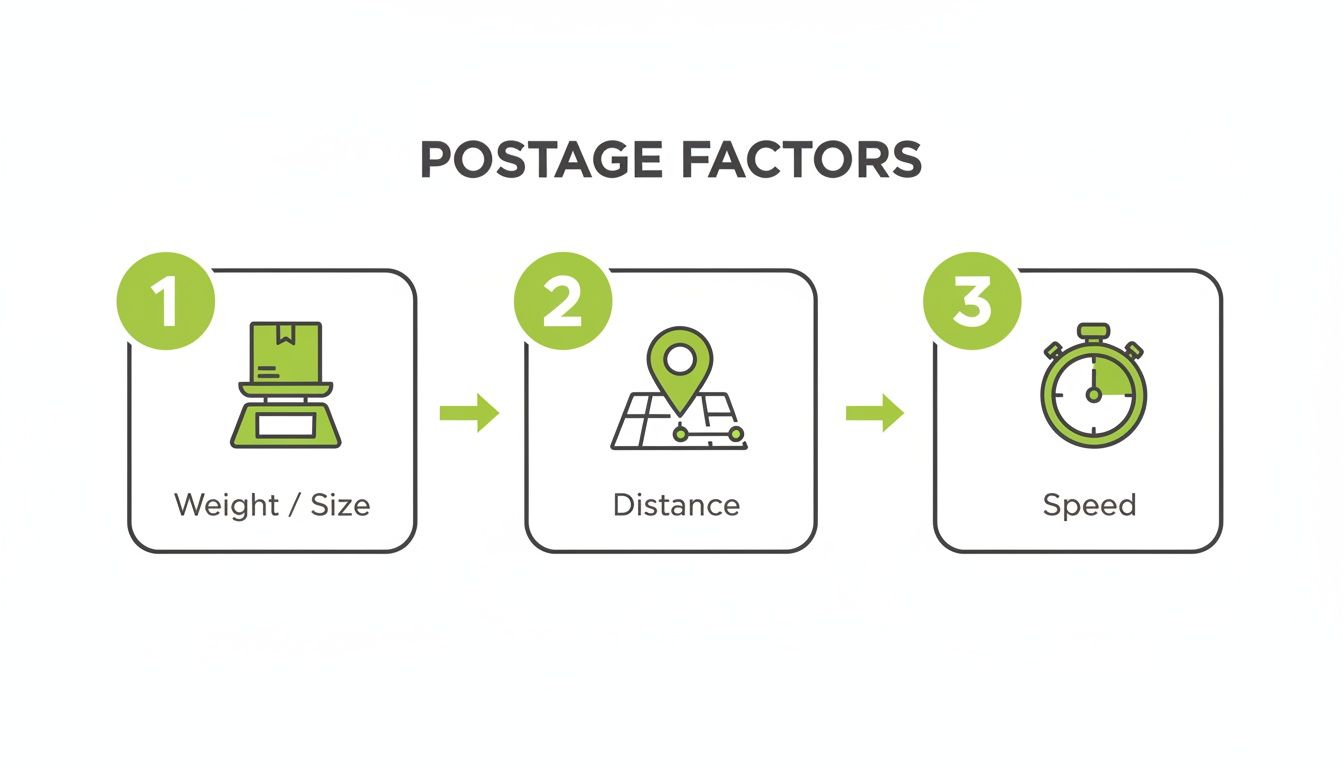
As you can see, each piece of information builds on the last to give you the final cost of postage. It all starts with the physical size and weight of your package.
Step 1: Gather Your Parcel Details
Before you can even think about getting a quote, you need the hard numbers. A rough guess just won’t cut it and will only lead to an inaccurate price.
You’ll need three key details:
- The actual weight in kilograms (kg).
- The dimensions in centimetres (cm) – Length x Width x Height.
- The pickup and delivery postcodes.
Grab a set of scales and a tape measure. A crucial tip: always measure your parcel after you’ve packed and sealed it up. That box, bubble wrap, and tape all add to the final weight and dimensions.
Example A: Shipping a Book from Sydney to Melbourne
Let's say you're an online bookseller sending a hardcover book from your Sydney warehouse (postcode 2000) to a customer in Melbourne (postcode 3000).
- Weigh the Parcel: Pop the packed book onto your scales. It comes in at 1.2 kg.
- Measure the Dimensions: With your tape measure, you get 25 cm long, 18 cm wide, and 5 cm high.
Now you have everything you need: 1.2 kg, 25x18x5 cm, from 2000 to 3000. This is the point where an online tool becomes your best friend. No need to trek to the post office; you can punch these numbers straight into a quoting platform and see all your options instantly.
Measuring accurately is the most important first step. It allows the online calculator to figure out both the actual weight and the cubic weight, giving you a price based on what it truly costs the carrier to ship. This simple habit prevents underquoting and getting stung with extra charges down the line.
Step 2: Use an Online Quoting Tool
It’s time to put that data to work. Modern courier platforms are built to make this part incredibly quick and easy.
Using a tool like the one from Aeros Couriers, you just plug your details into the fields on the website. You can easily calculate your specific shipping costs by entering the weight, dimensions, and postcodes. The system does the heavy lifting, instantly checking with different carriers to show you the available services and prices for that specific route.
Example B: Shipping a Carton from Brisbane to Regional WA
Okay, let's try a trickier one. You need to get a carton of stock from Brisbane (postcode 4000) all the way to a regional town in Western Australia, like Broome (postcode 6725). This trip involves a much greater distance and a less common delivery route.
- Weigh the Parcel: This bigger carton weighs 8.5 kg.
- Measure the Dimensions: The box measures 45 cm long, 35 cm wide, and 30 cm high.
Once you enter these details (8.5 kg, 45x35x30 cm, from 4000 to 6725) into the quoting tool, it will work its magic again. For a bulky item like this, it’s almost certain that the cubic weight will be higher than its actual weight, so the quote will be based on that bigger figure. You’ll also see how the long-haul journey to a regional area affects the price compared to our simple Sydney-to-Melbourne metro run.
By following these steps, you can see just how straightforward it is to figure out the exact cost of postage for any item, putting you in a great position to budget properly and pick the perfect service.
So, Why Do Postage Costs Keep Going Up?
Ever get that feeling of deja vu when you're at the post office? It seems like every year, the price to send a parcel inches up just a little more. You're not imagining it. The old-school postage system is being squeezed by some major economic shifts, and knowing what they are makes it clear why your shipping budget feels tighter than ever.
The biggest reason comes down to how we all communicate now. Just think about your own letterbox. When did you last get a handwritten letter from a friend, versus a text or an email? That massive shift to digital is the core of the problem.
The Slow Demise of Snail Mail
Traditional postal services were built on a mountain of letters. That constant stream of mail paid the bills, covering the huge costs of a delivery network that has to reach every single address in Australia. But as we've all moved our lives online, the foundations of that model have started to crumble.
The statistics tell the whole story. According to ACCC data, between early 2018 and late 2021, the number of letters being sent in Australia plummeted by a massive 13.4%. This wasn't just a minor dip; it was a steep drop across the board, from regular stamped letters to bulk business mail. If you're a numbers person, you can dig into the full ACCC analysis on letter volumes here.
This presents a huge financial headache. While the volume of mail is shrinking, the costs to run the network—paying posties, fuelling the vans, and keeping the lights on at sorting centres—haven't gone down. In fact, with a growing population, they now have more delivery points to service than ever before.
It's a classic business problem: massive fixed costs are being spread over a much smaller number of paying items. When there's less mail to fund the same giant network, the price for every remaining parcel and letter has to go up to cover the shortfall. For a business, this means you’re paying a premium for a system under serious strain.
A Smarter Way to Send Parcels
This is exactly the gap that modern courier platforms were designed to fill. Instead of being locked into a single, legacy network fighting an uphill economic battle, services like Aeros Couriers work on a completely different premise.
Our model is built for the world we live in today, sidestepping the problems that plague traditional post by focusing purely on efficiency.
- We bundle shipments together: By combining the parcels from thousands of small and medium businesses, we create the kind of bulk volume that carriers love to work with.
- We unlock wholesale discounts: This collective volume gives us serious buying power, letting us negotiate wholesale rates that are usually only available to the big players. We then pass those savings straight on to you.
- We use smart technology: Our online platform gets rid of expensive overheads. It automates everything from booking to printing labels and instantly finds the best carrier for any destination, all without the dead weight of a physical retail network.
It’s a far more sustainable model, one that isn't at the mercy of the dying letter market. By concentrating only on the logistics of moving parcels from A to B, we can provide a much lower and more predictable cost of postage. This helps Australian businesses grow without being punished for the decline of snail mail.
Actionable Strategies to Lower Your Shipping Expenses
Knowing what goes into postage costs is one thing, but actually putting that knowledge to work is where you’ll see the real difference on your bottom line. With a few smart strategies up your sleeve, you can start chipping away at your shipping expenses without cutting corners on service.
Most businesses overpay for shipping because of small, unnoticed inefficiencies that stack up over time. By making a few tweaks to how you pack and send, you can make sure every dollar is working for you, keeping your business competitive and profitable.
Optimise Your Packaging
Think of the space inside a courier van as prime real estate. You're paying for every centimetre your parcel takes up, which is why your packaging choices directly hit your final bill. The goal here is simple: make your parcel as compact and light as you can without putting the contents at risk.
That means it's time to ditch those oversized boxes stuffed with filler. Every pocket of empty air you ship is literally money down the drain.
- Right-Size Your Boxes: Always aim to match the box size as closely as possible to the item inside. Keeping a variety of box sizes on hand stops you from having to use a massive carton for a tiny product.
- Use Lightweight Materials: Swap out heavy packing materials for lighter options like air pillows or bubble wrap. Saving even a few grams on each parcel adds up to significant savings when you're sending hundreds of them.
- Consider Satchels for Small Items: For smaller, less fragile products, courier satchels are often a much more cost-effective choice than a box, as they minimise both size and weight.
Leverage Wholesale Courier Rates
One of the single most powerful ways for small and medium businesses to bring down shipping costs is to tap into wholesale rates. Historically, these deep discounts were only offered to huge corporations sending thousands of parcels a day. Thankfully, modern courier platforms have changed the game completely.
Services like Aeros Couriers work by pooling the shipping volume from thousands of smaller businesses just like yours, giving everyone collective bargaining power. This model gives you access to the cheapest courier service rates that were once out of reach, levelling the playing field and delivering instant savings on every single parcel you send. You get the pricing of a major player without needing the volume.
The idea is straightforward: by joining a larger group, you get benefits you could never get on your own. It's the shipping equivalent of a group buying deal, instantly turning your small business into a high-volume client in the eyes of the carriers.
Plan Ahead to Avoid Express Fees
Urgency always costs more. Express services are fantastic for those genuinely time-critical deliveries, but if you're using them as your default option, you’re likely blowing out your budget for no good reason. A little forward planning with your dispatch schedule lets you use far more economical standard road freight services.
If your delivery window has some flexibility, choosing a standard service over an express one can slash your shipping costs by 30-50% on certain routes. Be upfront with your customers about delivery timeframes and, if you can, build in an extra day or two to take advantage of these savings. This simple, proactive approach transforms shipping from a reactive expense into a managed cost.
Consolidate Your Shipments
Whenever you get the chance, consolidate multiple orders heading to the same address into a single, larger shipment. Sending one big box is nearly always cheaper than sending three small ones because you minimise the base charges and handling fees that apply to each individual parcel.
This strategy works especially well for B2B companies shipping to regular clients or for e-commerce stores that receive multiple orders from the same customer. It doesn't just lower your cost of postage; it also streamlines your own logistics and makes tracking much simpler.
By putting these actionable steps into practice, you can take direct control of your shipping expenses.
How Aeros Couriers Delivers Predictable Rates (And What That Means for You)
If you've ever felt frustrated by how much postage costs seem to change, you're not alone. For any business, trying to budget around those moving goalposts is a constant headache. That's where we come in.
Instead of being stuck with a traditional system that’s creaking under pressure, we built Aeros Couriers to offer a smarter, more predictable way to ship. We tackle the problem of surprise costs and confusing quotes head-on.
How? By combining our massive buying power with the flexibility of multiple carriers, all managed through one simple online platform. It’s a different way of thinking about shipping.
The Power of Shipping Together
At the core of what we do is a simple idea: there's strength in numbers. We bundle the shipping needs of thousands of Australian businesses just like yours. This creates an enormous volume of parcels that gives us serious negotiating power with the big carriers.
Think of it like a group buying deal, but for shipping. This lets us secure heavily discounted wholesale rates—the kind of prices that are usually out of reach for individual small or medium-sized businesses.
The result is you get access to a lower cost of postage right from the start. You're not paying retail; you’re tapping into the scale of a huge enterprise, which puts immediate savings back in your pocket.
We pass all these savings onto you through a clean, user-friendly platform. Our goal is to cut through the confusion and give you instant quotes without asking you to sign up or hiding fees in the fine print.
We believe in being upfront. One of the things our customers love most is our policy of zero credit card surcharges. The price you see is exactly what you pay. It takes the guesswork out of your shipping budget.
Features That Save You More Than Just Money
Lower rates are just the beginning. Our platform is built with features that protect your bottom line and make your shipping process a whole lot smoother. We know that truly stress-free deliveries come from a complete solution, not just a cheap price.
Here are a few advantages built right into our service:
- Included Freight Insurance: Every single booking comes with a baseline of freight insurance. It’s peace of mind that you don’t have to pay extra for.
- Clear Packaging Guidance: We help you get your packaging right from the get-go, so you can avoid those painful manual handling fees and surcharges for parcels that don't fit the mould.
- A Centralised Dashboard: Book your shipments, print labels, and track everything in real-time from one easy-to-use interface. It's a massive time-saver.
This is a world away from the old way of doing things, where postage prices have consistently climbed to cover ever-increasing operational costs. We’re offering a stable, cost-effective alternative so Australian businesses have a reliable partner to help them grow.
Got Questions About Postage Costs? We’ve Got Answers.
When you're trying to get your parcels from A to B, a few questions always seem to pop up. Let's tackle some of the most common ones so you can ship with confidence, knowing you’ve got all the facts.
What’s This “Volumetric Weight” Thing All About?
Ever wonder why a huge, light box of styrofoam might cost more to send than a small, heavy dumbbell? That’s volumetric weight in action.
Couriers don’t just care about how heavy something is; they also care about how much space it takes up in their van or plane. Volumetric weight is simply a way of calculating a price based on an item's size, not just its actual weight. It’s calculated with a formula like: (Length x Width x Height) x a special conversion number.
This is why packing smart is so important. A snug-fitting box will almost always be cheaper than letting your item rattle around in an oversized one.
Is a Satchel Cheaper Than My Own Box?
Ah, the classic packaging dilemma. The honest answer? It depends entirely on what you're sending.
Prepaid satchels are brilliant for items that are small but heavy. Think a paperweight or a dense book. You get a flat rate up to a certain weight limit, which can be a real bargain.
But if you’re shipping something light, bulky, or oddly shaped, using your own box is often the way to go. You’ll only pay for the exact size and weight you’re using, not a one-price-fits-all satchel rate.
The only way to know for sure is to do a quick check. Measure and weigh your item in your own box, then compare a real-time quote against the satchel price. The numbers will tell you the best option every time.
How Can My Small Business Get the Cheapest Postage Rates?
Getting the best shipping prices isn't about finding one magic trick; it's about combining a few smart habits that add up to big savings.
Here are the three most effective strategies you can start using today:
- Become a Packaging Pro: Always use the smallest and lightest box or satchel that will safely house your product. This cuts down on both actual weight and volumetric weight costs.
- Tap into Wholesale Rates: You don't need to be a corporate giant to get bulk discounts. Using a courier aggregator platform opens the door to discounted rates usually reserved for the big players.
- Choose the Right Speed: Not every delivery is a frantic, last-minute rush. If you have some breathing room, opting for standard road freight instead of express air services can slash your costs significantly.
Putting these steps into practice will make a real difference to your bottom line. For a deeper dive into your options, take a look at our guide to Australian postal and parcel rates.
Ready to stop overpaying and start shipping smarter? Aeros Couriers gives you instant access to wholesale rates from Australia's top carriers, with no account fees or credit card surcharges. Get your free, no-obligation quote today and see how much you can save.
