

Shipping costs can feel like a moving target, directly hitting your budget and, ultimately, your bottom line. But what if you could flip that uncertainty on its head and turn it into a genuine strategic advantage? This guide is your roadmap to mastering the cost for shipping across Australia, helping you transform a necessary expense into a powerful, streamlined part of your operation.
Navigating Your Australian Shipping Costs

Getting a handle on shipping costs is about so much more than just seeing a price tag; it's about seeing the opportunity hidden within the logistics. For any Australian business—from a buzzing e-commerce store to a corporate office sending out documents—shipping is the final, crucial link to your customers and a major operational expense. Get it wrong, and you're looking at shrinking profits and unhappy clients. But get it right? You unlock a new level of efficiency and growth.
Think of this guide as your personal playbook for taking back control. We're going to pull back the curtain on the key factors couriers use to calculate your price, from a parcel's size and weight to where it's headed. This isn't about memorising complicated formulas; it’s about gaining practical, real-world knowledge that puts you firmly in the driver's seat.
Why Mastering Shipping Costs Matters
Bringing clarity to your shipping expenses delivers benefits you'll feel straight away and for years to come. It empowers you to make smarter choices that protect your profits and leave customers smiling. The real wins include:
- Improved Budgeting: When costs are predictable, you can plan your finances with confidence, avoiding those nasty surprise fees that throw your cash flow into chaos.
- Increased Profitability: Every dollar you save on shipping is a dollar that goes directly back into your pocket, boosting the profit margin on every item you send.
- Enhanced Customer Experience: Offering fair, transparent shipping prices is a proven way to reduce abandoned carts and build the kind of trust that keeps customers coming back.
- Operational Efficiency: Once you know the rules of the game, you can build smarter packing and dispatch workflows that save you precious time.
What You Will Learn
Throughout this guide, we'll break down exactly how carriers calculate their charges and share practical strategies you can start using today. When figuring out the complexities of shipping, it's often a good idea to review a vendor's specific delivery and returns policies to see exactly how they handle costs and logistics.
Your goal should be to transform shipping from a mere cost centre into a streamlined, efficient part of your operation. This shift begins with understanding the core components of pricing.
We’re here to give you the insights you need to make smarter, more cost-effective decisions for every single delivery. To see how these principles apply in practice, you can explore our range of Australian courier services and see how they’re built to save you money from day one. By the end of this guide, you’ll be inspired to take full command of your shipping strategy.
The Real Reasons Your Shipping Costs What It Does
Have you ever sent two parcels that seemed almost identical, only to be hit with wildly different shipping prices? It can be frustrating, but I promise there’s a method to the madness. Once you pull back the curtain and understand how couriers calculate their prices, you gain the power to control your shipping budget and say goodbye to those nasty cost surprises for good.
Think of it like this: every delivery van and truck has a fixed amount of space and a maximum weight it can handle. Your shipping cost is simply a reflection of how much of that precious capacity your parcel takes up. It’s not just about how heavy something is; it’s about its entire footprint on the journey.
It's Not Just Weight, It's Size That Matters
Let's get straight to the biggest factors: the physical size and weight of your package. Couriers look at three specific measurements to figure out how much room your shipment needs. They'll always base the charge on whichever of these is the greater value.
- Dead Weight: This is the one we all know. It’s simply how heavy your parcel is in kilograms when you pop it on a scale.
- Dimensions: The classic length, width, and height. These numbers tell the courier how much physical space your box will occupy in their vehicle.
- Cubic Weight: This is the secret ingredient most people miss. It’s a measure of density, comparing how much space an item takes up versus its actual weight. This is often the most important factor in the final price.
Here’s a perfect example: a massive, lightweight box filled with foam pillows will almost always cost more to ship than a small, heavy box of books. Why? The pillows, despite weighing less, gobble up far more valuable real estate in the truck. That’s cubic weight in action, and it’s a game-changer.
Getting a handle on this balance is your first big step towards smarter shipping. To see exactly how these figures work together, check out our easy-to-follow guide to calculate shipping charges. You’ll be amazed at how a small change in your packaging can lead to some seriously big savings.
Before we move on, here’s a quick summary of the key elements that come into play when calculating your shipping costs.
Key Factors Influencing Your Shipping Cost
| Influencing Factor | How It Impacts Cost | Aeros Couriers Solution |
|---|---|---|
| Weight & Dimensions | Couriers charge on the greater of dead weight or cubic (volumetric) weight. Larger, lighter items can cost more than small, heavy ones. | Our Instant Quote Tool automatically calculates the correct chargeable weight, so you'll never be surprised by hidden costs. |
| Distance & Zones | The further your parcel travels, the higher the cost. Couriers use "shipping zones" to standardise pricing across different routes. | We provide clear ETAs for regional areas and transparent zone-based pricing, making it easy to see the cost upfront for any destination. |
| Service Speed | Express or overnight services use priority air freight and cost a premium. Standard road services are more economical but take longer. | Choose from a range of service levels to match your budget and urgency, all accessible with our wholesale buying power for better rates. |
| Surcharges | Unexpected fees for things like residential delivery, oversized items, or incorrect addresses can significantly increase the final price. | Our system helps you avoid common surcharges by flagging potential issues and ensuring all details are correct before you book. |
Understanding these factors is the key to unlocking more efficient and cost-effective shipping for your business or personal needs.
How Far Is It Going? Distance And Shipping Zones
Australia is a massive place, so it’s no surprise that the distance your parcel has to travel is a huge part of the cost. To make things simpler, couriers slice the country up into shipping zones, which helps them standardise prices for different journeys. A delivery from a Sydney CBD office to a neighbouring suburb is always going to be cheaper than sending the same package to a remote town in the Kimberley.
But these zones aren't just about the raw kilometres. They also account for how easy it is to reach the destination. Delivering to a busy city centre is a straightforward, efficient job for a courier. A trip to a regional town, on the other hand, often involves more complex logistics and hand-offs. The further and more remote the endpoint, the more fuel, time, and resources are needed—and the higher the shipping price reflects that.
Need It Now or Need It Cheap? Your Choice of Speed
Finally, how fast you need that parcel to arrive has a direct and significant impact on the final cost for shipping. Every courier offers a menu of service levels designed to fit different timelines and budgets.
- Express or Overnight: This is the premium, top-tier service for anything urgent. It almost always guarantees next-business-day delivery, but it comes with a higher price tag because it relies on priority air freight and special handling.
- Standard or Economy: This is your workhorse option—the most popular and budget-friendly choice. It generally uses road freight and provides a reliable delivery within a few business days, depending on the route.
The price difference here is tied directly to real-world operating costs. For instance, the price of road freight in Australia has been climbing relentlessly. After some big spikes driven by fuel prices, the service price index is projected to reach 136.0 points in 2025-26. Even though diesel prices have dipped slightly, they're still high enough to keep pressure on transport companies, and that cost inevitably gets passed on. You can read more about these Australian road freight price trends on IBISWorld.
By truly understanding these three pillars—size, distance, and speed—you're no longer just sending a parcel. You're making an informed, strategic decision that puts you in complete control of your shipping.
How Australian Shipping Costs Are Calculated
Ever wondered how a courier comes up with the price to send your package? It’s not just a stab in the dark. There’s a specific science to it, designed to measure exactly how much of a courier's resources your parcel will use. Getting your head around this is the first real step to turning shipping from a painful, unpredictable cost into something you can actually control.
Think of it this way: every delivery van or truck has a finite amount of space and a maximum weight it can carry. Couriers have to price their services based on how much of that precious real estate your shipment takes up. This brings us to the most important idea in shipping: chargeable weight. It's a simple comparison between two different measurements, and it's what determines your final bill.
This flowchart breaks down the core elements that all add up to your final shipping price.
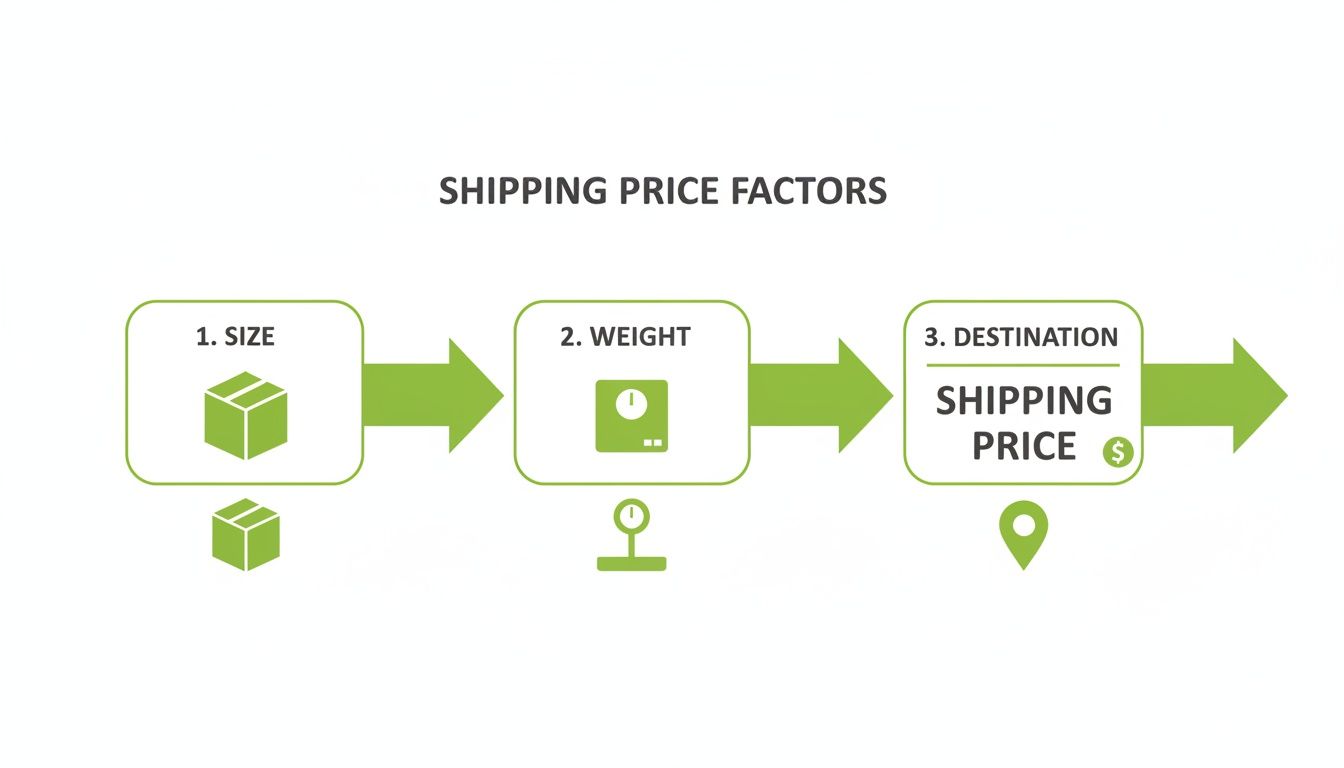
As you can see, the cost is a blend of your item's size, its actual weight on the scales, and how far it has to travel.
Dead Weight Versus Cubic Weight
The first measurement is what we call dead weight. It’s exactly what it sounds like—the actual weight of your parcel in kilograms if you pop it on a scale. Simple.
The second, and often more surprising, measurement is cubic weight (you might also hear it called volumetric weight). This is all about density. It calculates how much space your parcel occupies relative to how much it weighs. It's the reason a massive, feather-light box of pillows can cost more to ship than a small, heavy box of books. The pillows hog all the space in the van, making them more expensive to transport.
The golden rule is this: the courier will always charge you based on whichever weight is greater—dead or cubic. If you can master this one concept, you're well on your way to unlocking some serious savings.
Let’s run through a quick example. Say you have a box that's 40cm x 30cm x 30cm and weighs 5kg. To get its cubic weight for standard road freight, you multiply its dimensions (in metres) by an industry conversion factor, which is usually 250.
- Calculation: (0.4m x 0.3m x 0.3m) x 250 = 9kg cubic weight
So, even though your box only weighs 5kg (its dead weight), the courier will charge you as if it weighs 9kg. This is why learning to properly calculate your package's cubic weight is a non-negotiable skill for anyone looking to get their shipping costs down.
The World of Surcharges
On top of the base cost calculated from weight and distance, a whole range of extra fees, or surcharges, can pop up and inflate your final bill. These aren't sneaky hidden fees; they're applied when a delivery requires something outside the standard, automated process. Knowing what they are is crucial for accurate budgeting.
Some of the most common surcharges in Australia include:
- Residential Delivery: A small fee often added for deliveries to home addresses, which are usually spread out and less efficient than dropping multiple parcels at one business.
- Futile Pickup: If the driver shows up to collect a parcel and it’s not ready to go, this fee covers their wasted time and fuel.
- Manual Handling: Charged for items that are awkwardly shaped, too big, or not boxed properly, meaning they have to be handled by a person instead of zipping through sorting machinery.
- Remote Area Surcharge: An extra charge for deliveries to postcodes well outside the main metro and regional hubs, covering the extra distance and effort.
These extra costs show how wider economic forces can impact individual shipments. Fluctuations in fuel prices and operational costs can trickle all the way down to domestic prices, proving how interconnected the whole logistics network is.
By getting a handle on both the core calculations and these potential extra fees, you can start packaging your items smarter and choosing the right services. That’s how you stop getting hit with costly surprises and finally take back control of your shipping budget.
Practical Ways to Cut Your Shipping Expenses

Knowing how carriers calculate your bill is half the battle. Now, let’s get into the good stuff—actually taking control and bringing those costs down. This isn't about finding secret loopholes; it's about building smarter habits that directly lower the cost for shipping every single time you send something.
These are real-world, actionable tips you can start using today to protect your budget and give your bottom line a healthy boost. Think of them less as chores and more as foundational practices that turn shipping from a reactive cost into a proactive advantage. Trust me, every small adjustment adds up to make a huge difference.
Optimise Your Packaging
The single biggest lever you can pull to slash costs is right-sizing your packaging. Since carriers charge based on either dead weight or cubic weight (whichever costs more), every centimetre of empty space in your box is literally money down the drain.
Imagine sending a small item in a box that’s way too big. You’re not just paying to ship your product; you’re paying to ship air. By choosing a box that fits your item snugly, you dramatically reduce its cubic weight, which can lead to immediate and very satisfying savings. It’s one of the simplest yet most powerful moves you can make.
"A box that is just 20% smaller can slash the cubic weight, which directly translates to a lower shipping bill. It’s one of the few areas where a tiny physical change creates a massive financial win."
Consolidate Your Shipments
Another brilliant strategy is consolidating your shipments. Instead of sending out multiple small parcels to the same address over several days, why not group them into a single, larger shipment? This approach unlocks savings in a few key ways.
- One Pickup Fee: You’re only paying for one driver to show up, not several.
- Better Base Rate: It’s almost always cheaper to send one larger package than the combined cost of many smaller ones.
- Less Handling: It’s simply more efficient for the carrier, and that efficiency saving often gets passed right back to you.
Sure, this takes a little planning, but the payoff is massive, especially if you regularly send goods to the same clients or distribution centres.
Prepare Your Freight For Success
When you’re sending bigger, bulkier goods, how you prepare them is everything. If you’re shipping freight on a pallet, the way you pack it can make or break your budget.
Make sure your items are stacked securely within the pallet's edges, are stable, and are properly wrapped. An unstable or poorly packed pallet can’t be moved easily by a forklift, which means it needs special attention and—you guessed it—a manual handling surcharge. Taking a few extra minutes to prepare your freight properly ensures it sails through the network without attracting those pesky extra fees.
A huge part of this is also about who you ship with. Taking the time for comparing partnered vs. non-partnered carriers can reveal huge savings, as the right platform gives you access to pre-negotiated rates you could never get on your own.
Actively Avoid Surcharges
Surcharges are the silent killers of a shipping budget. These fees pop up for any little thing that deviates from the standard process, so being proactive is your best defence.
- Double-Check Addresses: Use an address validator to make sure every detail is perfect. This helps you dodge re-delivery fees.
- Be Ready for Pickup: Have your parcels packed, labelled, and good to go when the driver arrives. This will save you from futile pickup charges.
- Measure Accurately: Always provide the exact weight and dimensions when you book. "Guesstimating" is a surefire way to get hit with correction fees later.
Keeping a lid on these costs is more important than ever. Domestic freight costs are constantly influenced by factors like fuel prices and labour shortages. Sticking with a domestic-focused platform like Aeros Couriers helps you navigate this volatility and find the best available rates.
By putting these simple strategies into play, you’re not just sending parcels anymore—you’re building a smart, cost-effective shipping operation. If you’re ready to see how much you could save, you might also want to check out our guide to help you compare courier rates and make sure you’re always getting the best deal.
Turning Shipping Headaches into Your Biggest Advantage
So, you've got a handle on how shipping costs are calculated. That's the theory. But how do you actually put that knowledge to work and start saving real money? This is where having the right partner in your corner makes all the difference.
At Aeros Couriers, we’ve built a platform from the ground up to tackle Australia’s high shipping costs head-on. Our goal is simple: to make shipping affordable, crystal-clear, and maybe even a little inspiring. Forget about poring over confusing rate cards or getting hit with surprise fees. We’re here to give you an all-in-one solution that puts you firmly in control of your budget.
Get Instant Quotes, Make Instant Decisions
The first rule of saving money is knowing exactly what you're spending. The days of waiting on hold for a quote or being forced to create an account just to see a price are over. Our instant quote tool is all about speed and transparency, giving you clear pricing from multiple trusted carriers in a matter of seconds.
Just pop in your pickup and delivery details, add your parcel's dimensions and weight, and you're set. You’ll instantly see a whole range of options, allowing you to compare services and pick the perfect balance of speed and value for every single shipment. It’s about making smart, cost-effective decisions on the fly, without the guesswork.
True savings come from choice. By seeing all your options laid out clearly, you're empowered to pick the perfect balance of speed and cost every time, without any guesswork.
When you need to know a price, you shouldn't have to wait. Find out in seconds with our easy-to-use shipping fee calculator.
The Power of Shipping Together
One of the biggest perks of using Aeros Couriers is tapping into our massive wholesale buying power. Think of it like a group discount. Because we handle a huge volume of shipments for thousands of customers all over Australia, we get access to deeply discounted rates from major carriers—the kind of rates usually reserved for the big players.
We then pass those savings directly on to you. So, even if you’re just sending a one-off parcel, you get to enjoy the same pricing advantages as a large company. It’s like joining a huge buying group without any of the fees, instantly lowering your costs on every single delivery.
No Nasty Surprises—Just Honest Pricing
We believe the price you see should be the price you pay. Period. That’s why we’ve built our entire platform on honesty and simplicity, getting rid of all those common fees that can blow out your shipping budget.
With Aeros Couriers, you can always count on:
- No Account Fees: Use our platform and access our incredible rates without ever paying for a subscription or sign-up.
- No Credit Card Charges: We don’t tack on extra processing fees. What you’re quoted is what you pay.
This straightforward approach removes the financial hurdles and headaches that often come with traditional courier services, making great shipping rates accessible to everyone.
We know how frustrating the little things can be, so we designed our features to directly solve those common pain points.
Aeros Couriers Features vs Common Shipping Pains
| Common Shipping Challenge | The Aeros Couriers Solution | Your Benefit |
|---|---|---|
| Opaque and Slow Pricing | Our Instant Quote Tool provides real-time prices from multiple carriers in seconds. | You can make quick, informed decisions and always find the best value for your budget. |
| High Rates for Low Volume | Our Wholesale Buying Power gives you access to deeply discounted rates. | You save money on every shipment, regardless of whether you send one parcel or one hundred. |
| Unexpected Hidden Costs | We have a strict No Account Fee and No Card Charge policy. | Your budget remains predictable and you only pay for the shipping service itself. |
| Shipping as a Pure Cost | Our Unique Rewards Program lets you earn points on every dollar spent. | You can turn a necessary expense into a tangible reward, offsetting costs with merchandise. |
Our solutions are designed to make your life easier and your business more profitable. It’s that simple.
A Rewards Program That Actually Gives Back
We wanted to push the idea of "savings" even further. We reckon loyalty should be rewarded, which led us to create a unique program that turns your shipping spend into a genuine benefit for your business. For every dollar you spend with us, you earn reward points.
These points can be cashed in for thousands of branded merchandise items through our partner, Simply Merchandise. Need new team uniforms, some promotional gear for a marketing campaign, or even a new coffee machine for the office? Your shipping spend can help you get it. It's our way of saying thanks and helping you turn a necessary cost into a rewarding investment.
Your Australian Shipping Questions, Answered
Let's be honest, figuring out the ins and outs of shipping can feel like a maze. But getting clear, straight-to-the-point answers is the best way to feel confident and make choices that are good for your bottom line. We get asked a lot of questions about the cost of shipping in Australia, so we've put together the answers to the most common ones right here.
Think of this as your cheat sheet for shipping smarter, not harder.
What Is the Cheapest Way to Send a Parcel in Australia?
The honest answer? It depends. The cheapest way to get your parcel from A to B really comes down to its size, its weight, and how fast you need it there.
As a general rule, standard road freight will always be easier on the wallet than express or overnight services. But to find the absolute rock-bottom price for your specific item, there's no substitute for comparing live quotes from a few different carriers.
That's where a platform like Aeros Couriers really shines. It pulls all your options into one spot and gives you access to wholesale rates you simply can’t get by going direct. Another pro tip is to get your packaging right—using the smallest, snuggest box possible cuts down on its cubic weight, so you’re not paying to ship fresh air.
How Is Cubic Weight Calculated and Why Does It Matter?
Ever heard of cubic or volumetric weight? It’s a concept that trips a lot of people up, but it's crucial for understanding your shipping bill. It's essentially how couriers charge for the space a parcel occupies in their van or truck, not just how heavy it is.
The formula is pretty simple: multiply the length x width x height (all in metres), and then multiply that number by a cubic conversion factor. For most domestic road freight in Australia, that magic number is 250.
Let's say you have a box that’s 0.5m x 0.4m x 0.3m. The calculation would be (0.5 * 0.4 * 0.3) * 250, which equals 15kg. If you pop that same box on a scale and it only weighs 10kg, the carrier will still charge you for the higher 15kg cubic weight.
This is a huge deal because it means a big, light item (like a box of pillows) can cost more to ship than a small, heavy one (like a dumbbell). Getting your head around this and packaging efficiently is one of the single best things you can do to control your shipping costs.
What Are the Most Common Hidden Shipping Fees?
Nothing stings more than an unexpected surcharge on your invoice. Knowing what these "hidden" fees are is the first step to avoiding them entirely.
Here are the usual suspects:
- Residential Delivery Fees: A small extra charge often tacked on for delivering to a home address. Why? Because they're usually less efficient for a driver's route compared to a central business district.
- Futile Pickup Fees: This happens when a driver shows up to collect a parcel and it isn't ready. They can't wait around, so you get charged for the wasted trip.
- Manual Handling Fees: If your item is an awkward shape, poorly packed, or too big for the automated sorting machines, it needs to be handled by a real person. This fee covers that extra labour.
- Regional and Remote Area Surcharges: Delivering to postcodes far from the main transport hubs costs more in time and fuel, and this surcharge covers it. It's a very common one in a country as vast as Australia.
Using a transparent platform like Aeros Couriers is your best defence. You get a clear, all-inclusive quote upfront, which means the price you see is the price you pay. No nasty surprises.
Can I Get an Instant Shipping Quote Without an Account?
Yes, you certainly can! Gone are the days of needing to sign up for an account just to see a price. With a modern courier platform like Aeros Couriers, you can get an immediate, no-strings-attached quote in seconds.
Just pop in the pickup and delivery postcodes, add the accurate dimensions and weight of your parcel, and the system will instantly show you a list of competitive prices from different carriers. It’s a game-changer that saves a ton of time and makes comparing costs incredibly simple for everyone, whether you're a business or just sending a one-off gift. It puts you back in the driver's seat.
Ready to put this knowledge into action and see some real-world savings? With Aeros Couriers, you get instant access to competitive rates, transparent pricing, and a rewards program that actually gives back. Get your free, no-obligation quote today and discover a smarter way to ship across Australia. Learn more at https://www.aeroscouriers.com.au.
