



Finding the cheapest courier in Australia isn't as simple as just comparing a few quotes online. The sticker price you see is rarely what you end up paying. The real cost is buried in the details—fuel surcharges, delivery speeds, and whether or not you're actually covered if something goes wrong. Getting a handle on these variables is the first step to finding genuine, long-term savings for your business.
Looking Beyond the Advertised Rate
Before you can lock in the best deal, you need to understand what you're actually paying for. The logistics game is complex, and a handful of powerful forces are constantly pushing prices up. Just picking the carrier with the lowest number on their homepage can be a rookie mistake, often leading to surprise fees, late parcels, and, worst of all, unhappy customers.
The Aussie courier market is massive. We're talking about an industry worth around USD 11.75 billion in 2025, and it’s tipped to hit USD 15.02 billion by 2030. All that growth creates serious pressure on costs—think driver shortages, wage hikes, and new regulations. Those expenses don't just disappear; they get passed straight on to you, the sender. You can get a deeper look at these market trends in this detailed industry report.
The Hidden Costs That Bite You Later
So, what are these hidden costs? They're the sneaky extras that turn a cheap quote into an expensive invoice.
Here are the main culprits to watch out for:
- Fuel Surcharges: This is a big one. It's a variable fee that carriers tack on to cover fluctuating petrol prices. When fuel costs spike, your shipping bill can jump by 10-20% overnight.
- Last-Mile Delivery Costs: Getting a package from the depot to someone's front door is the single most expensive part of its journey. Think city traffic, tricky apartment access, and failed delivery attempts—it all adds up.
- Regional and Remote Surcharges: Delivering outside the big metro hubs costs more. It's simple maths: longer distances and fewer drop-offs in one area mean each parcel costs more to deliver. Sending something to regional Queensland will always be pricier than a cross-town trip in Sydney.
The chart below shows just how much the Australian courier market is growing, which is the engine driving these rising costs.
This trend is a clear signal that carriers' operating costs aren't going down anytime soon. That makes it more important than ever for you to know exactly where your money is going.
Smart business owners don’t just ask, "Who's the cheapest?" They ask, "What am I getting for my money?" Real value is a balance of price, reliability, decent tracking, and the experience you give your customer.
Seeing the Full Picture
Once you start thinking this way, you can make much smarter shipping decisions.
For example, a courier with a slightly higher base rate but clear, fixed surcharges and a great track record for first-time deliveries might actually save you money compared to a "budget" carrier that stings you with hidden fees and redelivery charges.
Using a good online tool is the best way to calculate shipping charges accurately, as it forces you to enter the parcel dimensions, weight, and destination to get a realistic price. When you understand the complete cost breakdown, you can find a courier that’s genuinely the cheapest for your specific needs.
A Practical Comparison of Australian Couriers
Choosing a courier can feel like you're just throwing a dart at a board, but it really boils down to a classic trade-off: cost versus speed and reliability. To find the cheapest courier service that actually works for your business, you need to look at what you’re really getting for your money.
Let’s run a real-world scenario. Imagine you're sending a standard 1kg parcel from Sydney to Melbourne—a bread-and-butter route for countless Aussie businesses.
At-a-Glance Courier Comparison (1kg Sydney to Melbourne)
Here’s a quick look at what you can expect to pay and the service you'll get for this common shipment. Keep in mind that these rates are always changing, but this gives you a solid baseline for comparison.
| Courier Service | Typical Cost (AUD) | Estimated Delivery Time (Business Days) | Tracking Quality |
|---|---|---|---|
| Australia Post | $10.85 | 2-4 | Good |
| CouriersPlease | $9.50 | 2-5 | Moderate to Good |
| Sendle Premium | $7.90 | 2-5 | Basic |
| Aramex (Fastway) | $7.46 | 2-4 | Low to Moderate |
As you can see, the price difference isn't huge in dollar terms, but the gap in service and reliability can be significant. This is where you need to decide what matters most for your customers.
The shipping landscape is constantly shifting, too. The Australian courier, express, and parcel (CEP) market is on a steep growth trajectory, which means more competition, but also potentially more complexity and fluctuating costs for sellers like us.
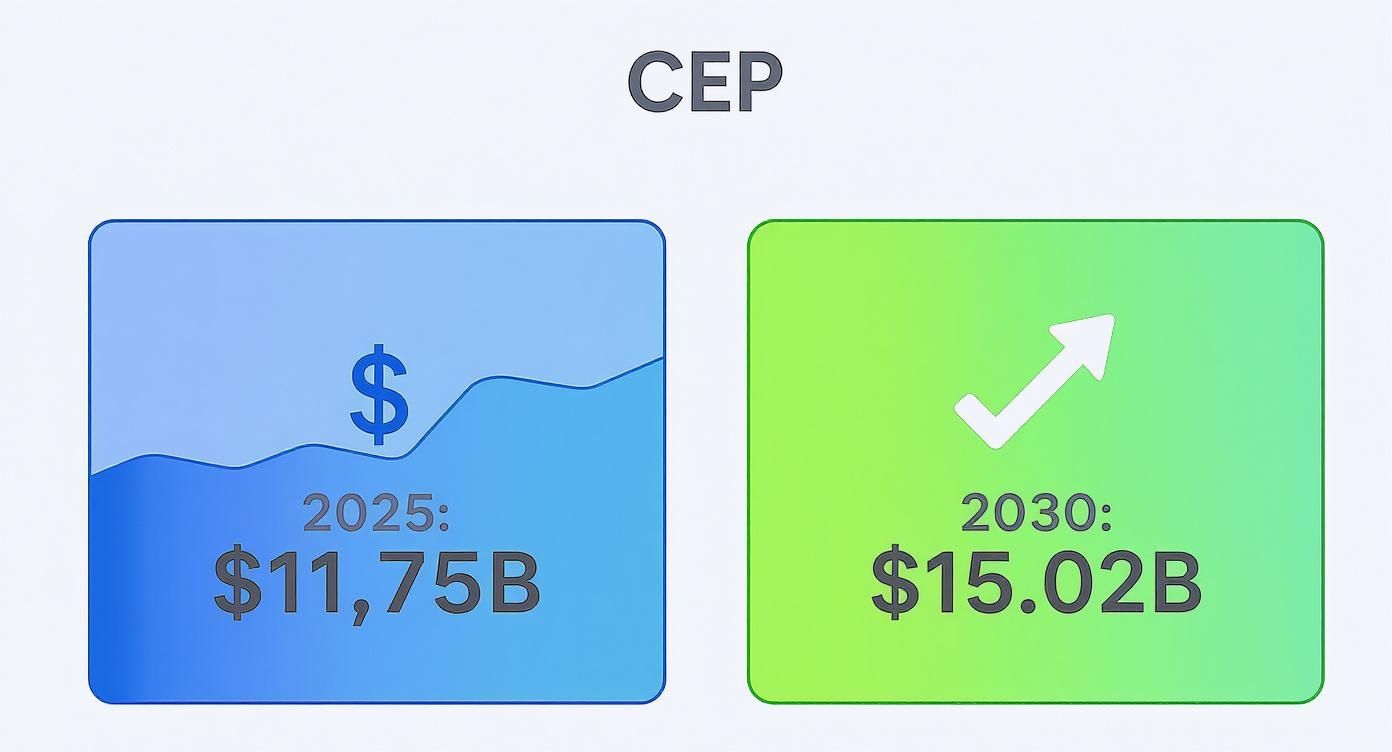
As the market swells by billions between 2025 and 2030, you can bet that both competition and operational costs will heat up, and those changes will trickle right down to the rates you pay per parcel.
Decoding the Cost vs. Quality Trade-Off
So, what’s the real difference between a $7 service and an $11 one? It’s not just a few dollars—it's about the entire delivery experience.
-
Budget Couriers (e.g., Sendle, Aramex): These guys are often the cheapest for a reason. They typically rely on a network of various delivery partners, which can sometimes mean less consistent tracking or slightly longer, less predictable delivery windows. They’re a brilliant choice for non-urgent, low-value items where every cent on the bottom line counts.
-
Established Carriers (e.g., Australia Post, CouriersPlease): Here, you're paying a small premium for a more robust, company-owned network. This usually translates to more reliable tracking, better customer support when things go wrong, and a more predictable delivery timeframe. If your customers value knowing exactly when their parcel will arrive, this extra cost is a smart investment in your brand’s reputation.
The real takeaway here? The "cheapest" courier on paper might not be the best value. A single lost parcel or a string of frustrating delays can cost you far more in customer loyalty than the few dollars you saved on shipping.
Choosing the Right Service Level for Your Shipments
Finally, you need to match the service to the journey. Sending a parcel across town is completely different from shipping it across the country.
When you're comparing prices, make sure you're looking at services designed for long-haul routes. You can find a seriously cheap interstate courier in Australia if you know where to look, as specialised services often provide much better value than the standard options.
Ultimately, your choice has to align with your brand and your customers' expectations. If you're selling premium, high-end products, using a budget courier with patchy tracking can instantly cheapen the experience. On the other hand, if you're a high-volume discount store, shaving even a dollar off every shipment with a no-frills service is just smart business.
How to Optimise Your Parcels and Slash Shipping Costs
Often, the secret to finding the cheapest courier in Australia has nothing to do with the courier themselves. It starts right at your packing bench. The way you pack your items has a massive impact on the final shipping bill, and getting this right is one of the fastest ways to cut your freight costs. A few small tweaks can add up to huge savings over a year.
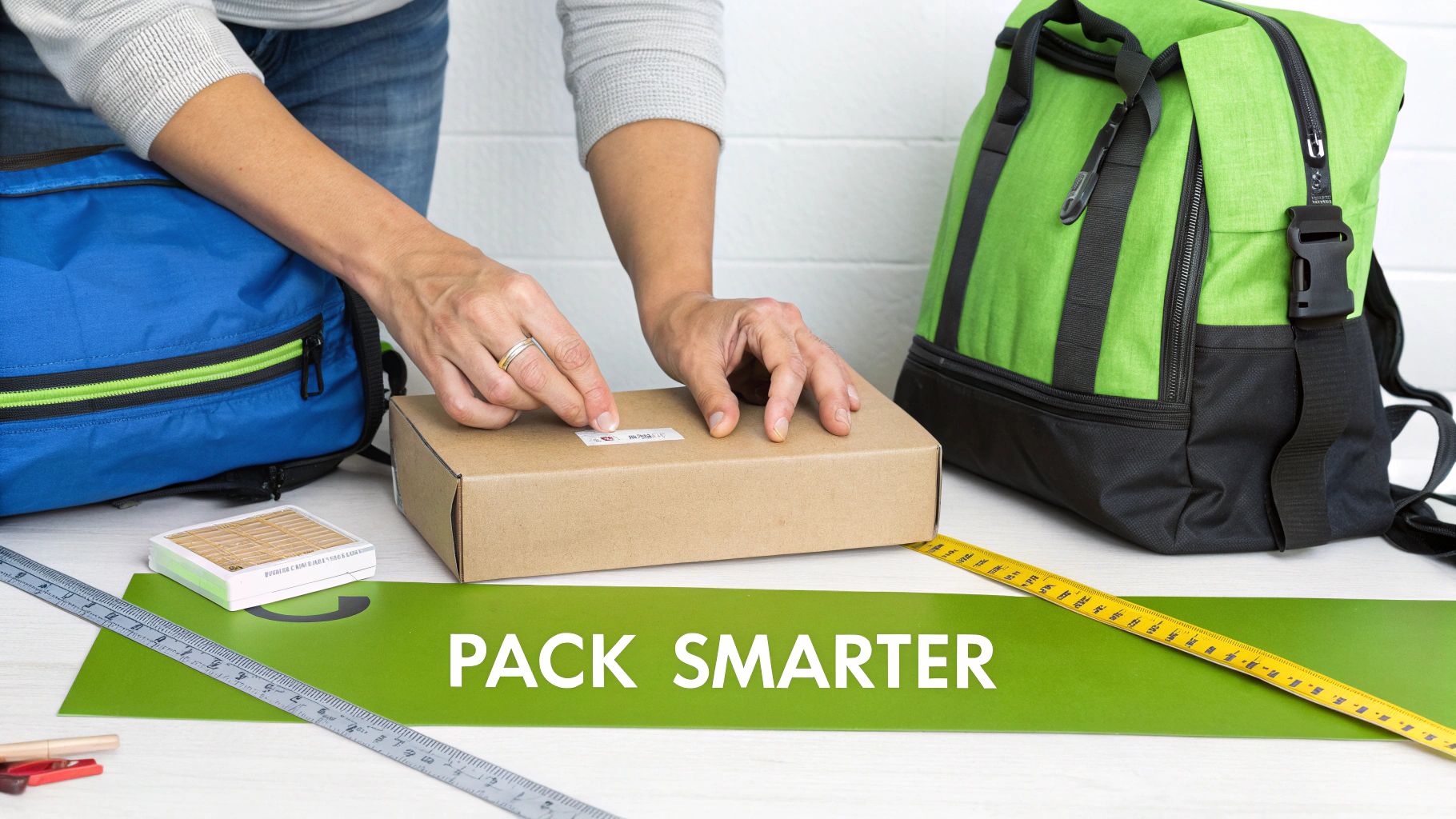
It’s a common mistake to think that shipping costs are all about an item's actual weight. The reality is that couriers use something called dimensional weight (often called cubic weight). They calculate your parcel’s volume, convert it to a weight equivalent, and then charge you for whichever is greater—the actual weight on the scales or this calculated dimensional weight.
This is why a big, light-as-a-feather cushion can cost more to ship than a small, heavy dumbbell. The cushion eats up more precious space in the van. Getting your head around this concept is fundamental to lowering your shipping expenses. For those just getting started and learning how to start an ecommerce business, understanding how shipping impacts your overall budget is a crucial first step.
Master the Art of Cubing
The single most powerful technique you can use is called 'cubing'. It’s simple: use the smallest possible box that will still keep your item safe. Stop reaching for that generic large box and stuffing the empty space with packing peanuts. That void is literally costing you money.
For instance, let's say you send a 1kg item in a 40x30x20cm box. The courier might calculate its dimensional weight as 4.8kg. Now, if you switch to a snugger 30x20x15cm box, the dimensional weight plummets to just 1.8kg. You could cut your shipping cost by more than half for that single parcel, just by choosing a better box.
Think of every centimetre of empty space in your boxes as wasted money. A quick packaging audit—measuring your top 10 products and finding perfectly sized boxes for each—can uncover hundreds or even thousands of dollars in savings per year.
The Satchel Advantage for Smaller Items
For your smaller, non-fragile goods, courier satchels are an absolute game-changer. Their main advantage is that they usually come with a flat-rate price up to a certain weight (typically 1kg, 3kg, or 5kg), no matter where it's going within their standard delivery zones.
- Fixed Cost: You know the exact price upfront. No more complex dimensional weight calculations catching you by surprise.
- Simplicity: There’s no need to measure or weigh every little thing. If it fits and it’s under the weight limit, it ships for one price.
- Speed: Packing becomes much faster, which helps you get more orders out the door each day.
Always ask yourself: "Can this go in a satchel?" If the answer is yes, you've probably just found the cheapest and easiest way to send it.
Choose Smart Packaging Materials
The materials you use do more than just protect your products—they directly affect your shipping costs. Of course, preventing damage is your top priority (because processing returns is a huge cost), but using lightweight materials can trim your expenses even further.
Here are a few practical tips:
- Use lighter void fill: Swap out heavier bubble wrap for air pillows or lightweight recycled paper.
- Select the right box strength: You don't need a heavy-duty, double-walled box to ship a t-shirt. Match the box to the item.
- Do a drop test: A simple drop from waist height onto a hard surface will tell you if your packaging is sufficient without being overkill.
By making these small but strategic changes, you can turn your packing station into a cost-saving powerhouse. For a more detailed look at this, you can explore our full guide on the cheapest way to send a parcel, which dives even deeper into packaging strategies.
Strategic Shipping That Lowers Your Overall Spend
Getting the best price on a single parcel is a great start, but the real, long-term savings come when you zoom out. Stop thinking about shipping on a parcel-by-parcel basis and start looking at your entire logistics picture. It’s this strategic mindset that will seriously cut down your costs over time.
One of the simplest yet most powerful tactics is shipment consolidation. Let's say you're sending five different orders to the same business customer over a week. Instead of five separate shipments, each with its own consignment fee and fuel surcharge, why not group them into one larger weekly delivery?
This one change can dramatically slash your per-item shipping cost. It does take a little coordination with your B2B clients, of course, but the financial upside is massive. You're moving from lots of small, inefficient deliveries to a single, cost-effective one.
Tapping into Bulk Rates Without the Volume
For most small businesses, the idea of getting "bulk rates" feels like a distant dream. The big-name couriers usually reserve their best prices for huge corporations sending thousands of parcels every month. This is exactly where courier aggregator platforms become your secret weapon for finding the cheapest courier service.
These platforms bring together the shipping volume of thousands of small businesses, creating a massive pool of collective buying power. This allows them to negotiate fantastic commercial rates with the carriers, which you get access to.
- No Minimums: You benefit from discounted rates from your very first shipment.
- Carrier Choice: Instantly compare pre-negotiated prices from a range of couriers on one screen. You can always pick the best deal for that specific parcel.
- Time Savings: Forget juggling multiple logins and invoices. You get one central dashboard to quote, book, and track everything.
Think of a courier aggregator as a giant buying group for freight. You immediately get the pricing power of a major corporation without needing to ship massive volumes yourself. It completely levels the playing field and puts money straight back into your business.
Navigating Surcharges Proactively
Nothing blows a shipping budget faster than unexpected surcharges. In Australia, the most common culprits are fees for regional and remote deliveries, which can easily add 30% or more to your initial quote. Don't wait for them to show up on your invoice; get ahead of them.
Before you finalise a quote for a customer, check their postcode. A good shipping platform will flag potential surcharges upfront. If you find you're sending a lot of goods to regional postcodes, it’s worth finding a carrier that has a strong network in those areas or offers better pricing for remote deliveries. A little bit of proactive planning here goes a long way in protecting your profit margins.
To really get your total shipping spend under control, you need to tie it back to your finances. You can learn more about effective small business bookkeeping tips to see how it all connects. By consolidating shipments, using smart platforms, and planning for surcharges, you’re no longer just sending parcels—you’re running a sharp, cost-effective logistics operation.
Urgent Deliveries: How to Balance Speed and Cost
We've all been there. A customer needs an order yesterday, and suddenly the hunt for the cheapest courier feels like a luxury you can't afford. But frantic, last-minute shipments don't have to decimate your profit margins. It's all about understanding what you're paying for when you dial up the speed.
Your standard, everyday shipping is fine for most orders, but when the clock is ticking, you’re looking at express services. Yes, they come with a higher price tag, but it’s not just about getting from Point A to Point B faster. You're paying for a higher tier of service and reliability.
Think about it: a standard delivery might have vague, once-a-day tracking updates. An express service, on the other hand, often throws in real-time GPS tracking, signature on delivery, and dedicated support lines. Those extras provide the peace of mind you and your customer desperately need when a delivery is time-critical.
What You're Really Paying for with Express and Same-Day Delivery
The cost of urgency can swing wildly, especially in major metro areas. If you look at the pricing for same-day and next-day couriers in a city like Melbourne, you’ll see it’s a different ball game.
For a same-day delivery, a small parcel under 3 kg will typically set you back $35 to $55. Got something heavier, say 10-25 kg? That can jump to $65 to $95. Those premium rates cover things like a dedicated vehicle and guaranteed proof of delivery—features you simply won't get with the budget options. For a closer look at the numbers, this breakdown of Melbourne's courier costs is a great resource.
Knowing these price brackets helps you make a call on the fly. Is the situation worth an extra $40? Sometimes, it absolutely is. But you might find that a next-day service is a fraction of the cost and still gets the job done for your customer.
The real trick is to avoid defaulting to the most expensive option in a panic. Always take a moment to compare the price jump between standard, express, and direct same-day services. You’ll often find that the 'next business day' option hits the sweet spot between speed and affordability.
Making the Smart Choice Under Pressure
So, how do you decide when to splash the cash on speed? Here’s a quick way to think it through:
- What's the real urgency? Is it a genuine business-critical emergency, like a replacement part to get a machine running? Or is it more of a customer preference? This alone should tell you whether a premium same-day service is truly necessary.
- Compare the service tiers. Don't just get a quote from one courier. Jump on a comparison platform to see multiple express options side-by-side. This is the fastest way to spot the best value in a hurry.
- Consider the 'premium' perks. For high-value goods, the added security from signature on delivery and better tracking isn't just a nice-to-have. It's insurance against loss or disputes, and that alone can be worth the extra cost.
By quickly running through these points, you can confidently pick a service that hits the deadline without you having to overpay. It’s a strategic move that keeps your customers happy and your bottom line healthy.
Your Top Questions About Finding Australia's Cheapest Courier Service Answered
When you're trying to get your shipping costs down, a lot of questions pop up. Let's tackle some of the most common ones we hear from Australian businesses trying to ship smarter without sacrificing quality.
Can a Small Business Really Negotiate Courier Rates?
Yes, you absolutely can, but it all comes down to one thing: volume.
If you’re just starting out and sending a handful of parcels each week, going direct to the big carriers for a special rate is usually a dead end. This is precisely where courier aggregator platforms are a game-changer. They bundle the shipping volume from thousands of small businesses like yours, giving you access to commercial discounts you could never secure on your own.
Once your business starts to scale and you're consistently sending, say, over 50 parcels a week, the tables turn. At that point, you’ve got enough volume to be interesting to the couriers directly. That's your cue to open a business account and start talking about a custom pricing structure.
Is the Cheapest Courier a Smart Choice, or a Risky One?
Honestly, it's rarely the best choice. That rock-bottom price tag often hides some serious compromises—think slower delivery times, vague tracking, and bare-bones insurance. A single lost or delayed parcel can easily trigger a bad review, and a lost customer costs far more than the few dollars you saved on postage.
The real goal is to find the sweet spot between affordability and reliability. A great strategy is to give your customers options at the checkout. Offer a super-economical standard service alongside a slightly pricier express option for those who need speed and peace of mind.
Your delivery partner is the final touchpoint a customer has with your brand. Choosing a cheap, unreliable courier can sour the whole experience, undoing all the hard work you put into your product and service.
How Do I Dodge Those Sneaky Shipping Surcharges?
In Australia, the most common surprise fees usually stem from a few predictable things:
- Regional & Remote Surcharges: Sending a parcel to anywhere outside a major metro area can attract an extra fee.
- Oversized & Heavy Parcels: Every carrier has strict limits. Go over their standard dimensions or weight, and you'll get hit with a penalty.
- Failed Deliveries: If the courier shows up and can't deliver the parcel, you might be charged a 'futility fee' for their time and fuel.
The best defence is a good offence. Always use an online quote tool to punch in the destination postcode before you ship to check for regional fees. Be meticulous about measuring and weighing your parcels, and always double-check the customer's address details. A good aggregator platform is often better at flagging these potential costs upfront, so you aren't left with a nasty shock on your invoice.
What’s the Absolute Cheapest Way to Send Small Items?
For anything under 500g, it’s tough to beat Australia Post’s domestic tracked letters. But for parcels up to 5kg, satchels are your best friend.
Whether you're sending across the city or across the country, a satchel usually has one flat price. This is brilliant because it protects you from complicated weight-based calculations and those pesky regional surcharges. Before you grab a box, always ask: "Can this fit safely in a satchel?" It's one of the simplest and most powerful hacks for locking in the cheapest courier rate for your smaller products.
Ready to stop overpaying for shipping? Aeros Couriers gives you instant access to discounted rates from Australia's top carriers with no account fees or minimums. Get an instant quote, compare your options, and book your next shipment in minutes. Find your cheapest rate today at https://www.aeroscouriers.com.au.
