


Getting a handle on your shipping costs is crucial, and it all boils down to four key things: the weight of your package, its size, how far it's going, and how fast you need it to get there. At Aeros Couriers, just like with any courier in Australia, these are the fundamentals that shape your final parcel postage costs.
The Building Blocks of Every Shipping Quote
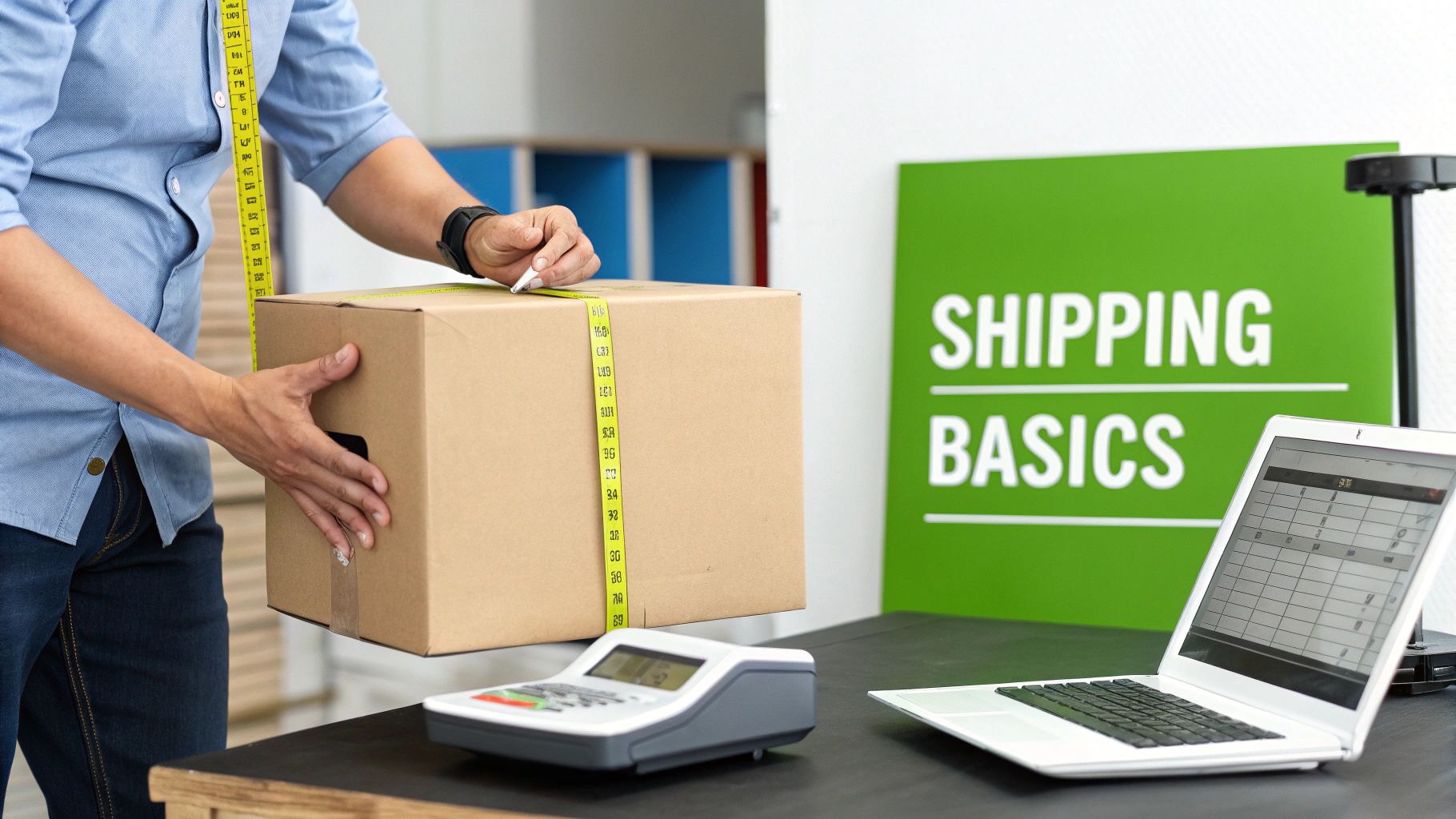
Before you can even think about getting a quote, you need to have a few details ready. Think of these as the non-negotiable building blocks of your shipping price. If you get these wrong, even by a little, you risk getting hit with surprise fees or undercharging your customers, which eats directly into your profit.
It always starts with the physical reality of your package. This is the first step for every courier out there and lays the groundwork for the entire calculation.
Start with Weight and Dimensions
The two most important pieces of the puzzle are your parcel’s actual weight and its exact dimensions—length, width, and height. It’s absolutely vital to be precise here because these numbers decide whether you’re charged for how heavy the item is or how much space it takes up in the van.
A common mistake I see is people guessing the weight or just using the product’s weight before it’s packed. Always, always weigh the final, sealed box. A small difference of a few hundred grams can easily bump your parcel into a more expensive shipping bracket.
For example, a pair of dumbbells is heavy but doesn’t take up much room, so the cost will be based on its actual dead weight. On the flip side, something like a large decorative pillow is light as a feather but bulky. This kind of item will almost certainly be charged based on its size, which we in the industry call volumetric or cubic weight.
Knowing exactly what you're shipping is the first step to accurately calculating your costs. This mindset also helps with the bigger picture; for instance, implementing effective inventory management strategies can make your entire operation run more smoothly.
Factoring in Distance and Speed
With your package measured and weighed, the next major factor is the journey it’s taking. Couriers in Australia operate on a zone system based on postcodes. Sending a package from your warehouse in Sydney to a customer in a neighbouring suburb is a simple, local zone delivery—and pretty cheap.
But send that exact same parcel to a remote town in Western Australia? Now you’re crossing multiple zones, and the base rate is going to jump up significantly.
Finally, the delivery speed you offer your customers will have a direct impact on the price tag. The choice is usually straightforward:
- Standard Delivery: This is your most budget-friendly option, with a typical transit time of 3-7 business days.
- Express Post: A step up in speed, getting parcels delivered in 1-3 business days. It's the go-to for more time-sensitive items.
- Same-Day Service: The premium choice for urgent, metro-area deliveries that absolutely have to arrive within hours.
Getting comfortable with these four elements—weight, size, distance, and speed—is how you start to master your shipping costs. It gives you the power to set clear pricing, earn your customers' trust, and ultimately protect your bottom line from avoidable mistakes.
Mastering Volumetric Weight Calculations
Ever been stumped by a shipping quote? You send a big, light box and the cost is way higher than expected. Then you ship a small, heavy one, and the price seems more reasonable. This isn't a mistake; it's all down to something called volumetric weight.
In the world of logistics, space is money. Couriers charge for how much room your parcel takes up in their van or plane, not just what it weighs on the scales. This is where volumetric weight (also called dimensional or cubic weight) comes in.
When your parcel gets priced, the courier looks at two numbers: its actual weight (what the scales say) and its volumetric weight. You'll always be charged based on whichever figure is higher. Getting your head around this is the single best way to avoid those nasty, margin-killing surprises on your shipping invoices.
The Core Formula Explained
Calculating volumetric weight is pretty simple once you see the formula. It's a standard across the Australian courier industry, so the method is consistent.
All you need are the three dimensions of your packed box:
- Length (in centimetres)
- Width (in centimetres)
- Height (in centimetres)
Here’s the formula: (Length x Width x Height) / Cubic Conversion Factor = Volumetric Weight (kg).
That cubic conversion factor is the crucial part. For most couriers in Australia, including Aeros Couriers, this number is 5000.
Let's say you're sending a parcel that measures 50cm x 40cm x 30cm. The maths would be (50 x 40 x 30) / 5000, which gives you a volumetric weight of 12 kg.
This is where it gets interesting. If that same 50x40x30cm box just had a puffer jacket inside and only weighed 2 kg on the scales, you'd still be charged for a 12 kg shipment. Why? Because its volumetric weight is the higher number. This is the detail that catches so many businesses out.
Real-World Scenarios
To see how this plays out, let's look at a couple of common examples.
Imagine you're shipping a compact set of 10 kg dumbbells. The box is small, maybe 30cm x 20cm x 15cm. The actual weight is 10 kg. Its volumetric weight is (30 x 20 x 15) / 5000 = 1.8 kg. In this scenario, you're charged for the 10 kg actual weight because it's greater. Simple enough.
Now, let’s say your next shipment is a large, framed art print. It's fragile, so it’s in a big, protective box measuring 80cm x 60cm x 10cm. The whole thing only weighs 3 kg. But when we run the numbers—(80 x 60 x 10) / 5000—we get a volumetric weight of 9.6 kg. So, you'll be charged for 9.6 kg, making the shipment cost over three times more than you'd expect based on its actual weight alone.
This is why you can’t just guess. To really understand the difference, have a look at this table. It breaks down how the final chargeable weight is decided for a few different items.
Actual Weight vs Volumetric Weight Scenarios
| Item Example | Actual Weight (kg) | Dimensions (cm) | Volumetric Weight (kg) | Chargeable Weight |
|---|---|---|---|---|
| Set of Dumbbells | 10.0 | 30 x 20 x 15 | 1.8 | 10.0 kg |
| Framed Art Print | 3.0 | 80 x 60 x 10 | 9.6 | 9.6 kg |
| Box of Pillows | 2.5 | 50 x 50 x 50 | 25.0 | 25.0 kg |
As you can see, bulky but light items like pillows can have a massive volumetric weight compared to their actual weight.
The takeaway here is simple: measure everything. By taking a moment to calculate the volumetric weight before you ship, you can predict your costs with complete accuracy. This small step keeps your budget on track and your pricing competitive. No more invoice shock.
Navigating Australia's Shipping Zones
Australia is a massive country, and that size brings some unique hurdles for logistics. You might not realise it, but a parcel sent from Sydney to Perth travels further than one going from London to Moscow. To make sense of these huge distances, couriers divide the country into shipping zones, a concept you absolutely need to get your head around to accurately calculate shipping charges.
This isn't just some random map-drawing exercise. It's a structured system built around postcodes. The simple rule is: the more zones a package has to cross to get from A to B, the more it's going to cost. A local delivery in the same city might never leave Zone 1, which is always the cheapest. But send that same parcel to a regional town, and you could be crossing into Zone 4 or 5, bumping up the price considerably.
Why Zones Matter for Your Business
Getting a handle on the zone system is a game-changer for building a smart and sustainable pricing strategy. If your warehouse is in Melbourne, for example, you need to know exactly which postcodes are local, which are regional, and which are considered remote. This insight is what allows you to give customers accurate, real-time shipping quotes at checkout, stopping those nasty, unexpected costs from eating into your profits.
Think about it: offering a single flat rate across Australia might feel easy, but it can be a financial nightmare. You’ll find yourself massively subsidising shipments to remote parts of Western Australia while possibly overcharging your customers just a few suburbs away. A zone-based model keeps things fair for you and your buyers.
Getting your zones right is really about managing customer expectations. Someone in a regional town expects shipping to cost a bit more, but they need to see that cost upfront and clearly, not as a nasty surprise after they’ve already committed to the purchase.
Setting Up Zone-Based Shipping
The good news is that most modern e-commerce platforms are designed to manage this kind of complexity. Whether you're on Shopify, WooCommerce, or another major platform, you can set up shipping rules based on postcode ranges.
You can get quite granular with it. For instance, you could set up rules like:
- Local Delivery: A low, flat rate for all postcodes within a 50km radius of your dispatch location.
- Metro Centres: A standard rate that covers the major capital city postcodes in different states.
- Regional & Remote: Higher, calculated rates for everything else, making sure those long-haul deliveries are properly costed.
Before you can even apply zone pricing, you have to know which weight to charge for—the actual weight or the volumetric weight. This is the first, most crucial step.
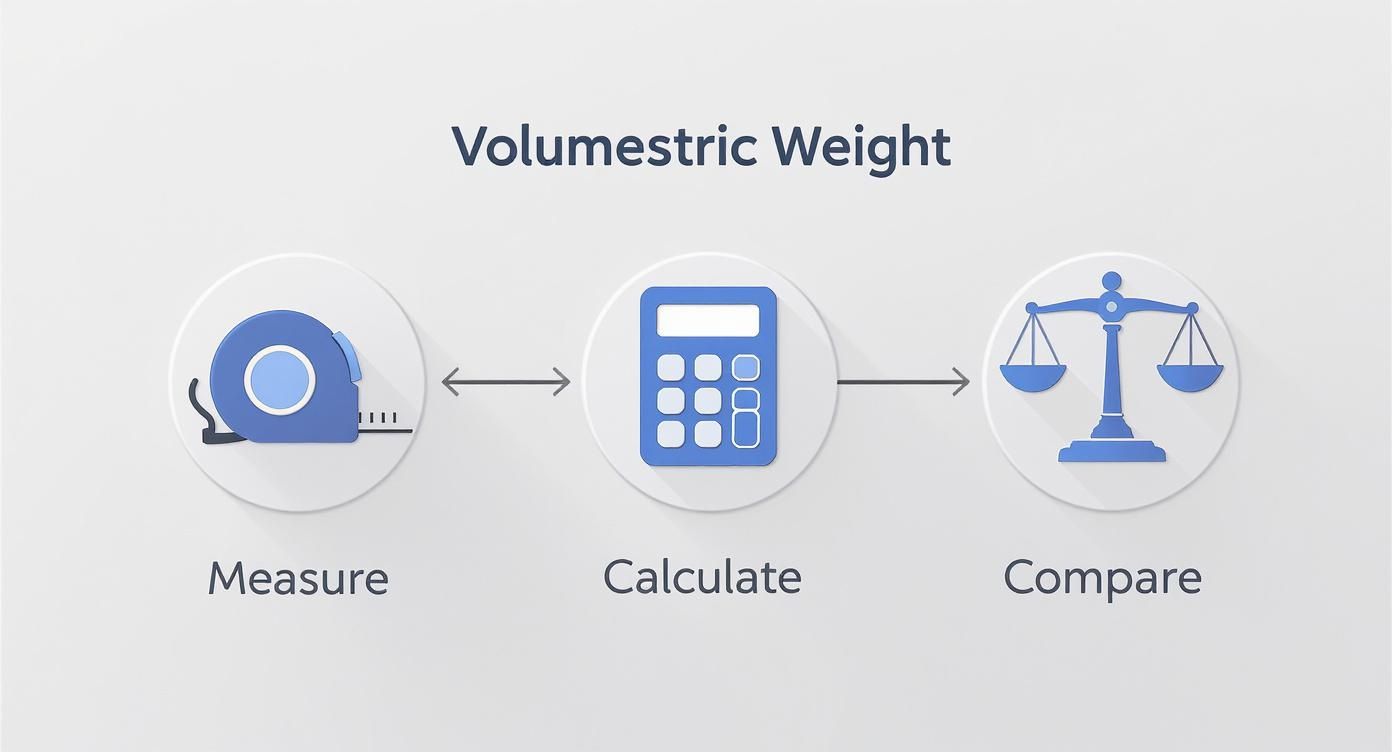
This process is so important because couriers will always use the higher of the two weights (actual vs. volumetric) to figure out the base rate. Only after that do they add the charges for the distance and zones crossed.
For anyone sending parcels across state lines, it pays to shop around for a carrier that hits the sweet spot between price and reliability. If you need a hand, our guide on finding a cheap interstate courier in Australia is packed with practical advice. This domestic zone system is essential for any business shipping within our borders.
Getting to Grips with Surcharges and Hidden Fees
That first shipping quote you get? Think of it as the base price. The final invoice you receive can sometimes look quite different, and that's usually down to a bunch of surcharges and extra fees that catch many businesses by surprise. Getting your head around these potential costs is the best way to protect your profit margins from any nasty shocks.
These fees aren't just plucked out of thin air. They’re how couriers cover the costs for anything that falls outside of a straightforward, point-A-to-point-B delivery. Once you know what they are, you can either factor them into your pricing from the start or tweak how you ship to sidestep them completely.
The Usual Suspects: Common Surcharges
One of the most frequent add-ons you’ll see is the fuel levy. This isn’t a fixed fee; it moves up and down with global fuel prices. That means the cost to send the very same package can actually change from one month to the next. It’s a standard part of the logistics game, especially in a country as big as Australia.
You'll also run into charges for specific delivery situations:
- Residential Delivery Fee: Dropping a parcel at a home address often costs a bit more than delivering to a business, simply because residential routes are typically less direct and efficient for drivers.
- Special Handling: Got something fragile, unusually shaped, or that needs to be kept upright? You can expect to see a fee for the extra care and attention required.
- Oversized & Overweight Penalties: This is a big one. If your package goes over the courier's maximum weight or size limits, you'll get hit with some pretty hefty penalty fees.
These kinds of charges really show how domestic shipping prices in Australia are shaped by wider operational realities. For instance, you only have to look at recent industry-wide price changes—like the updated Express Post satchel pricing, now ranging from AUD 13.05 for extra small up to AUD 32.30 for extra large—to see the impact of fuel and labour costs. It’s a clear signal that a parcel’s dimensions are becoming just as important as its weight when calculating the final cost.
Why Failed Deliveries Are a Drain on Your Business
The most irritating—and most preventable—fee has to be the futile delivery charge. This is the penalty the courier applies when they try to deliver a package but can't for some reason, like no one being home to sign for it or a dodgy address.
A single futile delivery fee might not seem like a big deal, but if you’re an e-commerce store sending hundreds of parcels a week, those small charges can snowball into thousands of dollars in lost profit each year. It’s a silent killer for your bottom line.
The good news is that this is one area where you’re firmly in control. A simple but effective fix is to use address verification tools before you even print the label. Another great tactic is offering an 'Authority to Leave' (ATL) option. This gives the driver permission to leave the parcel in a safe spot without needing a signature, which pretty much wipes out the risk of this fee. A little bit of proactive work here will always be cheaper than dealing with the costs later.
Getting Smart with Shipping Calculators and Platforms

Let's be honest, manually working out the postage for every single order is a tedious job. More than that, it’s a recipe for costly mistakes. Thankfully, you can ditch the guesswork and use technology to get fast, accurate shipping costs, freeing you up to actually focus on growing your business.
Using the right tools is the difference between an efficient, streamlined shipping process and one that’s a constant source of headaches. It gives you the accuracy you need to protect your profit margins on every single parcel you send out the door.
Popping Your Details into an Online Courier Calculator
The most straightforward way to get a quick price is to use the free online calculators that most major Aussie couriers offer. They're built for getting one-off quotes and are incredibly simple to use. All you need are the core details you've already gathered.
To get an instant price, you'll usually be asked for:
- Origin and Destination Postcodes: This tells the system the shipping zones and distance.
- Package Weight: The final, packed weight of your item in kilograms.
- Package Dimensions: The length, width, and height in centimetres.
A great example is the Australia Post Postage Calculator. You just plug in these details, and it spits out all the available service options and what they'll cost. It’s a fantastic starting point for checking a single price.
Of course, if you're looking for a quick, no-fuss price check specifically for your business shipments, you can always get an instant quote from Aeros Couriers to see how our rates stack up.
Why Integrated Shipping Platforms Are a Game-Changer
While those individual calculators are handy for a quick look, integrated shipping platforms are where the real magic happens for any serious e-commerce business. Tools like Shippit or Starshipit are designed to plug directly into your online store—whether that’s Shopify, WooCommerce, or another major platform—and automate your entire fulfilment process.
This is where you’ll see massive gains in efficiency. These platforms do much more than just calculate costs; they become the command centre for your whole shipping operation.
The moment a customer places an order on your site, these platforms get to work. They automatically pull the customer’s details, grab the product weights and dimensions, and instantly compare live shipping rates from a bunch of different Australian couriers. This isn't just about saving a few minutes; it's about making sure you get the best possible price for every single parcel.
Think about it. An order for a small, lightweight item heading to a metro address might be cheapest with Sendle. But a bigger, bulkier package going to a regional town could be far more cost-effective with another carrier. A shipping platform figures this out for you in seconds, picking the best service based on rules you’ve already set up.
From there, you can print shipping labels in one click and automatically fire off the tracking information to your customer. This level of automation doesn't just cut down on human error. It turns your shipping from a necessary expense into a real strategic advantage that keeps customers happy and directly helps your bottom line.
Frequently Asked Questions About Shipping Calculations
When it comes to figuring out shipping costs, a few questions pop up time and time again. Getting these sorted will help you build a smarter, more transparent shipping strategy that keeps your budget in check and your customers happy. Let's dive into some of the most common queries we hear from businesses around Australia.
Should I Use Flat-Rate or Calculated Shipping?
This is probably the biggest question on everyone's mind.
Flat-rate shipping is brilliant for its simplicity. Your customers see a single, predictable fee at checkout, which can be a great way to encourage them to buy more without worrying about the shipping cost creeping up. It's the perfect fit if your products are all roughly the same size and weight.
On the other hand, calculated shipping gives you precision. It figures out the exact cost based on the parcel's weight, dimensions, and where it's headed. This method is often fairer for both you and your customer, as it means you won't overcharge for a small item going just down the road or, more importantly, lose money shipping a bulky order to a remote postcode.
How Do I Handle the Cost of Returns?
Returns are just a part of doing business online, but they don't have to be a financial headache.
The best way to manage them is by using a shipping platform that lets you generate return labels on demand. This gives you control, allowing you to set clear rules, like deducting the return postage cost directly from the customer’s refund if that’s part of your policy.
A simple, no-fuss returns process builds incredible trust. Even if the customer is paying for the postage, making it easy for them is a game-changer. Be sure to outline your returns policy clearly on your website, explaining who covers the shipping fees, so there are no surprises.
What About Packaging Costs?
This one is so easy to forget! Your shipping charge needs to cover more than just what the courier charges you.
It's crucial to factor in the cost of everything that goes into getting an order out the door—from the boxes and mailer bags to the tape and bubble wrap. A lot of businesses will either add a small handling fee to their calculated rates or absorb these expenses into their product pricing to make sure every little cost is covered.
Ready to take the guesswork out of your shipping? Aeros Couriers provides instant quotes, multi-carrier options, and a simple dashboard to manage all your local and Australia-wide shipments. Book your next delivery in minutes at https://www.aeroscouriers.com.au.
