



For any Australian business, finding the right courier is about more than just getting a package from A to B. It’s a fundamental part of your customer experience and the backbone of your operations. The courier you choose is a direct reflection of your brand's promise, ensuring your products arrive safely and on schedule. It really comes down to finding that sweet spot between speed, cost, and rock-solid reliability for shipping within Australia.
Finding Australia's Best Courier Service for Your Needs
Navigating Australia’s crowded shipping market can feel like a huge task. But this isn’t just another box to tick on your logistics checklist; it’s a decision that has a real impact on your reputation and your bottom line. After all, one late or damaged parcel can instantly erode the customer trust you've worked so hard to build.
This guide is designed to cut through the noise of generic 'top 10' lists. Instead, we’re providing a practical framework to help you choose the best courier company based on what your business actually does day-to-day within Australia. The ideal partner for you depends entirely on your unique operational needs.
Key Differences in Australian Courier Services
Every local courier brings something different to the table. Think about it: a small e-commerce boutique shipping delicate, handmade goods from a Melbourne studio has completely different requirements than a national B2B supplier sending pallet freight to regional WA. Getting a handle on these nuances is the first, most important step.
As you start your research, it’s worth thinking about what makes for effective shipping solutions for a simpler e-commerce routine. This often boils down to how well a courier’s service offering aligns with your specific products and the expectations of your Australian customers.
| Feature | Large National Carrier (e.g., AusPost) | Specialised Local Courier (e.g., Aeros) |
|---|---|---|
| Primary Strength | Unmatched national and rural network coverage. | Cost-effective metro and interstate services. |
| Best For | Businesses needing to reach every corner of Australia. | High-volume urban e-commerce and B2B freight. |
| Flexibility | Standardised services, less room for customisation. | More agile with flexible pickup and delivery options. |
| Support | Often relies on large call centres and online portals. | Direct access to local, responsive support teams. |
The "best" courier is not a one-size-fits-all solution. It's the one whose capabilities perfectly match your shipping profile, budget, and brand promise, ensuring every delivery strengthens your customer relationships.
Ultimately, the goal is to find a truly reliable courier that feels like a natural extension of your own team. This guide will walk you through how to properly assess providers on the things that matter—delivery speed, network reach, and specialised handling—so you can lock in a partnership that helps your business thrive.
A Look at the Australian Courier Landscape
Before you can pick the right courier, you need to get a feel for the market itself. The Australian shipping industry is constantly shifting, influenced by everything from broad economic trends to the specific shopping habits of your customers. Getting your head around these forces is the first step to making a smart choice for your business.
The biggest shake-up has been the massive, ongoing boom in ecommerce. This flood of online shopping has sent parcel volumes through the roof, creating intense competition between the big national players and the smaller, more nimble local couriers. For a business, this is both a blessing and a curse; you have more options than ever, but it’s also harder to cut through the noise and find a partner you can truly count on.
What Customers Expect Now
These days, customers don’t just want their parcels dropped off; they demand speed and complete transparency. Same-day or next-day delivery used to be a luxury, but now it's fast becoming the standard, especially in the major cities. Couriers are scrambling to keep up, and the smart ones are investing heavily in technology to meet these new expectations.
This tech investment is happening in a few key areas that directly affect your customers:
- Real-Time Tracking: Live updates from the moment a parcel is picked up to its final destination are no longer just a nice perk. They're essential for keeping customers happy and cutting down on those "where is my order?" phone calls.
- Route Optimisation: Sophisticated software is helping couriers plan smarter, more efficient delivery routes. This translates to quicker delivery times and, hopefully, better control over costs.
- Proof of Delivery: Digital signatures and photo confirmations give both you and your customer peace of mind, confirming the job is done right every single time.
A courier’s tech stack is a huge differentiator. The ones with modern systems are simply better placed to give you the visibility and efficiency a modern business needs.
A courier's commitment to technology is a great sign of their long-term viability. Those who invest in things like route optimisation and live tracking are setting themselves up to handle market shifts and keep customers happy, no matter what comes next.
Dealing with Costs and a Volatile Market
While technology is improving service, economic factors can throw a spanner in the works. Fuel surcharges are a perfect example. As fuel prices bounce around, these surcharges can have a real impact on your final shipping bill. It's vital you understand how a potential courier calculates and communicates these extra fees. A good starting point is to explore different postal and parcel rates to see how these costs are broken down.
This growth and complexity is reflected across the entire sector. The Australian Courier Pick-up and Delivery Services industry is a huge market, tipped to be worth around AUD 13.7 billion by 2025. According to IBISWorld.com, it's been expanding at a compound annual growth rate of 8.5% for the last five years, almost entirely off the back of ecommerce. This shows just how much pressure—and opportunity—exists in the industry right now.
How to Evaluate Australian Courier Services
Choosing the right courier isn't just about finding the cheapest rate. It’s a strategic decision. To pick a partner that will genuinely support your business in Australia, you need a solid framework that gets past the marketing fluff and looks at what really matters for reliable shipping.
First things first, let's talk speed. Every courier offers a standard road service, but that's just the baseline. The real test is in their premium options. Look closely at their express and same-day services. What are the cut-off times? Are they guaranteed? And crucially, which specific metro areas are actually covered? These details make all the difference.
Assessing Network Coverage and Reach
A courier's network is everything. Their reach directly affects your ability to get products to your customers, so don't just accept a vague "national coverage" claim at face value. You need to dig into the details, especially if your customers are spread out beyond the big cities.
Here are the questions I always ask when vetting a courier's network:
- Regional Strength: How far into regional and rural Australia do they really go? Find out if they use third-party agents for these deliveries, as this can often lead to delays and frustrating tracking black spots.
- Metro Density: In major hubs like Sydney, Melbourne, and Brisbane, how well-established is their presence? A dense network is non-negotiable if you plan on offering services like same-day delivery.
- Remote Area Surcharges: Ask for a list of postcodes they consider "remote." Getting hit with unexpected fees for these deliveries can wreck your shipping budget.
A quick way to get a feel for this is to use an online tool to calculate shipping charges for a few of your most common metro and regional postcodes. This simple exercise often reveals a lot about a provider’s pricing strategy and where their network is strongest.
Scrutinising Tracking and Insurance
Let's be honest, in today's world, tracking isn't a bonus feature—it's an absolute necessity. A clunky tracking system just creates anxious customers and more work for your support team. When you're looking at a courier, demand to see their tracking portal. You want live, real-time updates that give you genuine visibility from the moment a parcel is scanned at pickup.
A courier's tracking technology is a direct reflection of their investment in customer satisfaction. Granular, real-time updates not only keep your customers informed but also reduce the operational burden on your own support staff.
Insurance is another area where you have to read the fine print. Most services will include some basic liability cover, but it’s usually capped at a pretty low value, often just $100. If you're shipping anything valuable, that's simply not going to cut it. You need to know exactly how much it costs to purchase extra cover and what the process is. Pay close attention to exclusions—fragile items, electronics, and even liquids are often not covered, so be sure you know the deal before you sign up.
Evaluating Specialised Service Capabilities
Finally, you have to match the courier’s capabilities to what your business actually sells. It’s a common mistake to assume all couriers can handle all types of freight, but that assumption can lead to damaged stock and serious compliance headaches.
Does your business need any of these specialised services?
- Refrigerated Transport: If you sell perishable goods, you need a partner with a proper cold chain logistics network. No exceptions.
- Dangerous Goods Handling: Shipping things like batteries, certain chemicals, or aerosols? Your courier absolutely must be certified and compliant with the Australian Dangerous Goods (ADG) Code.
- Pallet and Bulk Freight: For large or heavy items, you’ll need a courier with tailgate lift trucks and the right equipment to manage oversized freight without a fuss.
Picking the right partner comes down to this kind of systematic evaluation. By working through these key areas—speed, coverage, technology, insurance, and specialised services—you’ll get a much clearer picture of which courier is truly the best fit to help your business grow.
To help structure your decision, I’ve put together a simple scorecard. It’s a practical way to compare potential partners side-by-side and weigh what’s most important for your specific operation.
Courier Evaluation Scorecard for Australian Businesses
Use this rubric to score potential couriers against the criteria most important to your operations.
| Evaluation Criterion | What to Look For | Importance Weighting (1-5) | Courier A Score (1-10) | Courier B Score (1-10) |
|---|---|---|---|---|
| Pricing & Value | Transparent rates, minimal surcharges, value for money. | |||
| Network Coverage | Strong metro density, reliable regional/remote reach. | |||
| Delivery Speed | Reliable standard, express, and same-day options. | |||
| Tracking Technology | Real-time, user-friendly portal, proactive notifications. | |||
| Insurance Options | Adequate standard cover, affordable extra cover options. | |||
| Customer Support | Responsive, Australian-based, easy to contact. | |||
| Specialised Services | Handles dangerous goods, pallets, or refrigerated items if needed. | |||
| Pickup Reliability | Consistent and timely parcel collection from your location. |
By scoring each provider against your weighted criteria, you can move beyond a gut feeling and make a data-driven choice. This process ensures the courier you select is a true partner, equipped to handle your needs today and scale with you tomorrow.
Comparing Australia's Top Local Courier Companies
Now that we have a solid evaluation framework, it’s time to put Australia’s leading domestic couriers under the microscope. My goal here isn't to declare a single winner. Instead, it's about figuring out which service is genuinely the best courier company for your specific business. After all, a high-volume e-commerce retailer has completely different needs than a law firm sending urgent documents across town.
This comparison goes deeper than just listing generic pros and cons. We'll look at the key players through the lens of real-world business scenarios, focusing on what really matters: speed, coverage, and specialised capabilities.
The National Carrier: Australia Post
As the national postal service, Australia Post really is in a league of its own. Its greatest strength is its incredible network reach, making it the go-to for businesses that need to get parcels to every single corner of the country, from a bustling CBD to the most remote regional outposts.
Australia Post still dominates the domestic delivery scene, delivering a record-breaking 102.8 million parcels in the 2025 financial year. That figure is up 2.6% from the year before, which just goes to show its vital role in Australia's booming e-commerce world.
If you're an e-commerce business selling low-to-mid value items to customers spread far and wide, Australia Post is often the most practical place to start. Its flat-rate satchels and vast network of post offices for drop-offs and collections offer a level of nationwide convenience that private couriers find tough to beat.
The Franchise Model: Aramex (Formerly Fastway)
Aramex works on a franchise model, meaning local courier franchisees own and operate their own territories. This structure creates a pretty different service dynamic. The big advantage is often found in cost-effective metro deliveries, which is why it's a popular choice for businesses with a lot of customers in major cities.
But the franchise system means that the quality of service can be a bit of a mixed bag, varying from one area to another. A business in Sydney might rave about their local Aramex driver, while a similar business in Perth could have a totally different experience. It pays to do your homework here; I'd always recommend speaking with other local businesses to get their take on the franchisee in your specific area.
For something like a subscription box company shipping a large number of parcels within one capital city, Aramex can be a very competitive option. Their pricing for standard metro runs is often some of the sharpest in the market.
A courier's operational model directly shapes its service profile. Australia Post's corporate structure ensures standardised national service, while Aramex's franchise system offers localised expertise that can be a major asset—or a point of inconsistency.
The chart below helps visualise how these different models stack up against our core criteria of speed, coverage, and tracking.
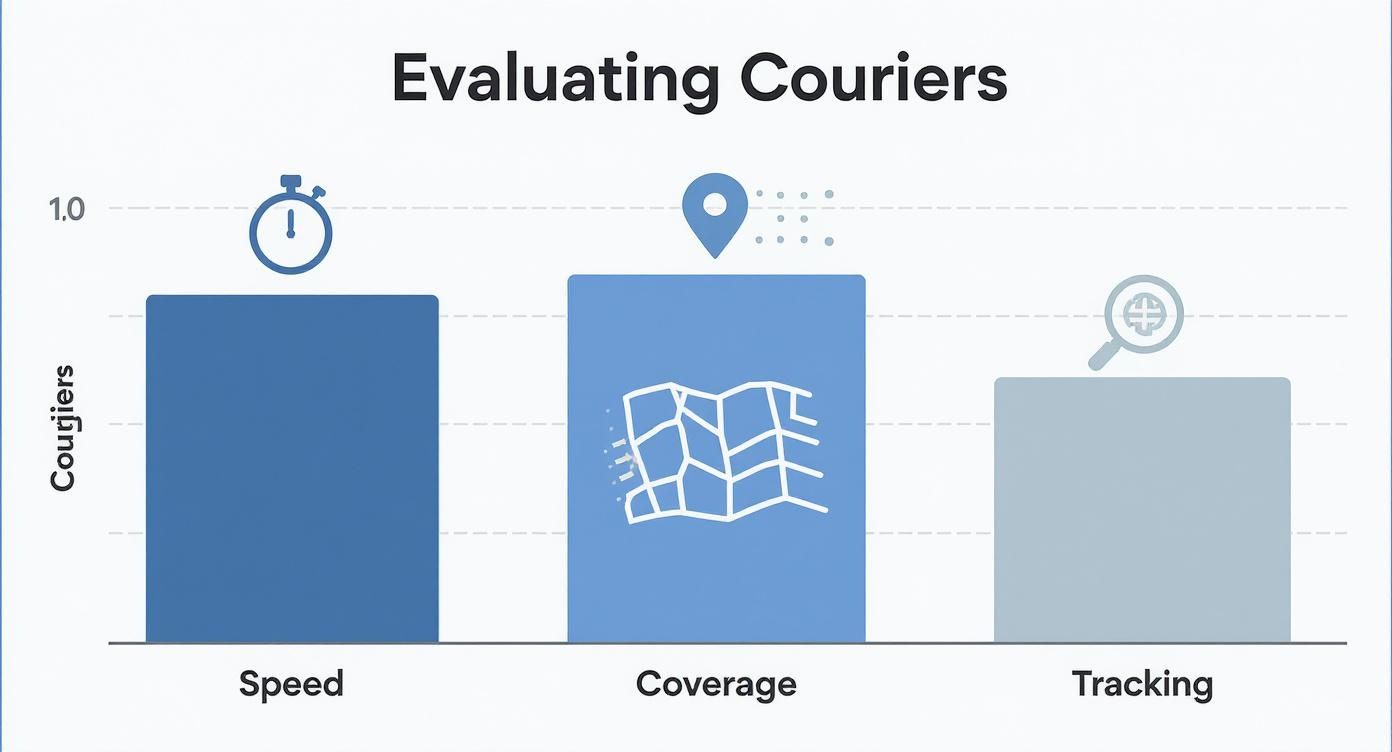
The data here reveals a classic trade-off: providers with fantastic coverage might not be the quickest in metro areas, while those with slick tracking technology might not reach as far into regional Australia.
Specialist and Aggregator Platforms
Beyond the household names, there's a growing world of specialist couriers and aggregator platforms offering some really compelling alternatives. These providers often carve out a specific niche or use technology to give you more flexibility. They're a fantastic fit for businesses whose needs don't quite fit the mould of the bigger players.
Let's look at a few examples:
- Urgent Metro Deliveries: Say you need to get time-sensitive documents or products across Melbourne on the same day. You’d be far better off with a specialist point-to-point courier built for speed and reliability over short distances. For more on this, our guide on finding a great courier service in Melbourne has some great insights.
- High-Volume E-commerce: An online retailer pushing out hundreds of parcels a day might find the best value with a multi-carrier platform like Aeros Couriers. These platforms plug into multiple carriers, letting you automatically pick the cheapest or fastest option for every single shipment, which is a game-changer for optimising costs.
- Bulky or Palletised Freight: If you're a B2B supplier sending oversized goods or pallets, you have specialised needs that standard parcel couriers just can't handle. You'll need a proper freight company with tailgate lift trucks and experience in heavy logistics.
Head-to-Head Comparison Framework
To make this really practical, let's compare these options using a common scenario: an online apparel store shipping about 30 orders a day all over Australia.
| Courier Type | Primary Strength | Ideal Use Case for Apparel Store | Key Consideration |
|---|---|---|---|
| Australia Post | Unmatched national and rural coverage. | Reaching customers in regional areas where other couriers either don't go or charge hefty surcharges. | Can be slower for interstate metro deliveries compared to road express services. |
| Aramex | Cost-effective metro delivery network. | Fulfilling lots of orders concentrated within major cities like Sydney, Melbourne, or Brisbane. | Service consistency can vary between franchise territories; checking local performance is a must. |
| Specialist Courier | Niche expertise (speed, freight type). | Offering a premium same-day or 3-hour delivery option for customers in your home city to gain an edge. | Usually more expensive and not for standard nationwide shipping. Best used as a supplementary service. |
What this really shows is that the best courier company is rarely just one provider. A smart business often uses a strategic mix: Australia Post for regional orders, Aramex for bulk metro shipments, and a local same-day service for those premium, urgent deliveries. This multi-carrier approach gives you the flexibility to get the best price, speed, and customer experience for every single order you send.
How to Match a Courier to Your Business Model
There’s no such thing as the single "best courier company." It's a myth. The real goal is to find the right partner whose strengths directly map to your unique business model. Think about it: the ideal courier for a city-based startup shipping handmade goods is completely different from what a B2B supplier needing reliable interstate pallet freight requires.
This is where we get practical and connect the dots between your day-to-day operations and the right courier profile. Once you understand what your business truly needs, you can cut through the marketing noise and focus on the services that will actually help you grow. It all comes down to pinpointing your most critical needs and matching them to a courier's specialisation.
This approach is more important than ever in Australia's booming Courier, Express, and Parcel (CEP) market. The sector hit an estimated value of AUD 18.83 billion in 2024 and is on track to reach AUD 32.16 billion by 2034. As you can discover more about this market growth on expertmarketresearch.com.au, this explosion is driven by e-commerce and sky-high customer expectations, making your choice of courier a critical business decision.
The Urban E-commerce Startup
Let’s say you’re running a small business selling handmade candles from a studio in Fitzroy, Melbourne. You’re shipping maybe 10-15 parcels a day, mostly to customers within the metro area and other capital cities. Your products are fantastic, but the margins are tight, so shipping costs can really sting.
For a business like this, your priorities are crystal clear:
- Cost-Effectiveness: You need access to competitive, bulk-rate pricing without being forced into a high-volume contract you can’t meet. Finding a service with cheap metro rates is key.
- Pickup Flexibility: As a small operator, you don't have time to wait around all day for a collection. A service with a reliable, scheduled pickup window is a non-negotiable.
- Simple Integration: Your time is your most valuable asset. You need a courier with a dead-simple booking system that plays nicely with your e-commerce platform to keep things running smoothly.
A multi-carrier platform or a courier that specialises in metro deliveries would be a perfect fit here. These services are built to give small, growing businesses the cost savings and flexibility they desperately need.
The B2B Interstate Supplier
Now, let's flip the script. Imagine you're a B2B supplier in Adelaide, shipping crucial machine parts to workshops and industrial clients all over Australia. Your shipments are often bulky, palletised, and incredibly time-sensitive. For your customers, a delayed delivery isn't just an annoyance—it can bring their entire operation to a grinding halt.
Your checklist looks completely different:
- Reliability and Transit Times: Consistent, predictable interstate delivery schedules are everything. You need a partner with a rock-solid track record in road express freight.
- Pallet Freight Capability: Your courier absolutely must have the right gear, like tailgate lift trucks, and genuine experience handling heavy, oversized, and awkward goods.
- Robust Tracking and Support: When a client calls asking for an ETA, you need answers, fast. A courier with detailed, real-time tracking and responsive, Australian-based support is vital.
For this business, a national freight specialist is the only way to go. You're not just shopping for the cheapest price; you're investing in a dependable partner who gets the unique pressures of B2B logistics. When these services are part of a larger supply chain, it's also worth choosing the right 3PL partner to ensure everything works in harmony.
The smartest shipping strategy is rarely a one-size-fits-all solution. It’s common for a national retailer to use a multi-carrier approach: Australia Post for remote areas, a metro specialist for same-day options in capital cities, and a heavy freight carrier for stock transfers between warehouses.
The National Retailer with High Volume
Finally, picture a national retailer with a huge online store and multiple brick-and-mortar locations. They’re shipping hundreds of orders daily—everything from small accessories to bulky furniture—to every postcode in the country. For them, the game is all about efficiency, scalability, and delivering a flawless customer experience.
The ideal courier setup has to deliver on these fronts:
- Multi-Carrier Options: No single provider is the cheapest and fastest for every parcel, every time. A platform that can automatically select the best carrier for each specific delivery is a massive advantage for optimising both cost and speed.
- Advanced API Integration: The ability to plug the courier's system directly into their warehouse management software (WMS) and e-commerce platform is non-negotiable for automating the entire fulfilment process.
- Scalability: The courier network must be able to handle enormous seasonal spikes, like Black Friday and Christmas, without breaking a sweat or letting service quality slip.
This kind of business is best served by a sophisticated multi-carrier shipping platform. It’s the only way to get the flexibility, automation, and control needed to effectively manage such a complex, high-volume shipping operation.
Your Checklist for a Smooth Courier Transition
You’ve done the hard work and picked the right courier for your business. That’s a huge step, but the job isn't quite finished. A well-managed switch is crucial to avoid any hiccups in your shipping and make sure you’re getting the benefits of your new partnership right away.
Following a clear onboarding plan helps you sidestep common frustrations like surprise charges on your first invoice or missed pickups. This checklist will walk you through setting up your new courier, step-by-step, so your operations keep ticking over without a hitch.
Account Setup and Integration
First things first, let's get the technical and admin side sorted. Getting these details right from the start saves a lot of headaches later on, so it pays to be thorough before you send your first parcel.
-
System Integration: The first job is to connect the courier's platform to your e-commerce store (like Shopify or WooCommerce) or whatever system you use to manage orders. Run a few test orders to make sure they pull through correctly and, just as importantly, that tracking details sync back to your system automatically.
-
Account and Billing Configuration: Double-check that your agreed-upon rate card has been loaded into your account. You'll also want to confirm your billing preferences, find out when invoices are sent, and get clarity on how extra costs like fuel levies or remote area surcharges will appear.
-
Pickup Schedule Confirmation: Lock in your regular pickup times and locations. It’s also a great idea to get a direct contact number for your local depot or driver, just in case you ever have an issue with a collection.
Operational Readiness and Training
Once the backend is set up, it’s time to get your team and your packing station ready. Clear communication here is key—everyone needs to know what the new process is and how to prepare parcels correctly to meet the courier's standards.
Getting your shipments ready is a make-or-break part of the process. Understanding the courier's specific rules for packaging and labelling isn't optional. For more on this, our guide on shipping labels and printing gives you practical tips to nail it every time.
A well-planned transition is about more than just software; it's about empowering your team with the knowledge and tools they need. A single day of focused training can prevent weeks of costly shipping errors and customer complaints down the line.
Finally, figure out your go-to contacts for any problems. Know who to call for a tracking question versus a billing query and keep these details somewhere your whole team can find them easily. Being prepared means that when small issues pop up—and they always do—you can solve them quickly without bringing your dispatch to a standstill.
Got Questions About Local Couriers? We've Got Answers.
When you're close to picking a courier partner, a few practical questions always pop up. Getting these sorted is the final step to making a decision you can feel good about, one that will genuinely help your business run smoothly.
How Do I Figure Out My Real Shipping Costs?
You've got to think in two ways: dead weight (what the scale says) and cubic weight (how much space the box takes up). Couriers will always charge you for whichever of these is the higher number. The formula for cubic weight is a standard one: Length (m) x Width (m) x Height (m) x 250.
To get the most accurate price, your best bet is to punch the exact dimensions into the courier’s online calculator. Just don't forget to keep an eye out for extras like fuel surcharges or fees for delivering to remote areas—they can definitely change the final amount.
How Much Shipping Insurance Do We Actually Need?
This one comes down to what your products are worth. Most couriers will throw in some basic liability coverage for free, but it's usually capped low, often around $100. If what you're sending is worth more than that, that basic cover just won't cut it. For anything of real value, you absolutely need to purchase extra transit insurance.
Take a hard look at the replacement cost of a typical shipment and pick a policy that covers it completely. A common mistake is assuming your general business insurance handles goods in transit—always double-check this with your provider.
How Hard Is It to Change Couriers?
Switching is doable, but you need a plan. The biggest headache is usually on the tech side, especially if your current courier’s system is deeply tied into your e-commerce store or warehouse software.
Before you sign on the dotted line for a long-term deal, read the fine print on termination clauses and notice periods. A really savvy move is to use a multi-carrier shipping platform. It gives you the freedom to easily add or drop courier services without causing chaos, so your shipping setup can grow and change right along with your business.
Ready to simplify your Australian shipping? At Aeros Couriers, we provide instant quotes, reliable nationwide delivery, and dedicated local support to help your business thrive. Get an instant quote online today.
