








Whether shipping insurance is worth buying usually comes down to three things: the value of what you’re sending, the type of coverage on offer and how much risk you can tolerate. Statutory consumer protections already cover many delivery problems, which changes the maths. This guide walks through the decision axes, the break-even formula and the claims process so you can decide for your next parcel.
TL;DR:
- Insurance becomes cost-effective only when the loss rate exceeds the insurer’s premium rate, typically around 1.25% to 1.50% for domestic and international shipments.
- A $2,000 shipment insured at 1.25% costs about $25, which is worthwhile if your loss rate is at least 1.5%, but not if it is below 0.5%.
- Carrier declared value caps payout to the declared amount and requires proof of fault, whereas third-party insurance pays out based on proof of loss without fault, often covering theft gaps.
- Filing claims promptly with detailed evidence and proper packaging reduces rejection risk and speeds recovery.
- For low-value, low-frequency shipments, self-insurance or platform dispute protections may be more economical than buying insurance.
Table of Contents
- When shipping insurance makes sense: quick decision criteria
- Carrier liability, declared value and third-party insurance explained
- Cost and break-even maths with worked examples
- How claims work in practice: deadlines, evidence and common pitfalls
- Alternatives and hybrid approaches that often beat buying cover on low-value parcels
- Aeros practical guidance and how our services support insured shipping
- When we tell customers to buy insurance
- How to compare rates, add cover and get support on Aeros
- Sources
- FAQ
When shipping insurance makes sense: quick decision criteria
Not every parcel needs cover. The decision gets easier once you weigh a handful of concrete factors rather than guessing.
- Declared value: high-value items (electronics, jewellery, collectables) justify insurance because a single loss wipes out many shipments’ worth of premiums.
- Fragility: glass, ceramics and anything with moving parts face a higher damage rate in transit, especially over multiple handling points.
- Resale or replacement cost: irreplaceable or custom items (art, vintage goods, one-off stock) deserve cover even at moderate declared values.
- International vs domestic: cross-border shipments face longer transit times, more handling and less carrier accountability, which raises the case for cover.
- Theft risk: unattended delivery areas or apartment blocks with shared entryways see more porch theft, a gap most carrier liability does not close.
- Shipment frequency: businesses sending parcels daily should think in terms of loss rate across hundreds of shipments, not the odds on a single one.
It’s worth remembering that Australian Consumer Law already gives buyers a right to a remedy, a repair, refund or replacement, when goods are faulty, damaged or simply never turn up, and paying for insurance at checkout doesn’t remove that right (Government of Western Australia). That’s the backdrop for every scenario above: insurance is about speed and certainty of recovery, not your only path to one.
Carrier liability, declared value and third-party insurance explained
Checking out “shipping protection” and carrier “declared value” sound similar but behave very differently, and confusing them is the most common reason people overpay or under-protect a shipment.
- Declared value caps what a carrier will pay if something goes wrong. It usually requires you to prove the carrier was at fault, not just that the parcel was lost or damaged.
- True third-party insurance pays out based on proof of loss, generally without you needing to establish exactly who caused it.
- Extra features with third-party cover often include porch-piracy protection, reimbursement for the shipping label itself, and cover for reshipping costs, features carriers rarely include in declared value.
The ACCC advises that sellers remain responsible for delivering goods in acceptable quality and within a reasonable time, and encourages consumers to check seller and platform policies when deliveries go wrong (ACCC).
A delivered-but-stolen parcel is the clearest gap. If tracking shows a parcel as delivered, carrier liability schemes typically treat their job as done, even if the parcel was stolen off a doorstep minutes later. Third-party insurance with porch-piracy cover, by contrast, is often built specifically to close this gap, one reason it can justify its cost on parcels left in exposed spots.
Cost and break-even maths with worked examples
Once you know roughly how often your parcels get lost, damaged or stolen, you can work out whether paying for cover actually saves money over time.
- Use this formula: insurance cost per $100 of value, divided by your loss rate, gives you the declared value at which insurance breaks even.
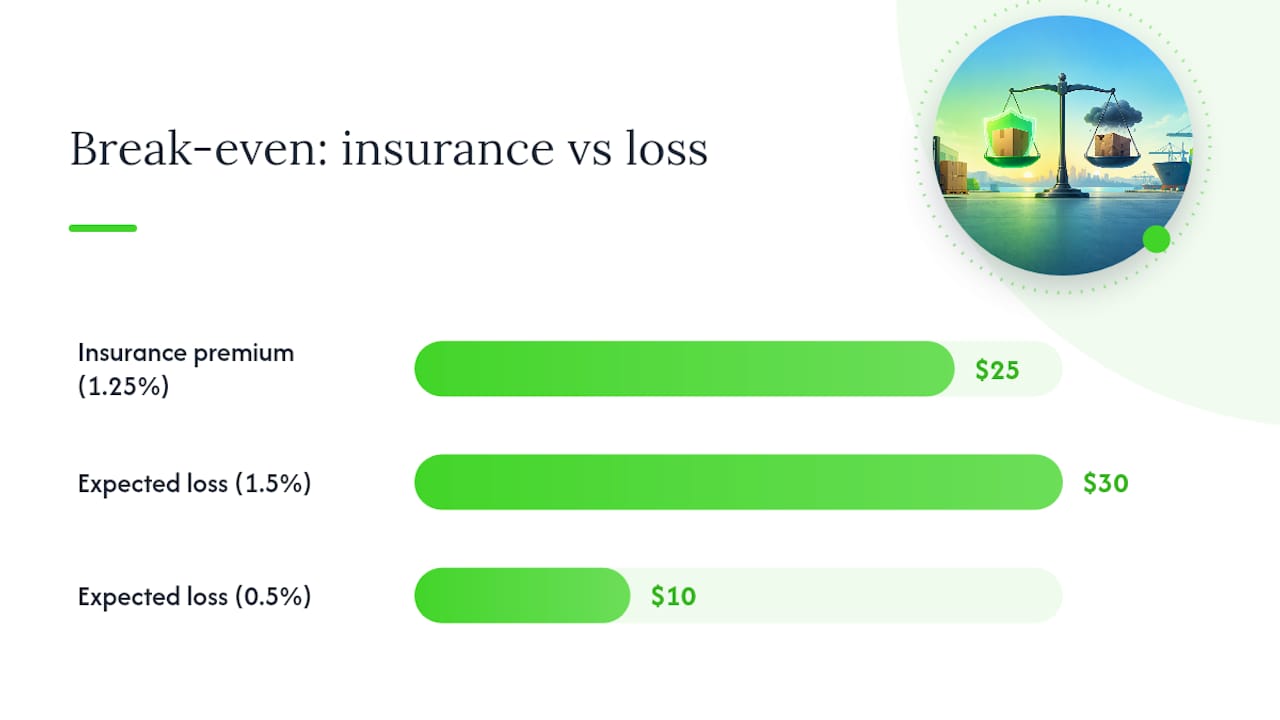
- Plug in sample rates: third-party insurers often price cover around 1.25% of declared value for domestic shipments and closer to 1.50% for international ones (Shippo).
- Compare that to your loss rate: at a 0.5% loss rate, a 1.25% premium only pays off on shipments worth well above the premium’s own rate, whereas at a 1.5% loss rate the same premium becomes cost-effective much sooner.
Worked example on a $2,000 shipment: at a 1.25% domestic rate, insurance costs $25. If your historical loss rate across similar shipments sits around 1.5%, the expected loss on an uninsured $2,000 parcel is $30, more than the premium, so buying cover is the cheaper bet. If your loss rate is closer to 0.5%, expected loss drops to $10, well under the $25 premium, and self-insuring makes more sense.
Base this calculation on your own recent loss rate rather than an industry-wide figure (Dimmath), since a 90-day sample of your own claims and complaints will always be a more reliable threshold than a generic average. Timelines matter too: some insurers process claims faster than carrier declared-value disputes, which can offset a slightly higher premium if cash flow is tight.
How claims work in practice: deadlines, evidence and common pitfalls
Filing a claim quickly and with the right evidence is often the difference between a paid claim and a rejected one.
- File promptly: many carriers and insurers set strict windows for lodging a claim, and missing the deadline forfeits it entirely (Shippo).
- Photograph everything: damaged contents, the outer packaging and any visible mishandling, before you dispose of anything.
- Keep tracking history: scans showing each handover point help establish where in transit a problem occurred.
- Retain invoices and proof of postage: insurers need proof of value and proof you actually sent the item.
- Check exclusions: some policies exclude specific goods (cash, certain electronics) or require particular packaging standards to be met.
Pro Tip: Keep one folder per shipment with photos, invoice, tracking history and correspondence together, insurers and carriers usually ask for the same evidence, so a prepared file speeds up resolution considerably.
Weak or missing packaging is a common reason claims get knocked back, so review how you pack fragile or high-value items before you need to make a claim, not after.

Alternatives and hybrid approaches that often beat buying cover on low-value parcels
Paying for insurance on every parcel isn’t the only way to manage risk, and for low-value, low-frequency shipments it’s often the more expensive option.
- Self-insure with a loss reserve: set aside the equivalent of your expected loss rate in a separate account and cover losses out of that pool instead of paying a premium on every shipment.
- Use marketplace or payment-provider disputes: many platforms and card providers offer buyer protection or chargeback options that can resolve a lost or damaged item without a separate insurance policy, though these come with their own evidence and time limits.
- Reduce risk operationally: better packaging, requiring a signature on delivery and sending tracking notifications to the recipient all lower your actual loss rate (Ecabrella), which shifts your break-even threshold upward and can make self-insuring the cheaper long-term choice.
A hybrid policy, insuring only shipments above a chosen value and self-insuring everything below it, is common among small merchants because it captures the upside of cover without paying premiums on routine low-value orders.
Aeros practical guidance and how our services support insured shipping
We build our platform around transparent pricing, active parcel monitoring and direct human support, which matters most when something actually goes wrong with a shipment. Two habits make the biggest difference regardless of who you ship with: pack fragile items with enough cushioning to survive a drop test, and photograph the sealed parcel before it leaves your hands. Combined with tracking data and prompt claim filing, that record is usually enough to resolve most disputes quickly. Guidance on cover options and support for an active shipment sits alongside your booking details when you compare and book through an online platform.
When we tell customers to buy insurance
Customers are generally pointed toward cover in three situations: the item’s replacement cost is high, the parcel is going somewhere with a longer or less predictable transit chain, or the customer simply can’t absorb the loss without disrupting cash flow. Outside those cases, the premium often costs more over a year than the losses it would have covered. The trade-off is really between paying a small, predictable amount and carrying a small, unpredictable risk yourself. Before your next shipment, run the break-even calculation on your own recent losses rather than trusting a rule of thumb.
— Aeros
How to compare rates, add cover and get support on Aeros
Once you’ve worked out whether a shipment is worth insuring, the next step is comparing rates rather than guessing at what a carrier will charge. Some online platforms compare rates from major carriers so you can see pricing before you commit, with optional cover, tracking and support available on the same booking.

- Compare rates instantly: check shipment rates across carriers before you book.
- Book freight or parcel delivery: use freight booking or the parcel delivery service depending on shipment size.
- Choose the right speed: express, same-day and air courier options are available where transit time affects your risk.
- Get support if something goes wrong: our team is on hand to help with claims and delivery issues on any booked shipment.
If you’re still working out which service level suits your shipment, our guide to choosing a courier company covers the trade-offs between speed, cost and reliability in more detail. Start by comparing a shipment rate for your next parcel.
Sources
- Peace of mind or piece of junk. Is shipping insurance worth it? — Government of Western Australia
- Buying online — ACCC
- Shipping insurance: what it is, when you need it, and how to get the most out of it — Shippo
- Shipping insurance – when to buy, carriers compared — Dimmath
FAQ
Do you really need shipping insurance?
Not always. Statutory consumer protections already require sellers to deliver goods in acceptable quality and within a reasonable time (ACCC), so insurance is most useful for high-value, fragile or international shipments where recovery would otherwise be slow.
Is it worth paying extra for shipping protection?
It depends on the value of the item and your own loss rate. Run the break-even calculation, insurance cost per $100 divided by your loss rate, using your own recent shipping history rather than a general estimate (Dimmath).
How much is shipping insurance for $2,000?
At a typical domestic rate of around 1.25% of declared value, insuring a $2,000 shipment costs about $25 (Shippo). Whether that’s worth paying depends on how often similar shipments are lost or damaged for you.
Is ship cover insurance worth it?
Checkout “shipping protection” can duplicate rights you already have under consumer law, so check the insurer’s terms against your statutory protections before buying (CHOICE). It tends to be worth it mainly for high-value, fragile or theft-prone shipments.
