Shipping can feel unfair when you’re running a small business.
You do the hard part. You source stock, answer customer messages, pack orders late in the day, then open your courier bill and wonder why sending a simple box across Australia costs more than expected. One week a parcel looks cheap. The next week, a similar one costs more. Regional jobs blow out. A customer asks where their order is. You end up wearing the cost and the stress.
That frustration is common. It also creates an opening. Once you understand how domestic courier services price, move, and prioritise parcels, shipping stops being a mystery charge and starts becoming something you can manage with intent.
Transform Your Shipping from a Cost to a Competitive Edge
A lot of business owners treat shipping like rent or electricity. It’s just there, unavoidable, and annoying when the invoice lands.
That mindset is expensive.
A candle seller in Melbourne, a supplements brand in Brisbane, and a spare-parts distributor in Adelaide can all sell very different products, but they run into the same courier problem. Their customers don’t judge shipping as a back-office task. They judge it as part of the purchase experience. If delivery is slow, confusing, or overpriced, the customer blames the seller, not the transport network.

Why this matters more than ever
Australian online retail keeps pushing more parcels into the network. E-commerce now represents over 10% of total retail sales, ABS reported e-commerce sales of AUD 62.4 billion in the 2023-24 financial year, up 9.5% from the previous year, and the Australian domestic courier market is projected to grow from about AUD 12.5 billion in 2025 to AUD 18.2 billion by 2030, a projected 7.8% CAGR according to this Australian domestic courier market report.
That growth creates pressure, but it also creates opportunity. Businesses that choose the right service level, pack smarter, and buy access to better rates can turn delivery into a reason customers come back.
The shift that changes everything
Think of shipping like your checkout experience. If checkout is clunky, buyers leave. If delivery options are clunky, buyers hesitate too.
The businesses that handle domestic courier services well usually do a few things:
- They match speed to customer value. Not every parcel needs the fastest option.
- They package for cost, not habit. A slightly smaller box can change the chargeable size.
- They compare multiple services before booking. They don’t rely on one carrier by default.
- They make tracking easy. Customers stay calmer when they can see movement.
If you want a practical example of how businesses approach lower-cost shipping through a structured account setup, this guide on a business postage account for cheaper faster shipping is a useful starting point.
Tip: The goal is not to make every shipment the fastest. The goal is to make each shipment appropriate, predictable, and profitable.
Once you see shipping as part pricing strategy, part customer service, and part operations, you stop reacting to courier costs and start shaping them.
Decoding the Australian Domestic Courier Ecosystem
The easiest way to understand domestic courier services is to picture Australia’s parcel network as a road map.
Some operators run the big highways. They move large volumes across major city pairs and established routes. Others are better on specialist lanes, awkward suburbs, or regional runs where flexibility matters more than sheer scale.
Who does what in the network
A direct carrier physically moves the parcel. That includes pickup, sorting, linehaul, depot handling, and final delivery.
A courier platform or aggregator sits above that network. It does not replace the transport system. It gives you a single place to compare services, book jobs, print labels, and track shipments without opening separate relationships with multiple providers.
That matters because most small businesses don’t have time to negotiate, test, and manage several carriers one by one.
Consider this:
- National carriers are the major roads.
- Specialist carriers are the side streets and shortcut routes.
- Aggregators are the traffic controller choosing the best path for each parcel.
Why aggregators can lower costs
Large shippers usually get better pricing because they send enough volume to unlock wholesale-style rates.
Smaller businesses rarely have that bargaining power on their own. An aggregator pools demand from many customers, then passes through access to rates and service options that would usually be harder to secure as a standalone sender.
That is the hidden mechanism many people miss. You are not only buying transport. You are buying access to a buying structure.
Why one carrier is rarely enough
Many businesses start by using whichever option feels familiar. That works until their shipping profile changes.
A fashion label may mostly send satchels to metro postcodes. Then it starts shipping gift packs in bigger cartons. A parts supplier may mostly ship to commercial addresses, then picks up more residential customers. One carrier may still suit some lanes, but no single service stays ideal for every parcel shape, destination, urgency level, and delivery preference.
A multi-carrier setup gives you room to choose:
- Fast for urgent metro jobs
- Cheaper for non-urgent nationwide parcels
- Different handling options for residential or business addresses
- Tracking and proof-of-delivery features where they matter most
For businesses comparing Australia-wide options, this overview of national courier services shows the sort of service mix that a centralised platform can bring together.
Key takeaway: The smartest shipping setups are not built around loyalty to one carrier. They are built around fit.
That idea alone saves many businesses from overpaying by habit.
Your Guide to Parcel and Satchel Service Levels
Most shipping mistakes happen before the parcel leaves the bench.
A business owner clicks the first option that looks safe, often paying for speed the customer did not need, or choosing a slow service for an order that really needed to arrive quickly. The fix is simple. Match the service level to the purpose of the parcel.
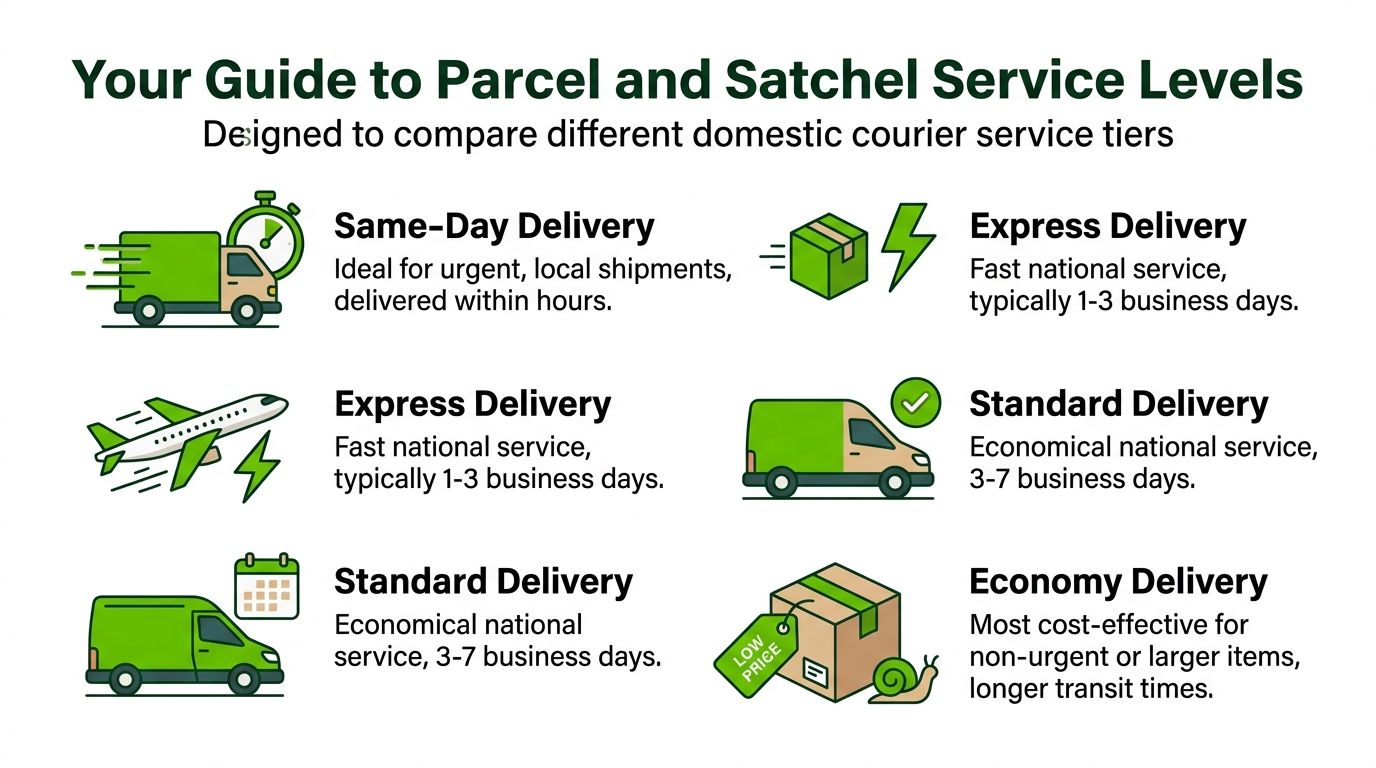
Four common service levels
Same-day delivery
Use this for urgent local jobs where timing matters more than price.
Good examples include forgotten event stock, replacement parts needed the same day, or documents that must arrive before close of business. Same-day works best within the same metro area. It is not the cheap option, but it can protect a sale or save a customer relationship.
Express delivery
Express is the practical middle ground for many Australian businesses.
It suits orders going to major cities when the buyer expects a fast turnaround but not a within-hours handoff. If your store promises quick dispatch and reliable national delivery, express often becomes the premium option that customers will willingly choose.
Standard delivery
Standard is where many healthy shipping programs live.
It is usually appropriate for everyday parcel traffic when buyers care about reliability and visibility more than urgency. If you sell products that are useful but not time-critical, standard service can keep your costs steadier while still meeting normal expectations.
Economy delivery
Economy is for parcels that can wait.
This suits low-urgency replenishment, lower-margin products, or customers who prefer the cheapest freight option available. It can also be the right choice when the item itself does not justify a higher shipping spend.
Choosing Your Courier Service Level
| Service Level | Typical Speed (Metro) | Cost Factor | Best For |
|---|---|---|---|
| Same-Day | Within hours | Highest | Urgent local deliveries, replacements, time-critical orders |
| Express | Fast | Higher | Major city orders, premium customer delivery options |
| Standard | Moderate | Mid-range | Everyday parcel shipping with balanced cost and speed |
| Economy | Slower | Lowest | Non-urgent orders, lower-margin goods, cost-sensitive buyers |
A simple way to decide
Ask one question first. What happens if this parcel arrives later than expected?
If the answer is “the customer will barely mind”, don’t buy speed you do not need.
If the answer is “the customer will chase us, cancel, or lose trust”, move up a tier.
A few practical examples help:
- Send express for customer-paid upgrades, premium orders, and gifts.
- Use standard for routine e-commerce orders where dependable delivery matters most.
- Choose economy for sale stock, restock orders, or low-urgency shipments.
- Reserve same-day for urgent local jobs.
For smaller soft-goods shipments, this page on a small satchel Australia Post option is helpful because satchel-based services often work well when your product is compact, durable, and easy to bag rather than box.
Tip: Customers usually accept slower shipping if you set the expectation clearly at checkout.
The wrong service level wastes money. The right one protects margin and keeps promises realistic.
Understanding the True Cost of Sending a Parcel in Australia
Many senders assume courier pricing is mostly about kilograms.
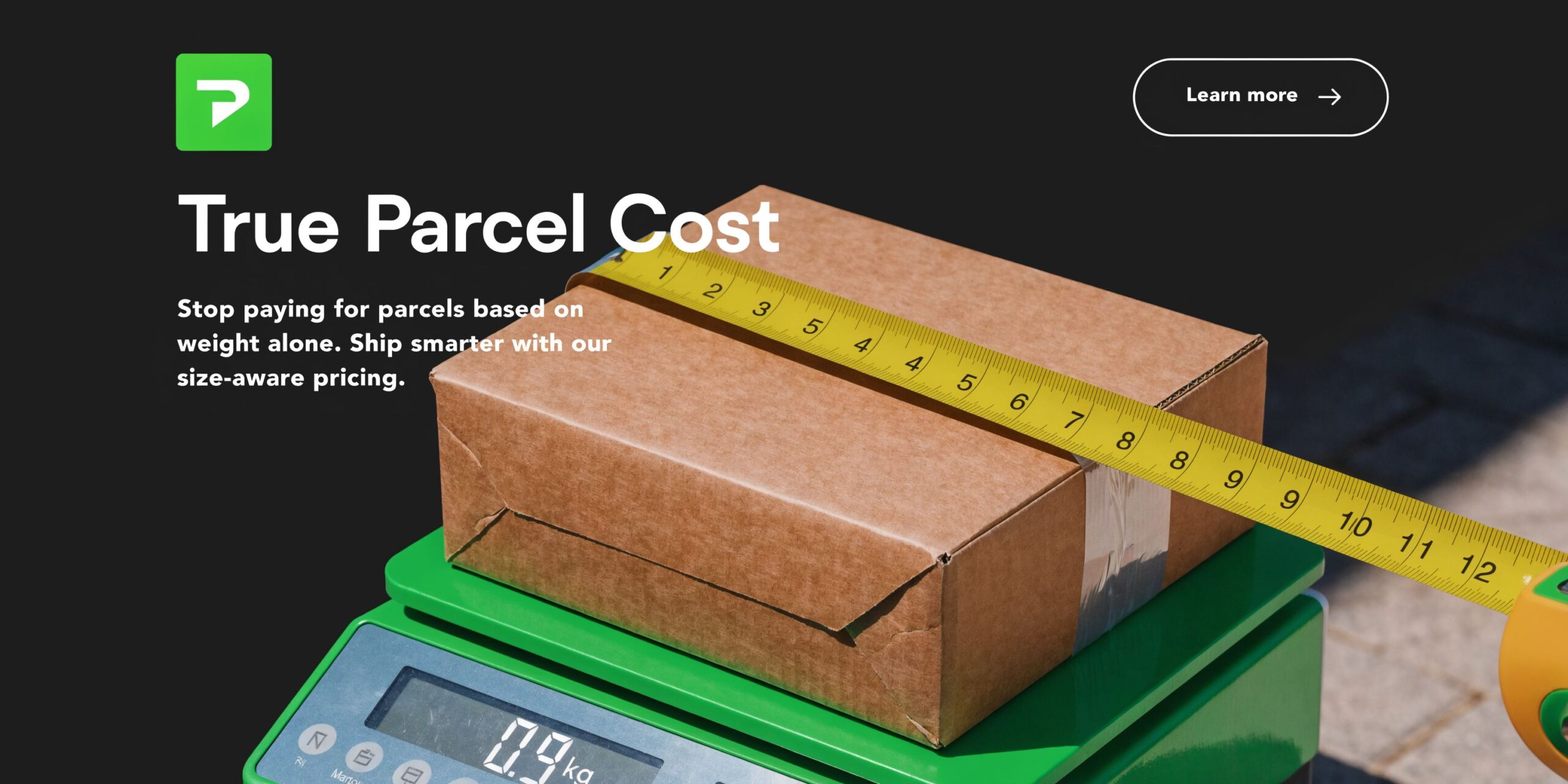
It isn’t. Weight matters, but space matters too. Carriers are not only selling lifting power. They are selling room in a vehicle and room in a sorting system. If your parcel is light but bulky, you may be paying to ship air.
The idea that catches people out
This is called dimensional weight, often shortened to cubing.
The formula commonly used is length x width x height / 5000. That means a big, fluffy, low-weight parcel can be charged as if it were heavier because it occupies valuable space.
In Australia, light parcels under 5kg account for about 75-80% of shipment volume, and dimensional-weight pricing based on length x width x height / 5000 encourages compact packaging that reduces average parcel mass by 15-20% and lowers fuel consumption per delivery stop by 12%, according to this courier market and packaging benchmark summary.
A plain-English example
Take two parcels:
- A dense small box filled with metal fittings
- A much larger box filled with lightweight apparel
The fittings box may weigh more on a scale. But the apparel box can still cost more to send if its outer dimensions push up the cubic calculation.
That’s why businesses are often surprised by a quote. They weighed the parcel, but they didn’t think about volume.
What usually drives the price
Courier charges often reflect a mix of factors, including:
- Dead weight measured on the scale
- Cubic size measured from the outside of the box
- Destination especially metro versus regional routes
- Service level such as express or economy
- Optional extras like signature on delivery or insurance choices
The biggest cost-saving lever for many senders is not haggling. It is box selection.
Packaging choices that save money
If your product is swimming in empty space, your shipping budget is leaking.
Try this approach:
- Measure the product first. Start with what the item needs, not the box you happen to have nearby.
- Use the smallest safe carton. Protection still matters, but oversized boxes create unnecessary cubic weight.
- Choose satchels where appropriate. Soft items often do better in satchels than cartons.
- Trim void fill. Too much filler can push you into a larger box than necessary.
- Standardise your packaging range. A short list of box sizes keeps packing faster and more consistent.
Key takeaway: If you want cheaper domestic courier services, your first pricing tool is often a tape measure, not a discount code.
Smart packaging does two jobs at once. It lowers transport cost and reduces the chance of a parcel shifting, collapsing, or getting remeasured in transit.
Mastering Packaging and Shipping Compliance
Good packing is part protection, part pricing discipline, and part professionalism.
A parcel that is packed well moves more cleanly through the network. Labels scan properly. Dimensions are easier to verify. The driver handles a stable box instead of a poorly taped science experiment.
Pack for the journey, not the shelf
Your product might look secure on a workbench and still fail in transit.
Domestic courier services involve lifting, sorting, stacking, and movement across multiple handoff points. Pack for vibration, compression, and quick handling.
A practical method looks like this:
- Choose the right outer packaging. Use a carton that fits the item closely, or a satchel if the contents are soft and durable.
- Protect empty space. Fill gaps so the item does not rattle around inside the box.
- Seal all openings firmly. Tape the seams properly, especially the bottom.
- Keep labels flat and visible. Avoid wrinkles, corners, and old stickers from reused cartons.
- Protect fragile items internally. Don’t rely on the words “fragile” to do the cushioning for you.
Declare the parcel accurately
Under-declaring dimensions or weight is one of the easiest ways to create avoidable problems.
If the booked details do not match the actual parcel, the shipment can be remeasured, repriced, delayed, or queried. Even when the difference seems small, it creates friction.
A simple checklist helps:
- Weigh the packed parcel, not the product alone.
- Measure the outside of the finished package.
- Round carefully and consistently according to the booking tool.
- Recheck after adding extra wrap or padding.
- Keep your own record in case you need to compare later.
If you want a clearer understanding of the paperwork side, this explainer on what a consignment note is is worth reading because the booking record becomes part of how the shipment is identified and handled.
Chain of Responsibility in plain language
Chain of Responsibility sounds legalistic, but the practical meaning is simple. Everyone involved has a role in keeping transport safe.
That includes the sender. If a parcel is badly packed, incorrectly described, or unsafe to handle, the consequences do not sit only with the carrier. Good compliance habits protect the warehouse team, the driver, and the people receiving the item.
Tip: Treat accurate dimensions, secure packaging, and clear labels as part of customer service. They prevent many delays before they start.
Businesses that pack neatly and declare accurately usually spend less time fixing shipping issues later.
How to Choose the Right Domestic Courier Service
Choosing between domestic courier services gets easier when you stop asking, “Which courier is cheapest?” and start asking, “Cheapest for which parcel, on which route, with which expectation?”
That one shift leads to better decisions.
Start with your shipping profile
Write down what you send most often.
Not in broad terms like “boxes” or “orders”. Be specific. Are they small satchels? Shoe-box sized cartons? Fragile goods? Repeat customer orders? Gifts? Spare parts? The more clearly you define your typical shipment, the easier it is to compare options that fit.
Then look at where those parcels go:
- Mostly metro postcodes
- A mix of metro and regional
- Commercial addresses
- Residential deliveries
- High-value orders needing more control
The four questions that matter most
How urgent is the delivery
A fast option only makes sense when speed protects revenue, reputation, or a customer promise.
If your customers mainly value low delivery cost, economy or standard may be the better fit. If they are buying gifts, urgent replacements, or premium items, express becomes more useful.
How important is tracking visibility
Some customers barely check tracking. Others refresh the page repeatedly.
If customer support gets flooded with “where is my order?” messages, choose a service and booking system that makes visibility easy for both sides.
Where do you send most often
Metro jobs and regional jobs behave differently.
A provider that suits major cities may be less appealing once a large share of your orders starts heading to outer or regional postcodes. Your best option depends on your lane mix, not just your average parcel size.
Do you need delivery controls
Some businesses want a plain drop-and-go service. Others need extra handling choices.
You might care about signature on delivery, insurance options, residential pickup, business delivery windows, or clearer proof of delivery. Those details can matter more than a small difference in base price.
Technology affects cost more than many people realise
Behind the scenes, route planning has become a major part of how carriers manage speed and efficiency. GIS-based route optimisation in Australian domestic courier services reduces travelled miles by 20-30% and boosts delivery efficiency by 25%, while dynamic routing also enables same-day metro ETAs for 85% of express parcels according to this market analysis on courier route optimisation.
You don’t need to run the routing software yourself. You just need to understand that better network planning can improve both service reliability and pricing.
A shortlist you can use
Before choosing a provider, check:
- Parcel fit. Does the service suit your usual box and satchel sizes?
- Lane fit. Are your common destinations served well?
- Tracking fit. Will customers get the visibility they expect?
- Cost fit. Are you paying for the right speed, not the maximum speed?
- Workflow fit. Can your team quote, book, and label parcels without wasting time?
The right domestic courier service is rarely the one with the flashiest promise. It’s the one that consistently suits your parcel mix, customer expectations, and operating rhythm.
Unlock Wholesale Rates and Efficiency with Aeros Couriers
Many small businesses know they should compare carriers. The problem is the admin.
Opening direct accounts, learning different booking systems, checking rates line by line, and tracking jobs across separate portals can turn a simple dispatch process into a daily drain. That is where a multi-carrier booking platform becomes useful.
What this model changes for smaller senders
A platform such as Aeros Couriers gives users one place to get quotes, book parcel jobs, print labels, and track deliveries across Australia. The practical advantage is not only convenience. It is access.
Instead of trying to earn better rates with your own volume alone, you use a system built around bulk purchasing and carrier choice. That can help smaller businesses reach pricing structures that are usually easier for larger shippers to access.
Why the workflow matters
Cost savings are only half the story. Time savings matter too.
A cleaner booking process helps when your team is juggling sales, packing, inventory, and customer support. If a platform shows service options clearly at checkout, keeps jobs in one dashboard, and reduces manual back-and-forth, the shipping process becomes more predictable.
A setup like that can help with:
- Instant quotes so you can compare before booking
- Centralised tracking instead of checking multiple systems
- Label generation without extra handling steps
- Optional service add-ons such as delivery controls
- Freight insurance inclusion for extra peace of mind
- Rewards features that return some value to regular shippers
For a fuller overview of how that model works in practice, this page on stress-free deliveries through Aeros Couriers gives a useful product-level summary.
Key benefit for growing businesses
The biggest change is mental.
When shipping lives in one organised workflow, it stops feeling like a string of one-off decisions. You can compare options consistently, choose service levels with more confidence, and avoid overpaying because the team is rushed.
Key takeaway: Wholesale-style access matters, but operational simplicity matters just as much. A cheap rate is less valuable if booking it creates extra work and errors.
For many businesses, the right platform does not make shipping glamorous. It makes it calmer, clearer, and easier to control.
Frequently Asked Questions about Domestic Shipping
Even after you understand pricing and service levels, a few practical questions tend to pop up right at booking time.
What is Authority to Leave
Authority to Leave, often shortened to ATL, means the driver may leave the parcel at the address without collecting a signature if it is safe to do so.
ATL can be convenient for low-risk deliveries and customers who are rarely home. It can also reduce redelivery hassles. The trade-off is control. If the parcel is left unattended, you need to be comfortable with that risk profile.
Use ATL when convenience matters and the contents are not highly sensitive. For expensive or important items, many businesses prefer an attended delivery option.
How does freight insurance work
Freight insurance is there to provide cover for approved loss or damage situations, subject to the policy terms of the booking service.
The key point is simple. Insurance is not a substitute for good packaging. If the item is poorly packed, a claim can become harder. Keep photos of the packed item, the packaging used, and the label if you are sending anything valuable.
Can I send to a PO Box or Parcel Locker
That depends on the service and carrier used.
Some domestic courier services focus on street addresses and business or residential delivery locations. Before booking, check whether the specific service accepts PO Boxes or locker-style destinations. If the address type matters, verify it before printing the label rather than assuming all networks handle it the same way.
What happens if my parcel is bigger or heavier than declared
The shipment can be remeasured and repriced.
In some cases, that only results in an adjusted charge. In others, it may also slow the job while the discrepancy is reviewed. If the parcel is materially different from what was booked, you can end up with avoidable admin and customer delay.
The easiest prevention is to measure the finished parcel after packing, not before.
Should I choose signature on delivery
Choose it when proof of handover matters.
It is useful for higher-value goods, disputed-delivery risk, or customers who want extra assurance. It may add a small layer of process to the delivery, but it can also reduce grey areas if a parcel later becomes the subject of a query.
Are satchels or boxes better
Neither is automatically better. The right choice depends on the product.
Satchels suit soft, compact, durable items. Boxes are usually better for rigid, fragile, or presentation-sensitive goods. If a soft item is going into a box mostly because that’s what is on hand, there may be room to reduce the package size and cost.
How do I reduce customer complaints about delivery
Start with expectation setting.
Be clear about dispatch times, likely transit windows, and what the tracking updates mean. Most customer frustration comes from uncertainty, not the passage of time alone. A customer who knows what is happening is usually easier to support than one left guessing.
If you’re ready to simplify domestic courier services for your business, Aeros Couriers offers an Australia-wide platform for quoting, booking, labelling, and tracking parcel deliveries in one place, with a workflow designed to make everyday shipping easier to manage.
Courier quotes, tracking and support
Ready to send a parcel? Compare the available services for your postcodes, parcel dimensions and weight. For an existing delivery, use your consignment number to check tracking or ask our team for help.