


Sending a parcel across Australia shouldn't feel like a logistical nightmare. This guide is your roadmap to making fast and cheap parcel delivery Australia wide a reality. We're here to pull back the curtain on the whole process, focusing on sending boxes and parcels locally within Australia, turning what can seem like a daunting task into a simple, confident click for your business or personal sends.
Your Go-To Guide for Sending Parcels in Australia
Shipping a package is the final, crucial step in so many interactions—it's how you connect with customers or send a bit of joy to loved ones. Whether it's a small box heading to the next city over or an urgent package destined for a remote town, striking that perfect balance between speed, cost, and reliability is everything. The good news is, modern shipping platforms have made this easier than ever, putting a massive local delivery network right at your fingertips.
This guide will walk you through getting an instant quote, comparing the cheapest options, and watching your parcel's journey in real-time. Let's ditch the complicated jargon and logistical headaches. It's time to ship smarter, not harder.
What’s Happening in the World of Shipping?
The demand for dependable, affordable parcel delivery has absolutely exploded, thanks in large part to the meteoric rise of e-commerce. Sending a package is no longer a game just for big corporations; it's a vital tool for small businesses, Etsy sellers, and everyday people. This boom has completely reshaped the local Australian shipping industry, making it more competitive and accessible than ever before.
The numbers paint a pretty clear picture. The Australian courier, express, and parcel (CEP) market hit a staggering AUD 19.87 billion and is expected to climb to an incredible AUD 33.94 billion by 2035. This isn't just business-to-business growth; it reflects a fundamental shift in how we all shop and live. Over 80% of Australian households—that's 9.5 million homes—are now regularly receiving parcels, proving just how woven into the fabric of our daily lives these services have become. You can discover more insights into the Australian CEP market and what's on the horizon.
Sending a parcel today is so much more than just moving an item from point A to B. It’s about keeping a promise to a customer, delivering a surprise to a friend, or simply keeping your business humming along. It’s the physical link in our digitally connected world.
What You'll Learn in This Guide
We've designed this guide to build your confidence from the ground up. You'll get a real, practical understanding of how nationwide couriers work, from the moment a parcel leaves your hands to when it safely arrives at its destination. We’ll be covering:
- The Journey of a Parcel: A behind-the-scenes look at how the 'hub and spoke' system works for Australian deliveries.
- Decoding Costs and Times: A straightforward breakdown of how distance, size, and weight affect the price for your box.
- Packaging and Compliance: Practical tips to pack your items securely and make sure they're good to go.
- Booking and Tracking: A simple, step-by-step walkthrough using a modern platform as our example.
- Pro Tips for Savings: Actionable advice you can use right away to cut costs and sidestep common delays.
By the time you're done, you'll have all the know-how you need to master parcel delivery Australia wide, making sure every single shipment is a success.
How a Parcel Travels Across Australia
Ever clicked ‘send’ on a parcel booking and just… wondered? What actually happens next? The journey your package takes is a marvel of coordination, like a perfectly timed relay race stretching across thousands of kilometres. Getting your head around this process really demystifies parcel delivery Australia wide and shows you how modern couriers find the quickest, cheapest routes for your boxes.
Let’s follow a single box on its adventure. Picture this: a small business in Perth needs to get a product to a customer way over in Cairns. This trip isn’t a simple A-to-B drive. Instead, it relies on a super-efficient logistics network known as the ‘hub and spoke’ model.
Think of it like catching a flight. You almost always fly from your local airport to a major city hub (like Sydney or Melbourne) before catching a connecting flight to your final destination. Parcels travel in much the same way.
The First Leg: Local Pickup and Sorting
The race starts the moment a local courier driver picks up the parcel from the business in Perth. This first step is often called the ‘first mile’. That driver isn't about to hit the highway to Cairns; their job is to collect all the parcels from a specific area and ferry them back to a local depot or sorting facility.
This is where the real magic starts. At the depot, every parcel is scanned, weighed, and sorted based on where it’s going. Our Perth package, destined for sunny Queensland, gets grouped with hundreds of others heading east. This consolidation is the secret sauce to keeping costs down—it’s far more efficient to move one full truck than dozens of half-empty vans.
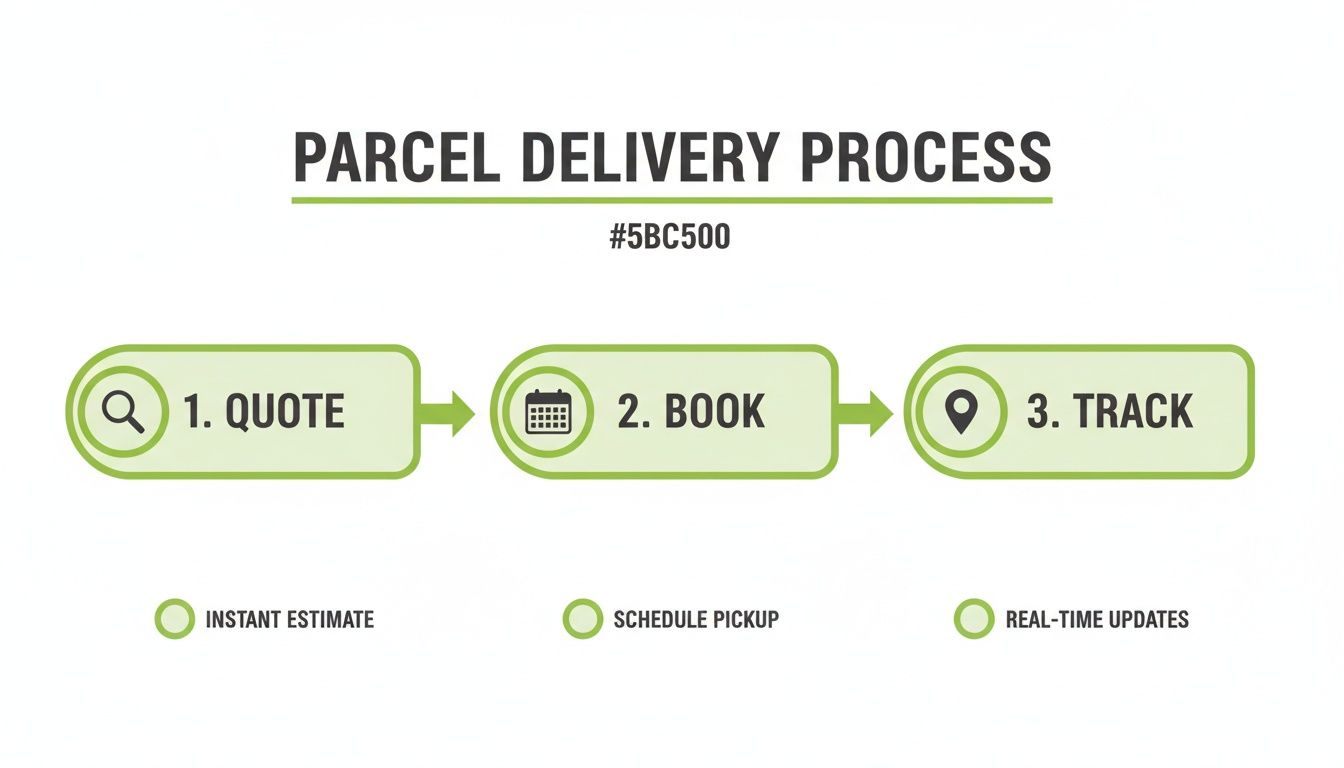
From your end, the process is beautifully simple. You get a quote, book the service, and then track its progress. This is what kicks off the complex physical journey happening behind the scenes.
The Main Event: The Long-Haul Journey
Once sorted, our parcel is loaded onto a long-haul vehicle. This could be a massive B-double truck or, for more urgent express services, a cargo plane. This is the ‘middle mile’, the longest and most significant leg of the journey. Our package travels from the Perth hub all the way across the Nullarbor to a major sorting hub in Brisbane.
The hub and spoke system is the absolute backbone of efficient national logistics. By funnelling everything through central hubs, carriers can pack their long-haul transport to capacity, which is the most expensive part of the whole delivery. This efficiency is precisely what makes surprisingly cheap parcel delivery possible across such a vast country.
Major cities like Sydney, Melbourne, Brisbane, Adelaide, and Perth serve as these critical hubs. When the truck finally rolls into Brisbane, the process happens in reverse. The shipment is unloaded, and every parcel is sorted again, this time by its specific delivery region. Our Cairns-bound package is separated from those going to the Gold Coast, Toowoomba, or local Brisbane suburbs.
If you’re watching the tracking info during this stage, you’ll see updates like ‘in transit’. To get a better feel for what’s happening, you can learn more about what 'in transit' means for your parcel and the various stages it covers.
The Final Sprint: Last-Mile Delivery
After being sorted at the Brisbane hub, our parcel is sent on another, shorter trip to a regional depot in Cairns. This is where the ‘last mile’ begins—often the most complex and time-sensitive part of the entire journey. A local delivery driver loads the parcel into their van along with all the other packages for that area.
This driver is responsible for the final handover. They’ll navigate the local streets to bring the package right to the customer’s doorstep. The moment the recipient signs for it or it’s left in a safe place, the delivery is officially complete. The tracking information is updated one last time to "Delivered," closing the loop on a journey that spanned over 4,000 kilometres, multiple sorting facilities, and several modes of transport. All of it, seamlessly coordinated.
How Much Will It Cost and When Will It Arrive?
Let’s get straight to the two questions that matter most: "How much will it cost?" and "When will it get there?" Getting your head around the answers is the key to mastering parcel delivery Australia wide. It’s not about just finding the cheapest price; it's about understanding the value behind each quote so you can strike the perfect balance between speed and budget for your box delivery.
Think of it this way: sending a parcel isn’t like buying something off a shelf with a fixed price tag. The cost is a living, breathing number shaped by a few core factors. Once you get a feel for these, you'll see exactly what you’re paying for and how to tweak things to get a better price.
The Key Ingredients of Your Shipping Quote
Three main things come together to determine the cost of sending your parcel. You can think of them as the three legs of a stool—each one is essential for calculating a fair and accurate price for the journey your package is about to take.
Size and Dead Weight: This is the most straightforward part. A big, heavy box naturally costs more to move than a small, lightweight satchel. It simply takes up more room and uses more fuel.
Cubic Weight (The Space It Takes Up): This is where people often get tripped up, but it’s a crucial industry concept. Couriers don’t just charge for how heavy something is; they charge for the space it occupies. Imagine you're sending a huge box filled with pillows. It's light, but its size means fewer other parcels can fit on the truck. That’s why we use cubic weight (or volumetric weight) to ensure the price fairly reflects the space being used.
The Journey’s Distance: The further your parcel has to travel, the more it will cost. A delivery from Sydney to Melbourne is a well-worn path, making it a relatively quick and cheap trip. But sending that same parcel from Melbourne all the way to a regional town like Broome involves a much longer haul and more complex logistics, which is naturally reflected in the price.
Getting a handle on these fundamentals is the first step. The best way to see it in action is to play around with an online tool yourself. You can calculate your shipping charges in real-time to see just how much the dimensions and destination can change the final cost.
The Great Divide: Metro vs. Regional Deliveries
Australia is a massive country, which means where your parcel is going is just as important as what’s inside it. Deliveries are generally split into two main camps: metro and regional/remote. This simple distinction has a huge impact on both the price and the ETA.
Metro-to-metro routes are the superhighways of Australian logistics. Think Brisbane to Sydney or Sydney to Melbourne. With massive volumes of parcels moving between these hubs every single day, the networks are incredibly efficient, keeping costs down and delivery times short.
Regional deliveries, on the other hand, are a whole different ball game. Reaching towns far from major capital cities requires extra transport links, different delivery partners, and more time on the road, which all adds to the final cost.
The boom in online shopping has put a massive spotlight on regional Australia. During a recent peak holiday season, the delivery sector handled nearly 111 million parcels, with Western Australia alone seeing a 15.2% jump in online purchases year-on-year. Growth in places like Toowoomba and Mackay proves that having a reliable regional network isn't just a bonus anymore—it's absolutely essential.
To give you a clearer picture, here’s a quick comparison of what you might expect.
Sample Parcel Delivery Costs and ETAs
This table gives you a rough idea of how costs and transit times can vary for a standard 5kg box, depending on the route. Notice how both the time and price stretch out as the distance and remoteness increase.
| Route (Origin to Destination) | Estimated Standard Delivery Time | Estimated Express Delivery Time | Indicative Cost Range (Standard) |
|---|---|---|---|
| Sydney to Melbourne | 1-2 Business Days | Next Business Day | $15 – $25 |
| Melbourne to Brisbane | 2-3 Business Days | 1-2 Business Days | $20 – $30 |
| Sydney to Perth | 5-7 Business Days | 2-3 Business Days | $35 – $50 |
| Melbourne to Broome | 8-12 Business Days | 3-5 Business Days | $55 – $80+ |
As you can see, the difference is significant. This is exactly why an instant quoting tool is so valuable. It takes all the guesswork out of the equation, laying out your options with transparent pricing so you can make the right choice every single time, without any hidden fees or nasty surprises.
Mastering Your Packaging and Pre-Shipment Checklist
Think of great packaging as your parcel’s first line of defence. It’s not just a box; it’s travel insurance for your item, safeguarding it on its journey across the country. Nailing this step isn't just about preventing a few bumps and bruises—it's your key to a smooth, hassle-free delivery for your box or parcel.
Follow this pre-shipment checklist, and you can send every parcel with the confidence that it’s safe, secure, and ready for anything.
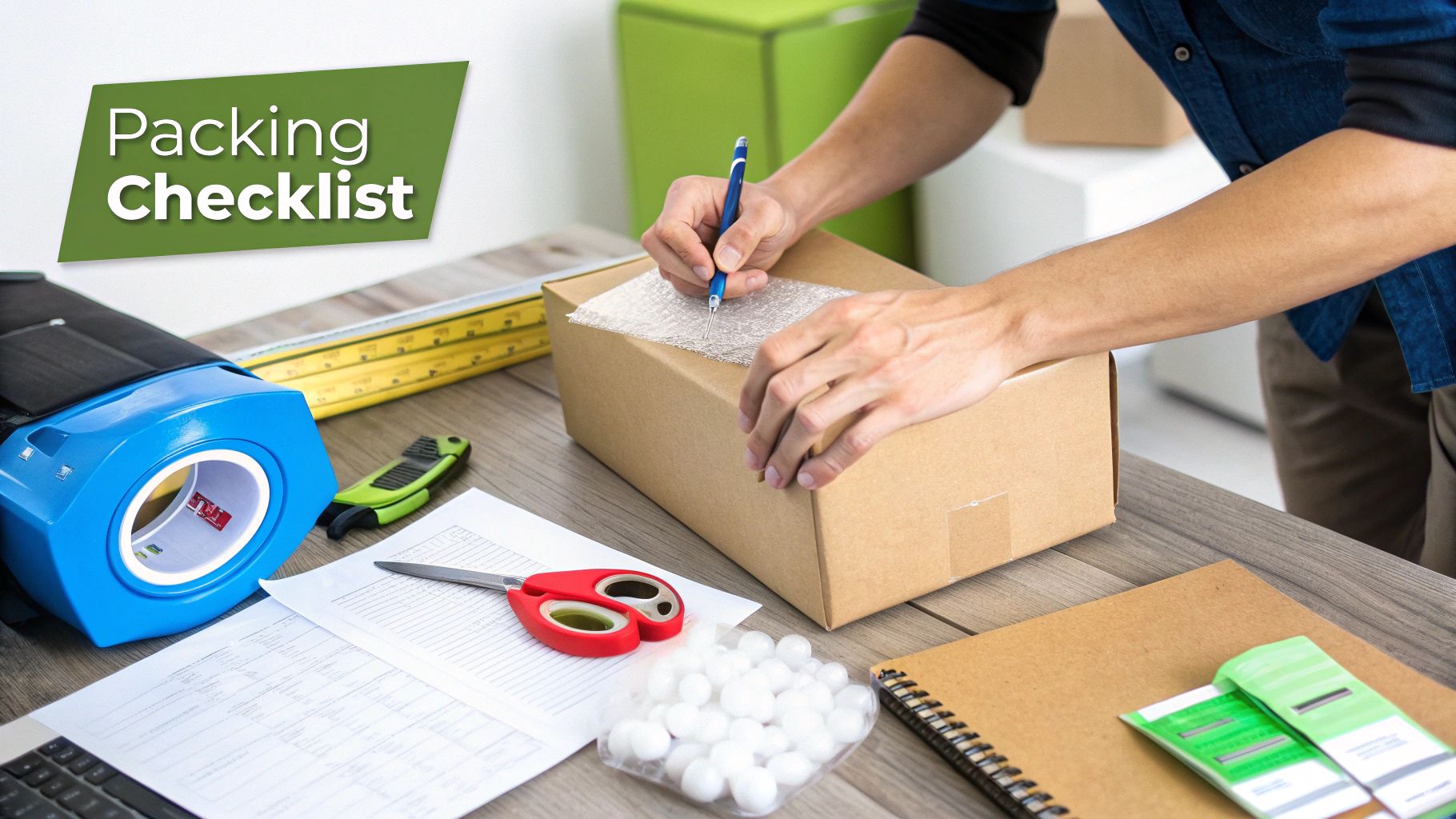
Choose the Right Box and Cushioning
It all starts with the box. While it's tempting to reuse an old one from the garage, this is where you set the stage for success. Your best bet is always a new or near-new corrugated cardboard box that's the right size for what you’re sending.
If the box is too big, you’re basically paying to ship air, which drives up your costs due to cubic weight. Too small, and you leave no room for protection. The sweet spot? A box that gives you about 5cm of breathing room on all sides of your item.
That gap is where the magic happens. Fill it generously with bubble wrap, packing peanuts, or even scrunched-up paper. The goal is simple: give the box a gentle shake, and your item shouldn't budge or rattle at all. It should be perfectly snug.
Seal It Securely and Label It Clearly
With your item safely cushioned, it's time to lock it down. Don't reach for regular sticky tape; you need strong, pressure-sensitive packing tape to seal every seam. The 'H-tape' method is a professional trick: run a strip along the centre seam where the flaps meet, then tape across both edge seams to create a capital 'H'.
Next up is the most important part of the exterior: the label. Your shipping label is your parcel’s passport, and it needs to be perfectly clear, correct, and firmly attached to the top of the box. To get your packages delivered accurately, you’ll need to properly print your custom shipping and mailing labels.
Remember, your parcel will be handled by countless hands and sorted by high-speed machines. A strong seal and a crystal-clear label are non-negotiable. They prevent accidental openings and ensure scanners can read the barcode at every checkpoint, keeping your delivery right on schedule.
Don’t forget to peel off or black out any old labels or barcodes on the box. It’s a common mistake that can send your parcel on an unexpected detour. For a deep dive into getting this just right, check out our guide on everything you need to know about shipping labels and printing.
Navigating Dangerous and Restricted Goods
This topic can seem a bit daunting, but it's crucial for every sender to grasp the basics. For the safety of everyone involved in the parcel delivery Australia wide network, couriers are legally required to refuse certain items. Trying to send them anyway can lead to returned packages, fines, or even having your goods disposed of.
And we're not just talking about obvious hazards like explosives. You'd be surprised how many everyday household items make the list.
Here are a few common culprits that are often restricted:
- Aerosol Cans: Things like deodorant, hairspray, and spray paint are under pressure and can be flammable.
- Lithium Batteries: These are in almost everything—laptops, phones, power banks—and pose a fire risk if they’re not packed correctly.
- Perfumes and Aftershaves: Most contain high concentrations of flammable alcohol, which classifies them as dangerous goods.
- Flammable Liquids: This category includes nail polish, hand sanitiser, and certain cleaning products.
The below screenshot from a dangerous goods guide shows a list of items that are typically prohibited.
This just goes to show how many common products are considered hazardous for shipping. Before you pack, always check your item against your courier’s dangerous goods list. If you're even slightly unsure, just call their customer support and ask. It's a quick, simple step that can save you a world of trouble.
Your Simple Step-By-Step Booking and Tracking Workflow
Alright, this is where the rubber meets the road. We've talked theory, now let's get into the action. Booking a courier and keeping an eye on your parcel should feel like you’re in complete control, not like you're lost in a logistical maze.
Let’s walk through the whole process together. We'll turn what seems like a complicated task into a few simple clicks, making sure your parcel delivery Australia wide gets from A to B without a hitch.
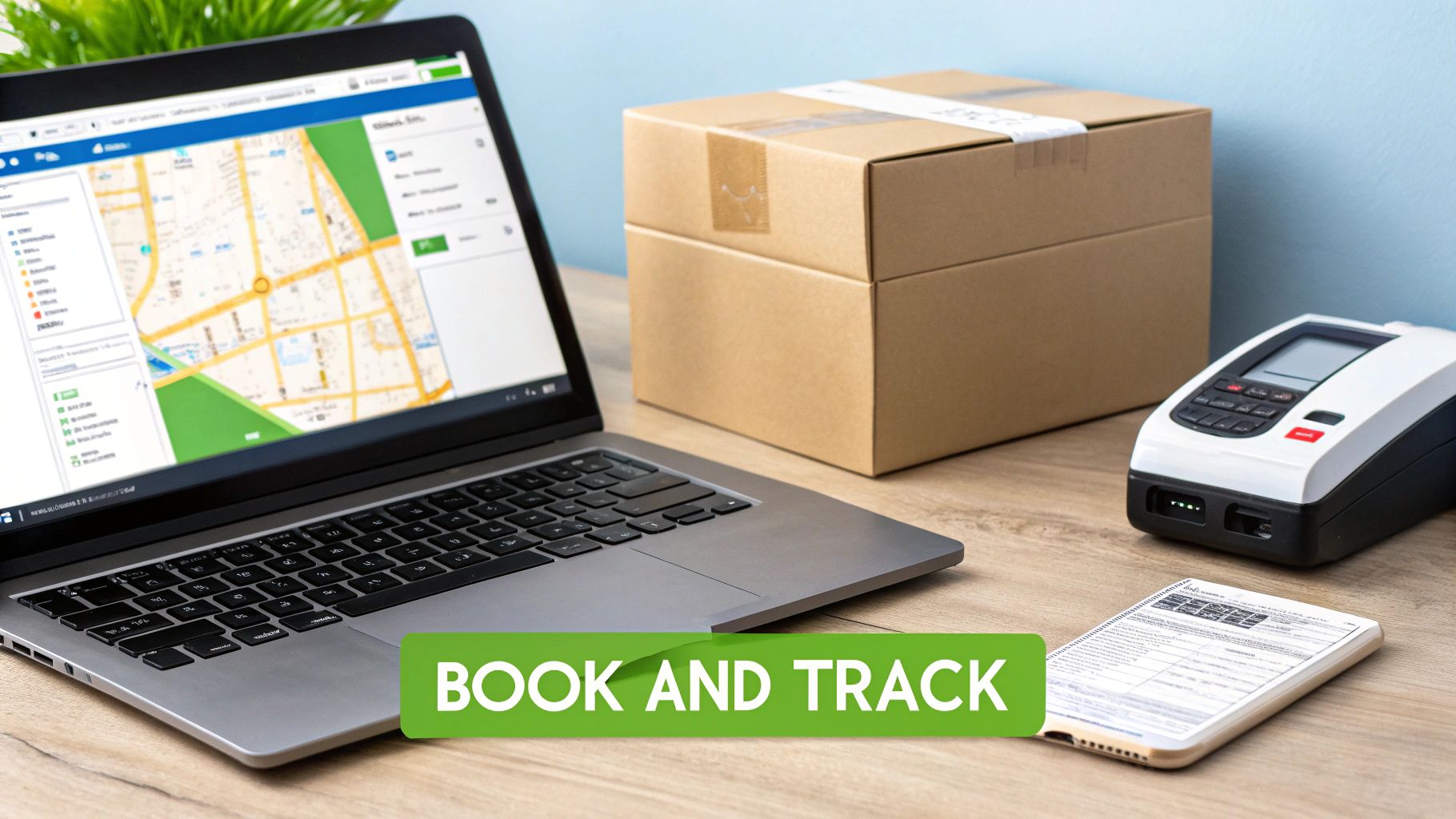
Step 1: Getting Your Instant Quote
Everything kicks off with a quote. Forget being stuck on hold or waiting days for an email back—modern courier platforms put the power right at your fingertips. This is your command centre for making smart, cheap shipping decisions on the fly.
To get started, you just need three key pieces of information:
- The pickup and delivery postcodes.
- Your box dimensions (length, width, and height in centimetres).
- The actual weight of your parcel in kilograms (its dead weight).
That's it. Punch in those details, and the system instantly calculates the cubic weight and scours its network to find the cheapest possible prices. Why not give it a try yourself? Jump on a real-time shipping quote calculator and see how easy it is.
Step 2: Choosing Your Service and Booking
Once you've entered your details, you'll see a menu of courier services pop up, each one tailored to your specific needs. It’s not a one-size-fits-all deal. You'll usually find a standard road service—the perfect budget-friendly choice for non-urgent deliveries—right alongside a zippy express option for when time is of the essence.
The best part? The system lays out the estimated delivery times and the cost for each one with total transparency. No hidden surprises.
Simply pick the service that fits your timeline and budget, fill in the final address details, and head to payment. Honestly, the whole thing can be done and dusted in less time than it takes to brew a cuppa.
Step 3: Printing Labels and Scheduling Pickup
Booking confirmed! You're almost there. The system will now generate your shipping label as a downloadable PDF. Think of this as your parcel's passport—it contains all the critical barcodes and addresses needed to guide it through automated sorting hubs and right to the correct doorstep.
Print it out and stick it firmly and flatly onto the top of your box. A self-adhesive label is best if you have one, and just make sure no tape is covering the barcode.
At the same time, you'll schedule the pickup. You can often choose a convenient time window for a driver to swing by your home or office, which means no more annoying treks to the post office.
The real magic of a modern courier platform is the control it gives you. You're no longer just a sender; you're the orchestrator of your own logistics, managing everything from your desk with just a few clicks. This is what makes fast and cheap parcel delivery not just possible, but accessible to everyone.
Step 4: Tracking Your Parcel to Its Destination
The moment your parcel is collected, the tracking journey begins. This is so much more than a simple status update; it's your live window into the entire delivery process, giving you—and your recipient—complete peace of mind.
Every time your parcel is scanned at a depot or loaded onto a truck, its tracking information is updated in real-time.
You can follow its adventure from a central dashboard, watching as its status changes from ‘In Transit’ to ‘Out for Delivery’. This kind of visibility is incredibly powerful. It means you can keep your customers in the loop, manage expectations, and get confirmation the second it's safely delivered, often with a digital proof of delivery for your records. It turns the old mystery of shipping into a transparent, completely manageable process.
Pro Tips to Lower Costs and Avoid Common Delays
Shipping smarter is the secret to saving money and keeping your customers happy. Mastering parcel delivery Australia wide isn't about finding some magic bullet; it's about building a toolkit of clever strategies that can turn shipping from a chore into a real competitive edge. These are the actionable tips that will help you ship your boxes with more confidence and less cost.
Think of it like becoming your own logistics expert. A few simple tweaks to how you pack, book, and manage your deliveries can lead to surprisingly big savings and far fewer headaches down the track.
Optimise Your Packaging
The quickest win for cutting costs is almost always in your packaging. Couriers charge based on a mix of actual dead weight and cubic weight, so every bit of wasted space is literally costing you money.
- Use the Right-Sized Box: Ditch the oversized boxes stuffed with filler. A smaller, snugger fit directly reduces your parcel's volumetric weight, which can slash the shipping price.
- Consolidate Shipments: Got a few small items heading to the same address? It’s nearly always cheaper to pop them into a single, larger box instead of paying to send several individual parcels.
Plan Ahead and Be Precise
Rushing is where mistakes—and extra costs—happen. A little forward-thinking can prevent the most common frustrations that lead to delays and surprise fees.
By far, the most common cause of delivery delays and frustrating re-delivery fees is a simple mistake: an incorrect or incomplete address. Always, always double-check unit numbers, street names, and especially postcodes before you lock in a booking.
Accuracy is your best friend in logistics. Making sure every detail is perfect before you click "book" is the best way to avoid a parcel being sent back to the depot. On top of that, booking your shipments in advance helps you dodge the peak-period surcharges that often pop up during busy seasons.
The domestic parcel business is only getting bigger, with a 2.6% increase in volume noted in a recent fiscal year, pushing the industry to get more efficient. With e-commerce now accounting for nearly 26% of all last-mile deliveries, the market is shifting towards platforms that give users real control over their costs.
You can explore detailed reports on the Australian last-mile delivery market to get a deeper insight. For more direct advice, check out our guide on finding the cheapest courier service to meet your needs.
Got a Question? We’ve Got Answers
Stepping into the world of couriers can feel a bit daunting, but it doesn't have to be. Here are some quick, clear answers to the questions we hear most often about sending parcels across Australia. We want you to feel completely confident every time you ship a box.
What's the Cheapest Way to Send a Parcel in Australia?
For the best value, a standard road service is almost always your winner. The real trick to keeping costs down is to pack your item as small and tight as you can. This reduces what's called 'cubic weight', which is how couriers charge for the space your parcel takes up.
Your smartest move is to use a courier comparison service. They have access to wholesale rates you simply can't get by going directly to a big-name carrier. Just pop your details in for an instant online quote, and you'll see all the cheapest options side-by-side.
How Long Does It Really Take for a Parcel to Cross Australia?
This is the big question, and the answer really depends on the service and the route. A fast express parcel heading from Sydney to Melbourne, for instance, can often land on the recipient's doorstep the very next business day. It’s remarkably quick.
On the other hand, if you're sending a standard parcel from Perth all the way over to Brisbane, you're looking at a much longer haul—anywhere from 5 to 10 business days is typical. And remember, deliveries to regional or remote towns will always add a little extra time to the journey. Always check the estimated time of arrival (ETA) when you get your quote.
The Bottom Line: That ETA you see when you book is your most reliable guide. It factors in the service type, the distance, and the destination to give you a realistic delivery window.
Can I Send a Parcel Without Signing Up for an Account?
You sure can. Modern booking platforms are built for people, not just big businesses. You can jump online, get an instant quote, book your delivery, and pay for it right then and there. No need to create an account or promise to send a certain number of parcels. It’s all about making shipping simple and flexible, even for a one-off delivery.
What Happens If I Put the Wrong Address?
An incorrect address is the number one cause of shipping headaches. If a driver can't find the right spot, your parcel usually ends up back at their depot. From there, you'll almost certainly have to pay a re-delivery fee to get it sent out again, which means extra costs and frustrating delays.
Before you click 'book', take a moment to double-check everything—especially the postcode and any unit numbers. It's the simplest way to ensure a smooth journey for your parcel.
Ready to see how easy fast, cheap, and reliable parcel delivery can be? With Aeros Couriers, you can get an instant quote, book your shipment in minutes, and follow it every step of the way—no account required. Visit Aeros Couriers to send your parcel today!
