


Trying to get your head around Australian postal parcel rates can feel like you're trying to solve a puzzle with a few pieces missing. But once you understand the moving parts, you're in a much better position to control your shipping budget. The price you pay comes down to a few key things: how big your parcel is, how much it weighs, and where it’s headed within Australia. Getting these basics down is a game-changer for anyone shipping goods, whether for business or personal reasons.
Demystifying Postal Parcel Rates in Australia
Shipping isn't just about slapping a stamp on something anymore. Thanks to the e-commerce boom, the whole logistics game has changed. Couriers aren't just delivering letters; they're handling a mountain of parcels every single day, and their pricing models have evolved to match.
It used to be that weight was pretty much the only thing that mattered. Not anymore. Now, the amount of space your package takes up in a van is just as critical. Imagine a delivery truck being packed—it’s a bit like a game of Tetris. A big, light box can be more awkward and take up more valuable real estate than a small, heavy item. The price you pay directly reflects that reality.
Why Understanding Rates Matters
For businesses and even individuals, getting a firm grip on how postal parcel rates work brings some serious benefits. You can stop guessing what the cost will be at the counter and start planning your shipping like a pro.
Knowing the system helps you:
- Budget with confidence: No more nasty surprises. You can accurately forecast what you'll spend on shipping.
- Pack smarter: You'll start making better choices about box sizes to avoid paying for empty space.
- Keep customers happy: Offering clear and fair shipping costs is a huge win for customer experience.
At its heart, it's pretty straightforward: the final price tag for sending a parcel is a direct calculation based on its weight, its dimensions, and the distance it has to travel within Australia. Understanding how these three factors play together is the secret to unlocking real savings and sharpening your entire shipping strategy.
Once you break down these components, you're no longer just accepting a price—you're actively managing your costs. For a deeper dive into how different factors shape the final price, checking out a detailed guide on parcel postage costs can give you the context needed to make smarter decisions. It will walk you through all the specifics and set you up for success.
How Australian Parcel Rates Are Calculated
Ever wondered how a shipping quote is actually put together? Think of it like a recipe, where a few key ingredients mix to create the final price. The core components are always your parcel's weight, its dimensions, and the distance it has to travel. Nailing this formula is the first real step to getting a handle on your shipping budget.
The boom in online shopping has completely reshaped how carriers price their services. In fact, parcel delivery has become a massive driver for Australia's postal industry, which pulled in an estimated A$11.2 billion in revenue over the last five years. This shift means carriers now have to think about the space a parcel takes up just as much as its weight.
Actual Weight vs Cubic Weight
One of the biggest hurdles for many people to understand is the difference between actual weight and cubic weight. It’s the reason why sending a big, light box of cushions can sometimes cost more than a small, heavy box of books.
-
Actual Weight: This one is simple. It’s what the scales say when you weigh your parcel, measured in kilograms (kg).
-
Cubic Weight: This is all about how much space your parcel occupies in a delivery van. Carriers use this calculation to make sure they’re paid fairly for bulky items that might not weigh much but still take up valuable room.
Carriers will always calculate both and charge you for whichever figure is higher. This is called the chargeable weight, and it's the number that ultimately determines your postal parcel rates.
This infographic breaks down how weight, size, and destination are the bedrock of every shipping quote.
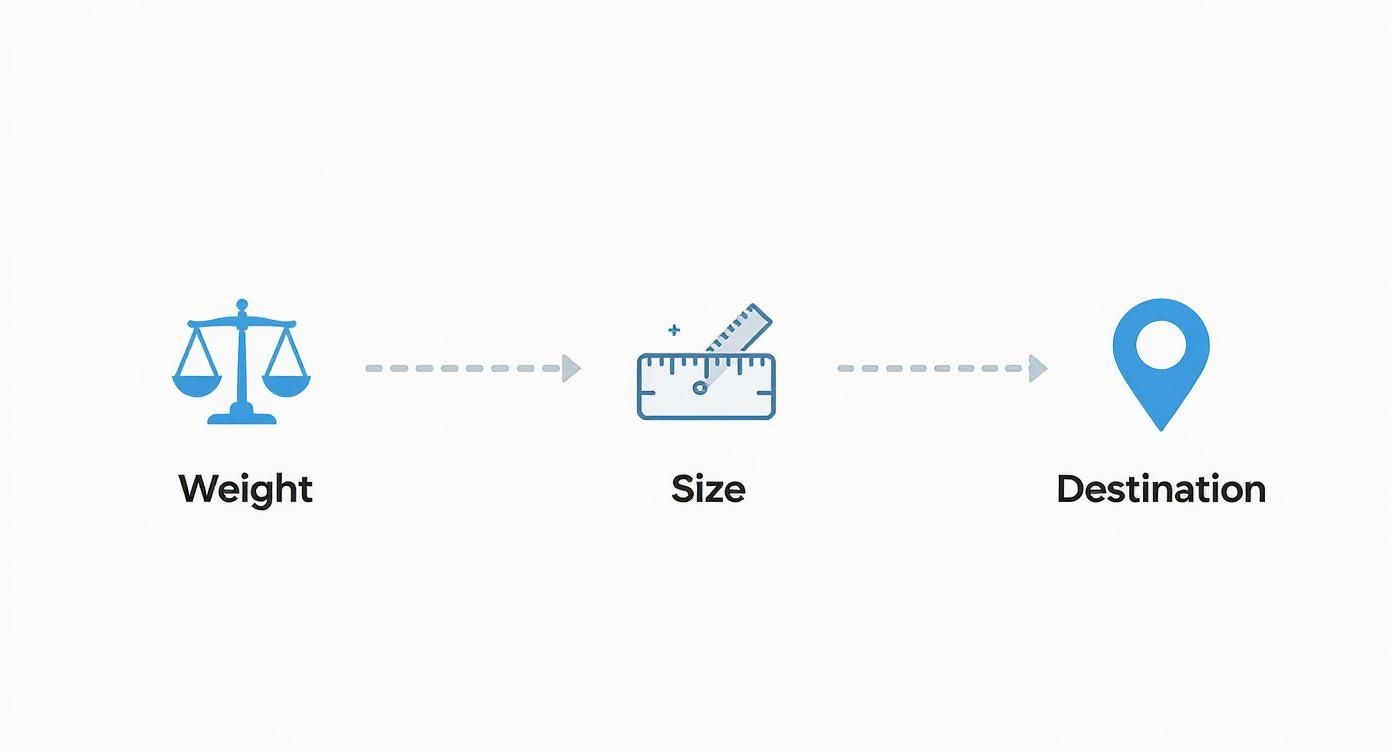
As you can see, these three elements are all linked, and each one plays a direct role in the final cost you'll pay.
Calculating Your Parcel's Cubic Weight
Working out your parcel's cubic weight is much easier than it sounds, and it gives you a huge amount of control over your shipping costs. Couriers use a standard industry formula to turn a parcel's dimensions into its weight equivalent.
The formula is: Length (m) x Width (m) x Height (m) x Cubic Weight Conversion Factor
The conversion factor used across the Australian freight industry is typically 250.
Let's say you have a box measuring 40cm x 30cm x 20cm. The calculation would look like this: 0.4m x 0.3m x 0.2m x 250 = 6kg cubic weight.
Now, if that same box only weighed 4kg on the scales (its actual weight), the courier would still charge you for the 6kg cubic weight. Once you understand this, you can start making smarter packaging choices to stop paying for empty space.
To see how this works in practice, you can use a tool to calculate your specific shipping charges before you lock anything in.
The Key Factors That Influence Your Shipping Costs

While weight and size are the starting point for any shipping quote, a handful of other critical factors will ultimately shape your final postal parcel rates. Think of these as the dials and levers that can either keep your costs down or send them climbing. Getting a handle on them is the key to making smarter shipping decisions.
The two most obvious variables are how fast you need it there and where it's going. The choice between standard and express shipping immediately puts you on different pricing paths. Likewise, the journey your parcel takes across Australia has a massive impact on the final bill. A simple run between two capital cities will almost always be cheaper than sending the same box to a remote country town.
Speed and Urgency
How quickly does your package need to land on the doorstep? This decision is one of the biggest cost drivers you'll encounter.
- Standard Delivery: This is your reliable, budget-friendly workhorse. It’s the perfect choice for non-urgent shipments where keeping costs low is the main game.
- Express Delivery: When time is of the essence, express services get your parcel there faster—often with next-day delivery in metro areas—but you’ll pay a premium for that speed.
The price jump between the two can be pretty steep. What you're really paying for is priority handling, access to faster transport networks, and a much tighter delivery window. For most businesses, offering customers both options is a must to keep everyone happy.
The Impact of Destination
Not all delivery routes are created equal. In the world of logistics, distance is measured in shipping zones, and the more zones your parcel crosses, the more it’s going to cost. This becomes especially true when you’re sending items far away from the major city hubs.
A parcel sent from Sydney to a remote town in Western Australia doesn't just travel a longer distance; it requires far more complex logistics than a straightforward Sydney-to-Melbourne delivery. That "last mile" into regional areas often means higher fuel costs and fewer deliveries along the route, all of which gets factored into the final price.
This is a fundamental principle of logistics. Understanding what goes into the cost is crucial, whether you're sending small satchels or something much larger. You can even see how these same concepts apply to bulky goods by exploring the factors influencing furniture shipping costs.
To illustrate, let's look at how these choices can affect the price of sending a standard 3kg parcel from a major city.
Cost Impact of Key Shipping Factors
| Factor | Option A (Lower Cost) | Option B (Higher Cost) | Estimated Cost Impact |
|---|---|---|---|
| Delivery Speed | Standard (3-5 business days) | Express (Next business day) | +$8 to +$15 |
| Destination | Metro to Metro (e.g., SYD to MEL) | Metro to Regional/Remote WA | +$12 to +$25 |
| Value-Added Service | No signature required | Signature on Delivery | +$2 to +$4 |
| Insurance | Standard liability included | Additional insurance for $500 value | +$5 to +$10 |
As the table shows, a few different choices can quickly add up, turning a basic shipment into a much more expensive one. It really highlights how important it is to select only the services you truly need.
Value-Added Services
Beyond just getting your parcel from A to B, carriers offer a menu of optional services for extra security and convenience. They're incredibly useful, but remember that each one will tack a little extra onto your total cost.
Some of the most common add-ons include:
- Signature on Delivery: This gives you undeniable proof that your parcel was received, offering peace of mind for important or valuable items.
- Transit Insurance: For high-value goods, extra insurance provides a financial safety net against loss or damage while it's on the move. Most carriers include some basic cover, but you can always pay to increase it.
- Tailgate Lifts or Special Handling: If you’re shipping heavy or awkward freight, you may need specialised equipment or handling, which naturally comes with extra fees.
Each of these elements plays a role in calculating your final postal parcel rates. By weighing up speed, destination, and any extra services, you can make informed choices that strike the right balance between cost and your specific requirements. For a seamless experience with transparent pricing, Aeros Couriers offers a clear breakdown for every local Australian parcel delivery.
The Evolution of Australian Postal Pricing
Today's parcel rates didn't just appear out of thin air. They're the result of decades of massive economic shifts and technological leaps across Australia. To really get your head around why shipping costs what it does today, it helps to glance back at how the whole industry has been reshaped, especially with the explosion of e-commerce and the slow death of traditional letter mail.
For most of the 20th century, the post office had a straightforward job built around letters. But as emails and instant messages took over, letter volumes dropped off a cliff, forcing a complete rethink. The focus had to switch from lightweight envelopes to parcels of every imaginable shape and size. This pivot demanded entirely new infrastructure, sorting technology, and pricing models just to stay afloat.
From Letters to Logistics
Moving from a letter-focused business to a parcel-centric one was a monumental task. The old system, based on a simple stamp and weight, was suddenly obsolete. It had to be replaced with a much more complex formula that could factor in a parcel's size, the distance it had to travel, and how fast it needed to get there. This reflects the new reality of logistics: the physical space a box takes up in a delivery van is often just as important as how much it weighs.
This wasn't just an Australian story, either. Postal services all over the world are constantly tweaking their prices to keep up with modern demands. Looking at developments like the recent Royal Mail price increases gives you a good sense of the shared economic pressures and operational challenges that shape postal rates globally.
Tracking Historical Rate Changes
A quick look at historical data tells a pretty clear story. Australia Post's rates have changed dramatically since the 1980s, driven not just by new business strategies but also by powerful economic forces like inflation. For instance, sending a standard domestic letter cost just A$0.24 back in 1981. By 1992, that had jumped to A$0.45, largely due to rising inflation. If you dig into Australia Post's historical pricing, you can see how each adjustment marks another chapter in this ongoing evolution.
This backstory is crucial. It shows that today’s parcel rates aren't just random fees. They are a direct response to a world turned upside down by online shopping and digital communication.
When you understand this journey, you start to see the "why" behind the shipping quotes you receive. Every fee and surcharge is tied to the incredibly complex puzzle of moving physical goods in an increasingly digital world—a challenge that continues to define the entire industry.
Practical Strategies to Reduce Your Shipping Expenses
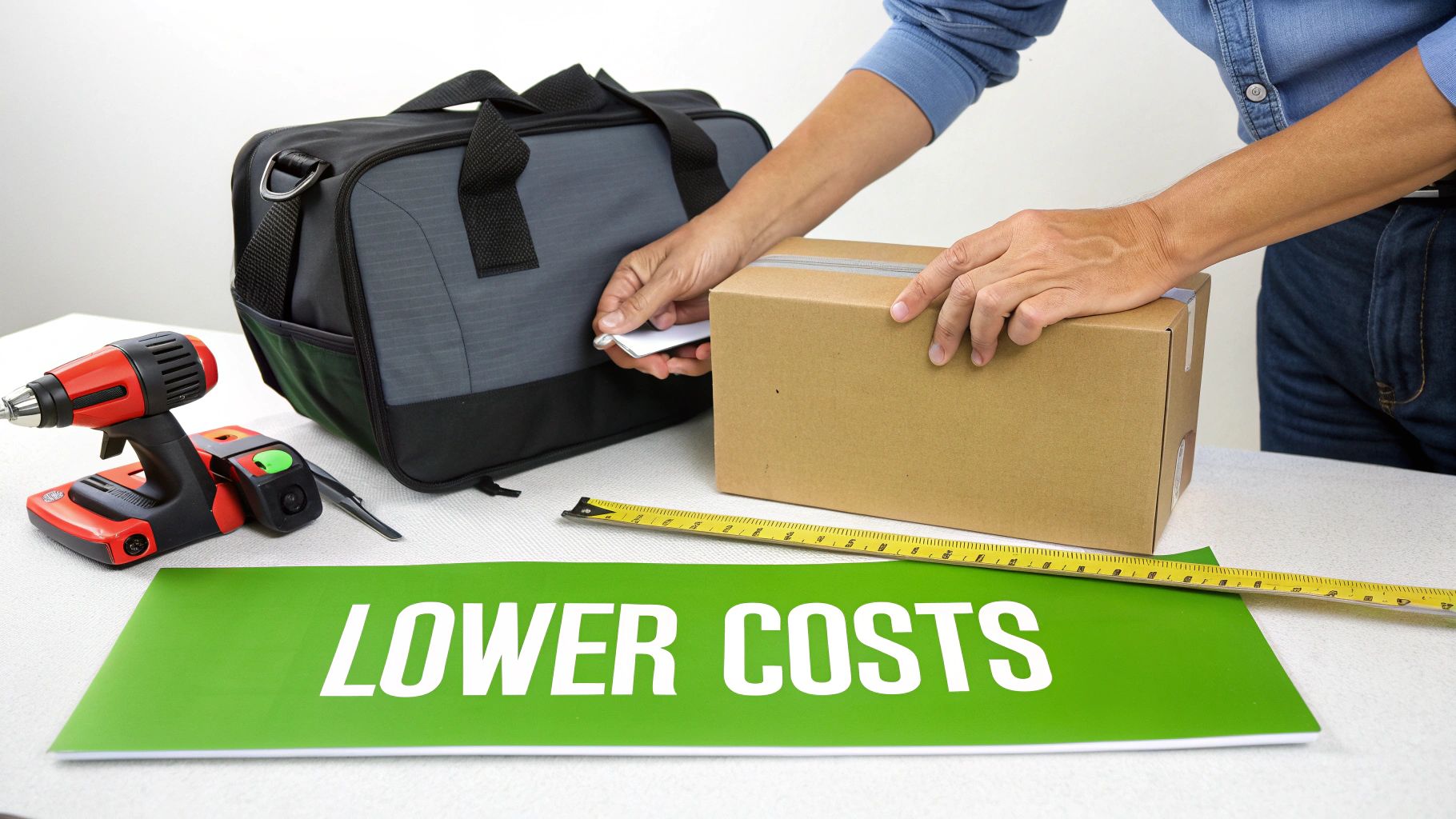
Understanding the 'why' behind postal parcel rates is the first step, but the real win comes from actively finding ways to lower them. With a few smart tweaks to how you pack and send your items, you can start chipping away at your shipping bill on every single parcel. These aren't massive operational overhauls, just a more strategic way of thinking about your dispatch process.
Your most powerful cost-cutting tool? Your packaging. Since couriers charge based on whichever is greater—the actual weight or the cubic weight—every bit of empty space in your box is wasted money. The aim is to get each parcel as compact and dense as possible without risking damage to what's inside. Shifting your mindset to this one principle can make a huge difference to your bottom line.
Optimise Your Packaging
Think of choosing a box as a key financial decision, because it is. Grabbing a box that’s way too big for your item is a surefire way to inflate its cubic weight, forcing you to pay for shipping air.
Here are a few simple changes you can make right away:
- Right-size Your Boxes: Don't just have one or two 'standard' box sizes. Keep a varied inventory so you can pick one that perfectly fits the item with just enough room for protection.
- Minimise Filler: Use only as much bubble wrap or void fill as you need to keep the item safe and snug. Overstuffing a box just adds to the volume.
- Consider Custom Packaging: If you're sending out the same products day after day, getting custom-sized boxes made might seem like a big upfront cost, but the long-term savings can be massive.
Consolidate and Compare
It's not just about the box itself; how you organise your shipments can also unlock some serious savings. If you've got multiple orders heading to the same customer, it's almost always more economical to combine them into one larger parcel instead of sending out several smaller ones.
The single most effective way to lower your shipping expenses is to ensure you're using the right carrier for the job. Never assume your default option is the cheapest.
Taking a minute to compare rates before you book a courier is crucial. Using online comparison tools or multi-carrier platforms lets you see quotes from different providers in one place. This puts you in the driver's seat, allowing you to find the best deal for every single delivery, from a tiny satchel to a bulk freight shipment.
Leverage Flat-Rate and Bulk Options
Most carriers have services designed to give you predictable pricing and reward you for sending more volume. Getting familiar with these can help you lock in much lower costs.
- Flat-Rate Satchels: For smaller items that can fit, prepaid satchels are brilliant. You pay one fixed price for delivery anywhere in Australia, which takes all the guesswork out of calculating your postal parcel rates.
- Negotiate Bulk Rates: If you're a regular shipper, don't be afraid to ask for a better deal. Carriers want your consistent business and will often offer preferential pricing that isn't available to one-off senders.
When you boil it all down, these strategies all point to the same thing: having the right shipping partner makes all the difference. By finding the cheapest courier service in Australia that truly fits your business needs, you can be confident you’re getting great rates without ever having to compromise on reliable service.
Finding Competitive Parcel Rates with Aeros Couriers
Alright, you’ve got a handle on what drives up postal parcel rates. Now, let's turn that knowledge into real savings. The next step is finding a modern shipping partner who actually helps you tackle those costs head-on, which is exactly where Aeros Couriers comes in. We’ve built a simple, cost-effective solution specifically for local Australian shipping.
Our whole approach is designed to cut through the confusion and high prices you often find with the old-guard carriers. With us, you get clear pricing, a super-easy rate calculator, and flexible choices that put you back in the driver's seat. It's about saving you money and making your whole shipping process run a lot smoother.
Unlock Savings and Simplicity
Picking the right shipping partner isn't just about cost; it directly impacts your bottom line and how happy your customers are. The benefits of shipping with Aeros Couriers become obvious from the very first parcel you send.
- Transparent Pricing: What you see is what you get. We show you all the costs upfront, with absolutely no hidden fees or sneaky account application charges.
- Wholesale Rates: We ship in massive volumes, and we pass those bulk-rate savings directly on to you. You get access to cheaper rates than you could ever secure on your own.
- Total Convenience: Everything you need is in one place. Get instant quotes, book jobs, print your labels, and track every delivery from a single, straightforward online dashboard.
When deliveries are reliable, your reputation gets a boost and your customers have a great experience. We give you the tools to make that happen, without the headache of costs that seem to change on a whim.
By simplifying the entire process, from quoting to delivery, you can focus less on logistics and more on what truly matters—growing your business. This efficiency is a competitive advantage.
Get Your Instant Quote in Minutes
Curious about how much you could actually save? Finding out is incredibly easy. We designed our system to give you a clear, competitive quote for your Australian shipments in just a few quick steps. This makes it a breeze to compare and see the value for yourself.
Ready to see the difference? You can easily get an instant quote right now on our website and discover how our competitive rates can slash your shipping expenses. It’s time to take control of your costs and experience a smarter, more reliable way to send parcels across Australia.
Got Questions? We've Got Answers
Still have a few things you're wondering about when it comes to postal parcel rates in Australia? You're not alone. Here are some of the most common questions we get, with clear, no-nonsense answers.
What’s the Absolute Cheapest Way to Send a Parcel in Australia?
Honestly, there's no single magic bullet, but it usually comes down to a smart combination of tactics. You need to pack smart to keep that cubic weight down, always opt for standard delivery unless it's a true emergency, and most importantly, shop around.
For many local deliveries, you'll find that modern couriers like Aeros Couriers can often beat the traditional post office on price. Why? Because we can access wholesale rates that aren't available to the general public.
How Does Cubic Weight Actually Affect the Price?
Think of it this way: a delivery van has limited space. Cubic weight is simply a way for carriers to measure how much of that valuable space your parcel takes up.
They'll look at the actual weight of your box and its cubic weight, then charge you for whichever number is higher. This is why a big, lightweight item (like a pillow) can sometimes cost more to ship than a small, heavy one (like a book). It's all about the space it occupies.
The lesson here is simple: always use the smallest box that will safely fit your item. Cutting down on empty space is the single easiest way to keep your shipping costs in check.
Can I Get a Discount If I Send a Lot of Parcels?
Absolutely. If you're a regular shipper, most carriers are more than happy to talk about volume discounts. Consistency is key, and if you're sending parcels frequently, you'll have some serious negotiating power.
That's where a service like Aeros Couriers really shines. We create plans specifically for businesses, making sure your shipping volume gets you the best possible pricing.
Why Is It So Much More Expensive to Ship to a Regional Area?
Shipping to regional and remote parts of Australia costs more because, well, it simply costs the carriers more to get there.
It comes down to a few key factors: longer driving distances, less "delivery density" (meaning fewer drop-offs per kilometre), and sometimes even needing to hand the parcel over to a local partner for that final stretch. All these operational hurdles add up, and that's reflected in the surcharges for regional postcodes.
Ready to stop overpaying and start shipping smarter? Get an instant, transparent quote with Aeros Couriers and see how our competitive rates can lower your shipping expenses today. Visit our Aeros Couriers homepage to learn more.
