



Sending parcels across Australia shouldn't feel like a guessing game that ends with a surprisingly high bill. For individuals and small businesses, the secret to saving money isn't finding one magic carrier; it's realising that the best price always depends on your parcel's size, weight, and where it's headed.
The truth is, there's no single cheapest carrier for every situation. But if you know how the system works, you can seriously cut down your shipping costs.
Your Guide to Finding Affordable Domestic Shipping

Trying to find reliable yet cheap postage can feel like a maze, but it's a vital skill for anyone sending goods across the country. Whether you're a new eCommerce store owner, an eBay seller clearing out your closet, or just posting a gift to family interstate, what you spend on shipping directly hits your wallet.
This guide is here to clear up the confusion. We'll give you a simple roadmap to smarter, more affordable shipping within Australia.
Think of postage costs like a puzzle. The final price is pieced together from a few key factors. Once you understand what those pieces are, you can start making them work for you, not against you.
What This Guide Will Cover
We've designed this to be a practical, hands-on resource. I'm not just going to list a bunch of carriers; I'm going to show you how to choose the right one for your specific parcel. You’ll learn how to compare services like a pro and make choices that protect your budget.
Here’s a sneak peek at what we’ll get into:
- Cost Drivers: We'll break down the main things that make up your shipping price, like parcel dimensions, weight, and delivery zones.
- Carrier Comparisons: A look at the major players in the Australian shipping game, pointing out what each one does best.
- Actionable Strategies: Simple, practical tips for packing, measuring, and booking your deliveries to see immediate savings.
- Tech-Savvy Savings: How you can use online tools and shipping platforms to find the best rates without all the legwork.
The boom in online shopping has completely reshaped Australia's shipping industry. More parcels are flying around than ever before, and carriers have rolled out a huge range of services to keep up. This actually creates more opportunities for savvy senders to find a great deal.
By the time you're done with this guide, you’ll have the confidence to tackle domestic shipping like an expert. You won't just know what the cheap options are, but why they're the best fit for you.
If you want a head start, checking out a cheap courier in Australia can give you a good baseline for the competitive prices and services out there. Now, let’s get you started on your journey to becoming a smarter shipper.
Decoding What Actually Drives Postage Costs
If you want to find the cheapest way to send a parcel, you first need to get your head around what you’re actually paying for. Postage pricing can feel a bit like a black box, but it all comes down to a few key rules. Once you master these, you’ll be able to size up any quote, spot where the savings are, and make smarter choices for your budget.
Think of a courier's van. It only has so much space. The more room your parcel takes up, the less space there is for everyone else. This simple idea is at the very heart of how postage is calculated, especially when we talk about the difference between actual weight and cubic weight.
Actual Weight vs Cubic Weight
Let's imagine you're sending two very different items: a small, heavy dumbbell and a big, fluffy pillow. The dumbbell has a high actual weight—that’s the number you see when you pop it on a scale. The pillow, on the other hand, is feather-light but has a high cubic weight because it’s bulky and takes up a lot of physical room.
Most Aussie carriers will calculate a price for both the actual weight and the cubic weight, and then they'll charge you for whichever is greater. This is the reason a large but lightweight item, like that pillow, can sometimes cost more to ship than something small but heavy. You’re not just paying for the heft; you’re paying for the real estate it occupies in the van.
A common mistake is focusing only on what a parcel weighs on the scales. Understanding cubic weight is the key to avoiding surprise charges and finding genuine savings on bulky items.
To figure out the cubic weight in kilograms, carriers use a standard formula: (Length x Width x Height in metres) x 250. So, a box that's 40cm x 30cm x 20cm (or 0.4m x 0.3m x 0.2m) has a cubic weight of 6kg, no matter what’s actually inside it.
Speed and Destination Zones
Beyond the size of your parcel, two other huge factors determine the final price: how fast it needs to get there and how far it’s travelling.
- Delivery Speed: Is it urgent? Express services will get your parcel prioritised for next-day or faster delivery, but you'll pay a premium for it. If you’re not in a rush, standard or economy services are much friendlier on the wallet, though they come with longer delivery windows.
- Destination Zones: Australia is a massive country, and couriers carve it up into shipping zones based on postcodes. Sending a package between major cities (like Sydney to Melbourne) is usually the cheapest. But shipping to regional or remote areas will always cost more because of the extra fuel, time, and logistics involved.
These factors all get thrown into a pretty complex pricing matrix. It's also worth noting that with letter volumes dropping by an estimated 8% to 11% annually, carriers are relying more on parcel revenue, making their pricing models more important than ever.
Optional Add-Ons and Surcharges
Finally, don't forget the little extras, because they can definitely add up. While they offer great peace of mind, they will bump up your total cost.
- Extra Cover (Insurance): A must-have for protecting valuable items against loss or damage.
- Signature on Delivery: This gives you solid proof that your parcel was received.
- Fuel Surcharges: A variable fee that carriers tack on to cover the ever-changing cost of fuel.
- Remote Area Surcharges: An extra fee for those deliveries to places that are well off the beaten track.
For people sending niche items, like collectibles or games, getting these costs right is crucial. For instance, guides on mastering board game shipping for crowdfunding campaigns dive deep into these kinds of complex logistics. By really understanding these core components, you can pull apart any shipping quote and see exactly where every single dollar is going.
Comparing Major Australian Postage Carriers
Picking the right carrier is probably the single most important decision you'll make when trying to find cheap postage. The Australian shipping scene is really dominated by a few big names, and each one has its own pricing quirks and advantages.
To make a smart choice, you have to look past the headline price. You need to understand which service is genuinely the best fit for what you’re sending—whether that's a small satchel across town or a heavy box to a remote community.
Let's break down the major players to give you a clear, side-by-side look. This will help you pinpoint the most cost-effective solution for different jobs, so you're not paying for features you simply don't need.
The infographic below gives a great visual snapshot, comparing three popular carriers on key metrics like the cost for a standard 500g satchel, their reach into remote areas, and average delivery speeds.
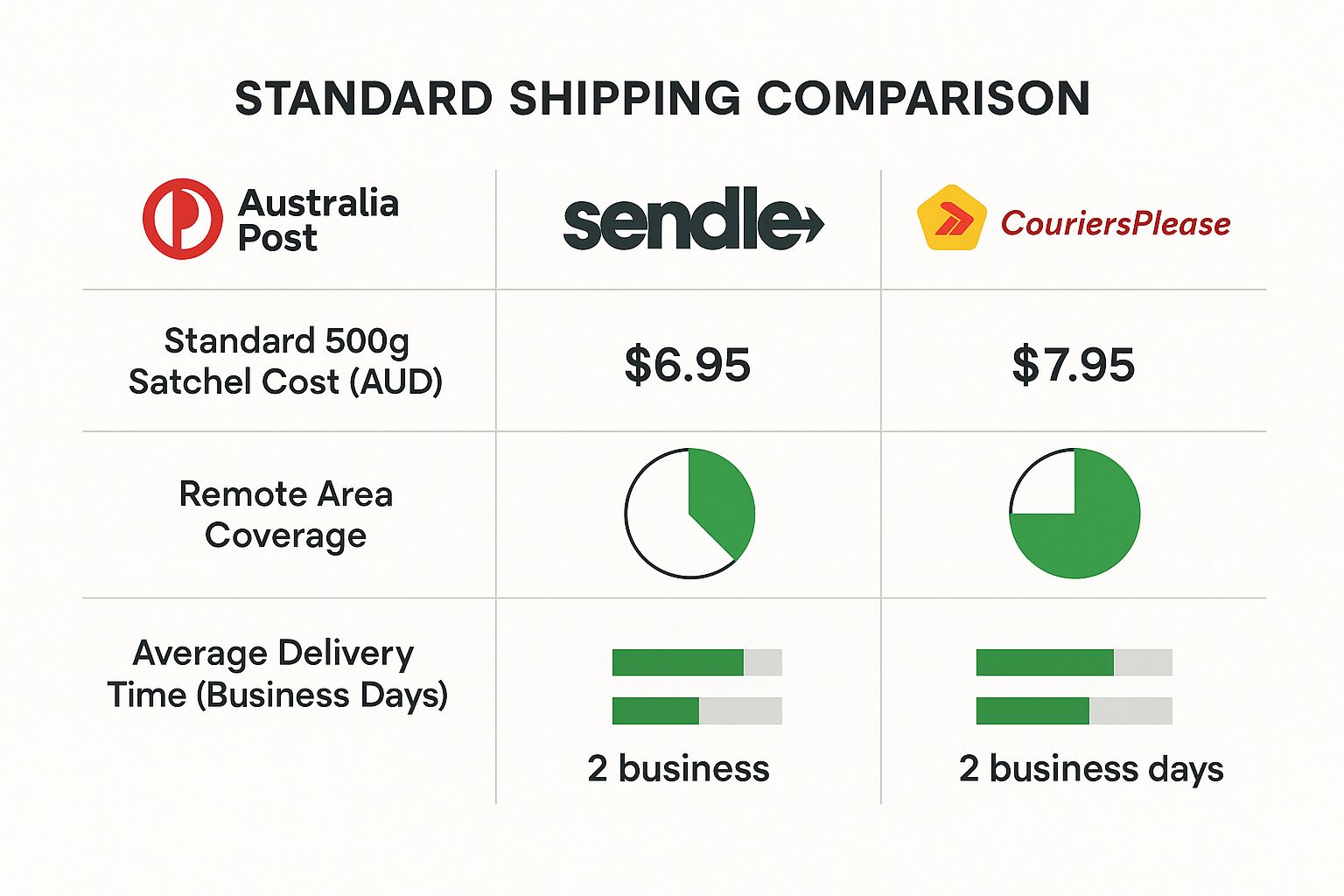
As you can see, while some couriers might be cheaper for city-to-city deliveries, Australia Post's real strength is its massive national network.
Australia Post: The National Backbone
For many Australians, Australia Post is the go-to, and for good reason. Its biggest drawcard is its unmatched reach. No other carrier can get a parcel to literally every corner of the country, from CBDs to the most isolated outback stations.
This massive network makes it the only real choice for a lot of regional and remote deliveries. If you're sending items nationwide, that reliability is often worth paying a little extra for, especially when other couriers might slap on a hefty remote area surcharge.
On top of that, Australia Post’s MyPost Business program offers discounts that get better the more you spend each quarter. It’s a system designed to reward loyal, high-volume senders, making it an increasingly good deal as your business grows.
The Courier Contenders: Aramex, CouriersPlease, and Sendle
While Australia Post has the regional game locked down, a bunch of agile courier services have made a name for themselves in the busy metropolitan and eCommerce markets. They often come in with incredibly competitive pricing for high-traffic routes between capital cities.
- Aramex (formerly Fastway Couriers): Known for its local franchisee model, Aramex often has some of the best prices for local and short-haul metro deliveries. Their prepaid satchels are a simple, effective solution for anyone shipping consistently.
- CouriersPlease: With a similar setup to Aramex, CouriersPlease fights hard on price for parcel deliveries within major cities. They’ve also been expanding their network of drop-off points, which adds a nice layer of convenience.
- Sendle: Sendle is a bit different. It’s a "shipping aggregator," meaning it doesn’t have its own fleet of vans. Instead, it buys up shipping capacity from other courier networks at wholesale rates and resells it to you, often for less. It’s also 100% carbon neutral and plugs straight into many eCommerce platforms, making it a huge favourite for online sellers.
Choosing the right carrier isn't just about price anymore; it's about finding the best fit for your specific needs. The table below offers a quick comparison to help you see where each service shines.
Australian Domestic Carrier Comparison
| Carrier | Best For | Key Services | Potential Drawbacks |
|---|---|---|---|
| Australia Post | Deliveries to regional & remote areas, reliability | Unmatched national network, Post Office drop-offs, MyPost Business discounts | Can be more expensive for metro routes |
| Sendle | eCommerce stores, metro-to-metro deliveries | Carbon-neutral shipping, excellent platform integrations, competitive pricing | Relies on third-party couriers, limited remote coverage |
| Aramex | Local metro & short-haul deliveries | Budget-friendly pricing, prepaid satchels | Service quality can vary between local franchises |
| CouriersPlease | Metro parcel delivery, convenient drop-offs | Competitive metro rates, growing network of collection points | Less coverage in regional and remote areas |
Ultimately, no single carrier is the cheapest or best for every single parcel. A smart approach means treating them as different tools for different jobs.
Making The Right Choice For Your Parcel
So, which one is it? The honest answer is: it depends entirely on what you're sending and where it’s headed.
Think of your carriers like tools in a toolbox. You wouldn't use a hammer to turn a screw. Similarly, the cheapest courier for a 1kg box to Sydney might be the most expensive for a 5kg parcel to Broome.
To make things simple, here’s a quick guide:
- For regional or remote destinations: Australia Post is almost always your most reliable and cost-effective bet.
- For metro-to-metro deliveries: Couriers like Sendle, Aramex, or CouriersPlease will often have the cheapest postage available.
- For small businesses & eCommerce: Sendle is fantastic for its integrations, while MyPost Business gives you discounts as you scale.
The smartest strategy is to get a quote from a few places for each shipment. For those regularly sending goods across the country, check out our guide on finding a cheap interstate courier in Australia for more specialised tips.
Practical Ways to Lower Your Shipping Costs
You’ve done your homework on the major carriers, which is a great start. But the real savings often come from looking closer to home—at your own packing bench. Making a few small, practical tweaks to how you pack and send your parcels can slash your shipping bill over time. It’s less about who you ship with and more about how you ship.
It's amazing how many people accidentally overspend simply by overlooking the small details. By being clever with your packaging, obsessive about your measurements, and savvy about where you buy your postage, you can start cutting costs straight away.
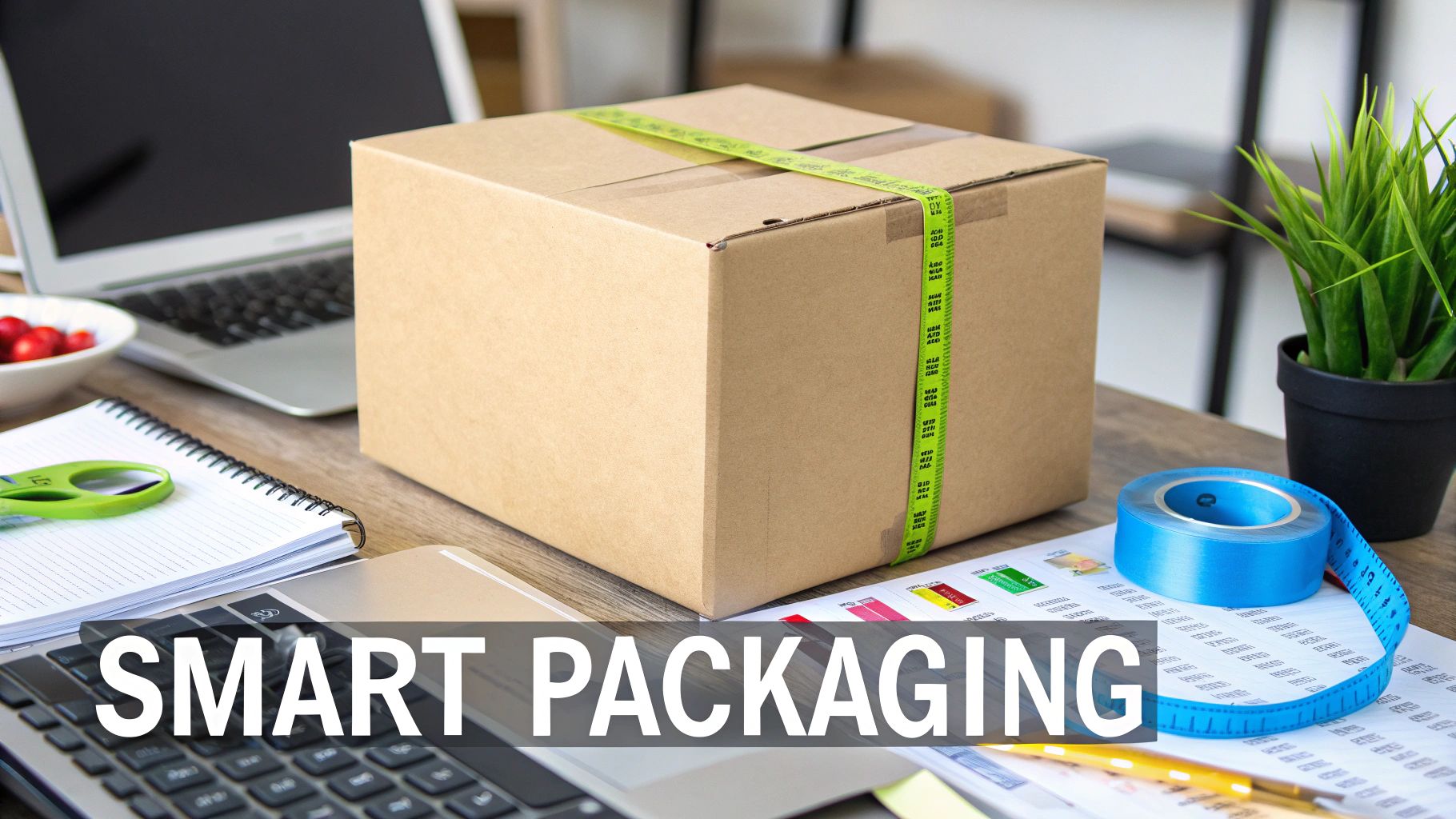
Sticking to standard size and weight limits isn't just a suggestion; it's your ticket to avoiding surprise fees. When you stay within the carrier guidelines, you ensure you're not paying a premium for parcels that are too big or heavy for standard post.
Master the Art of Smart Packaging
The box you pick directly influences your final shipping cost, mainly thanks to something called cubic weight. One of the most common and expensive mistakes is using a box that's way too big for your item. When you do that, you're literally paying to ship empty air.
Always try to find the smallest box or satchel that can safely hold your item with just enough protective filler. If you're sending something that isn't fragile, like a t-shirt, a tough poly mailer bag is almost always a lighter—and cheaper—choice than a box.
The golden rule of packaging is to match the container to the contents. A snug fit doesn't just protect your item better; it saves you from getting stung with unnecessary cubic weight charges.
Embrace Prepaid Satchels for Certainty
For items that fit into standard sizes, prepaid satchels from carriers like Australia Post or Aramex are brilliant. They offer incredible value and, best of all, cost certainty. You pay one flat rate for postage up to a certain weight (usually 500g or 5kg), and it doesn't matter where in Australia it's going.
This takes all the guesswork out of the equation. You know your exact cost upfront, which makes budgeting a breeze, especially if you're an e-commerce store offering flat-rate shipping to your customers.
Be Precise with Weight and Dimensions
"Guesstimating" your parcel's weight and size is a recipe for a budget blowout. Trust me, carriers use seriously accurate electronic scales and laser scanners to check every single parcel that comes through their doors.
If your declared weight or dimensions are even slightly off, you’ll get hit with an underpayment fee that completely wipes out any savings you thought you were making. Go and buy a simple digital kitchen scale and a tape measure. It’s a tiny upfront investment that will save you a fortune in penalties later on.
Use Shipping Comparison Platforms
Nobody has time to visit five different carrier websites to get a quote for every single parcel. It's tedious and a complete waste of time. This is where shipping comparison platforms and aggregators come in.
Services like Aeros Couriers let you pop in your parcel details just once to see instant quotes from a whole range of carriers. Not only does this save you time, but it also guarantees you're finding the absolute rock-bottom price for that specific delivery. These platforms often have access to bulk-buy discounts that you could never get on your own, and they pass those savings right on to you.
Buy Your Postage and Labels Online
Walking into a post office or courier depot to pay for postage is nearly always the most expensive way to do things. It's a simple truth: carriers give their best rates online to encourage people to self-serve.
Booking your shipment on their website and printing your own label can unlock discounts you just won't be offered at the counter. For businesses aiming to streamline their whole operation, looking into professional Shipping and Mailing Labels Printing can lead to big cost reductions and smoother logistics. It’s one of the easiest habits to change and one of the quickest ways to find cheap postage options.
Unlocking Savings with Tech and Bulk Shipping
For businesses or anyone sending parcels regularly, finding cheap postage isn't just about packing a bit smarter—it’s about changing how you approach the entire shipping process. The real key to unlocking serious discounts lies in using technology and your shipping volume to your advantage. Once you shift from sending one-off parcels to thinking in bulk, a whole new level of pricing opens up.
This is about treating shipping as a core part of your operations, something that can be fine-tuned for efficiency and major cost savings, not just a random expense.
Play the Loyalty Game with Carriers
Couriers love repeat business, and they’re more than willing to reward loyalty with better rates. A fantastic local example is Australia Post’s MyPost Business program. It's built for small businesses with a straightforward idea: the more you ship over a 13-week period, the higher your savings band gets, and the less you pay per parcel.
This tiered system essentially turns your shipping volume into a valuable asset. As your business grows, your cost per shipment actually goes down. This helps you either pocket the difference or pass those savings along to your customers to stay competitive.
Tying technology and postage costs together isn't a new concept. The price of sending a letter or parcel has always been linked to economic shifts and new innovations. For instance, after 1897, it became much cheaper to send a postcard in Australia, costing as little as one penny. This small change helped connect communities across the country's huge distances.
Use Shipping Aggregators for Instant Discounts
So, what happens if your shipping volume isn't quite high enough to hit the top discount tiers with a carrier directly? That’s where third-party shipping aggregators and platforms step in. These services act as a middleman, pooling together the shipping volume of thousands of small businesses.
Think of it like a group-buy for postage. By yourself, you might not have the numbers to get a big discount. But when your volume is combined with everyone else's, the aggregator suddenly has the power to negotiate incredible wholesale rates from major couriers—the kind of discounts normally reserved for huge corporations.
They then pass a chunk of those savings back to you. It gives you immediate access to cheap postage options that would otherwise be out of reach.
Automate Your Workflow by Integrating Your eCommerce Store
If you're selling online, the final piece of the puzzle is connecting your store directly to a shipping platform. Most modern eCommerce platforms, like Shopify, WooCommerce, and BigCommerce, are built to sync up flawlessly with shipping software.
This integration completely changes your fulfilment game.
- No More Manual Entry: Orders from your store pop up automatically in your shipping dashboard.
- Print Labels in a Flash: You can generate and print shipping labels for all your daily orders in just a few clicks, tracking numbers and all.
- Find the Best Rate, Every Time: The software can automatically compare services and pick the cheapest option for each order based on rules you set.
By linking these systems, you open the door to powerful tools like a shipment API, which allows for deep, custom integrations between your own business software and the courier networks. This level of automation doesn't just save you a ton of time; it turns your shipping into a well-oiled, cost-saving machine that gives you a genuine advantage.
Your Top Postage Questions, Answered
Alright, we've covered a lot of ground on strategies and carrier comparisons. But I know from experience that there are always a few specific questions that pop up right when you're about to book a shipment. Let's tackle those common head-scratchers so you can ship with confidence and avoid those nasty last-minute surprises.
Think of this as your go-to FAQ for those final "what if" moments.
What’s the Absolute Cheapest Way to Send a Small Parcel?
For a small, light item—say, something under 500g—that doesn't need to be there tomorrow, a prepaid satchel from Australia Post or a courier like Aramex is almost always your cheapest bet. They offer a simple, flat rate that works anywhere in the country, which means you don't have to get bogged down in complex distance-based calculations.
But here’s a pro tip: if you’re only sending it across town, you might find a better deal through a courier comparison service. They can sometimes unearth a cheaper point-to-point rate for local deliveries. The real key is to compare prices for your specific route; the cheapest option for sending something from Sydney to Perth is rarely the cheapest for sending it across two suburbs.
When Should I Use a Courier Instead of Australia Post?
Australia Post is the king when it comes to reaching regional and remote parts of the country. No one else has that kind of reach. However, couriers definitely have their own sweet spots.
A courier is generally your best choice when speed and cost between major cities are your main concerns. Many courier networks are optimised for high-volume, metro-to-metro routes, meaning they can often get a parcel from Melbourne to Brisbane faster and cheaper than the post.
On top of that, couriers tend to offer more convenient pickup times and specialised handling services, which can be a real lifesaver for small businesses.
How Do I Spot and Avoid Hidden Shipping Fees?
Nothing sours a great shipping deal faster than an unexpected fee tacked onto your invoice. The usual suspects are charges for getting the weight or dimensions wrong, surcharges for delivering to a remote area, and fees for a failed pickup attempt.
Here’s how you can steer clear of them:
- Always use a digital scale and a tape measure. Guessing the weight or size of your parcel is a recipe for disaster. Be precise.
- Check the delivery postcode before you book. Most carriers have a tool on their website that lets you see if an address falls into a "remote" category, which will always cost you extra.
- Make sure your parcel is packed and ready to go. If a courier turns up and your item isn’t ready, you can get hit with a futile pickup fee for their wasted trip.
A little bit of due diligence here goes a long way. By double-checking these details upfront, you can make sure the quote you get is the final price you pay.
Ready to stop guessing and start saving? Aeros Couriers gives you instant access to competitive quotes from a network of trusted carriers, ensuring you always find the cheapest, most reliable option for every parcel. Get your free quote and book in minutes at https://www.aeroscouriers.com.au.
